You are here
No Coal in Oakland

Kentucky Judge Dismisses “Billion Dollar” Suit Against Oakland
Ominous headlines appeared in The New York Times and other media last November. A Kentucky bankruptcy judge had issued a startling order holding the City of Oakland liable for up to $654 million in damages, before interest, for obstructing construction of a massive rail-to-ship coal export facility in West Oakland.
That all changed last Wednesday, September 30, as a federal judge in Kentucky dismissed the “billion dollar” lawsuit brought by Insight Terminal Solutions (ITS) against the City of Oakland.
“A Stand Against Coal Exports Could Push Oakland, California Toward Bankruptcy,” led The New York Times in a November 2025 story reposted widely, including on page one of the East Bay’s aspirational paper of record, the East Bay Times (“Coal project costs mounting”).
“The New York Times parlayed a recent rogue judgment issued by a handpicked bankruptcy judge in Kentucky into a tale of the wolf knocking at Oakland’s door,” No Coal in Oakland wrote at the time. The City’s attorneys protested, as they had from the outset of the Kentucky litigation, that the bankruptcy judge had no authority to hear the case, much less issue a judgment against the City.
But the tale of Oakland’s impending doom took hold, leaving City officials unwilling to voice opposition to coal. However shaky the legal grounds for the gargantuan lawsuit in Kentucky, the threat of a catastrophic defeat in a strange court left many in Oakland uneasy. Muckrakers slung muck on substack (see East Bay Insiders Oakland Newsletter and Oakland Report). Developer Phil Tagami’s PR flack, Zennie Abraham, posted a video confidently entitled “City Of Oakland Owes Insight Terminal Solutions $678 Million In OBOT Breach-Of-Contract Case.”
“We lost, lost, lost, and we continue to lose,” lamented Oakland city councilmember and developer ally Ken Houston, apparently convinced that the bankruptcy judge’s ruling would stand.
A dark cloud hung over City Hall.
The substance of the ITS lawsuit was the shell company’s sole asset, its sublease to develop a 19-acre corner of the shuttered Oakland Army Base as a marine export terminal. ITS claimed that the City of Oakland committed tortious interference with its effort to develop a coal export facility on the site, near the foot of the San Francisco Bay Bridge. According to its complaint, the City owed ITS “not less than $1 billion,” plus interest, punitive damages, fees, and expenses.
But last Wednesday, United States District Judge Benjamin Beaton ruled that the City’s attorneys, led by Danielle Leonard of Altshuler Berzon LLP, got it right when they argued that the Kentucky bankruptcy court lacked subject-matter jurisdiction to hear the case filed in early 2024. They insisted from the outset that the case involved California parties in a dispute governed entirely by California law and should be heard, if at all, in a California courtroom.
In his order of dismissal, Judge Beaton agreed, pointedly adding that “ITS’s decision to file an adversary proceeding in Kentucky, rather than to sue in the California courts, carries at least a whiff of forum shopping.” No Coal in Oakland made the same call nearly two years ago.
ITS chose the Kentucky forum to launch its “billion dollar” lawsuit after a California trial judge denied a $159.6 million claim brought by developer Phil Tagami in Alameda County. In 2018, the City terminated Tagami’s lease for failure to get terminal construction underway by deadlines set in the lease. This effectively rendered ITS’s sublease, executed weeks before the City’s termination of Tagami’s lease, worthless as well.
Although Alameda County Superior Court Judge Noël Wise ruled the City’s termination of the lease unlawful and reinstated the lease in early 2024, she rejected the mega damages sought by the developer as too speculative to be awarded under California law.
ITS, which had funded Tagami’s case in California, decided to take another shot at an unearned payday in front of the Kentucky bankruptcy court judge who had presided over ITS’s reorganization in 2021. ITS emerged from bankruptcy under new ownership by Autumn Wind Lending, a shell company owned by Los Angeles hedge fund operator Jon Brooks.
The bankruptcy case was fully resolved when Autumn Wind acquired ITS. The shell company’s attorneys nonetheless argued that ITS’s claim against the City was sufficiently “related to” the 2021 case to provide the Kentucky bankruptcy court with jurisdiction. Brooks’ lawyers tried but failed to bluster past the glaring fault in their argument that the issues they were trying to litigate could have been, but weren’t, raised by ITS or Autumn Wind Lending during the earlier proceeding.
After quoting the late Justice Antonin Scalia (“as many a curbstone philosopher has observed, everything is related to everything else”), Judge Beaton found no significant connection between the bankruptcy case and ITS’s 2024 lawsuit. He ruled that
the absence of any identifiable pre-confirmation claim or post-confirmation distribution dooms the jurisdictional basis for ITS to return to bankruptcy court. This litigation doesn’t involve application of the Bankruptcy Code, the interpretation of the reorganization plan, or any potential effects on creditors….The only relevant nexus between this case and ITS’s bankruptcy is the one linking its current owners to a potential future recovery. And that does not suffice…. Even the expansive reach of related-to bankruptcy jurisdiction doesn’t stretch this far.
The practical result of Beaton’s decision is that this litigation, after years in Kentucky federal courts, is almost certainly over in any forum that matters. ITS can refile its claims in California or appeal Judge Beaton’s decision to the Sixth Circuit, but neither approach is likely to lead to a different result.
California may provide a six-month window to refile in state court, but that window opens onto a limitations question ITS is unlikely to survive. The City cancelled Tagami’s lease and, effectively, rendered ITS’s sublease worthless in 2018. The business torts raised by ITS have a two-year statute of limitations so they became untimely long before ITS filed in Kentucky. Even if ITS could survive the limitations issue, the City has raised a number of other credible alternative grounds for summary judgment in its favor. The City need only win on one argument; ITS would have to prevail on all of them to survive a summary judgment motion in state court.
In the event of a successful appeal of last week’s ruling to the Sixth Circuit, the case would land back before Judge Beaton. He made it clear in his opinion that, if the appeals court were to overrule him on “related to” jurisdiction, he would nonetheless abstain from hearing the case, either dismissing it again or leaving it in limbo.
Abstention is a nonreviewable determination that a case is in the wrong court even though, technically speaking, the court has jurisdiction. Abstention is rarely invoked, but Judge Beaton included in his decision a detailed analysis, tallying up ten reasons no federal court in Kentucky should be handling the case.
“This case cried out for the exercise of discretionary abstention by the federal courts in favor of California litigation,” he concluded, sending a message to both ITS and the forum-shopped bankruptcy judge who hung on to the case for nearly two years.
ITS now faces an unappetizing choice between investing further resources in a California refiling that is likely to fail at the threshold or an appeal that leads nowhere. ITS may choose to plow ahead along one of these paths just for the nuisance value of holding formally unresolved claims over the City’s head, but the bell has rung and ITS has lost this round, if not the entire bout.
With victories in Alameda County and Kentucky, the City is now 2-0 against the developers’ suits for damages.
The decision is Insight Terminal Solutions, LLC v. City of Oakland, No. 3:25-cv-00023-BJB (W.D. Ky. Sept. 30, 2026) Opinion & Order of Dismissal.
Photo at top: Musicians Action Group bringing musical energy to kick off June 2016 No Coal rally outside Oakland City Hall. Credit: Brooke Anderson
Related coverageNina Singh-Hudson, Oakland Dodges $1 Billion Coal Terminal Lawsuit as Federal Judge Tosses Case, Hoodline (Oct 2, 2026)
Eli Wolfe, Coal company’s $1 billion lawsuit against Oakland dismissed, Oaklandside (Oct 2, 2026)
Israr Ahmad, Insight Terminal Solutions’ $1 Billion Lawsuit Against the City of Oakland Dismissed, What the Federal Court Actually Decided, All About Lawyer (Oct 3, 2026)
Juan Carlos Lara, Newsom Signs Coal Terminal Law as Oakland Wins Key Court Fight, KQED (Oct 4, 2026)
AB40 signed into law: mandates new EIR for proposed coal terminal
Responding to a vigorous campaign by climate, environmental justice, faith, labor, and public health advocates, as well as the urging of County Supervisor Nikki Fortunato Bas and city governments in Richmond, Emeryville, and Berkeley, Governor Gavin Newsom today signed the Community First Coal Review Act (AB40) into law.
Before a lead agency or air district can grant discretionary approval of a large coal storage, handling, or export facility, the new law mandates an Environmental Impact Report (EIR), California’s “gold standard” environmental review.
This legislation will ensure that the enormous coal export terminal proposed for West Oakland will be required to fully disclose environmental impacts and live up to developers’ promises of a state-of-the-art facility because impacts will need to be mitigated to the maximum feasible extent.
“West Oakland will not become a sacrifice zone for the fossil fuel industry,” said Veronica Eady, executive director of the West Oakland Environmental Indicators Project. “Our neighbors have fought against industrial pollution and corporate greed for decades, so we’re not about to let a major polluter come into our neighborhood without studying their impact, putting mitigations in place, and bringing community members to the table around decisions that affect their lives.”
No Coal in Oakland opposes any use of our publicly-owned waterfront for the shipment of coal from Utah or Wyoming to Asia, and doubts investors will be found to build a state-of-the-art terminal. A newly released report commissioned by the Rural Utah Infrastructure Coalition to support investment in the project estimates it would take 53 months to build the project as currently proposed, assuming it is not delayed by permitting or environmental review. That report estimates the cost of construction between $430M and $625M, significantly higher than estimates put forward by developers and by the Trump administration.
Crucially, before it can break ground, the project will need a permit from the Bay Area Air District. Seventy organizations and more than 3,000 Bay Area residents have signed an open letter to the Bay Area Air District, circulated by No Coal in Oakland, calling on the Air District to exercise its full regulatory and permitting authority in reviewing the project.
Oakland’s Assemblymember Mia Bonta introduced AB 40 shortly after Trump’s June announcement. The bill soon picked up co-authors Senators Jesse Arreguín and Henry Stern and Assemblymembers Stephen Bennett, Liz Ortega, and Chris Rogers. The bill was co-sponsored by Earthjustice and the West Oakland Environmental Indicators Project.
Image: Still from “Bulk Terminal Animation,” illustrating operation of the proposed coal terminal as currently designed, including two open-air “bunkers” with combined storage capacity of 300,000 tons of coal. The animation was submitted to City of Oakland’s Planning Department by Insight Terminal Solutions on August 28, 2026.
Emeryville, Berkeley, and Richmond Urge Stringent Regulation of Proposed Coal Facility
The momentum of East Bay cities pushing back on the proposed West Oakland coal terminal continues to grow with each passing week: No Coal in Oakland stands with Richmond, Emeryville, and Berkeley as those cities reiterate their longstanding opposition to the terminal and urge the Air District to fully exercise its permitting, regulatory, and enforcement authority to prevent PM2.5 emissions from coal transport through the planned Oakland Bulk and Oversized Terminal (OBOT).
Richmond and Berkeley City Councils passed unanimous resolutions against the proposed coal terminal in July and September, respectively, while the City of Emeryville submitted an urgent letter to the Air District.
The letter, dated September 11, 2026 explains that:
The City of Emeryville’s Land Use Section of the General Plan shows the rail line running through High-Density Residential areas, Mixed-Use/Residential areas, Park/Open Space Areas, Office/Technology areas, and Regional/Neighborhood Retail areas…
Maps show that the entire City of Emeryville is within one mile of the rail line, except the Marina Park area at the end of Powell St. The highest density areas are within 2400 feet of the rail line. As a result, the population of Emeryville would be highly exposed to toxic dust if it were to escape from trains passing through the city.
Emeryville passed a resolution in spring 2016 opposing the shipment of coal along the city’s Union Pacific rail line, declaring that “coal burning stands in direct conflict with the City of Emeryville’s Climate Action Plan.”
A month later, Emeryville’s then-Mayor Dianne Martinez co-signed a letter with ten other neighboring cities in a powerful display of unity, reinforcing the city’s opposition to any shipment of coal through West Oakland’s Marine Terminal. (Mayors’ letter on coal, April 14, 2016)
As the fight against Big Coal and developer Phil Tagami continues, now a decade later, so too does Emeryville’s steely resolution against the project. The 2026 letter was signed by current-Mayor Sukhdeep Kaur with the backing of the entire City Council.
Their letter, like the resolutions passed by Richmond and Berkeley, outlines a set of stringent measures the Bay Area Air District should take to protect workers and residents from “exposure to dangerous coal and petcoke emissions” — including covered rail cars and a wholly enclosed facility. It soberly concludes, “Bay Area residents are counting on the District to protect our health and safety.”
Image: Emeryville Amtrak station, June 2018. This is the rail line referenced in Emeryville’s letter (see above). Image credit: Pi.1415926535, via Wikimedia, CC BY-SA 3.0.
Energy Analysts Call Utah Coal Terminal Funding “A High-Risk Gamble”
A new report by the Institute for Energy Economics and Financial Analysis (IEEFA) calls a plan to spend $54 million of Utah public funds on coal export terminals in Oakland, California, and Longview, Washington, “a high-risk gamble to spend … money on out-of-state projects that could leave rural Utah with limited economic benefits — even if the coal terminals are eventually built.”
EEFA analyzed a recent report commissioned by the Rural Utah Infrastructure Coalition (RUIC) which recommended investing 80% of the funds ($43.2M) in Oakland and the remainder in Longview. IEEFA’s verdict is summed up in the title of its report, “Extensive financial risks and delays loom as Utah considers investing in coal export terminals that would divert funding from in-state needs.”
Ironically, the report commissioned by RUIC to justify investment in coal export terminals is full of red flags in IEEFA’s view:
The [Norda Stelo] report details a multitude of risks for investing in these projects, including:
- Far higher costs, hundreds of millions of dollars more than estimated by advocates
- Construction timelines at least two to three years longer than currently stated
- Lack of well-capitalized, experienced investors, including mining companies, commodity trading firms, or railroads that could see these projects through
- The very early-stage engineering status of the projects, especially Longview, greatly increasing the odds of delays and cost overruns
- Many potential bottlenecks that could sharply curtail export tonnage, including rail congestion, limited and inflexible terminal space, and loading equipment limitations
- International coal market risks
- Organized and influential state and local opposition in both California and Washington that has stopped previously proposed coal export projects
The report by the IEEFA, “which provides independent, evidence-based financial analysis of global energy markets, investment trends, and policies,” aligns closely with analysis of the Norda Stelo report published by No Coal in Oakland on September 8, 2026.
Though it matters very much to West Oakland residents and workers, the IEEFA didn’t comment on the open air stockpiles in which terminal operators plan to store as much as 300,000 tons of coal on the proposed terminal site — scrapping the empty promises and implications in conceptual drawings and legal filings with which developers marketed their dystopian project 8-11 years ago. It’s fair to assume that this looming threat flew under the IEEFA’s radar because the health and safety of Californians is not the State of Utah’s financial concern.
On the other hand, the IEEFA report details project risks that No Coal in Oakland did not raise in its ‘hot off the press’ analysis of the $488,000 RUIC-commissioned study.
For example, IEEFA cited the risk of increase in the already jaw-dropping OBOT construction cost estimate floated by Norda Stelo, reasoning that there are “significant and interrelated risk factors: additional equipment and construction cost inflation, unforeseen engineering challenges, rising interest rates, […] project delays [, and] the extremely limited size of the coal terminal site…”
IEEFA also called out “lack of well-capitalized, experienced investors” as a “financial red flag”; and the Norda Stelo admission that “rail congestion associated with BNSF and UP services to Californian west coast ports is increasing, with dwell times exceeding eight days at several ports” and “two rail bottlenecks near the Donner Pass that have ‘single-track tunnels with potential waiting and weather / rockslide / washout stoppages.’”
The independent IEEFA report then ends with a bang:
At this early stage of development, and given the absence of solid commitments from any financially strong and experienced commercial backers, these projects pose substantial risks to the RUIC’s money—risks that should not be borne by rural citizens of Utah.
The question now is whether Utah’s Community Impact Board (CIB) — the government entity that will decide whether or not to fund the risk-riddled OBOT project — will be gulled by RUIC’s smoke-and-mirror application for over $50,000,000 in public money … or whether they will act in the best interest of the people of Utah.
Stay tuned. The CIB meets next on October 1st, and it’s not yet clear whether they will evaluate the application for funding out-of-state coal terminals at that meeting, or whether RUIC will engineer a delay as the coalition of mining counties licks the wounds inflicted on its case by the IEEFA report.
A full PDF version of the IEEFA report is available here.
Image: State Capitol of Utah. Image credit: Strobel Adventures, via Wikimedia, CC BY-SA 4.0.
Five Reasons Labor Opposes Coal
The Alameda Labor Council and 19 local unions were among the leadership of this campaign to keep coal out of the East Bay ten years ago.
Today, we need even more labor presence in this campaign.
Let me tell you five reasons why.
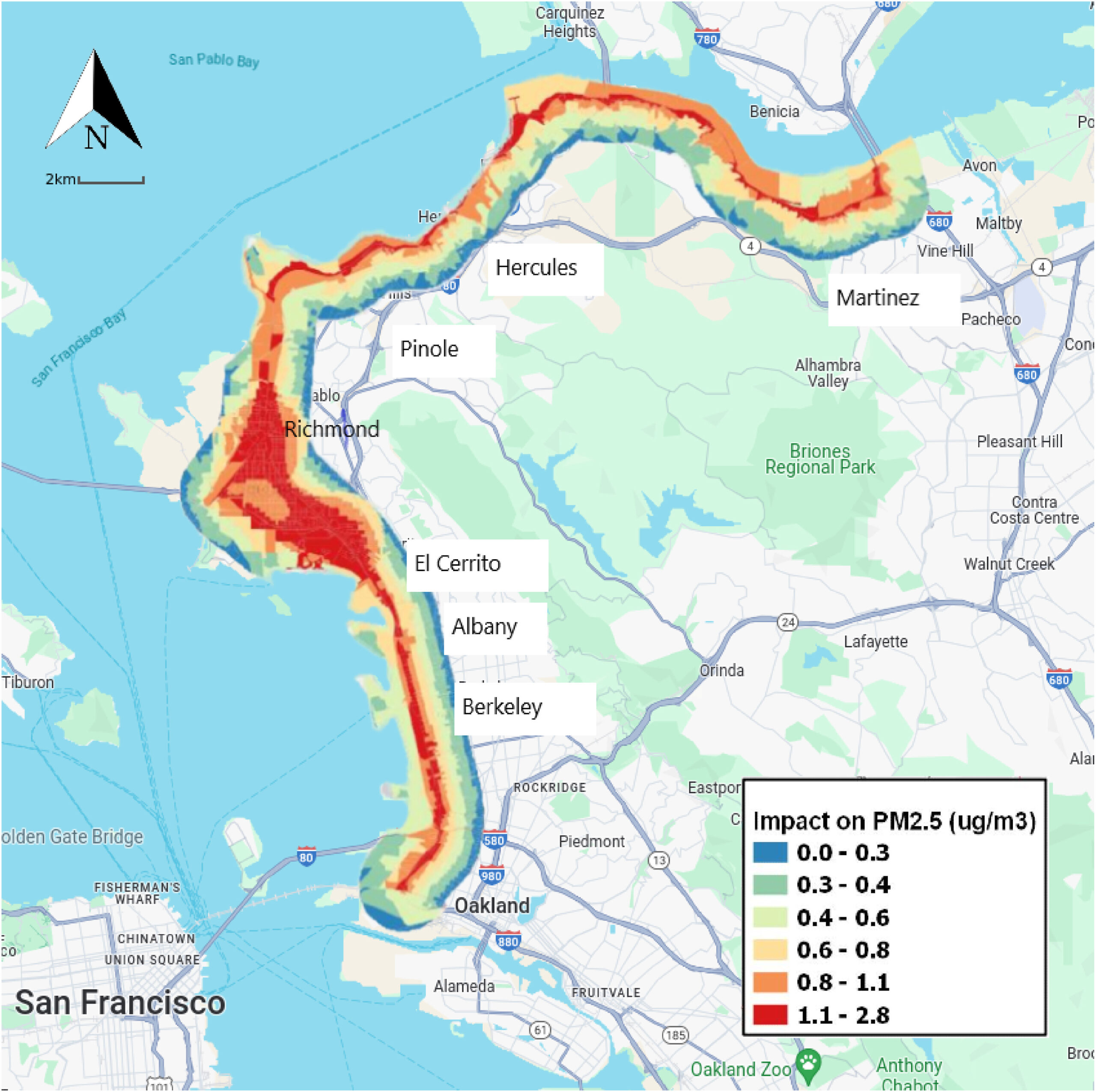
1) As you can see from this map, people of all classes would be hit by the toxic coal. But working-class communities would suffer the most. Workers are more than their jobs. They are parents whose children will be poisoned by coal. They are neighbors who will inhale toxic air and watch the people next door fall ill.
2) Our detractors tell us we have to choose between jobs and the climate, and we therefore must accept the consequences. But this terminal will create at most thousands of unhealthy, short-term jobs and a hundred permanent jobs in toxic workplaces. Some of our laboring brothers and sisters say, “Short-term unhealthy jobs are better than no jobs.” We hear them, we empathize with them, and therefore we are saying:
3) This is a “Yes to Healthy, Unionized Jobs” campaign as much as a No Coal campaign. Our coalition has been championing the redevelopment of the old Oakland Army Base, but in a way that will foster permanent, socially responsible employment. It is therefore crucial that many more unions and laborers join us because we can’t get that kind of development unless there is a mass movement of workers that puts pressure on local, state, and national governments to generate good jobs. This builds up to my next point:
4) The people who are behind this terminal – Trump and his oligarchs – are the same kind of people who bust unions throughout the country. They are also the ones who prevent any kind of legislation that would generate renewable energy jobs. In the last couple of years, bills that could have produced literally millions of green jobs in the US (with a heavy concentration in California) were killed due to their opposition. In other words, they are giving us (at best) thousands of unhealthy, short-term jobs with one hand, while they are taking away potentially millions of healthy, permanent jobs with their other hand.
5) This fight is also a matter of labor pride. The bosses want to build this terminal not just for the cash, which might be their primary motive, but also as an act of class vengeance. They always tell us that without them labor would be nothing. They create the jobs and they pay the wages, we are told. But the labor leadership in this campaign has shown that labor can coalesce with social movements and environmental justice communities to make big things happen. Whenever bosses see that kind of action, they are afraid for their fundamental privileges. That kind of victory shows that a world without oligarchs, a world where labor and communities self-consciously produce and control value, is possible. And therefore, they want to crush any living trace of such victories. Our win in 2016 is a cherished jewel of working-class memory. Ceding this turf to the oligarchs would mean abandoning our belief in a different world as much as abandoning our health and dignity.
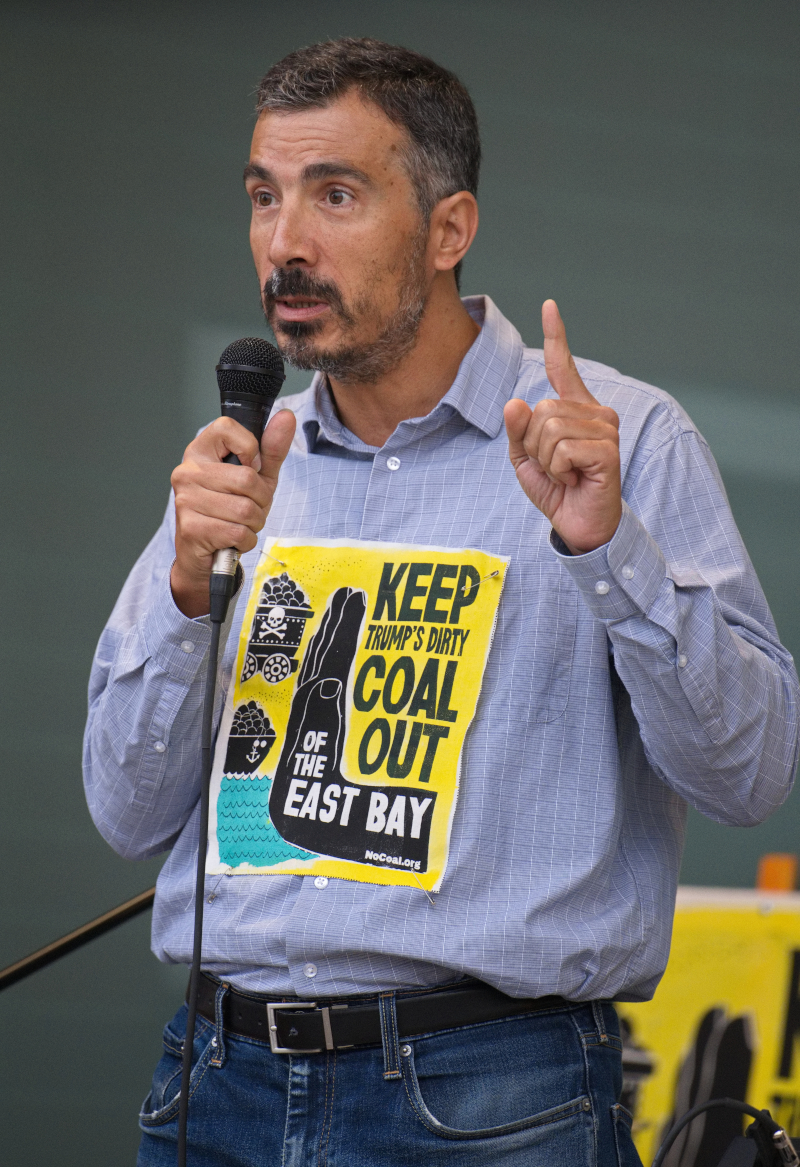
.stk-th4q7m9 {margin-bottom:15px !important;} @media screen and (min-width: 768px){.stk-096d817 {flex:var(--stk-flex-grow, 1) 1 calc(37.5% - var(--stk-column-gap, 0px) * 1 / 2 ) !important;}} @media screen and (min-width: 768px){.stk-0373019 {flex:var(--stk-flex-grow, 1) 1 calc(62.5% - var(--stk-column-gap, 0px) * 1 / 2 ) !important;}}Cihan Tuğal is a sociology professor at UC Berkeley and an organizer in East Bay DSA’s Climate Action Committee. He studies social movements, populism, capitalism, democracy, and religion and has a forthcoming book from Stanford University Press entitled The Social Roots of Autocratic Resilience. This piece is based on remarks Cihan made at the community rally of September 15, 2026, outside the Berkeley City Council meeting that adopted a resolution opposing the proposed Oakland coal depot. Photo credit: Leon Kunstenaar
.stk-q7i5evo {margin-bottom:12px !important;}Photo at top: Labor delegation led by Alameda Labor Council leader Josie Camacho speaks out against coal at Oakland City Council meeting in 2015 | Credit: Brooke Anderson
Berkeley Passes Resolution Against Toxic Coal Threat
Last night, over 125 people rallied outside Berkeley City Council in support of a resolution opposing coal handling, storage, and transport in the Bay Area while dozens of No Coal advocates made their support known to the City Council with signs and comments.
The Berkeley City Council passed the resolution unanimously.
The resolution is a response to the deadly Trump-funded coal terminal planned in West Oakland. The resolution also calls for the Bay Area Air District to strictly regulate coal facilities, and affirms the City’s support of Assembly Bill 40, which requires environmental review for large coal projects. The resolution was sponsored by Council members Igor Tregub (Author), Rashi Kesarwani (Co-sponsor), and Terry Taplin (Co-sponsor) as well as by Berkeley mayor Adena Ishii.
“We live in the flatlands near the railroad tracks, freeways, refinery, and airport, constantly exposed to various pollutants,” said Ms. Margaret Gordon, a longtime environmental justice advocate and resident of West Oakland. “This proposed coal terminal is one more burden we should not have to suffer under. Homes along the tracks lack indoor air filtration and air conditioning to block out coal dust, posing a direct threat to our health.
“Our health is just as important as corporate profits. Unhoused individuals are especially vulnerable and exposed to pollutants, as they do not have a home to protect their lungs,” said Ms. Margaret. “No coal in the Bay Area!”
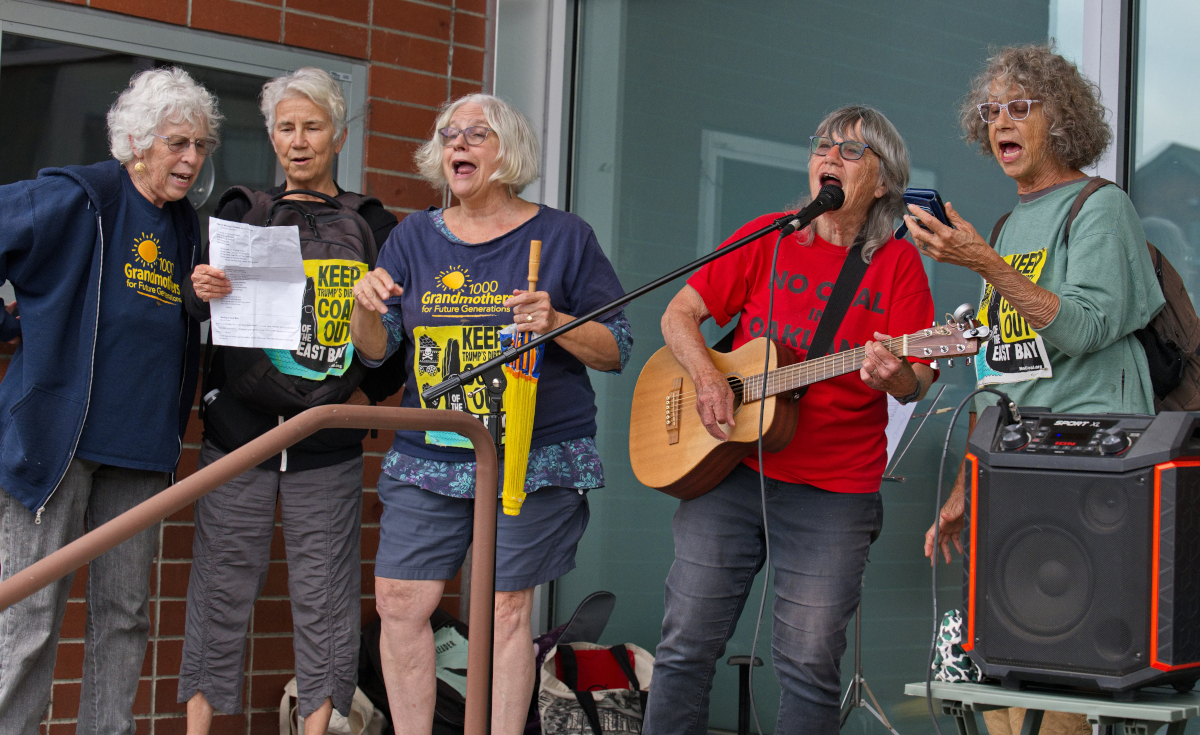
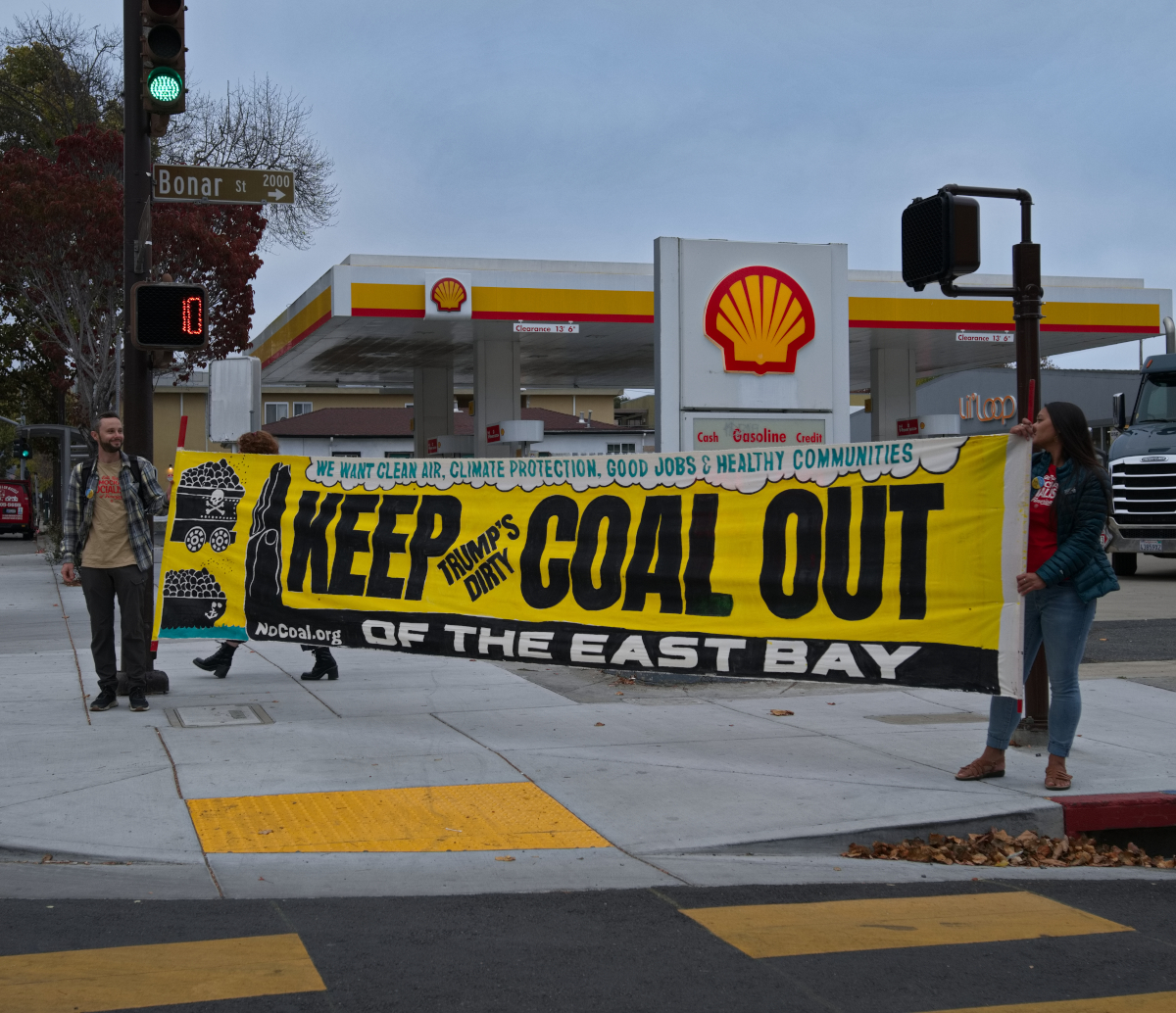
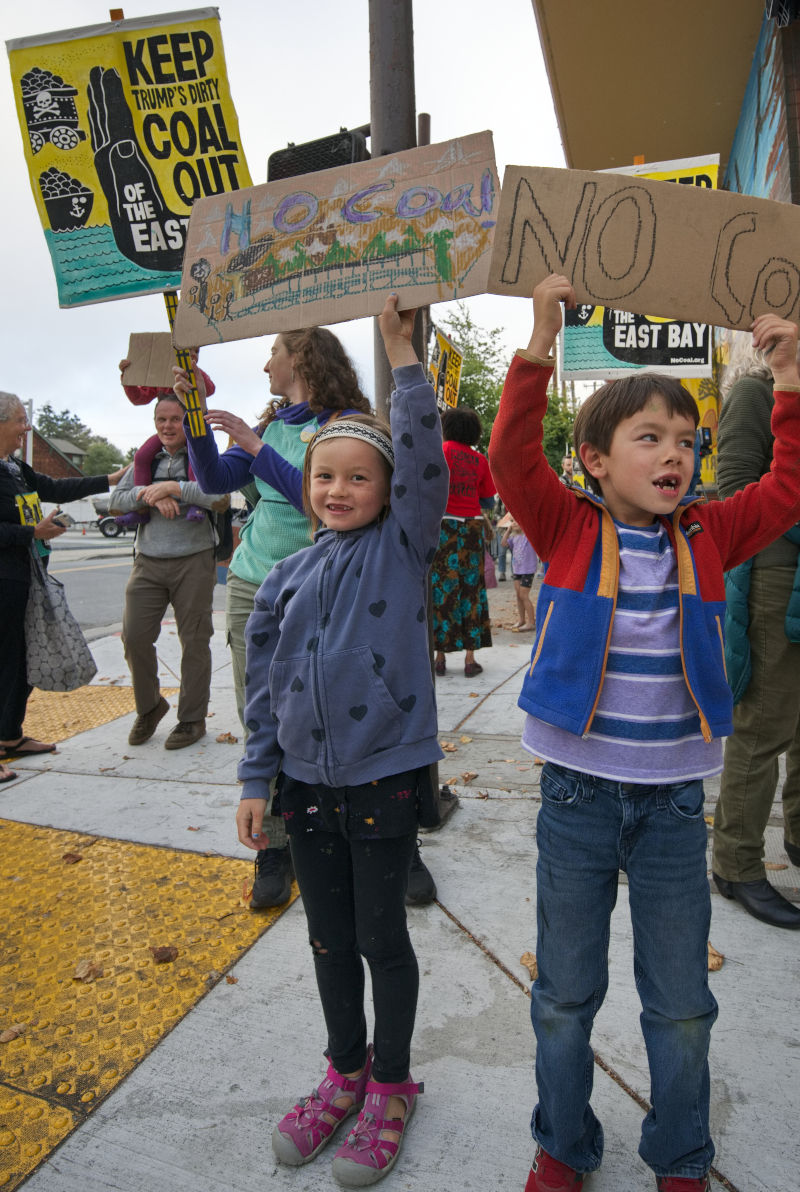
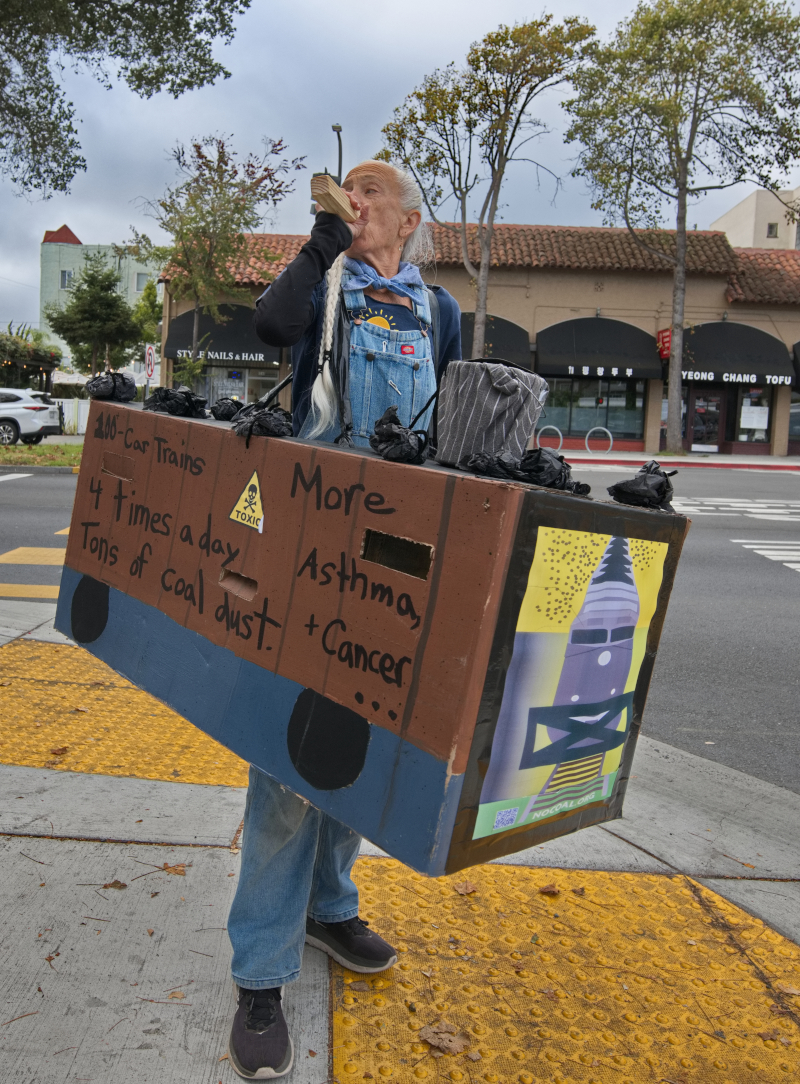
The rally was lively, defiant, and hopeful, with street theater performances including larger-than-life puppets blocking mock coal trains, chants and songs lead by Singing Resistance, and banners created at a community art build organized by “artivist” David Solnit.
“Living in Oakland, I am sick and tired of my community being ground zero for toxic pollution and environmental injustice,” said Berkeley Youth Vs. Apocalypse member Ashley Jahja. “Our health, our lives are not disposable. The fight against the coal terminal started in West Oakland but with recent mapping, is going to impact the entire Bay Area. Our fight is your fight, and we have to do whatever it takes to prevent the coal terminal from happening.”
“Berkeleyans are not about to let the East Bay become a ‘sacrifice zone’ so developers and the coal mining industry can poison the planet while they get even richer,” said Steve Masover, Berkeley resident and No Coal in Oakland organizer. “We’re here tonight because we’re determined to stop this calamity.”
“As a primary care physician, mom and community organizer who lives in West Berkeley, I could not be more opposed to the efforts to build a dirty coal terminal by the Bay Bridge,” said Ashley McClure, MD, the Executive Director of Climate Health Now. “My patients are already dealing with asthma, heart disease and dementia – all of which scientific evidence assures us would be made worse by the dirty soot of toxic coal dust (primarily fine particulate matter, or PM2.5) from coal trains smothering our communities. We care too much about the health of our families and communities to let the selfish profit motives of the billionaire class hawking dirty fossil energy move this ludicrous plan forward. This misanthropic dirty energy plan stops here.”
“These coal trains will pass a few hundred feet from places where my kids play soccer or attend summer arts camp,” said Megan Wachspress, Berkeley parent. “My kids will breathe the dust off these railcars while they’re moving, and kids in West Oakland will breath even more dust while the cars sit and are unloaded. I have a responsibility to my kids and to all the kids and families along these tracks to stop toxic coal dust from entering the East Bay.”
The resolution was proposed in response to the massively unpopular coal terminal planned in Oakland, which would flood Berkeley and other Bay Area cities with toxic coal pollution from mile-long coal trains. In June of this year, President Trump announced $75 million in funding for the terminal. Developer Phil Tagami aims to build a terminal to export coal carried by rail from Utah to Martinez to West Oakland, where he plans to load coal onto ships bound for Asian markets.
This resolution is part of a growing wave of resistance throughout the East Bay and statewide: The City of Richmond passed a similar resolution in July. Coalition members are organizing in other cities along the East Bay portion of the rail route to pass their own resolutions. The California State Legislature passed Assembly Member Mia Bonta’s AB40 last month. Governor Newsom is being urged by dozens of labor, faith, and environmental organizations, Supervisor Nikki Fortunato Bas, and countless Californians to sign it into law.
Rosa Parks Elementary School contingent, Photo Credit Leon Kunstenaar.
Singing Resistance, Photo Credit Leon Kunstenaar.
Labor speaker Cihan Tugal, Photo Credit Leon Kunstenaar.
Banner, Photo Credit Leon Kunstenaar.
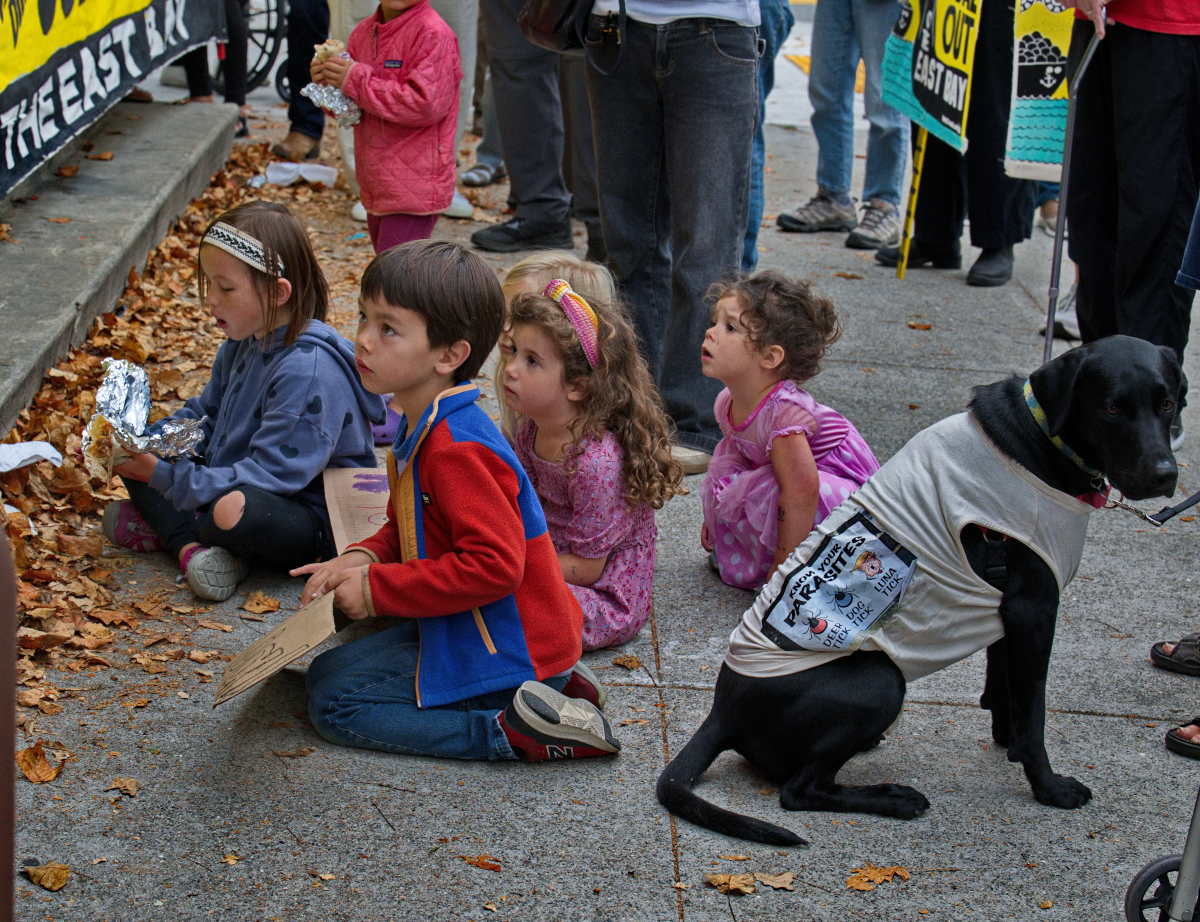
Kids against Coal, Photo Credit Leon Kunstenaar.
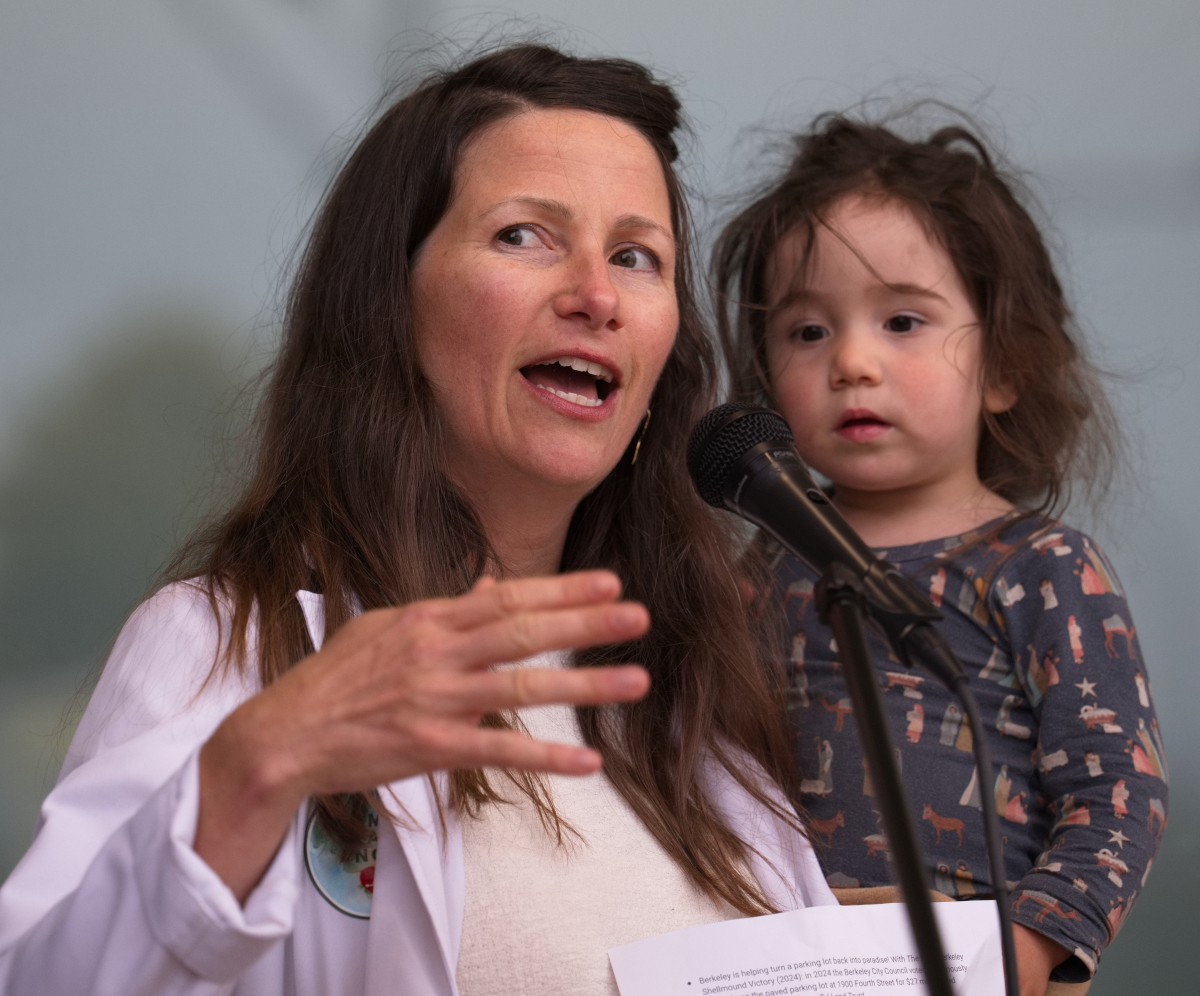
Berkeley Parent Sarah Berg at the mic, Photo Credit Leon Kunstenaar.
Coal Train (1000 Grandmothers), Photo Credit Leon Kunstenaar.
Images credit: Leon Kunstenaar
The Fine Print I:
Disclaimer: The views expressed on this site are not the official position of the IWW (or even the IWW’s EUC) unless otherwise indicated and do not necessarily represent the views of anyone but the author’s, nor should it be assumed that any of these authors automatically support the IWW or endorse any of its positions.
Further: the inclusion of a link on our site (other than the link to the main IWW site) does not imply endorsement by or an alliance with the IWW. These sites have been chosen by our members due to their perceived relevance to the IWW EUC and are included here for informational purposes only. If you have any suggestions or comments on any of the links included (or not included) above, please contact us.
The Fine Print II:
Fair Use Notice: The material on this site is provided for educational and informational purposes. It may contain copyrighted material the use of which has not always been specifically authorized by the copyright owner. It is being made available in an effort to advance the understanding of scientific, environmental, economic, social justice and human rights issues etc.
It is believed that this constitutes a 'fair use' of any such copyrighted material as provided for in section 107 of the US Copyright Law. In accordance with Title 17 U.S.C. Section 107, the material on this site is distributed without profit to those who have an interest in using the included information for research and educational purposes. If you wish to use copyrighted material from this site for purposes of your own that go beyond 'fair use', you must obtain permission from the copyright owner. The information on this site does not constitute legal or technical advice.
 This site is not the official webpage of the Industrial Workers of the World.