




You are here
REPORT: Canadian pension fund investment managers’ entanglement with fossil fuel industry raises conflict of interest concerns
By Adam Scott and Patrick DeRochie - Shift Network, May 5, 2022
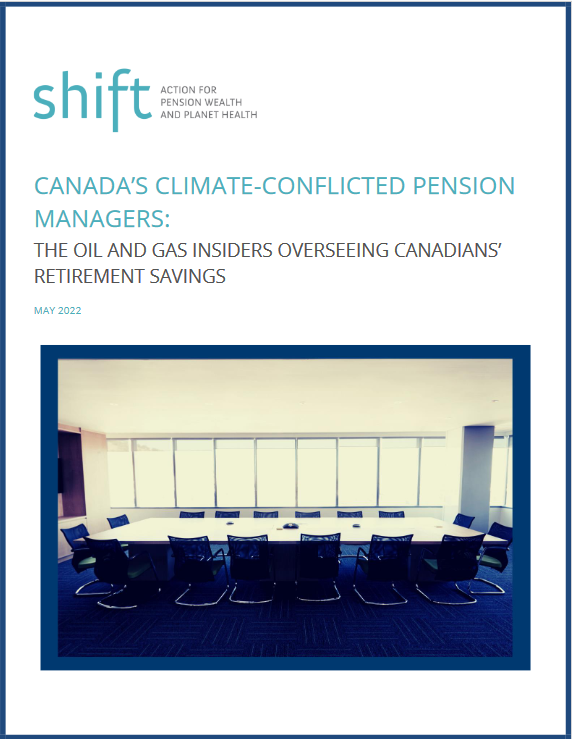
New analysis finds 80 Canadian pension managers with 124 different roles at 76 fossil fuel companies, raising questions from beneficiaries about fiduciary duty and pension administrators’ potential conflicts of interest on climate-related investment decisions.
Shift Action for Pension Wealth and Planet Health’s May 2022 report, Canada’s Climate-Conflicted Pension Managers: The Oil and Gas Insiders Overseeing Canadians’ Retirement Savings, reveals the deep entanglement between the fossil fuel industry and directors, trustees and investment managers at Canada’s largest public pension funds.
The overlap raises serious questions from beneficiaries about their pension administrators’ ability to objectively manage climate-related financial risks and make critical climate-related investment decisions – when the pension administrators are so deeply entangled with an industry whose products are the primary cause of the climate crisis, whose bottom line depends on the continued production of climate-damaging products, and that has a long and ongoing legacy of obstructing efforts to cut carbon pollution.
The analysis finds that among Canada’s ten largest pension funds, which together manage more than $2 trillion in assets:
-
80 different pension directors, trustees, executives and senior staff currently hold or previously held 124 different roles with 76 different fossil fuel companies.
-
This includes nine current pension fund directors or trustees that currently hold 13 roles on the board of directors of 12 different fossil fuel companies, and 56 senior staff or investment managers at pension funds who hold 76 different corporate director roles at 39 different fossil fuel companies.
-
Seven of the ten pension funds have at least one board member who simultaneously sits on the board of a fossil fuel company.
-
In some cases, over a quarter of the pension fund’s board has direct connections to the oil and gas industry.
The best long-term interests of pension fund beneficiaries are not aligned with the financial interests of shareholders of fossil fuel companies. A pension director who is also a corporate director of a fossil fuel company could find themself with real or perceived conflicts of interest between their fiduciary duty to invest in the best long-term interests of pension beneficiaries, and their simultaneous legal obligation to act in the financial interests of the fossil fuel company on whose board they sit.
Disclaimer: The views expressed here are not the official position of the IWW (or even the IWW’s EUC) and do not necessarily represent the views of anyone but the author.
The Fine Print I:
Disclaimer: The views expressed on this site are not the official position of the IWW (or even the IWW’s EUC) unless otherwise indicated and do not necessarily represent the views of anyone but the author’s, nor should it be assumed that any of these authors automatically support the IWW or endorse any of its positions.
Further: the inclusion of a link on our site (other than the link to the main IWW site) does not imply endorsement by or an alliance with the IWW. These sites have been chosen by our members due to their perceived relevance to the IWW EUC and are included here for informational purposes only. If you have any suggestions or comments on any of the links included (or not included) above, please contact us.
The Fine Print II:
Fair Use Notice: The material on this site is provided for educational and informational purposes. It may contain copyrighted material the use of which has not always been specifically authorized by the copyright owner. It is being made available in an effort to advance the understanding of scientific, environmental, economic, social justice and human rights issues etc.
It is believed that this constitutes a 'fair use' of any such copyrighted material as provided for in section 107 of the US Copyright Law. In accordance with Title 17 U.S.C. Section 107, the material on this site is distributed without profit to those who have an interest in using the included information for research and educational purposes. If you wish to use copyrighted material from this site for purposes of your own that go beyond 'fair use', you must obtain permission from the copyright owner. The information on this site does not constitute legal or technical advice.
 This site is not the official webpage of the Industrial Workers of the World.