By Dayton Martindale - Truthout, September 27, 2021

Airport employees and community allies protest a proposed expansion of Los Angeles International Airport on September 14, 2021; image by author.
“Are you scared you’re going to lose all your jobs ’cause there will be no planes?”
The audience chuckled at MSNBC host Chris Hayes’s first question for Sara Nelson, international president of the Association of Flight Attendants, at a March 2019 special on the Green New Deal. Nelson, an ardent climate advocate, dismissed the notion out of hand: “We still have to get around.” The real threat to flights, she insisted, is an increase in extreme weather events. It is climate inaction, then, that could keep planes from flying, rather than climate action.
Across the Atlantic, the messaging is notably different. Environmentalists across the U.K. and France have campaigned against airport expansions, and the Swedish language now has a word (flygskam) for the climate shame felt by those who fly. In August 2019, Swedish climate change activist Greta Thunberg chose to ride a boat to New York to reduce emissions and draw attention to the crisis.
So, will we have to keep any airplanes on the ground? The answer is complicated, depending on how quickly certain technologies become widespread, how willing we are to tolerate financial and environmental costs of jet fuel alternatives, and whether we aim to eliminate greenhouse gas emissions entirely or merely reach “net-zero” emissions (in which scenario we would continue to emit, but attempt to offset the climate impact through carbon capture and storage).
But there is a growing consensus that even in technologically optimistic scenarios, some constraints on demand will be necessary to curtail the expected growth in flights over the decades to come. Many climate activists argue that because these technologies are uncertain, we should start reducing flights as soon as possible. And some early indications — such as an ongoing union-led fight against an airport expansion in Los Angeles — suggests that the climate movement’s most powerful ally against rampant growth in air travel may be labor.
Few demonstrators at the Los Angeles International Airport (LAX) during a September 14 rally held greenhouse gas emission foremost in their minds as they decried the proposed expansion. The 50 or so protesters — most wearing the shirt of either SEIU United Service Workers West (SEIU-USWW) or Unite Here Local 11 — were more vocal about issues such as health care, wages, and the impact of air pollution and traffic congestion at their jobs and in their neighborhoods. The two unions, representing thousands of food, custodial and passenger service employees at the airport, were joined by Sunrise LA and other community and environmental groups outside a meeting of the Los Angeles Board of Airport Commissioners (BOAC).
An SEIU-USSW press release argues that the current plans to expand LAX “ignore the needs of workers at the airport as well as those who are most impacted by it: nearby neighborhood residents,” but they do not oppose the expansion outright. Instead, the labor groups want to see a community benefits agreement — an enforceable contract between the airport and community groups that allows workers and residents to provide substantive input, ensuring any airport development respects economic and environmental justice. If this demand is not met, SEIU-USWW President David Huerta tells Truthout, the union “could transition into direct opposition.”
Any solution must ensure worker voices are heard, says Sunrise LA spokesperson Josiah Edwards. Airport employees kept LAX running through the pandemic for inadequate pay, and already bear a heavy environmental burden. That they are not invited to the BOAC’s closed-door meetings is “a clear instance of environmental injustice,” Edwards says.




 California’s ambitious climate goals, supported by state and federal investment, will create enormous economic opportunity over the coming decades. To meet the 2045 target of carbon neutrality, a 100% clean electric grid, and a 90% reduction in oil consumption and refinery production, the state will need to modernize its electrical grid and build storage capacity to meet increased demand for electricity. Carbon management techniques, plugging orphan wells, and the development of new energy sources such as geothermal will all come into play, providing economic opportunities to workers and businesses alike. Reducing use of polluting fossil fuels will likewise result in significant health benefits to Californians, especially to communities disproportionately burdened by polluting enterprises and proximity to freeways.
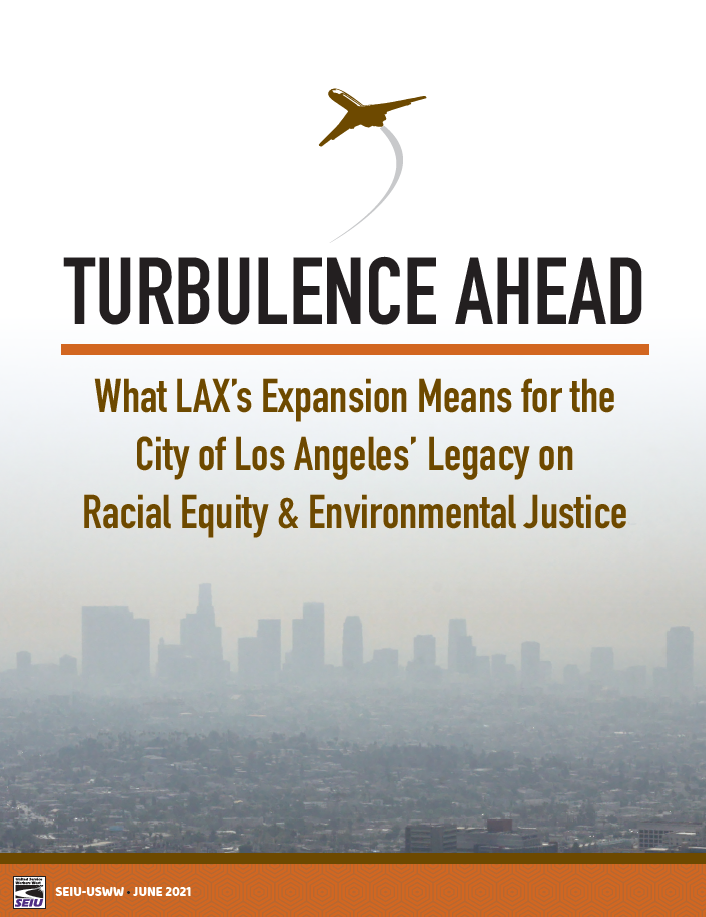 Right now, Los Angeles International Airport (LAX) is charging ahead on an expansion project of a scale not seen for decades. Los Angeles World Airports (LAWA), the organization that owns and operates LAX, quietly released a draft Environmental Impact Report late last year that reveals a project with a host of alarming implications for communities near the airport. If the City of Los Angeles and its elected officials are serious about leadership on environmental justice and equity, resolving the issues presented by this project will be critically important.
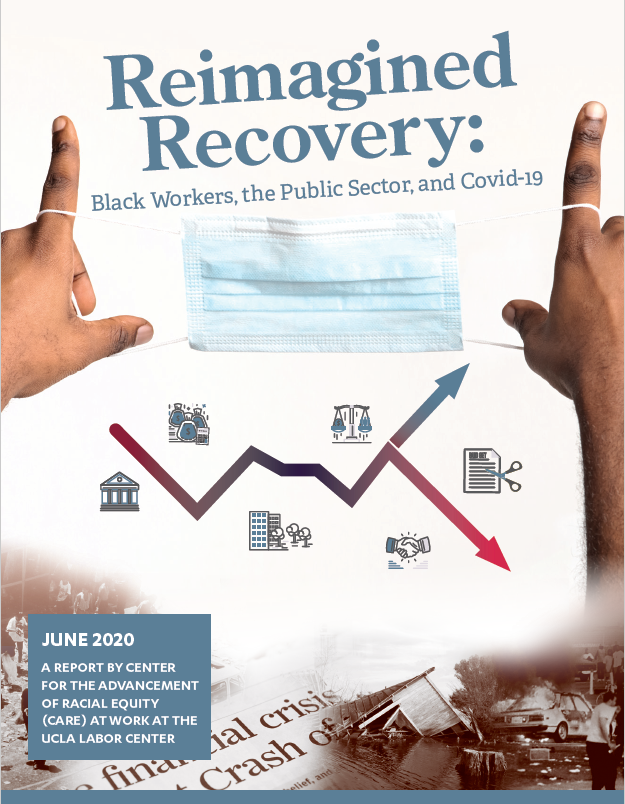 This report highlights the validity of public sector work as a solution in the response and recovery to the Covid-19 pandemic on Black people across communities in Los Angeles County. Covid-19 disproportionately impacts Black workers and communities. History shows that even once a disaster is over, Black workers and Black people across communities continue to disproportionately feel its impact far longer than other communities.
 More than 1,200 California Nurses Association/National Nurses Organizing Committee registered nurses, environmental and healthcare activists, and students on Dec. 3 marched and rallied in Los Angeles to demand that the world’s leaders, now convening in Paris for the United Nations Conference on Climate Change, adopt a binding and enforceable climate treaty, commit resources to fund the transformation to clean, renewable energy including a just transition program for those who now work in the fossil fuel industry, and call on wealthy, developed countries to provide resources for the less-developed countries to act on climate, with funding coming from a carbon tax and the Robin Hood tax.
 This site is not the official webpage of the Industrial Workers of the World.