You are here

wind power

Texas Democrats, unions call on Interior to protect workers’ rights in offshore wind leasing

By Zack Budryk - The Hill, June 2, 2022

A coalition of Texas unions and members of Congress is calling on the Biden administration to ensure workers’ rights are protected in the buildout of offshore wind infrastructure in the Gulf of Mexico. 

In a letter sent out Thursday morning, Democratic Reps. Al Green, Lloyd Doggett, Sylvia Garcia, Marc Veasey, Veronica Escobar, Vicente Gonzalez, Sheila Jackson-Lee and Joaquin Castro, who all represent districts in Texas, called on the Bureau of Ocean Energy Management (BOEM) to ensure that Gulf-based wind power projects are built by union labor.

The representatives noted that due to organizing obstacles at the state level, union membership among workers is about one-third the national rate in Texas.

In the letter, the members called on BOEM to ensure that leasing terms for wind projects in the Gulf include a requirement for a project labor agreement (PLA), or a pre-hire collective bargaining agreement between construction unions and contractors. 

The members also called for the use of a community workforce agreement, a PLA with a goal of hiring low-income workers for construction projects. 

The letter follows a public comment submitted in February by the Texas Climate Jobs Project, a coalition of labor unions in the Lone Star State that aims to bridge the gap between addressing climate change and the needs of workers. The group cites what it says is endemic wage theft in the construction business in Texas, and called on BOEM to incorporate local working conditions into its environmental analysis. 

“What we’re asking for is when they do issue those leases, that those leases have requirements in there for job quality, for the ability of workers to come together … and community benefits so that even as we build this renewable capacity, we’re making sure that working people, and people who have historically been disadvantaged by the way energy has been produced in Texas, have a real seat at the table,” Rick Levy, president of the Texas AFL-CIO, said in an interview with The Hill Wednesday. 

Levy described offshore wind as the ideal project to assuage what he said was unease among parts of organized labor about renewable energy’s effect on jobs. 

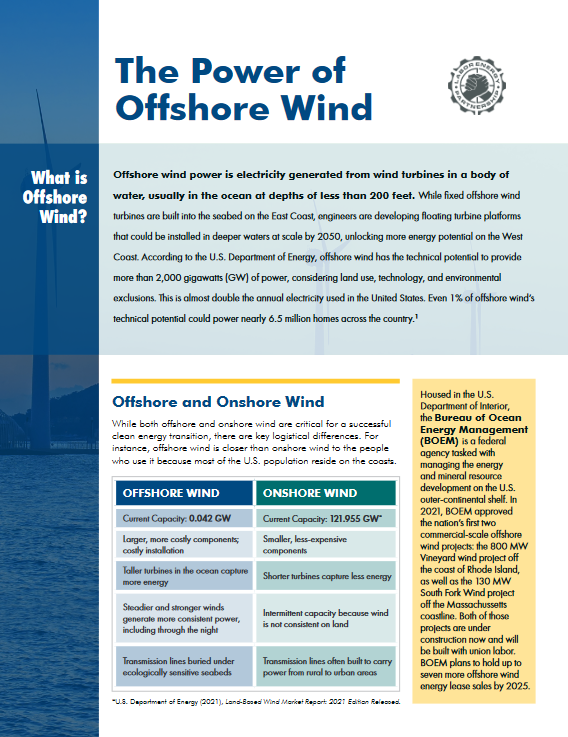
The Power of Offshore Wind

By Sarah Clements and Angie Kaufman - Labor Energy Partnership, June 2022

The U.S. offshore wind energy industry is on the rise. As a climate solution with opportunities to create and support good-paying jobs, the offshore wind industry demonstrates the symbiosis between labor and the energy transition. 

This fact sheet was developed by EFI and AFL-CIO under the Labor Energy Partnership. It will help you understand the basics: what offshore wind energy is, why the East Coast has more potential, what the Biden Administration has pledged, and how to build the industry sustainably and equitably. 

Decarbonized Electrification Would Generate Significant Job Gains

By Jim Stanford. - Center for Future Work, May 26, 2022

A new report from the David Suzuki Foundation takes a deep dive into the employment gains that could be achieved through the rapid electrification of Canada’s economy, driven by the expansion of sustainable power generation and infrastructure. The new report, “Shifting Power: Zero-Emissions Electricity Across Canada by 2035”, estimates that 75,000 net new jobs would be created by the expansion of clean electricity generation and use over a 15-year period. This would contribute substantially to the attainment of Canada’s net-zero objectives, as well as to strengthening employment outcomes for Canadian workers as the economy shifts toward sustainable energy sources.

Centre for Future Work Director Jim Stanford provided a supplementary analysis for the report, addressing the economic and employment opportunities associated with decarbonized electrification. He notes those benefits would occur through several complementary channels:

  • Jobs in developing and operating renewable generation systems (including solar, wind, geothermal and hydroelectric power). Construction of these projects will create hundreds of thousands of person-years, with thousands more ongoing jobs in operation and maintenance.
  • New work in expanding and upgrading the electric grid. Major investments will be required to upgrade transmission facilities, install modern control and regulating equipment and prepare the grid for the more complex and variable power distribution requirements associated with dispersed renewable generation.
  • Manufacturing of capital equipment and other material inputs to renewable generation projects. With appropriate value-added industrial strategies to enhance Canada’s industrial footprint in these growing industries, thousands of permanent jobs would be created manufacturing wind turbines, solar power equipment, transmission equipment and materials, and other capital inputs to electrification.
  • Installation and maintenance of new equipment that uses electricity in various industrial and consumer applications — everything from residential heating systems to electric vehicles to large industrial power systems.
  • Jobs in new industries attracted to Canada by the availability of clean, reliable and competitive electricity. Canada’s abundance of primary renewable electricity resources would position us at the forefront of the global transition to sustainable electric energy. That will stimulate interest and investment by industrial firms and financial investors from around the world.

Overstated and misleading warnings that shifting away from fossil fuel use will inevitably cause major job losses and dislocation have already been disproved by the progress in decarbonizing electricity that has already been made. Stanford notes that reliance on fossil fuels in electricity generation in Canada has already fallen by one-third since the turn of the century – yet the electricity generation and distribution industry has created 10,000 net new jobs over that same period. And since renewable energy sources, in general, are more labour-intensive than fossil fuels, this continuing shift can be expected to produce more net job gains in the years ahead.

Jim Stanford’s full commentary for the Shifting Power report is posted here. For more details, please see the Suzuki Foundation’s full report, “Shifting Power: Zero-Emissions Electricity Across Canada by 2035

Climate change: IPCC report confirms that just transition and green jobs are central to success

By staff - International Trade Union Confederation, May 4, 2022

ITUC General Secretary Sharan Burrow said: “This report lays out a stark reality: global greenhouse gas emissions need to peak before 2025, and we have to cut emissions by 43% by 2030 to give us a chance to limit global warming to 1.5°C.

“That’s a lot, but the report says that solar and wind energy have the potential to deliver over one-third of this target.

“It’s unavoidable: the world needs rapid, deep and immediate investments in jobs to build this infrastructure and deliver the cuts to emissions we need.

“At the same time, the report is clear that we have to leave the oil and gas in the ground to survive. We need fossil fuel infrastructure and subsidies to be repurposed.

“This requires just transition: a plan to convert these jobs in fossil fuels to jobs in clean energy. Every country, every industry, every company, and every investor must have a plan developed, in partnership with working people and their communities, and must implement it rapidly.

Our report with the World Resources Institute and the New Climate Economy showed that this shift makes economic and social sense too. Investing in solar power creates 1.5 times as many jobs as investing the same amount of money in fossil fuels.

“The IPPC has sounded a call to action for jobs in renewables. Investors, companies and governments need to make this a reality now. We know that for every ten jobs in renewable energy, there are another five to ten in manufacturing supply chains and, if these are good jobs with just wages, 30 to 35 jobs in the broader community.”

The IPPC report makes clear the transformational potential of just transition, saying it can “build social trust, and deepen and widen support for transformative changes”. It goes on to say: “This is already taking place in many countries and regions, as national just transition commissions or task forces, and related national policies, have been established in several countries. A multitude of actors, networks, and movements are engaged.”

Sharan Burrow added: “We need unions at the table everywhere to build these plans and to guarantee income support for secure pensions, reskilling and re-deployment.”

Unions Making a Green New Deal from Below: Part 1

By Jeremy Brecher - Labor Network for Sustainability, May 2022

While Washington struggles over job and climate programs, unions around the country are making their own climate-protecting, justice-promoting jobs programs.

While unions have been divided on the Green New Deal as a national policy platform, many national and local unions have initiated projects that embody the principles and goals of the Green New Deal in their own industries and locations. Indeed, some unions have been implementing the principles of the Green New Deal since long before the Green New Deal hit the headlines, developing projects that help protect the climate while creating good jobs and reducing racial, economic, and social injustice.

Even some of the unions that have been most dubious about climate protection policies are getting on the clean energy jobs bandwagon. The United Mine Workers announced in March that it will partner with energy startup SPARKZ to build an electric battery factory in West Virginia in 2022 that will employ 350 workers. The UMWA will recruit and train dislocated miners to be the factory’s first production workers. According to UMWA International Secretary-Treasurer Brian Sanson, “We need good, union jobs in the coalfields no matter what industry they are in. This is a start toward putting the tens of thousands of already-dislocated coal miners to work in decent jobs in the communities where they live.”[1]

Alaska's Renewable Energy Future: New Jobs, Affordable Energy

By Kay Brown, Carly Wier, et. al. - Alaska Climate Alliance, March 21, 2022

Alaska has a vast endowment of renewable energy resources that can be tapped in its transition to a renewable energy future. Benefits of accelerating the energy transition in Alaska include more jobs, lower energy prices, higher energy security and the potential for renewable resources to support zero carbon hydrogen-based fuels for the aviation and maritime industries.
The state has already begun to develop its renewable energy resources and continues to support renewable technology development for Alaska’s challenging environment. The scale of Alaska’s vast undeveloped renewable energy resource endowment remains more than 14 times the total U.S. energy consumption.

Renewable energy technologies, including wind, solar, geothermal, and ocean and river hydrokinetic, along with complementary energy storage technologies, are continuing to exhibit declining costs which make them increasingly attractive as a primary energy source to substitute for fossil fuels in the electric sector and to support the electrification of buildings and the transformation of the transportation sector to electrification and renewable hydrogen-based fuels.

As local fossil fuel costs escalate across Alaska, from 2.5X higher in the Railbelt to as much as 4X higher in Rural Alaska (as compared to the U.S. average), renewable energy technologies are increasingly attractive investments and are poised to affordably replace legacy fossil fuel energy systems in the 2030-to-2050 time horizon while providing greater energy security, increased energy resiliency especially in rural Alaska, and broad environmental, economic and health benefits.

Independent studies have confirmed that the development of Alaska’s renewable energy potential will generate thousands of jobs – at least comparable in magnitude to the fossil fuel jobs that may be displaced by the transition to a clean renewable energy sector.

Read the report (PDF).

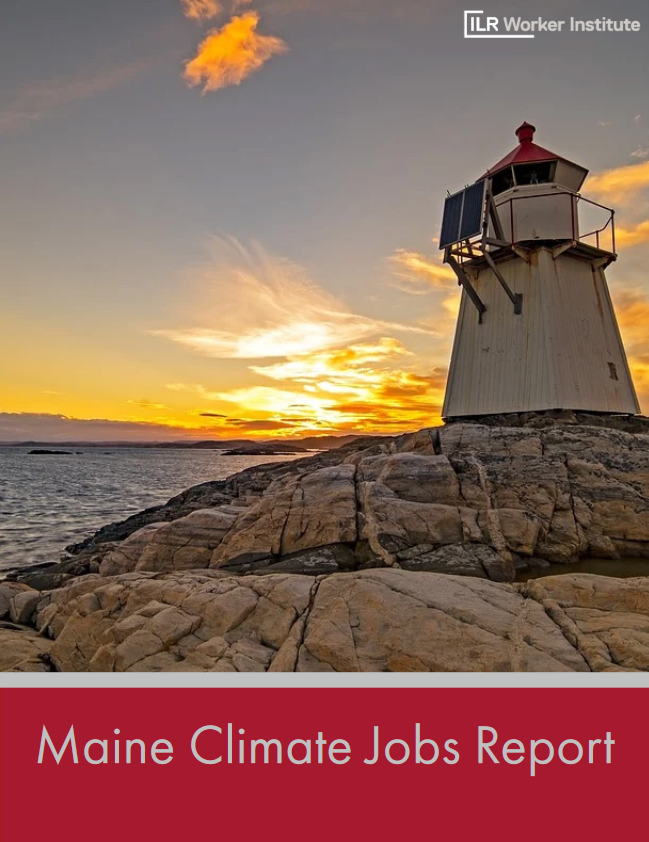
Maine Climate Jobs Report

By J. Mijin Cha, Hunter Moskowitz, Matt Phillips, and Lara Skinner - Maine Labor Climate Council, March 2022

This report, written in consultation with researchers at Cornell University’s Worker Institute, examines the interrelated crises of climate breakdown and inequality, and lays out an ambitious roadmap for how Maine can build a renewable energy economy, create good union jobs, and tackle racial and economic inequality.

The report’s science-based recommendations will broadly help our state achieve four goals: quickly decarbonizing Maine’s economy; ensuring that the tens of thousands of new jobs that get created as part of Maine’s energy transition adhere to high labor standards in terms of pay, benefits, training, and job security; bringing underrepresented workers into the clean-energy workforce through well-run apprentice and pre-apprentice programs; and ensuring a just transition for workers and communities most affected by these changes. 

The report sets bold objectives for building out Maine’s renewable energy economy, including:

  • Electrifying all state and local vehicles, including school and city buses, by 2040;

  • Building a high speed rail corridor from Bangor to Boston while connecting to Lewiston/Auburn;

  • Doing deep energy-efficiency retrofits and installing solar on all K-12 public schools and publicly owned buildings by 2035; and

  • Installing 3GW of renewable energy by 2030 and upgrading Maine’s energy transmission and storage capacity

Read the report (PDF).

Climate-Safe Energy Production–From Below

By Jeremy Brecher - Labor Network for Sustainability, February 2022

Climate-safe energy is being produced locally all over the country in ways that also produce jobs and increase racial, social, and economic justice – fulfilling the basic principles of the Green New Deal.
Protecting the climate requires meeting the original Green New Deal proposal’s goal of 100% of national power generation from renewable sources within ten years.[1] That requires greatly expanding climate-safe sources of energy. It involves an unprecedented transformation of the energy system, and that requires national investment and planning. But much of the transformation will actually be composed of local building blocks – and those can begin right now. Indeed, hundreds of local initiatives around the country, ranging from community solar to municipal ownership to local microgrids, are already expanding renewable energy production.

Sunlight, Jobs, and Justice

Solar gardens are sprouting up all over Denver.

On November 3, 2020, Denver voters overwhelmingly approved Ballot Measure 2A, the Climate Protection Fund, to raise approximately $40 million per year dedicated to climate action. As stated in the ballot measure, the intent of this fund is to “fund programs to eliminate greenhouse gas emissions and air pollution and adapt to climate change. Funding should maximize investments in communities of color, under-resourced communities and communities most vulnerable to climate change.”[2]

Community solar gardens use photovoltaic (PV) panels to produce electricity from sunlight for an entire neighborhood. Now such solar gardens are dotting sites owned and financed by the City of Denver, including rooftops, parking lots, and vacant lands. The power generated from the solar gardens will be shared between city facilities, income-qualified residents, and publicly accessible electric vehicle charging stations.

In accord with the principles of the Green New Deal, Denver’s solar garden program has a strong justice dimension. Since Denver owns the project, it can set its own standards. Ten percent of the energy generated by the solar gardens is allocated to low-income housing through the Denver Housing Authority. An additional 10 percent will be allocated to low-income households through Energy Outreach Colorado, and will be exempt from subscription fees. A paid workforce training program available to Denver residents will provide 10 percent of the city and county’s solar workforce.

The solar gardens are designed to contribute to the goal of Denver’s “80 x 50 Climate Action Plan” to transition Denver to 100 percent renewable electricity for municipal buildings by 2025; achieve 100 percent community-wide renewable electricity by 2030; and reduce Denver’s greenhouse gas emissions 80 percent, as compared to a 2005 baseline, by 2050.[3]

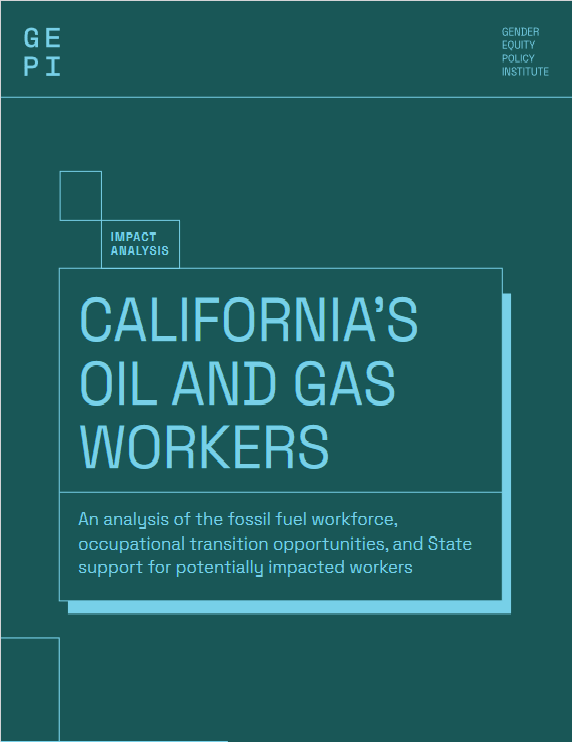
Impact Analysis: California’s Oil and Gas Workers

By Staff - Gender Equity Policy Institute, January 23, 2023

California’s ambitious climate goals, supported by state and federal investment, will create enormous economic opportunity over the coming decades. To meet the 2045 target of carbon neutrality, a 100% clean electric grid, and a 90% reduction in oil consumption and refinery production, the state will need to modernize its electrical grid and build storage capacity to meet increased demand for electricity. Carbon management techniques, plugging orphan wells, and the development of new energy sources such as geothermal will all come into play, providing economic opportunities to workers and businesses alike. Reducing use of polluting fossil fuels will likewise result in significant health benefits to Californians, especially to communities disproportionately burdened by polluting enterprises and proximity to freeways.

Supported by state investment and federal funding through the Infrastructure Investment and Jobs Act and the Inflation Reduction Act, the actions necessary to tackle the challenges of climate change are projected to create 4 million new jobs in the state. California is investing in developing the clean energy workforce, with an equity commitment to recruit and train historically disadvantaged and under- represented communities.

Decarbonizing the economy and accelerating the adoption of clean energy is necessary if we are to preserve a habitable planet. Progress to a carbon neutral future is already well underway in the state. Wind and solar power are less expensive than natural gas or coal powered electricity. A large majority of Californians are concerned about climate change and support action to address its impacts.

However, as with all sectoral economic change, some industries will grow and thrive, while others will shrink, leaving some of their workers behind. Labor unions and trades groups are rightly concerned that workers are not forced to abandon skills developed over their careers and thrown into an inhospitable labor market with no support.

Thus, a key challenge in meeting California’s climate action goals is to devise a fair, equitable, and empirically-based policy to provide support for workers at risk of unemployment and income loss as many factors combine to reduce demand in state for oil and gas products.

As the Biden Administration Eyes Wind Leases Off California’s Coast, the Port of Humboldt Sees Opportunity

By Emma Foehringer Merchant - Inside Climate News, January 5, 2022

The administration wants to sell its first lease in 2022, and a new bill in California requires a plan. Some in Humboldt have been waiting years for this moment to arrive.

In the early 20th century, the U.S. Census Bureau declared Humboldt County, California—now famous for its redwoods—the “principal center” of the state’s lumber industry. In 1900, the product accounted for nearly 60 percent of the region’s exports. 

But now, though lumber yards and wood suppliers still line Humboldt Bay, the industry is a shadow of its former self. 

“You look at old photographs of Humboldt Bay from back then and there’s mills everywhere, pulp mills and ships and docks,” said Matthew Marshall, executive director of the Redwood Coast Energy Authority. “As that retracted there’s a lot of available land and waterfront …. So, there’s a big opportunity.”

The Redwood Coast Energy Authority (RCEA)—a power organization formed by the County of Humboldt and Northern Californian cities such as Trinidad and Eureka—has been working for years to prepare for that opportunity. In 2018, RCEA submitted an unsolicited application to the U.S. Department of the Interior in hopes of building wind energy in waters just west of Humboldt Bay. 

Pages

The Fine Print I:

Disclaimer: The views expressed on this site are not the official position of the IWW (or even the IWW’s EUC) unless otherwise indicated and do not necessarily represent the views of anyone but the author’s, nor should it be assumed that any of these authors automatically support the IWW or endorse any of its positions.

Further: the inclusion of a link on our site (other than the link to the main IWW site) does not imply endorsement by or an alliance with the IWW. These sites have been chosen by our members due to their perceived relevance to the IWW EUC and are included here for informational purposes only. If you have any suggestions or comments on any of the links included (or not included) above, please contact us.

The Fine Print II:

Fair Use Notice: The material on this site is provided for educational and informational purposes. It may contain copyrighted material the use of which has not always been specifically authorized by the copyright owner. It is being made available in an effort to advance the understanding of scientific, environmental, economic, social justice and human rights issues etc.

It is believed that this constitutes a 'fair use' of any such copyrighted material as provided for in section 107 of the US Copyright Law. In accordance with Title 17 U.S.C. Section 107, the material on this site is distributed without profit to those who have an interest in using the included information for research and educational purposes. If you wish to use copyrighted material from this site for purposes of your own that go beyond 'fair use', you must obtain permission from the copyright owner. The information on this site does not constitute legal or technical advice.