You are here

infrastructure and mega-projects

DOE Quietly Backs Plan for Carbon Capture Network Larger Than Entire Oil Pipeline System

By Sharon Kelly - DeSmog, July 18, 2021

Obama Energy Secretary Ernest Moniz and major labor group AFL-CIO are behind the “blueprint” for a multi-billion dollar system to transport captured CO2 — and offer a lifeline to fossil fuel plants.

An organization run by former Obama-era Energy Secretary Ernest Moniz, with the backing of the AFL-CIO, a federation of 56 labor unions, has created a policy “blueprint” to build a nationwide pipeline network capable of carrying a gigaton of captured carbon dioxide (CO2).

The “Building to Net-Zero” blueprint appears to be quietly gaining momentum within the Energy Department, where a top official has discussed ways to put elements into action using the agency’s existing powers.

The pipeline network would be twice the size of the current U.S. oil pipeline network by volume, according to the blueprint, released by a recently formed group calling itself the Labor Energy Partnership. Backers say the proposed pipeline network — including CO2 “hubs” in the Gulf Coast, the Ohio River Valley, and Wyoming — would help reduce climate-changing pollution by transporting captured carbon dioxide to either the oil industry, which would undo some of the climate benefits by using the CO2 to revive aging oilfields, or to as-yet unbuilt facilities for underground storage.

The blueprint, however, leaves open many questions about how the carbon would be captured at the source — a process that so far has proved difficult and expensive — and where it would be sent, focusing instead on suggesting policies the federal government can adopt to boost CO2 pipeline construction. 

Climate advocates fear that building such a large CO2 pipeline network could backfire, causing more greenhouse gas pollution by enabling aging coal-fired power plants to remain in service longer, produce pipes that could wind up carrying fossil fuels if carbon capture efforts fall through, and represent an expensive waste of federal funds intended to encourage a meaningful energy transition.

In March, over 300 climate and environmental justice advocacy groups sent a letter to Congress, arguing that subsidizing carbon capture “could entrench the fossil economy for decades to come.”

The AFL-CIO and the Energy Futures Initiative, which jointly produced the blueprint, did not respond to questions about concerns over their proposals.

Proponents of carbon capture, usage, and sequestration (CCUS) often highlight ways that it could be used for sectors like steel and cement whose carbon pollution is generally considered “hard to abate.” Yet, the pipeline network envisioned by Moniz would be capable of carrying over 10 times as much carbon dioxide as the steel and cement industries emit in total nationwide, according to U.S. Environmental Protection Agency (EPA) data from 2019. In fact, it could transport more CO2 than the entire industrial sector emits in the U.S., leaving the rest of the pipeline network’s capacity available for carbon from fossil fuel-fired power plants or from “direct air capture” technologies that would remove ambient CO2 but don’t currently exist at a commercial level

“Even the advocates of direct air capture technology acknowledge that they don’t anticipate that it would be at a scale to make any meaningful reduction in atmospheric CO2 levels until 2060, 2070 and beyond,” said Carroll Muffett, president of the environmental law nonprofit Center for International Environmental Law. “When we’re dealing with a world where we need to cut emissions in the next decade, direct air capture just has no meaningful place in that conversation.”

Instead, the proposed CO2 pipeline network would be used to offer a lifeline to existing fossil fuel power plants. In Appalachia, for example, 90 percent of the carbon emissions the plan seeks to capture would come from existing coal-fired power plants in the Ohio River Valley. Those plants, none of which are currently outfitted with the costly upgrades needed for capture carbon, are already facing difficult questions about their ability to compete economically with wind and solar energy.

Nonetheless, momentum behind the project appears to have been gathering behind the scenes in Washington, D.C., particularly inside the Department of Energy (DOE).

“It’s a great pleasure to have our first kind of public interaction with our good friend, Dave Turk,” Moniz said of Biden’s Deputy Secretary of Energy at the blueprint’s online launch on July 1.

“It’s incredible the volume and quality of the thought-leadership that you all are behind,” Turk, who is second in command to Energy Secretary Jennifer Granholm, told Moniz. “And I think the report that you all have put together is incredibly helpful to show that we need to do more from the DOE side, other agencies, and Congress,” he added, describing the blueprint as “actionable.”

Renewable energies and ‘green hydrogen’: Renewing destruction?

By Joanna Cabello - World Rainforest Movement, July 9, 2021

Industrial-scale renewable energy infrastructure has seen a revival in the agenda of the ‘energy transition’ and as part of the economic recovery plans in front of the pandemic. Besides, the production of so-called ‘green hydrogen’ from these projects adds another layer of injustices. The energy matrix and over consumption remain untouched.

In a 2020 statement from the International Hydropower Association, the world’s largest hydropower corporations are calling on governments for “fast-track planning approvals” to ensure new large dams construction can commence as soon as possible. (1) The hydro energy industry is also lobbying to make sure large dams are seen as essential to the economic recovery from the Covid-19 pandemic and to “the transition to net-zero carbon economies” (2), casting devastating projects as both ‘clean’ and central to a ‘green energy transition’.

Industrial-scale renewable energy, including hydro, wind and solar, is positioned as a solution to our ever-increasing energy consumption. On top of this, the production of the so-called ‘green hydrogen,’ adds another layer of injustices related to this mega infrastructure. Yet, the replacement of the energy source by no means addresses the real problem posed by the excessive levels of energy consumption, which are driven by accumulative economic growth. This also leaves unchallenged the violence intrinsic to the societies that such energy powers. (3)

Many corporate and state actors are pushing for increasing their capacity to produce and use hydrogen as part of the ‘green’ recovery plans from the economic crisis caused by the pandemic. It is becoming central in the ‘green transition’ debates. The German government has announced plans to spend 9 billion euros (UD10.7 billion dollars) supporting its domestic hydrogen industry. (4) Likewise, the European Commission has started to promote hydrogen as a way of cutting carbon emissions and reaching its Green Deal climate targets. The EU plans to scale up ‘renewable hydrogen’ projects and invest a cumulative amount of 470 billion euros (US740 billion dollars) by 2050. (5) Moreover, US Energy Secretary, Jennifer Granholm, said that hydrogen “will help decarbonize high-polluting heavy-duty and industrial sectors [in the United States] (…) and realizing a net-zero economy by 2050.” (6)

Green Left Show #14: Why nuclear is NOT a climate solution

10 reasons why climate activists should not support nuclear

By Simon Butler - Climate and Capitalism, June 23, 2021

In a recent Guardian article, Jacobin magazine’s founding editor Bhaskar Sunkara declared that “If we want to fight the climate crisis, we must embrace nuclear power.” He praised nuclear as a clean and reliable and suggested that opponents of nuclear power are either gripped by “paranoia … rooted in cold war associations” or are relying on “outdated information.”

I disagree entirely. Here are 10 reasons why nuclear power is still no solution for climate change.

1. Nuclear is dangerous. Building many new nuclear power plants around the globe means a higher risk of unpredictable Fukushima-type accidents. We know more extreme weather events are locked in due to climate change, adding to the danger as time passes.

What if a nuclear power plant had been in the path of Australia’s huge bushfires in 2020? What nuclear power plant could withstand super typhoons like the one that flattened Tacloban City in the Philippines in 2013? What if a nuclear plant was submerged by unexpectedly massive floods, like those in Mozambique for the past three years in a row?

Planning for a hotter future means switching to safer, resilient technologies. Building more nuclear power plants in this context is reckless.

2. Nuclear wastes water. Nuclear power is an incredibly water-guzzling energy source compared with renewables like solar and wind. We know climate change-induced droughts and floods will make existing freshwater shortages a lot worse. So it’s a bad idea to waste so much water on more nuclear.

Uranium mining can also make nearby groundwater unusable forever. Half of the world’s uranium mines use a process called in-situ leaching. This involves fracking ore deposits then pumping down a cocktail of acids mixed with groundwater to dissolve the uranium for easier extraction. This contaminates aquifers with radioactive elements. There are no examples of successful groundwater restoration.

Try Filling Jails Before Blowing Pipelines

By Dave Jones - System Change not Climate Change, June 16, 2021

While the year 2020 saw numerous activist mobilizations, it was the police murder of George Floyd that instantly filled streets around the world with outraged protest. People marched, torched police stations, tore down statues, and confronted police in actions noticeable both for their dedicated persistence and the diversity of participants. There is no question this uprising was effective in certain ways; a much-needed spotlight has been focused on racialized, militarized policing, on the lack of accountability within police unions, and on the basic injustice of the carceral state in general.
And yet. Given the level of outrage, it must be acknowledged that little change has occurred at the policy, much less the institutional level. Commissions are formed, local reforms proposed, and a predictable backlash invigorated, replicating a long-established pattern of protest followed by bureaucratic inertia. Time and again we witness the absorption of movement energy into the grinding processes of the regulatory labyrinth.

As with gun control following school shootings, with climate action following extreme weather events, with antiwar protests in anticipation of invasions, with international trade deals, with Occupy or pipeline blockades, the pattern is clear. I am not saying that protest is dead. My argument is that these particular forms of reactive protest are no longer effective.

What I would like the Climate Movement to consider is a tactic that moves beyond protest as it is now conceived and practiced. This nonviolent, direct action tactic is best described as “fill the jails.”

While the mass civil disobedience of both anti-KXL in Washington DC in 2011 and Extinction Rebellion more recently were steps in the right direction, the historical examples of mass arrest I am promoting have a qualitative difference.

I first learned of “fill the jails” when researching the free-speech fights conducted at the beginning of the 20th century by the Industrial Workers of the World. From San Diego, California to Missoula, Montana, Wobblies defied local ordinances that banned impromptu public speaking. They gained the right to openly organize by calling in masses of fellow workers to be arrested and fill jails until the burden on local authorities became overwhelming. Another historical example is Gandhi’s India campaign, where he vowed to “fill the prisons” in order to make governing impossible for the British.

Perhaps the best-known example of this tactic being applied successfully is the Civil Rights Movement, especially the campaign centered in Birmingham, Alabama (the “most segregated city in America”), in 1963. This is how the large-scale, non-violent direct action was described by historian Howard Zinn:

“Thursday, May 2nd, is ‘D-Day’ as students ‘ditch’ class to march for justice. In disciplined groups of 50, children singing freedom songs march out of 16th Street Baptist church two-by-two. When each group is arrested, another takes its place. There are not enough cops to contain them, and police reinforcements are hurriedly summoned. By the end of the day almost 1,000 kids have been jailed. The next day, Friday May 3rd, a thousand more students cut class to assemble at 16th Street church. With the jails already filled to capacity, and the number of marchers growing, Eugene ‘Bull’ Connor, the Commissioner of Public Safety in charge of the police and fire departments, tries to suppress the movement with violence.”

Between April 3 and May 7 roughly three thousand were arrested and booked, filling not only the jails but an “improvised fairground prison … and open-air stockade” as well. This all took place in conjunction with a well-organized boycott of downtown businesses and public transport. Televised scenes of savage reaction by the racist police were broadcast throughout the stunned world and a horrified nation — which was then forced to confront the injustice.

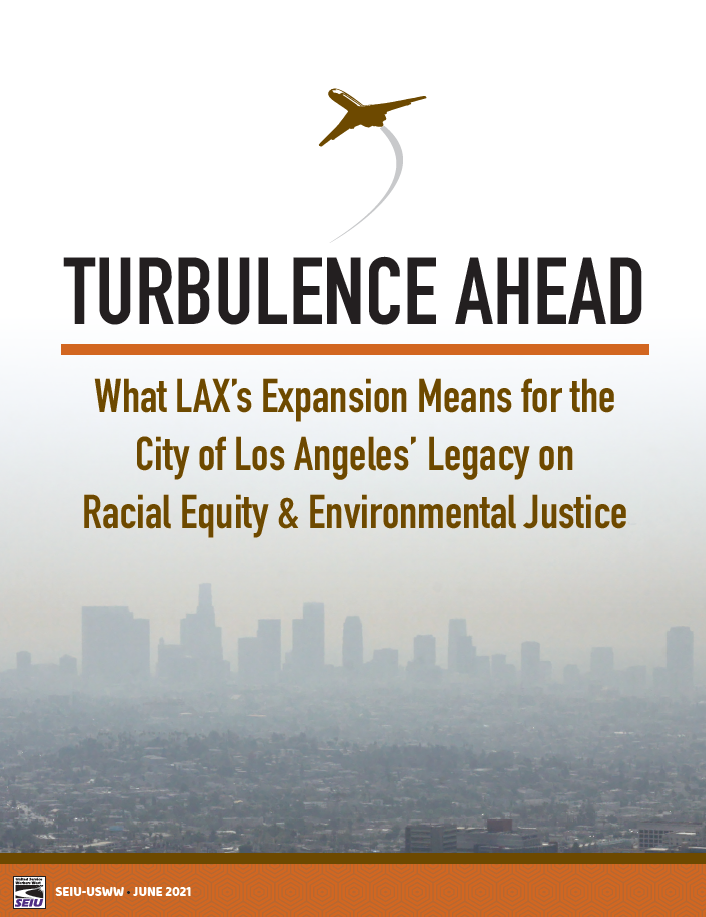
Turbulence Ahead: What LAX’s Expansion Means for the City of Los Angeles’ Legacy on Racial Equity and Environmental Justice

By staff, editor, et. al - SEIU United Service Workers West, June 2021

Right now, Los Angeles International Airport (LAX) is charging ahead on an expansion project of a scale not seen for decades. Los Angeles World Airports (LAWA), the organization that owns and operates LAX, quietly released a draft Environmental Impact Report late last year that reveals a project with a host of alarming implications for communities near the airport. If the City of Los Angeles and its elected officials are serious about leadership on environmental justice and equity, resolving the issues presented by this project will be critically important.

As it stands, the proposed development is poised to worsen traffic in an area already infamous for it, expose thousands of new residents to the noise of one of the busiest airports in the world, and intensify the air quality impact of a facility that is already a statewide leader in air pollution. Worse still, these outcomes are set to be concentrated within Black and Brown communities near LAX that already grapple with a longstanding history of environmental racism—communities that have suffered disproportionately from the health and economic fallout of the COVID pandemic.

LAWA’s current approach signals that the airport is not only failing to adequately protect the community from the consequences of LAX’s largest expansion in decades, but is, in effect, concealing the real, long-term effects of that expansion as it rushes toward approval as early as this year. The City of Los Angeles, LAWA, and the airlines that will occupy the new terminals have an obligation to do better and ensure that this project is carried out equitably, that it will not become another sad chapter in the story of environmental injustice in South Los Angeles and the continued exploitation of essential workers as the city emerges from the pandemic.

In this report, we take a deeper look at the proposed development and what the draft Environmental Impact Report does and doesn’t reveal about the consequences of LAWA’s plans for the airport. We will contextualize this project and what it means for workers, families and communities—particularly communities of color—as well as the direction of the City of Los Angeles as a whole. Finally, we will lay down a foundation for how the airport can approach this project as a real, positive opportunity for the region, and not a cautionary tale of corporate greed and bureaucratic complicity in the making. In the coming years, the City of Los Angeles will prepare to host major events—the Super Bowl, the 2028 Summer Olympics, the World Cup—and enjoy global attention. It is critical that the city and its leaders take every opportunity to be a leading model for an equitable and just economy. With the whole world watching, showing how LAX’s development can be done without harm to communities of color will be an excellent place to start.

Read the text (PDF).

Once again on sabotage and climate change

By Lars Henriksson - Climate and Capitalism, May 22, 2021

What should we do when airy political promises amount to little more than excuses for business as usual, and when the friendly climate protests have not prevented the world from heading towards a burning inferno? Submissively accept doom or take the climate struggle to a new level?

That Andreas Malm does not preach resignation will come as no surprise to those who know the author — activist and socialist since childhood and today well-known in the radical section of international academia. For those unfamiliar with him, the book’s title should dispel all doubt.

To stoically wait for doom is not an option for most of us, even if some claim to have drawn that conclusion. The book’s final section is a reckoning with intellectuals such as Roy Scranton and Jonathan Franzen who flirt with that standpoint.

For the rest of us, who either try to do something, or wish we knew how to do something, the question is: what do we do now? It is this question to which Malm devotes most of his book.

The attention given to the book ahead of publication has mostly concerned the question of sabotage as a method in the climate struggle. Despite the book’s provocative title, this is far from an anarchist cookbook but a thought-through — albeit impatient — contribution to the debate about strategy and tactics in the climate movement.

Malm raises a question posed by the British author John Lanchester: Why has the climate movement not resorted to violence? Given what is at stake is humanity’s survival, it is strange that nobody has started blowing up petrol stations or at least started scratching the paint on city jeeps, Lanchester states, in what Malm refers to as Lanchester’s paradox.

In the latter case, the effort is very small and would make these gas guzzling monster cars almost impossible to own in a city like London. Malm himself has a past as an SUV-saboteur of the milder kind, when the group The Indians of the Concrete Jungle in the early 2000s let the air out of gas guzzling luxury cars’ tyres in upper class neighborhoods. He takes this paradox — that the climate movement, despite knowing what is at stake, continues to be peaceful and well behaved — as the starting point for his argument.

The National Black Climate Summit

Can sabotage stop climate change?

By Simon Butler - Climate and Capitalism, April 28, 2021

Despite the climate movement’s growth, epitomized by Extinction Rebellion and Student Strike for Climate, fossil fuel extraction continues to grow, and a safe climate can seem dismayingly distant. Given a choice between forgoing capital accumulation and tipping the whole world into a furnace, our rulers prefer the furnace.

In How to Blow Up a Pipeline, Andreas Malm asks how the climate movement can emerge from the Covid-19 hiatus as a stronger force. In particular, he questions whether the movement’s until now near-universal commitment to non-violent protest is holding it back. “Will absolute non-violence be the only way, forever the sole admissible tactic in the struggle to abolish fossil fuels? Can we be sure that it will suffice against this enemy? Must we tie ourselves to its mast to reach a safer place?”

To make his point, Malm cites examples of popular historic movements, some of which are invoked by today’s climate campaigners as examples of non-violent change. The overthrow of Atlantic slavery involved violent slave uprisings and rebellions. The suffragettes of early 20th century Britain regularly engaged in property destruction. The US civil rights movement was punctuated by urban riots. As part of the struggle against apartheid in South Africa Nelson Mandela co-founded the armed wing of the African National Congress. The Indian National Congress is known for its non-violent tactics but violence also played a role of the resistance to British rule from the Great Rebellion of 1857 until independence.

Malm absolutely rules out violence that harms people, but he wants the climate movement to include sabotage and property destruction in its plans.

He puts forward several reasons why these kinds of protests might help “break the spell” of the status quo. Targeting the luxury consumption of the rich in this way could help to stigmatize the notion that the rich can blithely condemn the rest of us to ecological disaster. Physical attacks on new CO2 emitting devices might reduce their use and make them less popular options for new investment. He also speculates that such actions could help bring together a “radical flank” of the movement, helping to win partial reforms by making elites more keen to compromise with the movement moderates.

Malm believes such tactics could make for some powerful political symbolism: “Next time the wildfires burn through the forests of Europe, take out a digger. Next time a Caribbean island is battered beyond recognition, burst in upon a banquet of luxury emissions or a Shell board meeting. The weather is already political, but it is political from one side only, blowing off the steam built up by the enemy, who is not made to feel the heat or take the blame.”

Malm’s arguments have been met with alarm in some quarters. In a review posted on the Global Ecosocialist Network website Alan Thornett says adopting the book’s proposals would “not only be wrong but disastrous” and anyone who did so would soon have “armed police kicking down their door.” He calls Malm’s argument an impatient “bid for a shortcut” resulting from “frustration compounded by the lack of a socially just exit strategy from fossil energy.”

James Wilt’s review in Canadian Dimension is even harsher: he says How to Blow Up a Pipeline “veers awfully close to entrapment” — a totally unworthy accusation. More to the point, Wilt says Malm doesn’t look deeply at the likely outcomes of his proposals, failing to mention any “planning for the inevitable backlash” and repression activists would face.

But, as Bue Rübner Hansen points out in a Viewpoint Magazine article, Malm’s “provocative title makes a pitch for viral controversy, but its contents are more nuanced and equivocal.”

When Does the Fightback Begin?

By Andreas Malm - Verso Books, April 23, 2021

Andreas Malm response to critics of How to Blow Up a Pipeline and asks when, and how, will the militant resistance movement emerge.

When writing interventions on contemporary events, one’s best hope is that comrades of all stripes will engage with them closely and critically. I have recently written two –Corona, Climate, Chronic Emergency: War Communism in the Twenty-First Century and How to Blow Up a Pipeline: Learning to Fight in a World on Fire– and in return received an abundance of such gifts. Some have, naturally, raised serious objections to my arguments. Some of these concern vital strategic questions for the climate movement and the broader left. I therefore feel a duty to respond and elaborate on certain points, and I shall here begin with How to Blow Up a Pipeline. But, first, I should like to point out that the most productive discussions I have had about this book have not made it into text. They have come in talks with comrades in and around the climate movement, very much including, I should like to stress, given that I am rather critical of this organisation in How to Blow, people from Extinction Rebellion, who have struck me as highly astute and lucid in their views of the dilemmas of the struggle. Here I shall focus on critique presented in written form, after having restated and updated some of the basic propositions in How to Blow Up a Pipeline.

Pages

The Fine Print I:

Disclaimer: The views expressed on this site are not the official position of the IWW (or even the IWW’s EUC) unless otherwise indicated and do not necessarily represent the views of anyone but the author’s, nor should it be assumed that any of these authors automatically support the IWW or endorse any of its positions.

Further: the inclusion of a link on our site (other than the link to the main IWW site) does not imply endorsement by or an alliance with the IWW. These sites have been chosen by our members due to their perceived relevance to the IWW EUC and are included here for informational purposes only. If you have any suggestions or comments on any of the links included (or not included) above, please contact us.

The Fine Print II:

Fair Use Notice: The material on this site is provided for educational and informational purposes. It may contain copyrighted material the use of which has not always been specifically authorized by the copyright owner. It is being made available in an effort to advance the understanding of scientific, environmental, economic, social justice and human rights issues etc.

It is believed that this constitutes a 'fair use' of any such copyrighted material as provided for in section 107 of the US Copyright Law. In accordance with Title 17 U.S.C. Section 107, the material on this site is distributed without profit to those who have an interest in using the included information for research and educational purposes. If you wish to use copyrighted material from this site for purposes of your own that go beyond 'fair use', you must obtain permission from the copyright owner. The information on this site does not constitute legal or technical advice.
