You are here

agricultural workers and peasants
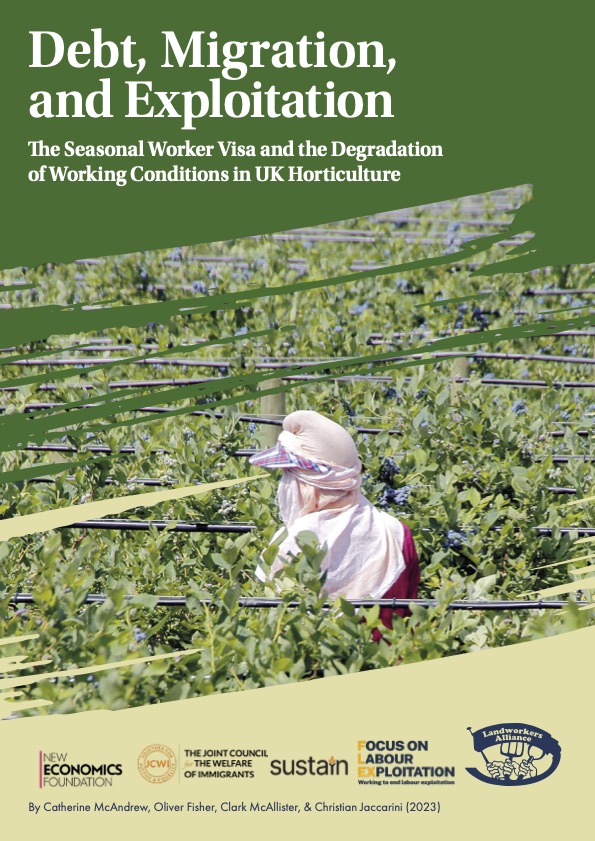
Debt, Migration, and Exploitation: The Seasonal Worker Visa and the Degradation of Working Conditions in UK Horticulture

By Catherine McAndrew, Oliver Fisher, Clark McAllister, and Christian Jaccarini - Landworkers Alliance, et. al., July 10, 2023

The report ‘Debt, Migration and Exploitation: The Seasonal Worker Visa and the Degradation of Working Conditions in UK Horticulture’ has been written in collaboration with the Joint Council for the Welfare of Immigrants, New Economics Foundation, Focus on Labour Exploitation, Sustain and a farmer solidarity network of former migrant seasonal workers.

Seasonal work plays a significant role in UK agriculture. The government estimates that between 50,000 and 60,000 seasonal workers are needed annually to bring in the wider harvest across the UK, and these workers are almost entirely recruited from outside the UK.

Many of these workers are recruited via the new Seasonal Worker Visa scheme, a temporary migration programme introduced in 2019 to alleviate post-Brexit labour shortages, but a series of recent media exposés have revealed that visa holders are facing mounting issues including low wages, wage theft, excessive hours, debt bondage, and abuse by supervisors.

Our new report adds to this mounting body of evidence, and lays bare the legal and economic structures that facilitate the exploitation of farmworkers by the industrial food system, giving a platform for farmworkers to share their own account of life on the UK’s farms and develop solutions to the abuses they have faced.

The report also includes a supply chain analysis carried out by the New Economics Foundation, which reveals that migrant seasonal workers picking soft fruit retain on average just 7.6% of the total retail price of the produce.

Furthermore, the report outlines how workers who have to pay illegal broker fees (money paid by migrant workers to recruitment agencies in their home countries) can result in negative earnings. This means that after accommodation, subsistence and travel costs, some workers are essentially left out of pocket and end up paying more to come to the UK and work, than they keep as retained income to take home.

Another chapter in the report features an extended testimony from a former migrant seasonal worker from Nepal, in which they describe the exploitation of recruitment agencies, the debt associated with taking out loans to pay for agency fees and the need for the UK Government to design a more safe and secure seasonal visa scheme.

In response to issues raised in previous chapters relating to the supply chain, workers’ rights violations, and lack of redress, the final section of the report explores alternative approaches to labour rights, based on worker-led social responsibility (WSR), using the experience of the Coalition of Immokalee Workers (CIW) and Fair Food Program (FFP) in Florida as a case study.

Download a copy of this publication here (PDF).

UNDROP Alive and Kicking: Zainal Arafin Fuad - SPI - Indonesia

UNDROP Alive and Kicking: Ramona Dominiciou - Ecoruralis - Romania

UNDROP Alive and Kicking: Jessie MacInnis – NFU – Canada

UNDROP Alive and Kicking: David Otieno - Kenyan Peasants League - Kenya

UNDROP Alive and Kicking: Pramesh Pokharel - All Nepal Peasant's Federation - Nepal

UNDROP Alive and Kicking: Alberto Silva - Uniterre – Switzerland

Hugo Blanco: A man who loved humanity and Mother Earth

By staff - La Via Campesina, June 30, 2023

Latin America sows a great soul, who defended the rights of the peasantry, indigenous peoples and Mother Earth, founded the National Agrarian Confederation (CNA) and made the long-awaited Agrarian Reform in Peru a reality.

(Bagnonet, June 26, 2023) La Vía Campesina recognizes the enormous political, social and humanist legacy of our comrade Hugo Blanco, a Peruvian and internationalist, who died yesterday in Sweden. His militancy and commitment marked the organization of peasant farmers for agrarian reform in the 20th century, not only in Peru, but also throughout Latin America.

Hugo participated in the fight for the first agrarian reform in Peru, organizing peasants and indigenous people in the early 1960s in the semi-tropical zone of the department of Cusco, more specifically in the province called La Convención and in the district of Lares to the south of the country, where coffee, tea and cocoa are grown. He denounced the exploitation and slave labor experienced by the peasantry, who were forced to work free in days of up to more than 12 hours a day, including women and children.

He was sentenced by the Peruvian justice to the death penalty, which he managed to avoid due to a strong international campaign of solidarity, but he spent nearly 7 years in prison and had to live several years in exile as well. “When I entered the room to be judged, and saw my comrades after three years in prison, I yelled: Earth or Death! That was our slogan. They responded: We will win!” He commented in an interview conducted in 2018, and added, “some said that it was Hugo Blanco’s agrarian reform, but it was not Hugo Blanco’s agrarian reform, because when it happened I was already in prison, it was the peasantry in struggle as a whole that conquered the land.”

Throughout his militancy, Hugo understood that the struggle and the need for the organization was even broader, not only against the latifundio, but against neoliberalism, capitalism and transnationals. So he became a tireless defender and staunch critic of extractivism and the depredation of Mother Earth. He accompanied marches, walks, crossed and toured the entire country defending the rights and dignity of the peoples of the countryside and cities.

“In the past, the struggle was to have land, work and farm. Now that neoliberalism acts and fiercely attacks nature, our fight has changed to the defense of mother earth, of pacha mama, that is the fundamental fight of now. Before I fought to socialize the land, today I have to fight for the maintenance of the human species” he commented.

For La Vía Campesina, Hugo Blanco is today a native seed, with an enormous potential for life, which inspired and will continue to inspire many generations in Peru and in the world. His legacy and commitment will endure in the struggle, in the organization and in the collective memory, because ideas do not die, like seeds multiply, grow and bear fruit.

“There are men that fight one day and are good. There are others that fight for a year and are better. Some fight for many years and are very good. But there are those who fight all their lives: those are the essentials» Bertolt Brecht

La Via Campesina and ECVC express their dismay at the authoritarian drift in France

By staff - La Via Campesina, June 28, 2023

Bagnolet | 28 June 2023: Instead of finding real answers to the environmental, social and democratic crises, the French government is choosing to imprison activists and ban movements critical of the extractivist agro-industrial model.

On 21 June, the French government announced the dissolution of the movement Les Soulèvements de la Terre, which campaigns against land and water grabbing and the destruction of ecosystems. That same week, dozens of activists were arrested by the anti-terrorist police, on the pretext that they had taken part in demonstrations against mega-basins, extractivist industries or agro-industry and its pollution. On June 28th, two peasant trade unionists from the Confédération Paysanne, Nicolas Girod and Benoît Jaunet, along with Julien LeGuet, spokesperson for the collective Bassines non merci, were arrested by the police for their involvement in organizing these collective gatherings as representatives of their respective organizations. They were released later in the day but received court summonses for the month of September. Such acts of repression against legitimate protests are unacceptable and unjust, creating a negative precedent and seeking to intimidate all defenders of fundamental rights. In this context it seems that the FNSEA, a French farmers’ union, has also been calling for the dissolution of La Confédération Paysanne.

We, La Via Campesina and European Coordination Via Campesina, stand together with our member organisation in France, La Confédération Paysanne. We firmly reject these threats and will act decisively in Europe and around the world to ensure that La Confédération Paysanne and its members can continue to defend peasant agriculture and its workers.

We express our support for Les Soulèvements de la Terre (the Uprisings of the Earth ). These tens of thousands of young people mobilising to ensure land and water are shared fairly, which is an expression of the acute sense of responsibility that young people have in the face of social inequalities and the destruction of ecosystems.

We call on the French Government to cease its violations of human rights, and in particular of the rights recognised in the United Nations Declaration on the Rights of Peasants and Other Rural Workers (UNDROP), such as freedom of thought, opinion and expression, freedom of association and the right to participation.

We call on our member organisations and allied organisations to mobilise in support of the
Confédération Paysanne and social movements in France, in particular by sending letters to French embassies and the French government and by organising rallies in front of French embassies.

France: Confederation Paysanne and CETIM echo UN Expert group’s concern about criminalization of social movements by the French State.

By staff - La Via Campesina, June 17, 2023

UN EXPERTS’ COMMUNIQUE: Will the rights of trade unions and social and environmental movements be respected by the French government?

On 15 June 2023, seven independent experts from the United Nations expressed their concerni at allegations of excessive use of force during the recent demonstrations against pension reform and mega-water basin projects in France.

“Lack of restraint in the use of force against members of civil society who are peacefully demanding their participation in decision-making processes concerning their future, access to natural resources, protection of human rights, dignity and equality, would not only be anti-democratic, but deeply worrying for the rule of law”, the experts said.

The Confédération Paysanne and CETIM welcome this position and call on the French government to heed these warnings. The concerns expressed are in line with those we voiced in our submission to the UN experts on the occasion of the International Day of Peasant Struggles (17 April). Indeed, mega-basin projects are being carried out at the expense of the right to water of all peasants in the territories because they reinforce the problem of drought and the increasing scarcity of access to water. Peasant organizations and other sectors of civil society have mobilized to question these projects and demand respect for human and environmental rights, suffering unprecedented repression.

This communique from the UN experts has a very particular resonance, given that mobilizations are continuing around water and land issues in many areas, and at a time when the criminalization and repression of these mobilizations and of trade unions and social and environmental movements are still the order of the day.

Human rights issues, and more specifically the rights to water, food, freedom of expression and demonstration, cannot be scorned and repressed in this way. We cannot accept the threats to dissolve the Soulèvements de la Terre movement. In view of the above, we urge the French authorities to honour their international human rights commitments, as recalled by the UN experts.

The Confédération Paysanne is continuing its trade union action to obtain a moratorium on mega-basin projects and for the establishment of a dialogue on the management and sharing of water in France, a sine qua non for the respect of human rights.

Pages

The Fine Print I:

Disclaimer: The views expressed on this site are not the official position of the IWW (or even the IWW’s EUC) unless otherwise indicated and do not necessarily represent the views of anyone but the author’s, nor should it be assumed that any of these authors automatically support the IWW or endorse any of its positions.

Further: the inclusion of a link on our site (other than the link to the main IWW site) does not imply endorsement by or an alliance with the IWW. These sites have been chosen by our members due to their perceived relevance to the IWW EUC and are included here for informational purposes only. If you have any suggestions or comments on any of the links included (or not included) above, please contact us.

The Fine Print II:

Fair Use Notice: The material on this site is provided for educational and informational purposes. It may contain copyrighted material the use of which has not always been specifically authorized by the copyright owner. It is being made available in an effort to advance the understanding of scientific, environmental, economic, social justice and human rights issues etc.

It is believed that this constitutes a 'fair use' of any such copyrighted material as provided for in section 107 of the US Copyright Law. In accordance with Title 17 U.S.C. Section 107, the material on this site is distributed without profit to those who have an interest in using the included information for research and educational purposes. If you wish to use copyrighted material from this site for purposes of your own that go beyond 'fair use', you must obtain permission from the copyright owner. The information on this site does not constitute legal or technical advice.