You are here

clean tech

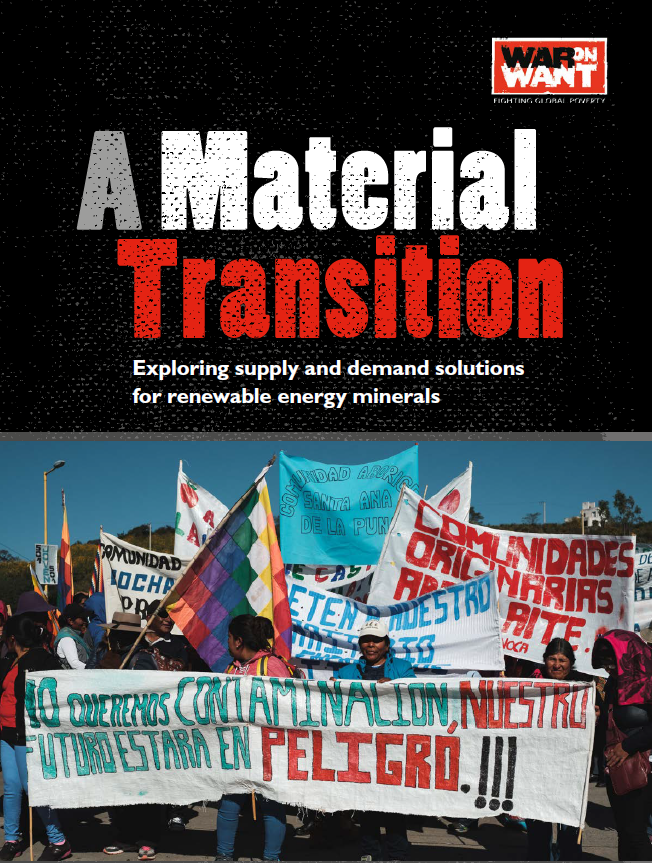
A Material Transition: Exploring supply and demand solutions for renewable energy minerals

By Andy Whitmore - War on Want, March 2021

There is an urgent need to deal with the potential widespread destruction and human rights abuses that could be unleashed by the extraction of transition minerals: the materials needed at high volumes for the production of renewable energy technologies. Although it is crucial to tackle the climate crisis, and rapidly transition away from fossil fuels, this transition cannot be achieved by expanding our reliance on other materials. The voices arguing for ‘digging our way out of the climate crisis’, particularly those that make up the global mining industry, are powerful but self-serving and must be rejected. We need carefully planned, lowcarbon and non-resource-intensive solutions for people and planet.

Academics, communities and organisations have labelled this new mining frontier, ‘green extractivism’: the idea that human rights and ecosystems can be sacrificed to mining in the name of “solving” climate change, while at the same time mining companies profit from an unjust, arbitrary and volatile transition. There are multiple environmental, social, governance and human rights concerns associated with this expansion, and threats to communities on the frontlines of conflicts arising from mining for transition minerals are set to increase in the future. However, these threats are happening now. From the deserts of Argentina to the forests of West Papua, impacted communities are resisting the rise of ‘green extractivism’ everywhere it is occurring. They embody the many ways we need to transform our energy-intense societies to ones based on democratic and fair access to the essential elements for a dignified life. We must act in solidarity with impacted communities across the globe.

This report includes in-depth studies written by frontline organisations in Indonesia and Philippines directly resisting nickel mining in both countries respectively. These exclusive case studies highlight the threats, potential impacts and worrying trends associated with nickel mining and illustrate, in detail, the landscape for mining expansion in the region.

Read the text (PDF).

Canada’s net zero future should include policies to support technology “wild cards”: report

By Elizabeth Perry - Work and Climate Change Report, February 10, 2021

Canada’s Net Zero Future: Finding our way in the global transition is a policy document released on February 8  by the Canadian Institute for Climate Choices, the national research network created by Environment and Climate Change Canada in 2020. The report provides a simple definition of net zero: “shifting toward technologies and energy systems that do not produce emissions, and offsetting any remaining emissions by removing GHGs from the atmosphere and storing them permanently.” Based on technical analysis by Navius Research which examined more than 60 modelling scenarios, the report is announced as “the first in-depth scenario report to explore how Canada can reach net zero emissions by 2050”. It concludes that the goal is doable, using two pathways: “safe bets” and “wild cards”.

Most impact will be made by “Safe bets—commercially available, cost-effective, existing technologies like electric vehicles, heat pumps, and smart grids” which they estimate can generate at least two-thirds of the emission reductions required. In the longer-term, to reach the 2050 target, the authors rely on results from unproven “wild cards”— “high-risk, high reward technologies like advanced biofuels, zero-emissions hydrogen, and some types of engineered negative emission technologies that are not yet commercially available”.   The conclusion: “To scale up safe bets, governments should continue to steadily increase the stringency of policies such as carbon pricing and flexible regulations. To advance wild cards, governments should spread their bets—supporting a portfolio of emerging technologies, without delaying progress on existing smart bet solutions over the next crucial decade.”

Of the four formal Recommendations, #4 is “Governments should work to ensure that the transition to net zero is fair and inclusive”.  ….. “It is vital that governments understand the full range of implications the transition will have on all of Canada’s regions, sectors, workers, communities, and income groups. This is necessary to ensure that policies successfully address adverse impacts and work to lift up groups who have historically been left behind, instead of exacerbating those inequalities. This will require direct engagement with all of those groups.”

The lead author of the report is Jason Dion, Mitigation Research Director at the Canadian Institute for Climate Choices, but the report is a “consensus document” involving many advisors who compose its Mitigation Expert Panel Working Group, as well as expert external reviewers.  Two accompanying blogs condense the message in “What puts the “net” in net zero?” (regarding three means of negative emissions) and “Net zero is compatible with economic growth if we do it right” (emphasizing the importance of likelihood of GDP growth through the recommended policies.) 

How “clean” are clean energy and electric vehicles?

By Elizabeth Perry - Work and Climate Change Report, January 19, 2021

Several articles and reports published recently have re-visited the question: how “clean” is “clean energy”? Here is a selection, beginning in October 2020 with a multi-part series titled Recycling Clean Energy Technologies , from the Union of Concerned Scientists. It includes: “Wind Turbine blades don’t have to end up in landfill”; “Cracking the code on recycling energy storage batteries“; and “Solar Panel Recycling: Let’s Make It Happen” .

The glaring problem with Canada’s solar sector and how to fix it” (National Observer, Nov. 2020) states that “While solar is heralded as a clean, green source of renewable energy, this is only true if the panels are manufactured sustainably and can be recycled and kept out of landfills.” Yet right now, Canada has no capacity to recycle the 350 tonnes of solar pv waste produced in 2016 alone, let alone the 650,000 tonnes Canada is expected to produce by 2050. The author points the finger of responsibility at Canadian provinces and territories, which are responsible for waste management and extended producer responsibility (EPR) regulations. A description of solar recycling and waste management systems in Europe and the U.S. points to better practices.

No ‘green halo’ for renewables: First Solar, Veolia, others tackle wind and solar environmental impacts” appeared in Utility Drive (Dec. 14) as a “long read” discussion of progress to uphold environmental and health and safety standards in both the production and disposal of solar panels and wind turbine blades. The article points to examples of industry standards and third-party certification of consumer goods, such as The Green Electronics Council (GEC) and NSF International. The article also quotes experts such as University of California professor Dustin Mulvaney, author of Solar Power: Innovation, Sustainability, and Environmental Justice (2019) and numerous other articles which have tracked the environmental impact, and labour standards, of the solar energy industry.

Regarding the recycling of wind turbine blades: A press release on December 8 2020 describes a new agreement between GE Renewable Energy and Veolia, whereby Veolia will recycle blades removed from its U.S.-based onshore wind turbines by shredding them at a processing facility in Missouri, so that they can be used as a replacement for coal, sand and clay in cement manufacturing. A broader article appeared in Grist, “Today’s wind turbine blades could become tomorrow’s bridges” (Jan. 8 2021) which notes the GE- Veoli initiative and describes other emerging and creative ways to deal with blade waste, such as the Re-Wind project. Re-Wind is a partnership involving universities in the U.S., Ireland, and Northern Ireland who are engineering ways to repurpose the blades for electrical transmission towers, bridges, and more. The article also quotes a senior wind technology engineer at the National Renewable Energy Laboratory in the U.S. who is experimenting with production materials to find more recyclable materials from which to build wind turbine blades in the first place. He states: “Today, recyclability is something that is near the top of the list of concerns” for wind energy companies and blade manufacturers alike …. All of these companies are saying, ‘We need to change what we’re doing, number one because it’s the right thing to do, number two because regulations might be coming down the road. Number three, because we’re a green industry and we want to remain a green industry.’”

These are concerns also top of mind regarding the electric vehicle industry, where both production and recycling of batteries can be detrimental to the planet. The Battery Paradox: How the electric vehicle boom is draining communities and the planet is a December 2020 report by the Dutch Centre for Research on Multinational Corporations (SOMO). It reviews the social and environmental impacts of the whole battery value chain, (mining, production, and recycling) and the mining of key minerals used in Lithium-ion batteries (lithium, cobalt, nickel, graphite and manganese). The report concludes that standardization of battery cells, modules and packs would increase recycling rates and efficiency, but ultimately, “To relieve the pressure on the planet, …. any energy transition strategy should prioritize reducing demand for batteries and cars… Strategies proposed include ride-sharing, car-sharing and smaller vehicles.”

Wind Turbine Blades Don’t Have To End Up In Landfills

By James Gignac - Union of Concerned Scientists, October 30, 2020

This is one of four blogs in a series examining current challenges and opportunities for recycling of clean energy technologies. Please see the introductory post, as well as other entries on solar panels and energy storage batteries. Special thanks to Jessica Garcia, UCS’s Summer 2020 Midwest Clean Energy Policy Fellow, for research support and co-authoring these posts.

Wind turbines have increased in size and quantity to meet clean energy capacity demands

Modern wind power converts the kinetic (movement) energy from wind into mechanical energy. This happens through the turning of large fiberglass blades, which then spin a generator to produce electricity. Wind turbines, as they are known, can be located onshore or offshore.

Wind power is projected to continue growing across the US by 2050. The latest Wind Technologies Market Report prepared by Lawrence Berkeley National Laboratory found that wind energy prices are at all-time lows, and for 2019, 7.3 percent of utility-scale electricity generation in the US came from wind. In this blog post, we will examine land-based wind turbines and the recycling opportunities that exist but are not yet widely implemented for the turbine blades.

Source: Berkeley Lab Electric Markets & Policy (https://emp.lbl.gov/wind-energy-growth)

Reinventing the Wheel - Kicking the Oil Habit

By x356039 - June 17, 2013

Disclaimer: The views expressed here are not the official position of the IWW (or even the IWW’s EUC) and do not necessarily represent the views of anyone but the author’s.

Oil. It is the eight hundred pound gorilla in the room at every discussion of climate, energy, and the economy. Our society is unquestionably addicted to it, with the United States consuming a whopping 19.1 million barrels of oil every day. When the total energy used is converted from barrels of oil to watt hours the figure is staggering. Running in at 31 terawatt hours per day, this massively dwarfs all energy consumed in the electric grid which runs in at a much smaller 4 terawatt hours daily. Much of this goes to running our transportation networks, providing fuel for trucks, ships, trains, and airplanes across the country before we even start looking at military consumption. With how incredibly ubiquitous oil is for our economy it is no surprise mainstream environmentalists talk of slowly phasing it out as opposed to going cold turkey on the black stuff, implying one more hit won't put us over the edge.

This is all based on the assumption that we do not have the means to go off of oil. Even renewable energy production is caught in its sticky web. Yet there is hope. The current potential for renewable energy is so great that if we implemented it on a sufficiently large scale even the massive demand for energy the oil economy supports could be met. As was established in a National Renewable Energy Laboratory study released in 2008 if 7% of all commercial and residential rooftops in the United States were fitted with photovoltaic solar panels our electric power demand of 4.05 terawatt hours per day would be completely satisfied. Now granted oil does provide for 33.8 terawatt hours of energy per day so how could solar meet that demand? If we increased the number of solar panels to cover 65% of all residential and commercial rooftops in the United States the massive thirst for oil would be quenched by clean, free sunlight.

Reinventing the Wheel - The REAL Green Jobs Story

By x356039 - May 2, 2013

Disclaimer: The views expressed here are not the official position of the IWW (or even the IWW’s EUC) and do not necessarily represent the views of anyone but the author’s.

In the accepted limits of debate in Washington and Wall Street the main argument by proponents of the fossil fuel industry is the same as its always been: do you want to protect the environment or create more jobs? They argue expanding fossil fuel exploitation, in spite of the proven risks to the environment and public health, is necessary for the sake of job creation. By building Keystone XL across the Great Plains, opening the Powder River Basin to coal interests, expanding offshore drilling, and opening up new lands to fracking the fossil fuel dinosaurs claim our economy will recover & energy independence will be achieved. When confronted with the facts on clean energy sources like wind and solar power fossil fuel proponents argue clean energy is too expensive. They claim it would not be cost-effective to build a green energy economy and that it would lead to a decline in standard of living.

Quite contrary to the boldest of claims made by those dinosaurs the facts show shifting to a clean energy economy would create more jobs, cost less money, and easily exceed all performance needs. Research by the Renewable & Appropriate Energy Laboratory at University of California, Berkeley shows the fossil fuel industry's claims of better job creation rates compared to green, clean energy are vastly overblown. As shown in this chart below renewable energy sources produce as many if not more jobs per megawatt of capacity as traditional dirty sources of electricity:

Pages

The Fine Print I:

Disclaimer: The views expressed on this site are not the official position of the IWW (or even the IWW’s EUC) unless otherwise indicated and do not necessarily represent the views of anyone but the author’s, nor should it be assumed that any of these authors automatically support the IWW or endorse any of its positions.

Further: the inclusion of a link on our site (other than the link to the main IWW site) does not imply endorsement by or an alliance with the IWW. These sites have been chosen by our members due to their perceived relevance to the IWW EUC and are included here for informational purposes only. If you have any suggestions or comments on any of the links included (or not included) above, please contact us.

The Fine Print II:

Fair Use Notice: The material on this site is provided for educational and informational purposes. It may contain copyrighted material the use of which has not always been specifically authorized by the copyright owner. It is being made available in an effort to advance the understanding of scientific, environmental, economic, social justice and human rights issues etc.

It is believed that this constitutes a 'fair use' of any such copyrighted material as provided for in section 107 of the US Copyright Law. In accordance with Title 17 U.S.C. Section 107, the material on this site is distributed without profit to those who have an interest in using the included information for research and educational purposes. If you wish to use copyrighted material from this site for purposes of your own that go beyond 'fair use', you must obtain permission from the copyright owner. The information on this site does not constitute legal or technical advice.