You are here

energy

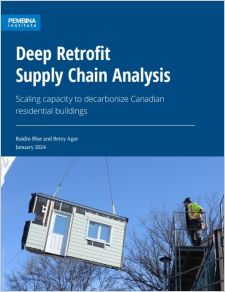
Deep Retrofit Supply Chain Analysis

By Raidin Blue and Betsy Agar - Pembina Institute, January 17, 2024

Canada’s buildings sector is the third-largest contributor to the country’s emissions at 87 Mt CO2e. That’s 13% of the total. Retrofitting existing buildings is the only climate action that can both drive down emissions and protect Canadians from weather events that are increasing in severity and frequency as our climate changes.

A deep retrofit goes beyond simple renovations, encompassing upgrades to various building systems and equipment, including the envelope, HVAC, lighting and building controls. Retrofits could also integrate renewable energy systems to enhance sustainability by reducing reliance on grid electricity, especially while Canada’s electricity grid continues to decarbonize, thus freeing up grid capacity to enable electrification of other sectors of the economy.

Work on retrofits needs to go deeper and scale up until 4% to 6% of Canada’s building stock is being decarbonized yearly if we are to meet our 2050 decarbonization goals. Investment in retrofitting is an investment in local economies and jobs, and an opportunity to grow the workforce by improving access to equity-deserving groups. The research in this report aims to support the supply chain needed to make these deep retrofits happen.

Recommendations

  • Recommendation 1: Provide market certainty by implementing regulations that require deep building decarbonization.
  • Recommendation 2: Drive demand by clarifying the benefits of deep retrofits, helping to build trust in industry, and helping reduce complexity.
  • Recommendation 3: Work with utilities and other levels of government to increase grants and incentives to help reduce the high cost of innovative, low-carbon technologies used in deep retrofits that is holding back market growth.
  • Recommendation 4: Foster a more inclusive industry culture and practice by raising awareness and removing barriers to access for equity-deserving groups, and by requiring the employment of equity-deserving groups.

Download a copy of this publication here (PDF).

Renewable Energy is (Mostly) Green and Not Inherently Capitalist, Volume 1: Wind Power (REVISED)

By That Green Union Guy - IWW Eco Union Caucus, Revised January 16, 2024

Is renewable energy actually green? Are wind, solar, and storage infrastructure projects a climate and/or envi­ronmental solution or are they just feel-good, greenwashing, false "solutions" that either perpetuate the deep­ening climate and environmental crisis or just represent further extractivism by the capitalist class and the privileged Global North at the expense of front-line communities and the Global South? 

This document argues that, while there is no guarantee that renewable energy projects will ultimately be truly "green", there is nothing inherent in the technology itself that precludes them from being so. Ultimately the "green"-ness of the project depends on the level of rank-and-file, democratic, front-line community and working-class grassroots power with the orga­nized leverage to counter the forces that would use renewable energy to perpetuate the capitalist, colonialist, extractivist system that created the cli­mate and environmental crisis in which we find ourselves.

In‌ order to do that, we mustn't fall prey to the misconceptions and inaccuracies that paint renewable energy infrastructure projects as inherently anti-green. This series attempts to do just that. This first Volume, on utility scale wind power addresses several arguments made against it, including (but not limited to) the following misconceptions:

  • Humanity must abandon electricity completely;
  • Degrowth is the only solution;
  • New wind developments only expand overall consumption;
  • Wind power is unreliable and intermittent;
  • Wind power is just another form of "green" capitalism;
  • The extraction of resources necessary to build wind power negates any of their alleged green benefits;
  • Wind power is an extinction-level event threat to birds, bats, whales, and other wildlife (and possibly humans);
  • Only locally distributed renewable energy arrayed in microgrids should be built without any--even a small percentage--of utility scale wind developments;
  • Only nationalized and/or state-owned utility scale renewable energy developments should be built;
  • No wind power developments will be green unless we first organize a socialist revolution, because eve­rything else represents misplaced faith in capitalist market forces.

In fact, none of the above arguments are automatically true (and the majority are almost completely untrue). However, they're often repeated, sometimes ignorantly, but not too infrequently in bad faith. This document is offered as an inoculation and antidote to these misconceptions and misinformation.

Download a copy of this publication here (PDF).

Assembly Bill 525 Offshore Wind Strategic Plan - Volume II: Main Report

By Melissa Jones, Jim Bartridge, and Lorelei Walker - California Energy Commission, January 2024

Assembly Bill 525 (AB 525, Chiu, Chapter 231, Statutes of 2021) directs the California Energy Commission (CEC) to complete and submit a strategic plan for offshore wind development in federal waters off the California coast to the Natural Resources Agency and the relevant fiscal and policy committees of the Legislature.

This strategic plan is the last of four work products the CEC is directed to prepare by AB 525. The strategic plan consists of three volumes: Volume I is an overview report, Volume II is the main report, and Volume III contains the technical appendices.

In preparing the strategic plan, the CEC coordinated with federal, state, and local agencies and a wide variety of stakeholders. As required by AB 525, this strategic plan identifies suitable sea space to accommodate the offshore wind planning goals, includes a discussion of economic and workforce development and port space and infrastructure, and assesses transmission investments, upgrades, and associated costs. In addition, this strategic plan discusses the permitting processes for offshore wind facilities and identifies potential impacts on coastal resources, fisheries, Native American and Indigenous peoples, national defense, and underserved communities. The plan also includes a discussion of strategies that could address those potential impacts such as avoidance, minimization, monitoring, mitigation, and adaptive management.

For more details, see: AB 525 Reports: Offshore Renewable Energy

Download a copy of this publication here (PDF).

Assembly Bill 525 Offshore Wind Strategic Plan - Volume I: Overview Report

By Melissa Jones, Jim Bartridge, and Lorelei Walker - California Energy Commission, January 2024

Assembly Bill 525 (AB 525, Chiu, Chapter 231, Statutes of 2021) directs the California Energy Commission (CEC) to complete and submit a strategic plan for offshore wind development in federal waters off the California coast to the Natural Resources Agency and the relevant fiscal and policy committees of the Legislature.

This strategic plan is the last of four work products the CEC is directed to prepare by AB 525. The strategic plan consists of three volumes: Volume I is an overview report, Volume II is the main report, and Volume III contains the technical appendices.

In preparing the strategic plan, the CEC coordinated with federal, state, and local agencies and a wide variety of stakeholders. As required by AB 525, this strategic plan identifies suitable sea space to accommodate the offshore wind planning goals, includes a discussion of economic and workforce development and port space and infrastructure, and assesses transmission investments, upgrades, and associated costs. In addition, this strategic plan discusses the permitting processes for offshore wind facilities and identifies potential impacts on coastal resources, fisheries, Native American and Indigenous peoples, national defense, and underserved communities. The plan also includes a discussion of strategies that could address those potential impacts such as avoidance, minimization, monitoring, mitigation, and adaptive management.

For more details, see: AB 525 Reports: Offshore Renewable Energy

Download a copy of this publication here (PDF).

Assembly Bill 525 Offshore Wind Strategic Plan - Volume III: Appendices

By Melissa Jones, Jim Bartridge, and Lorelei Walker - California Energy Commission, January 2024

Assembly Bill 525 (AB 525, Chiu, Chapter 231, Statutes of 2021) directs the California Energy Commission (CEC) to complete and submit a strategic plan for offshore wind development in federal waters off the California coast to the Natural Resources Agency and the relevant fiscal and policy committees of the Legislature.
This strategic plan is the last of four work products the CEC is directed to prepare by AB 525. The strategic plan consists of three volumes: Volume I is an overview report, Volume II is the main report, and Volume III contains the technical appendices.

In preparing the strategic plan, the CEC coordinated with federal, state, and local agencies and a wide variety of stakeholders. As required by AB 525, this strategic plan identifies suitable sea space to accommodate the offshore wind planning goals, includes a discussion of economic and workforce development and port space and infrastructure, and assesses transmission investments, upgrades, and associated costs. In addition, this strategic plan discusses the permitting processes for offshore wind facilities and identifies potential impacts on coastal resources, fisheries, Native American and Indigenous peoples, national defense, and underserved communities. The plan also includes a discussion of strategies that could address those potential impacts such as avoidance, minimization, monitoring, mitigation, and adaptive management.

For more details, see: AB 525 Reports: Offshore Renewable Energy

Download a copy of this publication here (PDF).

Labor unions are still giving Democrats climate headaches

By Alex Nieves - Politico, December 4, 2023

One of California’s most powerful unions is not loosening its grip on oil jobs.

Despite the Biden administration and California lawmakers pouring billions of dollars into new climate-friendly industries like electric vehicles, hydrogen and building electrification, a key player in state politics is still defending fossil fuel interests that provide thousands of well-paying jobs.

President Joe Biden’s investment in clean energy sectors through a pair of massive spending bills — which promise lucrative tax credits for projects that pay union wages — was supposed to speed up the labor transition away from oil and gas. That hasn’t happened in deep-blue California, home to the country’s most ambitious climate policies — and most influential labor unions.

“We believe we’re still going to be working in the oil and gas space for the foreseeable future,” said Chris Hannan, president of the State Building and Construction Trades Council of California, which represents nearly 500,000 members across dozens of local unions, from pipefitting to electrical work.

Unions’ longstanding — and well-founded — distrust of the renewable energy industry as a reliable source of labor-friendly jobs is slowing the “just transition” that Biden, Gov. Gavin Newsom and Democratic leaders around the country have pushed.

With federal officials trying to get clean energy funding out as fast as possible ahead of the 2024 election, and California politicians cracking down on the fossil fuel industry, unions’ reluctance to relinquish fossil fuel jobs undermines Democrats’ aggressive climate targets, according to a lawmaker who serves both a union- and oil-rich area of the state.

While the union embrace of fossil fuels is unique to California — one of the few blue states with significant oil production — the struggle highlights a larger question over how states can quickly build massive amounts of clean energy infrastructure without undercutting labor.

Life after coal exports: Worker solidarity and the transition

By Li Mei Brusey, Tim Lang, Grant Howard, Matthew Jeffrey, Maddy Yerbury, and Zane Alcorn - Green Left, November 24, 2023

Response measures to the energy crisis: policy targeting and climate trade-offs

By Béla Galgóczi - European Trade Union Institute, November 2023

Were national response measures to the energy crisis targeted, and were they social and climate friendly? 
These are the main questions addressed by this book, which examines whether and how short-term national responses to the cost of energy crisis applied social and ecological preferences. Europe has ‘survived’ two much-feared winters without energy shortages, power cuts and recession, showing a considerable level of resilience. Between September 2021 and August 2023, EU Member States allocated almost 700 billion euros to shield consumers and industry from rising energy costs. Were these resources properly targeted and is there a climate dividend? The national case studies included in this book reveal that the measures were mostly broad-based, including subsidies, tax cuts and price controls. The chapters also address questions on how such policies tackled the conflicting objectives and examine whether there are any good practices that can be identified in which short-term social protection can be aligned with longer term ecological objectives.

Download a copy of this publication here (link).

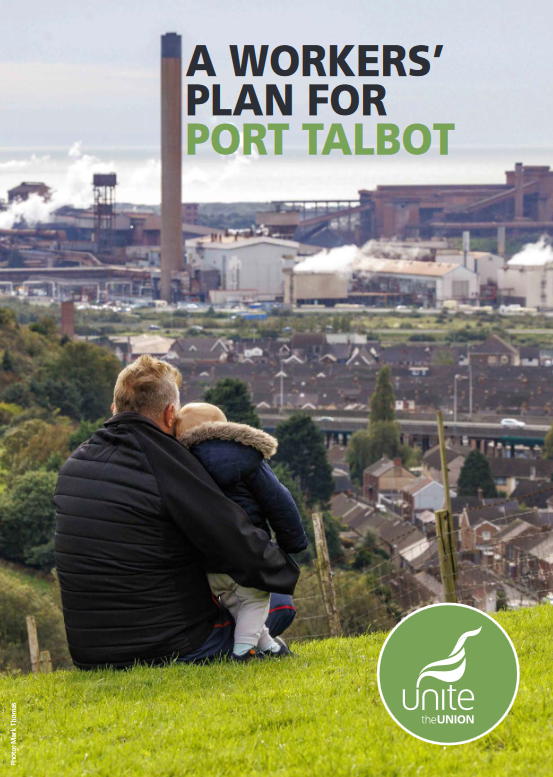
The Fight for Steel: A Workers’ Plan for Port Talbot

By staff - UNITE, November 2023

For further background, visit this site.

We are at the crossroads. There are two paths on offer, and it’s time to choose. On the one hand, there is a path of cuts: further decimating our steel industry and the town. On the other, a path of growth: an immediate gateway to rebuilding the industry.

The current plan from Tata is a hammer blow. It would severely shrink the plant: cutting production capacity by another 40%, with thousands of job losses. Another well-meaning proposal from the consultants Syndex also involves cutting capacity. It would also mean thousands of job losses: some immediately, and some in the longer term.

Why can’t we have another option? A path that would deliver profitability in the long term, and safeguard every job now. That’s the Unite plan. The cuts path wouldn’t just cost thousands of jobs on the site. It would also have massive knock-on effects on contractors, downstream sites, and the town and local economy of Port Talbot.

Our industry has suffered decades of decline. We don’t forget the impacts of the mine closures, or of the steel works at Ebbw Vale. We must not let Port Talbot be next. It is time to stop this vicious cycle.

Download a copy of this publication here (PDF).

“Enough is enough”: Demanding transparency, Texas labor coalition files open records requests for HyVelocity hydrogen application details

By Veronica Serrano - Texas Climate Jobs Project, October 13, 2023

Houston, Texas – Today Texas Climate Jobs Project, a nonprofit organization working with more than twenty labor organizations in Texas including the Texas AFL-CIO, announced it has filed public information requests with public bodies across Texas that are listed as partners on HyVelocity’s website

Today’s announcement to pursue more information about the HyVelocity hydrogen hub comes after the Department of Energy’s decision to select the HyVelocity application as one of its regional clean hydrogen hubs.

“Enough is enough,” said Bo Delp, executive director of Texas Climate Jobs Project. “HyVelocity, which is partnered with some of the largest and wealthiest corporations on Earth, is poised to receive $1.2 billion in hard earned taxpayer dollars and Texas families deserve to evaluate these projects in the light of day.”

“While we welcome the concept of a hydrogen hub in Texas, without concrete agreements in place with labor organizations this application could have profoundly negative impacts on working people in Texas.” 

Workers in Texas face growing racial and economic inequality and worsening safety standards, and HyVelocity has failed to provide meaningful answers for how it intends to mitigate these deeply concerning dynamics in the Texas economy. 

Texas Climate Jobs Project and its coalition of more than twenty Texas labor organizations are calling on HyVelocity to commit to binding community workforce agreements and labor peace agreements to address these concerns and ensure a just transition for fossil fuel workers.

Link: Website

Link: Digital thread on today’s announcement

Pages

The Fine Print I:

Disclaimer: The views expressed on this site are not the official position of the IWW (or even the IWW’s EUC) unless otherwise indicated and do not necessarily represent the views of anyone but the author’s, nor should it be assumed that any of these authors automatically support the IWW or endorse any of its positions.

Further: the inclusion of a link on our site (other than the link to the main IWW site) does not imply endorsement by or an alliance with the IWW. These sites have been chosen by our members due to their perceived relevance to the IWW EUC and are included here for informational purposes only. If you have any suggestions or comments on any of the links included (or not included) above, please contact us.

The Fine Print II:

Fair Use Notice: The material on this site is provided for educational and informational purposes. It may contain copyrighted material the use of which has not always been specifically authorized by the copyright owner. It is being made available in an effort to advance the understanding of scientific, environmental, economic, social justice and human rights issues etc.

It is believed that this constitutes a 'fair use' of any such copyrighted material as provided for in section 107 of the US Copyright Law. In accordance with Title 17 U.S.C. Section 107, the material on this site is distributed without profit to those who have an interest in using the included information for research and educational purposes. If you wish to use copyrighted material from this site for purposes of your own that go beyond 'fair use', you must obtain permission from the copyright owner. The information on this site does not constitute legal or technical advice.