You are here

public transit

Union leaders call for new investment to meet net-zero targets

By staff - Morning Star, April 12, 2023

UNION leaders are calling for new investment to meet net-zero targets, saying it would create high-quality jobs in transport and manufacturing.

The TUC has set out an investment plan for public transport across England and Wales, arguing it would improve quality of life and boost the economy.

The union organisation says its proposals fill a gaping hole in the government’s recently published net-zero strategy, which it claims fails to explain how it will achieve a shift away from car use.

The TUC says its plan would require an average of £9.9 billion in annual capital expenditure up to 2035.

Extra operating costs for expanded bus, tram and rail services would reach £18.8bn a year by 2030, its report, published today, says.

The plan is estimated to boost annual economic growth by £52.1bn by 2030 through productivity gains, creating 140,000 jobs in the bus, tram, and rail sectors.

A further 830,000 jobs would be created in manufacturing, construction, and infrastructure for buses and trams up to 2035, says the TUC.

TUC general secretary Paul Nowak said: “Everyone knows that we have to cut carbon emissions and that switching to public transport is a big part of how do it.

“Investing in public transport will help us meet net-zero targets and reduce the threat of catastrophic climate change, and it creates jobs throughout England and Wales, boosts the economy in every community and improves everyone’s quality of life.

“Commuters will have faster and cheaper journeys to work. New connections will bring new businesses to places where people need economic opportunities.

“We will save lives with cleaner air, and we will reduce loneliness and isolation by making everyone better connected, wherever you live.

“With this report, we’ve done the work that Conservative ministers should have done with their empty and incompetent net-zero strategy.”

RMT general secretary Mick Lynch, who will be speaking at the launch of the report today, said it shows that investing in public transport is vital for fighting climate change and delivering significant economic and social benefits.

He said: “This report shows that there is an alternative where we can expand and invest in our transport infrastructure.

“It is therefore vital that bus and rail services all run as a public service under a public ownership model which is free from profit-hungry multimillion-pound private companies.”

RMT welcomes public transport and climate report

By staff - National Union of Rail, Maritime and Transport Workers (RMT), April 12, 2023

RMT responds to TUC transport and climate change report.

Responding to the TUC Public Transport for the Climate Emergency report, RMT general secretary Mick Lynch said: "This is a welcome report that shows investing in public transport is not only vital for fighting climate change but that it will deliver significant economic and social benefits for everyone.

"The government - in league with private transport operators, are ideologically committed to securing the maximum profit for shareholders. This approach is leading to the managed decline of rail and bus services across the country.

"This report shows that there is an alternative where we can expand and invest in our transport infrastructure. This will create thousands of jobs in across every region of England and Wales, helping build strong local economies and at the same time, secure an environmentally sustainable future.

"It is therefore vital that bus and rail services all run as public service under a public ownership model which is free from profit hungry multimillion pound private companies."

The full report can be viewed here.

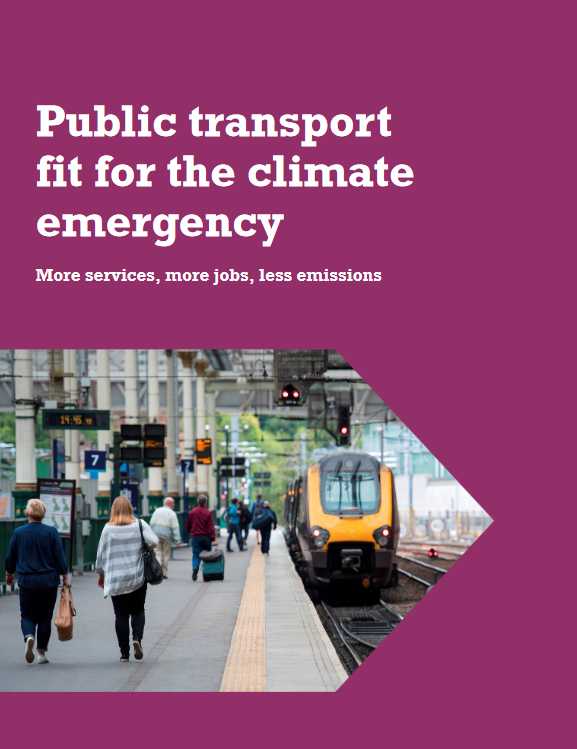
Public transport fit for the climate emergency: More services, more jobs, less emissions

By Liz Blackshaw; Gareth Forest; Kamaljeet Gill, et. al. - Trades Union Congress (TUC), April 11, 2023

Public transport has a vital role to play in decarbonising our economy and safeguarding a planet fit for our children and grandchildren to live in. Improving our public transport is not only about protecting our environment, it’s also about the quality of life in communities all over England and Wales.
Decent public transport is essential for access to work across the economy, it also means that grandparents get to see their grandkids, and working parents get home earlier to spend time with their children, we call get to share in culture and entertainment. It means that teenagers can get to school and adult learners can access training that can transform lives. It means people on low incomes can visit town centre shops, and businesses can get the customers they need to reinvigorate local economies.

For too long, people have had to put up with inadequate services. All too often, buses are expensive and infrequent, with routes that get cut because the private providers are driven more by private profit than by a public service ethos. Train services are expensive and chaotic, with services frequently delayed – when they’re not cancelled at short notice due to staffing levels cut to the bone and maintenance services outsourced and short-staffed. The transport workforce has suffered alongside passengers. Years of frozen pay and attacks on terms and conditions are a poor reward for those on the frontline during the pandemic.

Public transport fit for the climate emergency sets out a plan for the investment in public transport throughout England and Wales that has long been needed. From town and cities, to villages and rural communities, this plan would mean more services, new routes, cheaper fares and modern fleets of low emission vehicles. This radical transformation must be funded by central government and delivered by local and regional transport authorities. And we should all get a say on the transport needs where we live and how this investment is allocated.

Passengers, local communities, and transport workers should all be consulted on public transport improvement plans where they live and work.

The investment proposed by this report would achieve the transition to low-carbon transport needed to honour our climate action agreements with the rest of the world. It would generate green and sustainable economic growth in regions across England and Wales. And it would directly create hundreds of thousands of jobs in the transport sector, plus many more in construction and manufacturing supply chains. As well as cheaper, more extensive and reliable buses, trams and trains, we would have cleaner air to breath. And the roads would be less congested for all road users.

To make sure that every community benefits as fully as possible, with ongoing investment and the best value fares, our public transport should be publicly owned.

The climate emergency means we must act. But the benefits of affordable, reliable and extensive public transport are so great that we should want to anyway – for the lower cost of living and higher quality of life it will bring. This report lays out the blueprint for 21st century public transport, all that’s left is to build it.

Download a copy of this publication here (link).

Storytelling on the Road to Socialism: Episode 3: A Bicycle Repairman Speaks

By Candace Wolf - Storytelling on the Road to Socialism, April 4, 2023

On this episode, a bicycle repairman in Los Angeles talks about seeking alternatives to the fossil-fuel-powered transportation system

Music:

  • The Internationale - Workers Party of Jamaixca In-House Raggae Group
  • Bycicle Race - by Queen
  • Socialism is Better - Words & music by Bruce Wolf; performed by Bruce Wolf, Noah Wolf, Gaby Gagnoux-Wolfsohn

The Lithium Problem: An Interview with Thea Riofrancos

By Alyssa Battistoni and Thea Riofrancos - Dissent, Spring 2023

Can we rapidly reduce carbon emissions while minimizing the damage caused by resource extraction?

After years of outright climate denial and political intransigence, the development of renewable energy is finally underway. When it comes to transportation—the number one source of U.S. carbon emissions—the strategy for decarbonization has focused heavily on replacing gas-powered cars with rechargeable electric vehicles. The Inflation Reduction Act offers billions of dollars of subsidies for both producers and consumers of EVs, including a $7,500 tax credit for buying new EVs made in the United States. The infrastructure bill passed in late 2021 included $5 billion to help states build a network of EV recharging stations. New York and California have announced bans on the sale of vehicles with internal combustion engines beginning in 2035. Half of this year’s Superbowl car ads touted electric vehicles. By 2030, it is estimated that electric vehicles will make up half of U.S. car sales.

For our reliance on privatized transportation to remain the same, everything else will have to change. We’re already seeing concerns about shortages of “critical minerals” necessary for batteries and other renewable technologies. Based on current consumption patterns, for example, U.S. demand for the lithium used in batteries would require three times the existing global supply—which comes primarily from Australia, Latin America, and China—by 2050. In anticipation of booming demand, a flurry of new mining operations has begun around the world—and so have protests by those worried that mines will disturb ecosystems, contaminate water supplies, generate toxic waste, and disrupt local livelihoods.

What does the current trajectory of the “green energy transition” mean for global environmental justice? What other options are there? Is it possible to rapidly reduce carbon emissions while also minimizing extraction and maintaining—or even increasing—people’s ability to move freely and safely?

A new report from the think tank Climate and Community Project presents the data behind different visions of the green future. A scenario in which the United States reduces car dependency by improving public transit options, density, and walkability could see a 66 percent decrease in lithium demand compared to a business-as-usual model. Even just reducing the size of U.S. vehicles and batteries could potentially reduce lithium use by as much as 42 percent in 2050. In other words, the choices Americans make about domestic transportation, housing, and development matter worldwide. In this interview, the report’s lead author, political scientist Thea Riofrancos, explains the implications of its findings for climate and environmental politics in the United States and around the planet.

A Worker-Led Approach: Shaping the Future of Aviation

ULEZ and Just Transition Debate

By staff - Greener Jobs Alliance, March 8, 2023

This Blog contains a number of statements and briefings on the Ultra Low Emissions Zone extension.

  • Editor’s view (pers cap)
  • Health impacts of Polluted Air in Outer London – Imperial College
  • Mum’s for Lungs view
  • Trade Union Clean Air Network (TUCAN) statement
  • Friends of the Earth Briefing
  • The truth about Low Traffic Neighbourhoods – Possible

Making Positive Demands to clean up our air and cut car dependence

Anyone who watched the London Mayor’s Question Time from Ealing last week will not have missed the atmosphere of fear and loathing that make this issue almost as toxic as the air we breathe.

There are four overlapping imperatives when dealing with transport in cities.

That greenhouse gas emissions from transport are a quarter of the UK’s total and have not declined for ten years because, while car engines have become more efficient, more people are driving them, and the models they are driving are heavier. This has to be cut hard and fast to allow us to survive as a society.

People have to get around and, overall, cars are becoming more of a problem than a solution. If the 40% of people in London who don’t have cars did, no one would be able to get anywhere; because the streets would be gridlocked. The individual “aspiration” to own a car becomes socially dystopian if universally realised. For freer flowing, quieter, safer streets, we need fewer cars and fewer car journeys. We will have less of a need to travel inconvenient distances if we enrich our immediate neighbourhoods. 

We need cleaner air for our health and life expectancy. 90% of people want it. Some people drive. Everybody breathes. 

Some people are locked into car use, because they can’t afford to live near work and need concrete affordable alternatives as they are understandably anxious about how they are going to cope.

Learning From Rosa Parks on Transit Equity Day

By staff - People's Transit Alliance, February 6, 2023

This past Saturday, Feb. 4th, 2023, was Transit Equity Day, “a collaborative effort of several organizations and unions to promote public transit as a civil right and a strategy to combat climate change…” organized by Labor 4 Sustainability.

For Transit Equity Day 2023, the People’s Transit Alliance held a canvass of transit riders in Downtown Berkeley to discuss what improvements could be made to the bus system, the planned service redesign, and the importance of transit workers and riders building power together.

Labor 4 Sustainability chose Feb. 4th, Rosa Parks’ birthday, in order to honor her legacy as a civil rights icon, and her courageous action taken on a segregated bus on December 1, 1955. Those of us raised in the United States know the story of Rosa Parks, and her refusal to give up her seat to a white passenger.

What is less well known is her long history as an organizer for the NAACP, her radical politics, and her lifelong commitment to fighting white supremacy in the United States. 

The People’s Transit Alliance wishes to share this neglected side of Rosa Parks’ story. As we organize in her name, we must disrupt the whitewashed version of her life that is taught in schools, and used by politicians and corporations to maintain the very systems of oppression that she spent her life fighting against.

Railroad Nationalization Must Be Part of the Green New Deal

By Mayor Seidel - Sewer Socialists, February 5, 2023

In December, Congress and the Biden Administration forced a deal on railroad workers and stripped them of their right to strike. This made two things clear: how draconian the private freight railroads are to their workers, and yet how essential they are to the functioning of the country. Equally, private railroads are not only essential to the economy, but to the climate. Transportation is responsible for more greenhouse gas emissions than any other sector, including electricity generation. Within transportation, among the modes primarily used for freight (trucks, rail, and boats), railroads were responsible for only 7% of emissions despite carrying 27% of cargo (in ton-miles). Despite being a net reducer of emissions by taking trucks off the roads, the private railroads are avowed enemies of climate action. Afraid of losing their lucrative coal-hauling traffic, the same four railroads who Congress acted on behalf of have spent millions to lobby against climate action and deny climate change. Capitalists who bankroll climate deniers own the most important system of low-carbon infrastructure on the continent.

The effects of the existing freight railroads on climate change, both good and ill, are minuscule compared to the unrealized potential that they hold. The railroads would have a higher share of freight traffic if not for the shortsighted management of their private ownership. Additionally, 57% of transportation emissions come from “light duty vehicles,” i.e. passenger cars. The strongest opportunities to eliminate car trips are in urban centers, by building inviting pedestrian spaces, safe bicycle infrastructure and robust public transit networks. At the same time, to build a credible alternative to automobile travel, these green transportation systems must be connected to one another into metropolitan and intercity rail networks. This cannot be done without the infrastructure that, outside the Northeast, is controlled by the private freight railroads.

The private railroads are hostile to passenger service, which they see as a threat to their freight operations. Amtrak publishes a “report card” each year, ranking the private freight railroads by how much they delayed passenger trains. In 2021, at least 20% of riders were delayed on more than half of state-supported routes and 14 of 15 long-distance routes. The private railroads even hold back some commuter railroad services. Several Metra lines serving suburban Chicagoland are operated under “purchase-of-service” agreements with freight railroads, leaving commuters at the mercy of their private owners. Newer systems like Virginia’s VRE that use private freight corridors must negotiate complicated and expensive agreements with host railroads to expand service. Confronting climate change must include rationalizing the relationship between freight and passenger rail service, both of which are essential to reducing greenhouse gas emissions.

Discussions on the New Anti-Union Laws

By staff - Earth Strike UK, February 1, 2023

The labour movement is facing a grave threat in the form of a raft of new and incredibly restrictive anti-union laws. These laws will make all-out strike action in several industries outright illegal and are designed to immobilise our movement.

Current anti union laws limit legal strike action to disputes between a specific group of workers and their employer over workplace issues, ruling out strikes over “political issues” or in support of other workers. The law also imposes a slow and bureaucratic balloting process and sets strict ballot thresholds. The new laws will also require unions in some sectors to break their own strikes and continue providing a minimum service level, set by the government.

In response to this threat Earth Strike UK and Free Our Unions organised a demonstration outside the Department for Business, Energy and Industrial Strategy, the government department responsible for both environmental and trade union policy. There was drumming, chanting, banners, and we heard from workers from across numerous industries who explained how current anti-union laws affected them and the threat posed by these new ones. Following the demo, we held a small assembly to discuss in more detail the challenges posed by all anti-union legislation and begin to develop a strategy of resistance. During the meeting we discussed 3 questions. Here are some of the outcomes of that discussion.

Question 1. What are the most important ways in which existing anti-union laws hinder workers’ struggles and the Labour movement? How will the proposed new laws do so?

Pages

The Fine Print I:

Disclaimer: The views expressed on this site are not the official position of the IWW (or even the IWW’s EUC) unless otherwise indicated and do not necessarily represent the views of anyone but the author’s, nor should it be assumed that any of these authors automatically support the IWW or endorse any of its positions.

Further: the inclusion of a link on our site (other than the link to the main IWW site) does not imply endorsement by or an alliance with the IWW. These sites have been chosen by our members due to their perceived relevance to the IWW EUC and are included here for informational purposes only. If you have any suggestions or comments on any of the links included (or not included) above, please contact us.

The Fine Print II:

Fair Use Notice: The material on this site is provided for educational and informational purposes. It may contain copyrighted material the use of which has not always been specifically authorized by the copyright owner. It is being made available in an effort to advance the understanding of scientific, environmental, economic, social justice and human rights issues etc.

It is believed that this constitutes a 'fair use' of any such copyrighted material as provided for in section 107 of the US Copyright Law. In accordance with Title 17 U.S.C. Section 107, the material on this site is distributed without profit to those who have an interest in using the included information for research and educational purposes. If you wish to use copyrighted material from this site for purposes of your own that go beyond 'fair use', you must obtain permission from the copyright owner. The information on this site does not constitute legal or technical advice.