You are here

California

Redwood Uprising: Introduction

By Steve Ongerth

Download a free PDF version of this chapter.

The arc of history is long, but it bends towards justice.

—Martin Luther King Jr.

I know, I know. I need to write a book about all this. Fighting to save the redwoods, building alliances with the loggers, getting car bombed and finding out what we’re up against not just the timber industry but also the FBI. Then coming back home and ending up back on the front lines again. I fully intend to write about it eventually, but it’s hard to write about something when you’re still in the middle of it.”

—Judi Bari, introduction to Timber Wars, 1994

“All this,” is a very complex and intriguing story (not to mention a call to action), and while most people have never heard it, a great many are at least partially aware of its defining moment.

On the morning of May 24, 1990, two activists, Judi Bari and her friend and comrade Darryl Cherney, set out from Oakland, California, while on a tour to organize support for a campaign they had organized called Redwood Summer. They were part of the radical environmental movement known as Earth First!, which had a reputation for militant tactics, including the sabotaging of logging and earth moving machinery as well as spiking trees—the act of driving large nails into standing trees in order to deter logging operations. The previous year in Arizona, five environmentalists, including Peg Millett and Earth First! cofounder Dave Foreman, had been arrested and charged by the FBI for a conspiracy to sabotage power lines in protest against nuclear power. Some welcomed Earth First!’s uncompromising reputation. Others denounced them as reckless, or even as terrorists.

According to the mainstream media, Earth First!’s radical agenda earned them the animosity of the timber workers whose jobs the environmentalists supposedly threatened. They were described as “outside agitators” (among many other things) who had “polarized” the timber dependent communities of northwestern California’s redwood region—historically known as the “Redwood Empire”, but more recently as the “North Coast”—with their militant and uncompromising “environmental extremism.” Their alleged hard-line anti-logging stances were seen as too extreme even by most environmentalists, and they supposedly stood upon the radical fringes of the ecology movement. Redwood Summer was reportedly planned as a summer-long campaign of direct actions by these “fringe” environmentalists to thwart the harvesting of old growth redwood timber in northwestern California, specifically Humboldt, Mendocino, and Sonoma Counties.

On May 24, however, Bari’s and Cherney’s planned destination was Santa Cruz County, where—just one month previously—power lines had supposedly been sabotaged by unknown perpetrators calling themselves the “Earth Night Action Group”. Just before 11:55 AM a bomb in Bari’s car exploded, nearly killing her and injuring Cherney. Within minutes the FBI and Oakland Police arrived on the scene and arrested both of them as they were being transported to Highland Hospital. The authorities called them dangerous terrorists and accused the pair of knowingly transporting the bomb for use in some undetermined act of environmental sabotage when it had accidentally detonated. The media spun the event as the arrest of two potentially violent environmental extremists.

This Lawsuit Could Bring Down Big Oil

Comments of Construction Trades Workforce Initiative on the California Energy Commission Equitable Building Decarbonization Program

By Beli Acharya, Andreas Cluver, Bill Whitney, and Danny Bernardini - Construction Trades Workforce Initiative (CTWI), January 12, 2023

Alameda, Contra Costa and Napa-Solano Building & Construction Trades Councils (BTC) and Construction Trades Workforce Initiative (CTWI) respectfully submits our comments in response to the California Energy Commission (CEC) Equitable Building Decarbonization Program Request for Information (RFI).

CTWI is the nonprofit partner of the East Bay Building Trades, working to ensure the long term sustainability of the construction industry by bridging the gap between union construction labor and key stakeholders. The three BTC’s together represent a coalition of over 30 affiliated unions representing workers in various construction trades throughout the East Bay. Together, CTWI and the three BTC’s act as the collective voice of construction trade labor.

We support equitable efforts toward decarbonization and climate sustainability, and we believe the California Energy Commission (CEC) initiative to develop and implement an Equitable Building Decarbonization Program is a great opportunity to advance these shared goals. We appreciate the opportunity to submit comments for consideration.

It is important that equity be considered for all stakeholders involved in the program. We believe that decarbonization work and climate sustainability can be achieved in a manner that allows for everyone to be better off and collectively prosper. There is a clear emphasis in the program on equity for low-to-moderate-income residents and ensuring that the program is accessible to these residents. There must also be a clear emphasis on equity for the low-to-moderate-income workers who will be performing the work and labor involved in the program. The jobs created and utilized by the program should be quality, high road jobs available to local and disadvantaged residents.

'Groundbreaking' Report Shows Promise of Greener Jobs for Former Fossil Fuel Workers

By Julia Conley - Common Dreams, January 3, 2023

New analysis shows how California "can achieve a just and equitable transition away from fossil fuels for oil and gas workers."

A new analysis out Tuesday shows how a just transition towards a green economy in California—one in which workers in the state's fossil fuel industry would be able to find new employment and receive assistance if they're displaced from their jobs—will be "both affordable and achievable," contrary to claims from oil and gas giants and anti-climate lawmakers.

The study published by the Gender Equity Policy Institute (GEPI) notes that a majority of workers in the oil and gas sectors will have numerous new job opportunities as California pushes to become carbon neutral by 2045 with a vow to construct a 100% clean electricity grid and massively reduce oil consumption and production.

"The state will need to modernize its electrical grid and build storage capacity to meet increased demand for electricity," reads the report. "Carbon management techniques, plugging orphan wells, and the development of new energy sources such as geothermal will all come into play, providing economic opportunities to workers and businesses alike."

GEPI analyzed the most recent public labor data, showing that the oil and gas industries in California employed approximately 59,200 people as of 2021 across jobs in production, sales, transportation, legal, and executive departments, among others.

The group examined potential job opportunities for fossil fuel workers "in all growing occupations, not solely in clean energy or green jobs," and found that about two-thirds of employees are likely to find promising opportunities outside of fossil fuel-related work.

"Our findings show that a sizable majority (56%) of current oil and gas workers are highly likely to find jobs in California in another industry in their current occupation, given demand in the broader California economy for workers with their existing skills," the report says.

California Case Studies

By staff - Labor Network for Sustainability, January 2023

LNS is working strategically in key states that are leading the national narrative on climate justice. This year, LNS and Jobs with Justice San Francisco launched California Labor for Climate Jobs, a coalition of labor unions calling for an equitable, worker- and union-led transition to a resilient economy with good jobs based on clean energy and expanded public and social services. The coalition won a $40M Displaced Oil and Gas Workers Fund in the California State Budget, and advocated for support for communities and public jobs that will be impacted as oil and gas phases out across the state.

LNS also participated as a member of the Los Angeles County and City Just Transition Task Force that released a Just Transition Strategy – a first-ever framework for supporting workers and communities impacted by oil drilling phase-out policies. Essential to making the transition just is the necessary support to transition workers’ skills into jobs of comparable, family sustaining compensation or retirement. The Just Transition Strategy was noted as core to LA City’s Green New Deal laws, and a test-case for Native Nations, environmental justice communities, and workers to begin to envision together an ecologically just and economically sustainable future.

Los Angeles Just Transition Strategy

The Road to Equity: Concerns and Analysis of RUC Pricing Mechanisms

Real Climate Solutions are No Mystery

Sunflower Alliance Webinar: California Climate Justice Plan

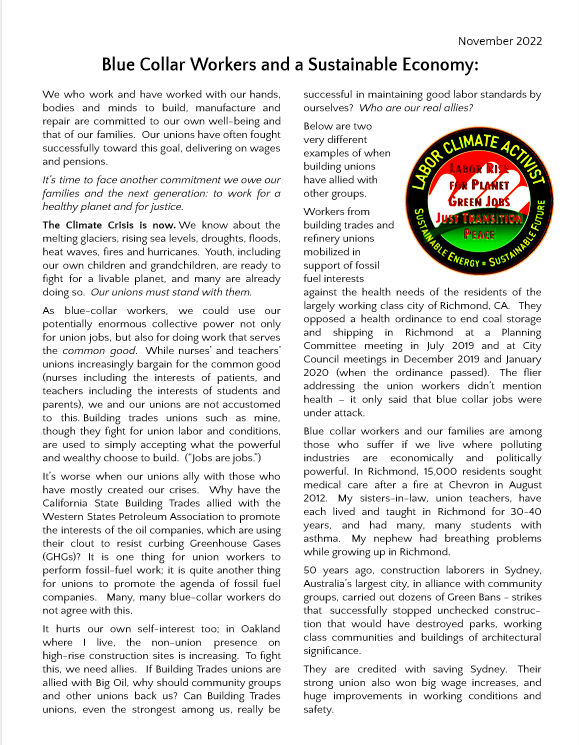
Blue Collar Workers and a Sustainable Economy

By Steve Morse - Labor Rise for Climate, Jobs, Justice, and Peace, November 2022

We who work and have worked with our hands, bodies and minds to build, manufacture and repair are committed to our own well-being and that of our families. Our unions have often fought successfully toward this goal, delivering on wages and pensions.

It’s time to face another commitment we owe our families and the next generation: to work for a healthy planet and for justice.

The Climate Crisis is now. We know about the melting glaciers, rising sea levels, droughts, floods, heat waves, fires and hurricanes. Youth, including our own children and grandchildren, are ready to fight for a livable planet, and many are already doing so. Our unions must stand with them.

Pages

The Fine Print I:

Disclaimer: The views expressed on this site are not the official position of the IWW (or even the IWW’s EUC) unless otherwise indicated and do not necessarily represent the views of anyone but the author’s, nor should it be assumed that any of these authors automatically support the IWW or endorse any of its positions.

Further: the inclusion of a link on our site (other than the link to the main IWW site) does not imply endorsement by or an alliance with the IWW. These sites have been chosen by our members due to their perceived relevance to the IWW EUC and are included here for informational purposes only. If you have any suggestions or comments on any of the links included (or not included) above, please contact us.

The Fine Print II:

Fair Use Notice: The material on this site is provided for educational and informational purposes. It may contain copyrighted material the use of which has not always been specifically authorized by the copyright owner. It is being made available in an effort to advance the understanding of scientific, environmental, economic, social justice and human rights issues etc.

It is believed that this constitutes a 'fair use' of any such copyrighted material as provided for in section 107 of the US Copyright Law. In accordance with Title 17 U.S.C. Section 107, the material on this site is distributed without profit to those who have an interest in using the included information for research and educational purposes. If you wish to use copyrighted material from this site for purposes of your own that go beyond 'fair use', you must obtain permission from the copyright owner. The information on this site does not constitute legal or technical advice.