
You are here

anarcho-syndicalism

Resist-Occupy-Produce

By Leroy Maisiri and Lucien van der Walt - Pambazuka News, May 24, 2018

The authors use the example of the working class in Argentina to demonstrate how social movements and working people can create alternative models of production that serve the interests of people and not of those of capitalism. 

Introduction

The remarkable “recovered factories” (fábricas recuperadas) movement saw hundreds of closed factories reopened by the workers, run democratically, creating jobs and helping working class and poor communities. It showed that there is only so much protesting can accomplish – at some point you have to create something new. But it also shows it is essential that such alternative sites of production form alliances with, and become embedded, in other movements of the working class, poor and peasantry, including unions and unemployed movements. This assists them in building larger struggles, and provides them with some protection from the capitalist market and the state.

It is, meanwhile, important for unions and social movements to start to systematically develop alternatives to capitalist—and state—run social services and media. However, it is simply impossible to escape capitalism by creating cooperatives, social centres or alternative spaces – almost all means of production remain in ruling class hands, secured by force and backed by huge bureaucracies. It is essential to build a mass revolutionary front of unions and other movements, embracing popularly-run social services, media and production, and aiming at complete socialisation of the economy and of decision-making through a revolutionary rupture.

Documentaries like The Take—a movie that has been widely seen in South African labour and left circles—have drawn global attention to a remarkable challenge to neo-liberalism. In Argentina, in South America, economic crisis saw a collapse in working class conditions. High unemployment, low wages, attacks on social services: we are familiar with such things in South Africa. But something happened, which is very different. In Argentina, from the 1990s, something new started.

Monopoly capitalism and the rise of syndicalism

By Mark Leier - reprinted by Libcom.Org, January 27, 2018

A portion of the first chapter of labour historian Mark Leier’s 1990 book Where the Fraser River Flows: The Industrial Workers of the World in British Columbia, which may serve as an introduction to the IWW’s syndicalist ideas and practices, as well as what conditions brought about the revolutionary union in the first place.
(Note: Besides the final paragraph, ~3,200 of the last words were left out for the sake of being concise. What was left out went further in depth about how "the essence of the new system of production was [...] in increasing the division of labour and in reducing the initiative of the workers over the work process," showing how some tried to achieve this.)

By the last years of the nineteenth century, many American and Canadian workers were keenly aware that the craft unions affiliated to the American Federation of Labor and the Trades and Labor Congress of Canada would not alter the basic relations between capital and labour. Unions could continue to carve out better wages for their members, but they would not help the mass of workers who were not organized. Nor would they work to abolish the unjust system of capitalism. At the same time, the socialist movement was isolated from the working class and its daily struggles. Prompted by the Western Federation of Miners and the left wing of the Socialist Party of America, unionists and radicals tried to create a new organization that would be able to unite all workers and work towards revolution as the only way to solve labour’s problems once and for all. Late in 1904, workers from the American Labor Union, the United Railway Workers, the Amalgamated Society of Engineers, and the Brewery Workers met to begin the formation of “a labor organization that would correspond to modern industrial conditions.” In January 1905, several delegates drew up a manifesto which would lay the foundation for a revolutionary industrial union. The manifesto decried the power of monopoly capitalism and outlined the fundamental changes in the labour process which accompanied it. As machines replaced skilled workers, the tradesman was “sunk in the uniform mass of wage slave. . . . Laborers are no longer classified by differences in trade skill, but the employer assorts them according to the machines to which they are attached.” Trade unions could not address this problem; at best, they could offer “only a perpetual struggle for slight relief within wage slavery.” The manifesto ended with a call for unionists and radicals to assemble in Chicago that June to create a new labour organization.1

By early morning on 27 June 1905, Brand’s Hall in Chicago was filled with tobacco smoke and people. More than two hundred delegates had shown up in response to the January manifesto.

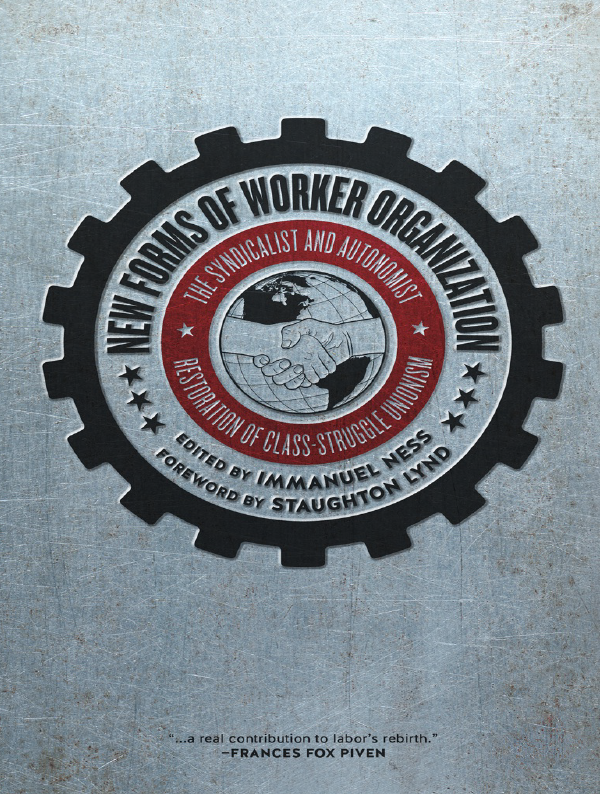
New Forms of Worker Organization: The Syndicalist and Autonomist Restoration of Class Struggle Unionism (Ness)

By Henry Laws - LibCom.Org, January 19, 2018

This is the first book to compile workers’ struggles on a global basis, examining the formation and expansion of radical unions in the Global South and Global North.

Bureaucratic labor unions are under assault. Most unions have surrendered the achievements of the mid-twentieth century, when the working class was a militant force for change throughout the world. Now trade unions seem incapable of defending, let alone advancing, workers’ interests.

As unions implode and weaken, workers are independently forming their own unions, drawing on the tradition of syndicalism and autonomism—a resurgence of self-directed action that augurs a new period of class struggle throughout the world. In Africa, Asia, the Americas, and Europe, workers are rejecting leaders and forming authentic class-struggle unions rooted in sabotage, direct action, and striking to achieve concrete gains.

The tangible evidence marshaled in this book serves as a handbook for understanding the formidable obstacles and concrete opportunities for workers challenging neoliberal capitalism, even as the unions of the old decline and disappear.

Read the report (PDF).

Unions, Trade and Nationalism

By Tom Crofton - CounterPunch, October 31, 2017

A recent statement from the AFL-CIO regarding a rejection of NAFTA and other corporate/globalist trade agreements unfortunately only skims the surface of the issues working people face.

As the dominate union leadership in America, the AFL-CIO and its member unions need to take a deeper look at their historical behavior, and their role in enabling the evolution of the corporate state with its current right wing/anti labor swing.

American unions never were interested in taking responsibility for production. American unions developed to confront management but not to replace it. The Industrial Workers of the World (IWW) was the only organization that tried to organize horizontally across all sectors to create a “new world in the shell of the old”. The vision of workers building a society where prosperity was available to all and artificial class barriers would dissolve was never a popular theme in American labor. We have always felt that we needed the owners, agreeing at least subliminally that capital has more power than basic human needs; that human weakness, pettiness, and laziness would wreck any sort of money-free effort to exchange services; that hierarchies of wages and benefits were natural and that those at the bottom were there due to their own fault.

The evolution of trade unions cemented in place these hierarchies, leaving the least skilled workers unorganized until the CIO attempted to fill the need while organizing mine workers and African Americans during the Great depression. The following era of war-induced prosperity, and the ongoing economic expansion during the Cold War, created a phony, unsustainable sense of American prosperity for a growing middle class, where 5% of the world’s population consumed 80% of its resources. The AFL-CIO was active in this period wrecking third world union organizing attempts as a front for a CIA run, right-wing sponsored, American style Imperialism. On the home front, a rising middle class of workers were happy to build low quality products, for good wages, as the disposable society offered an endless supply of the “latest” consumer goods. Conspicuous consumption and keeping up with the Jones’s did not include the working poor or the third world.

Why Libertarian Socialists Reject Free Market Liberalism

By Geoff R - Ideas and Action, October 4, 2017

Libertarian socialists’ political goals are both radical and ambitious: we seek to replace capitalism in its entirety with libertarian socialism. As a result, libertarian socialists do not just stand against capitalism as it exists today but also against positions in favor of increasing liberalism of markets; positions to reduce regulation of markets by external actors, including the government. This is largely because there is more evidence that increased market liberalism worsens problems of markets rather than improving or resolving them.

A fundamental promise of free market liberalism is that market share becomes more equitable among competing firms due to increased competition. This means firms are both created and go out of business at a higher rate than that which currently exists. Assuming this is true, it would mean that both employers and workers would face extreme economic uncertainty and therefore have trouble planning economically for the future. It’d be harder for workers to plan personal economic decisions and harder for employers to make business decisions regarding their firms. Meeting the demand economic actors have for stability is one of the many areas where markets particularly fail.

But this argument – that market share would be more equitable among competing firms due to increased competition – lacks evidence. All firms seek to increase their market share to compete and often firms end up dominating and even monopolizing markets simply by buying up their competition. Early industrialists in the U.S. were known for doing this and that was a time where there was far less regulation in markets by the government than there is today.

Early American industrialism is also known for company towns where one company owned nearly everything; from stores to housing to the local government. As a result, all law and public policy in these towns was solely for the benefit of the employer and kept the rest of the town under complete subjugation. Such was famously the case in West Virginia, the site of the mine wars including the Battle of Blair Mountain which was the largest insurrection in the United States since the American Civil War.

The Epic Failure of Labor Leadership in the United States, 1980-2017 and Continuing

By Kim Scipes - CounterPunch, August 4, 2017

The US labor movement is in terrible shape; in 2016, union membership was only 6.4 percent of workers in the private sector, and 34.4 percent of the public sector, giving an overall percentage of 10.7 percent.[1]  (It had been 33.4 percent in 1954.)  But, worse than the actual numbers and percentages is the all-but-total lack of vision as to what to do about this.  The labor movement has been under direct attack since at least the PATCO strike in 1981, and the leaders of the labor movement—and focus here is on the AFL-CIO, although there are others labor organizations outside of its ambit—have had no vision and, arguably, no clue about what to do about this.  And other than perhaps a nine-year window under John Sweeney (1996-2005)—I’m being generous—it has been blind and vision-less.  And this continues today under Richard Trumka.[2]

This problem is a major reason for the election of Donald Trump to the presidency, aided strongly by working class voters, and I’m speaking of those who are not generally racist, sexist, homophobic and/or xenophobic.

The fact is that, no matter how good any one of our national/international union leaders might be as an individual trade union leader, that does not necessarily make them a good labor leader.  By “labor leader,” I’m referring to those who look out for the well-being of working people in general in this country; i.e., those who go beyond members of their own union to think about working people overall.  I would give the AFL-CIO leaders, individually and collectively, an “F” for their efforts since the early 1980s—with Sweeney possibly getting a D for the nine years referred to above.

This failure is even worse in light of myriad efforts by rank-and-file activists, lower level leaders and staffers, and labor researchers/academics who have spent years of their lives struggling to get the labor movement to address its’ weaknesses and change its ways.  Whether through organizing new members, educating and mobilizing current members, analyzing what we can learn from workers’ struggles in the past as well as from studying contemporary efforts at home and overseas, and thinking about how we can revitalize the labor movement so as to seriously address the problems facing working people in this country, there has been extensive efforts by those “below” to overcome the lack of vision and ineptitude of national labor leaders; but the institutional power granted these “leaders” has overcome all efforts to date to initiate progressive, life-enhancing change.[3]

I’m going to argue that this organizational failure is more than individual failures, which could perhaps be overcome by the election of new leaders, although obviously individual leaders can have a significant impact once put into office.  However, I’m going to argue that the primary problem is in our very model of trade unionism in this country:  I argue that the model of trade unionism that has dominated US unionism—business unionism—offers no viable way forward and must be replaced by another model, that of social justice unionism.  I’m going to argue that unless this change from business unionism to social justice unionism is made, and made soon, the US labor movement is going to fade into irrelevancy, with its power and importance diminishing even further as years go by.

Several steps must be made to develop this argument.  First, the theoretical delineations of business and trade unionism are presented, which are crucial to understand the argument being made.  Then, a historical overview is presented, with a primary focus on the CIO years, 1933-1955, and special attention is paid to the removal of “the left” from the CIO in the late 1940s.  This is followed by a discussion of “global competition, the US economy and the attacks on working people,” and then a question:  “where is the AFL-CIO leadership?”

Following, there is an effort to make sense of why the AFL-CIO leadership has been “missing in action.”  Key to understanding this, it is argued, is to connect the lack of AFL-CIO initiative in domestic situations to the initiative it shows in international affairs—and that requires discussion of the US Empire, and the AFL-CIO leadership’s support of it.  And why they support the US Empire.

And then, there is the beginning of a discussion of how progressive workers can reclaim our labor movement.

From Solidarity Networks to Class Organisation in Times of Labour Hallucinations

By Angry Workers World - LibCom.Org, June 24, 2017

Dear sisters and brothers,

Some comrades from Frankfurt got in touch recently, wanting to set up a solidarity network. They approached us with some concrete questions. [1] We want to use the opportunity to reflect more generally on our limited experiences with our solidarity network initiative so far and about the political direction we want to take steps towards. We do this against the current background of post-election ‘Corbyn-mania’ and a surge in political activities focused on the Labour Party. The first part of this text briefly explains our opposition to the focus on electoral activities, whether that be through the Labour machinery or in the more post-modern form of ‘municipalism’ [2] – despite the fact that locally in our area, the election circus had less of an impact, given that most workers here are not allowed to vote anyway. And as an alternative to this electoral turn, the second part focuses on our political proposals towards a locally rooted class organisation. We then go on to talk in more detail about our concrete experiences with the solidarity network in west London.

The Labour of wishful thinking

  • * We understand that ‘hope’ is needed amongst a divided and beaten working class and that Labour’s rhetoric of social unity and equality is welcomed.
  • * We would criticise our comrades of the radical left if they merely proliferate this ‘message of hope’ and material promises (end of austerity), without questioning the structural constraints which will make it difficult for a Labour government to deliver on their promises. Syriza in Greece has shown how a hopeful high can quickly turn into an even deeper depression once ‘our government’ has to turn against us.
  • * For us it is less about warning the working class not to vote on principle or focusing on Corbyn’s problematic power struggle within the Labour apparatus, but about pointing out the general dynamic between a) a national social democratic government, b) the global system of trade, monetary exchange and political power and c) the struggle of workers to improve their lives. In other words, all of the historical lessons have shown us that the outcomes of channelling working class energies into parliamentarism within a nation state that fits into an overall system of capital flows, has always ended up curtailing a longer-term working class power.
  • * The Labour party proposals in general are not radical as such, e.g. their promise to increase the minimum wage to £10 per hour by 2020 (!) under current inflation rates would more likely lead to a dampening of wage struggles amongst the lower paid working class, rather than instigating them. The minimum wage regulation introduced by Labour under Blair in 1998 had this effect in the long run.
  • * An increase in taxation to mobilise the financial means to deliver on their promises will increase capital flight and devaluation of the pound – most capital assets which bolster the UK economy are less material than in the 1970s, therefore it would be difficult to counter the flight with requisition (‘nationalisation’), a step which Labour does not really consider on a larger scale anyway.
  • * While any social democratic program on a national level is more unlikely than ever, the Labour program focuses workers’ attention increasingly on the national terrain: struggle for the NHS, nationalisation of the railways etc.; (in this sense the leadership’s leaning towards Brexit is consequential and at odds with most liberal Corbynistas); while officially Labour maintains a liberal approach towards migrants, those Labour strategists who are less under public scrutiny as politicians, such as Paul Mason, are more honest: if to carry out a social democratic program on a national scale means to have tightened control over the movement of capital, by the nature of capital-labour relation, this also means to tighten the control over the movement of labour; it would also mean re-arming the national military apparatus in order to bolster the national currency that otherwise wouldn’t have the international standing the pound still has. [3]
  • * A social democratic government needs a workers/social movement on the ground in order to impose more control over corporate management, e.g. through taxation. At the same time it hampers the self-activity of workers necessary to do this – e.g. through relying on the main union apparatus as transmission belts between workers and government.
  • * In more concrete terms we can see that groups like Momentum or local Labour Party organisations have done and do very little to materially strengthen the organisation of day-to-day proletarian struggles on the ground, but rather channel people’s activities towards the electoral sphere, siphoning off energy and turning attention away from concrete proletarian problems. Many ‘independent’ left-wing initiatives – from Novara media to most of the Trot organisations – became election advertisement agencies.
  • * While for the new Labour activists – many of them from a more educated if not middle-class background – there will be advisory posts and political careers, we have to see their future role with critical suspicion.
  • * If a Labour government would actually try to increase taxation and redistribute assets, the most likely outcome is a devaluation of the pound and an increase in inflation due to a trade deficit, which cannot be counteracted easily (see composition of agriculture, energy sector, general manufactured goods etc.)
  • * The new Labour left – trained in political activism and speech and aided by their influence within union leadership – will be the best vehicle to tell workers to ‘give our Labour government some time’, to explain that ‘international corporations have allied against us’ and that despite inflation workers should keep calm and carry on; wage struggles will be declared to be ‘excessive’ or ‘divisive’ or ‘of narrow-minded economic consciousness’. More principled comrades who told workers to support Labour, but who would support workers fighting against a Labour government risk losing their credibility and influence.
  • * Instead of creating illusions that under conditions of a global crisis ‘money can be found’ for the welfare state we should point out the absurdity of the capitalist crisis: there is poverty despite excess capacities and goods (for which ‘no money can be found’ if they don’t promise profits for companies or the state). We have to be Marxists again, analysing structures rather than engaging in wishful thinking.
  • * We should focus our activities to a) build material counter-power against bosses and capitalist institutions that makes a difference in the daily lives of working class people and b) prepare themselves and ourselves for the task of actually taking over the means of (re-)production. [4] For this we need to be rooted and coordinated internationally. We can clearly see that in the face of these big questions our actual practice seems ridiculously modest, but we want to share our experiences honestly and invite others to organise themselves with us. [5]

Anger from the underground: Bulgarian miners in wildcat strike

By evgeni5150 - libcom.org, June 5, 2017

The miners from Obrochishte - the third largest manganese mine in the world, located in eastern Bulgaria, went on wildcat strike on 01.06.2017. The strike was supported by the anarchosyndicalists from ARS (Avtonomen Rabotnicheski Sindikat / Autonomous Workers Union), while the bureaucratic union in the mine opposed the strike and sided with the bosses.

17 miners from the day shift refused to come out of the mine and stayed underground for 5 days. All the workers from the other shifts, around 150 people, joined the strike. The miners, alongside with the anarchosyndicalists, blocked the main portal so the trucks of the company could not get the goods out. The strike broke out after the management refused to comply with the collective bargaining agreement that was signed earlier this year. The collective agreement was the result of similar strikes in March, when the miners went on hunger strike and organized mass protests to demand raise in salaries, improvement of the working conditions and review of the mining concession contract. Wages in the mine are extremely low - between 230 EUR ( the minimum wage in Bulgaria) and 305 EUR per month. Workers do not receive the necessary equipment, no food vouchers, they don't have transportation provided and the working conditions in the mine are terrifying.

The current 25-years concession contract for the mine was made back in 1999 by the right wing government of Ivan Kostov, famous for his mass privatization policy. For the last 18 years, the private operator of the mine - "EuroMangan", failed to comply with any of the concession agreements, which led to ecological and social disaster in the region. During all those years not a single inspection or regulation was made by the authorities. The organization is owed by a Cyprus offshore company with unclear ownership, but the day-to-day operations are managed by a women named Teresa Dankova, famous among the workers as 'the satan'. She regularly insults the miners, refuses to sign their papers for their social benefits and once she even refused to open the gates for an ambulance to pick up a heavily injured worker. During the March strike, the CEO of "EuroMangan" David Wellinges called the miners' demands - "an extortion". Nevertheless, following pressure from the workers, and through the mediation of the Minister of Energy and the Ombudsman, a collective labor agreement was signed, which stipulated an increase in salaries (albeit with the pitiful 75 EUR), transportation for the workers and also the employer made a commitment to abide by the labor laws.

But it turned out the collective agreement means nothing to the company. They have so far failed to fullfil any of the agreed terms. Furthermore the management has yet to pay salaries for April. That's why the miners went on strike again, but this time with more radical demands - they want all the bosses to leave the mine for good. The strikers got a lot of media attention and solidarity. Autonomous Workers Union organized actions of solidarity with the miners in the capital city of Sofia. Workers from the Varna's section of the union (the closest big town to the mine) joined the strikers in their blockade and raised money for food supplies.

The strike ended on 05.06.2017 when the government officials stepped in, "freezed" the concession and gave 14-days term to terminate it permanently. With this semi-victory, the miners went out from the underground after 5 days, but said that the blockade of the mine stays, as well as strike-readiness, and that if the bosses return after the 14-days term, they will resume the direct actions. In that period, Autonomous Workers Union plans to organize more solidarity actions as well as protests in front of the ministry of electricity (the ministry that is in charge of the concession), so it can put pressure on the officials to comply with the workers' demands.

The World Needs Big Ideas — Here are 10 from the Far Left

By Mary Lorax - Medium, March 4, 2017

The world is in crisis — socially, economically, and environmentally. The world needs big ideas, people want big ideas, and the Democratic Party doesn’t have any. That’s why Hillary lost — she offered nothing.

Bernie offered some narrative, and some solutions, too — like free college — and that’s why he gained a following, and why he was polling ahead of Trump. But Trump offered explanations for our crises too. And not only that, he offered ideas, BIG IDEAS, as terrible as they may have been.

The radical left has a lot to offer. We have new, innovative, and necessary ideas. However instead of promoting them and developing them, we often get caught up in reacting to an increasingly far-right, neoliberal political landscape — always on the defensive. We need to be developing our own ideas, and creating and sharing visions. We can’t be afraid of presenting bold proposals for fear of them sounding too far-fetched in an extremely right-wing media and political climate. People want big, revolutionary ideas.

So here’s a list of some of the left’s coolest ideas.

Are Americans Ready to Strike?

By James Trimarco - Yes Magazine, February 14, 2017

It was April 2012, and I was standing outside a Brooklyn subway station, handing out fliers for the May 1 general strike. Organizers were calling on employees to refuse to go to work and for students to refuse to go to school. We were urging everybody to gather in the streets instead for a festival of resistance and to demand economic justice.

Our fliers said “No work, no school,” and we meant it. We knew that getting even 5 percent of the city’s workers and students to strike would show the 99 percent’s willingness to walk away from an economy that exploited them. “Just try running this city without our labor,” we wanted to say.

But when May Day came around, we found most businesses bustling. Shopping and banking went on without a hitch. Even though thousands of people in cities across the United States participated, our organizing just hadn’t been strong enough to make a dent in business as usual.

Today, there are new calls for strikes in response to the actions of the Trump administration. The novelist Francine Prose published the first of these at the Guardian website. “Let’s designate a day on which no one (that is, anyone who can do so without being fired) goes to work, a day when no one shops or spends money, a day on which we truly make our economic and political power felt,” she wrote. Shortly after that, the creator behind the TV show The Wire, David Simon, suggested the date of Feb. 17 on Twitter. “No one spends, no one produces,” Simon tweeted in response to a critic. “The metric they understand is profit.”

Organizers quickly put together a website and are organizing local events in almost every state via a Google doc. This strike has two specific demands, according to its website, both of which ask members of Congress to stand up for the U.S. Constitution.

But Feb. 17 is just the beginning.

Pages

The Fine Print I:

Disclaimer: The views expressed on this site are not the official position of the IWW (or even the IWW’s EUC) unless otherwise indicated and do not necessarily represent the views of anyone but the author’s, nor should it be assumed that any of these authors automatically support the IWW or endorse any of its positions.

Further: the inclusion of a link on our site (other than the link to the main IWW site) does not imply endorsement by or an alliance with the IWW. These sites have been chosen by our members due to their perceived relevance to the IWW EUC and are included here for informational purposes only. If you have any suggestions or comments on any of the links included (or not included) above, please contact us.

The Fine Print II:

Fair Use Notice: The material on this site is provided for educational and informational purposes. It may contain copyrighted material the use of which has not always been specifically authorized by the copyright owner. It is being made available in an effort to advance the understanding of scientific, environmental, economic, social justice and human rights issues etc.

It is believed that this constitutes a 'fair use' of any such copyrighted material as provided for in section 107 of the US Copyright Law. In accordance with Title 17 U.S.C. Section 107, the material on this site is distributed without profit to those who have an interest in using the included information for research and educational purposes. If you wish to use copyrighted material from this site for purposes of your own that go beyond 'fair use', you must obtain permission from the copyright owner. The information on this site does not constitute legal or technical advice.