You are here

New York (state)

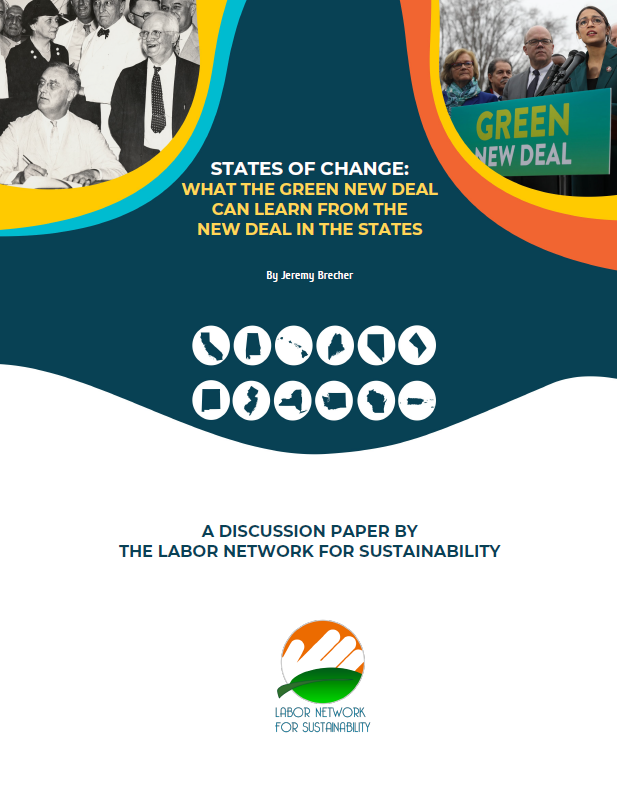
States of Change: What the Green New Deal can learn from the New Deal In the states

By Jeremy Brecher - Labor Network for Sustainability, November 2020

With the likelihood of a federal government sharply divided between Republicans and Democrats, states are likely to play an expanded role in shaping the American future. The aspirations for a Green New Deal may have support from the presidency and the House, but they are likely to be fiercely contested in the Senate and perhaps the Supreme Court. Bold action to address climate and inequality could emerge at the state level. Are there lessons we can learn from the original New Deal about the role of states in a highly conflicted era of reform?

The original New Deal of the 1930s was a national program led by President Franklin D. Roosevelt. But states played a critical role in developing the New Deal. The same could be true of tomorrow’s Green New Deal.

There is organizing for a Green New Deal in every one of the fifty states. But our federal system is often ambiguous about what can and can’t be done at a state level and how action at a state level can affect national policy and vice versa. The purpose of this discussion paper is to explore what we can learn about the role of states in the original New Deal that may shed light on the strategies, opportunities, and pitfalls for the Green New Deal of today and tomorrow.

Read the text (PDF).

Climate Jobs and Just Transition Summit: Maine, Texas, Illinois and Connecticut

Climate Jobs and Just Transition Summit: Green Recovery - Building Clean Energy Industries and a Low-Carbon Economy that Works for All

Climate Jobs and Just Transition Summit: Building a Robust Equitable Offshore Wind Industry

Climate Jobs and Just Transition Summit: Securing an Effective and Just Transition

Climate Jobs and Just Transition Summit: The Importance of Labor Leading on Climate

The Huntley Experiment

By Richard Lipsitz and Rebecca Newberry, Labor Network for Sustainability, May 9, 2017

As the Huntley coal-fired power plant in Tonawanda, NY, a working class suburb of Buffalo, NY, began cutting back on its production, the company began cutting back on its payments to the town; as a result, three schools were closed and 135 school employees lost their jobs. The workforce at the plant was slashed from 125 to 75. In response to the likely closing of the plant, the Kenmore-Tonawanda Teachers Association, the IBEW, the Western New York Area Labor Federation, and the Clean Air Coalition formed the Huntley Alliance.

They won funding from the new state Fossil Fuel Plant Closure Fund to offset lost tax revenue. And they are continuing to campaign for jobs and/or retraining for those employed at the plant and reuse of the plant for activities that will enhance the economic and cultural life of the community. Richard Lipsitz, President of the Western New York Labor Federation, and Rebecca Newberry, Executive Director of the Clean Air Coalition of Western New York, tell the inside story of this successful effort in “Huntley, a Case Study: Building Strategic Alliances for Real Change.”

[Full Text] of the case study

The subways should be free

By Christopher Baum - Socialist Worker, February 1, 2019

But socialists should also use this opportunity to ask why anyone in New York — or anywhere else — should have to pay a fare to use the subways.

It’s time to claim public transportation as a basic right — a service that should be available to all people, and fully funded not through fares, but through progressive taxation of the city’s wealthy businesses and individuals.


AFTER ALL, while it is primarily working people who ride public transportation every day, it’s our bosses who reap the benefits from our daily commutes.

As Vincent Michael wrote in SW, “[V]iable transit systems are vital to the larger capitalist economy, connecting workers to employers and consumers to products, and enabling urban development, from which the real estate, construction and financial industries profit.”

Whether you’re a local on your way to work or a tourist headed into the city to see a show or do some shopping, capitalists need you to be able to get where you’re going. Disrupt the flow of workers or consumers by removing mass transit, and the whole system threatens to break down.

As gentrification pushes us further and further away from the central areas where many of us work, our commutes get longer, we spend increasingly more time in buses and our crumbling subway system, and our quality of life suffers accordingly — especially for those who work more than one job.

Meanwhile, those who can’t afford to pay are left with a choice of geographic isolation or risking criminal punishment. New York City has reduced arrests for turnstile jumping, but over 5,000 people were still arrested last year for not being able to afford a Metrocard, while another 53,000 were issued summonses.

All in all, not only do capitalists rely upon public transportation to maintain the flow of workers, and therefore the goods and consumers on which their profits depend, they also play a decisive role in setting the terms under which the transit system is accessed.

So why shouldn’t they pay for it?

Labor Network for Sustainability Calls for “Climate Solidarity” on Anniversary of Superstorm Sandy

By staff - Labor Network for Sustainability, Octber 24, 2017

On this fifth anniversary of Superstorm Sandy, it is time to recognize that climate change is a dagger pointing at the jobs and well-being of American workers.

Since Sandy we have seen storm after storm, wildfire after wildfire, flood after flood, all demonstrating the greater intensity that climate scientists have warned us will result from climate change. In the aftermath of Hurricanes Harvey and Irma, the Labor Department said 1.5 million workers were not at their jobs because of weather. And the experience of Sandy, Katrina, and other climate-intensified storms shows that the devastation to workers and unions continues for years after the immediate impact.

There is no escape from climate devastation except a planned transition from a fossil fueled economy to a fossil free economy. That will require change in every industry from manufacturing to construction to agriculture. And that will require millions of jobs. Climate protection is our best jobs program.

The transition to a climate-safe economy must be a just transition. We need to use that transition to reverse the growing inequality and injustice of our society. And we need to make sure that poor and working people are protected against any unintended side effects of climate protection.

The labor movement’s most essential value is solidarity. Summed up in the hallowed adage “An injury to one is an injury to all,” it is the recognition that “looking out for number one” doesn’t work, that we will survive and prosper only if we look out for one another. Climate protection is the new solidarity: protecting our brothers and sisters as well as ourselves from destruction.

NYC Public Pension Funds Fossil Fuels Divestment Campaign

By Nancy Romer - Labor Network for Sustainability, November 22, 2017

New York City Public Worker Pension Funds are on the cusp of selling off or divesting from their fossil fuel stocks.  How and why are NYC workers and climate activists so intent on achieving this?  What will it mean if they win this?  First some background.

Pension Funds are the Capital of US Workers

American workers too often feel overwhelmed by the power of capitalism in general and financial corporations in particular.  We may feel we have few economic resources with which to exert our opinions and defend our needs in a system based on money.  We may want to challenge “fossil fuel capitalism” that threatens the future for our grandchildren, but how?

Most American workers do own capital in the form of their own homes and, especially, in their pension funds.  Often the pension funds are managed with the support and participation of their unions or, more specifically, their union leaders. What if union members were to look closely at our pension funds and see how we could use them to create the kind of world we want:  investments in renewable energy, public transportation, affordable housing, public education, regenerative agriculture?

As a sector, pension funds are the single largest institutional investor followed by banks, investment firms, and insurance companies (Global Pension Statistics Project, GPS).  Approximately $40 trillion was invested by pension funds in financial markets in 2015 and that gives workers much more financial punch than we realize or use.

Pensions represent deferred compensation to workers and are negotiated through contracts on behalf of union members.  The intention is to provide income during retirement years. Workers have the potential financial power through collectively using their pension funds to both protect us through financially insecure times such as these and to have an impact on the world we want to see, the world we want to leave to our children and future generations.  Too often the second part of this formula—having an impact on the world we want to see—is totally ignored.

A growing number of American workers are questioning the wisdom of keeping their hard-earned deferred income in fossil fuel holdings.   Some unions, particularly public service unions, are joining the other financial entities, like universities, faith organizations, and foundations, which have divested their funds from fossil fuel holdings. Pension funds committed to divestment comprised 12% of all divestment commitments. Globally, a full $5.2 trillion in assets has been pledged to divest from fossil fuels. [Arabella Global Divestment Report, 2016]  That’s a huge start!  We are denying funds from the fossil fuel industry, devaluing their stocks, stopping to “feed the beast”, making fossil fuel corporations pariahs, like we did with tobacco companies that caused cancer.

Pages

The Fine Print I:

Disclaimer: The views expressed on this site are not the official position of the IWW (or even the IWW’s EUC) unless otherwise indicated and do not necessarily represent the views of anyone but the author’s, nor should it be assumed that any of these authors automatically support the IWW or endorse any of its positions.

Further: the inclusion of a link on our site (other than the link to the main IWW site) does not imply endorsement by or an alliance with the IWW. These sites have been chosen by our members due to their perceived relevance to the IWW EUC and are included here for informational purposes only. If you have any suggestions or comments on any of the links included (or not included) above, please contact us.

The Fine Print II:

Fair Use Notice: The material on this site is provided for educational and informational purposes. It may contain copyrighted material the use of which has not always been specifically authorized by the copyright owner. It is being made available in an effort to advance the understanding of scientific, environmental, economic, social justice and human rights issues etc.

It is believed that this constitutes a 'fair use' of any such copyrighted material as provided for in section 107 of the US Copyright Law. In accordance with Title 17 U.S.C. Section 107, the material on this site is distributed without profit to those who have an interest in using the included information for research and educational purposes. If you wish to use copyrighted material from this site for purposes of your own that go beyond 'fair use', you must obtain permission from the copyright owner. The information on this site does not constitute legal or technical advice.