You are here

British Columbia

First year progress report on the Pan-Canadian Framework lacks any mention of Just Transition

By Elizabeth Perry - Work and Climate Change Report, December 12, 2017

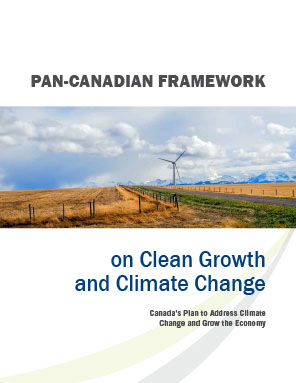
On December 9th, the Governments of Canada and British Columbia jointly announced the first annual progress report on the implementation of the Pan-Canadian Framework on Clean Growth and Climate Change – officially titled,  the First Annual Synthesis Report on the Status of Implementation – December 2017 (English version)  and Premier rapport annuel du cadre pancanadien sur la croissance propre et les changements climatiques (French version).     The report summarizes the year’s policy developments at the federal and provincial/territorial  level – under the headings pricing carbon pollution ; complementary actions to reduce emissions;  adaptation and climate change resilience ; clean technology, innovation and jobs; reporting and oversight; and looking ahead.  It is striking that the report is up to date enough to include mention of the Saskatchewan climate change strategy, released on December 4, as well as the Powering Past Coal global alliance launched by Canada and Great Britain in November at the Bonn climate talks – yet in the section on “Looking Ahead”, there is no mention of another important outcome of the Bonn talks: a Just Transition Task Force in Canada.  As reported by the Canadian Labour Congress in “Unions applaud Canada’s commitment to a just transition for coal workers”,  “Minister McKenna also announced her government’s intention to work directly with the Canadian Labour Congress to launch a task force that will develop a national framework on Just Transition for workers affected by the coal phase-out. The work of this task force is slated to begin early in the new year.”  No  mention of that, nor in fact, any use of the term “Just Transition” anywhere in the government’s progress report.

Environment Canada touts ‘good progress’ on climate after scathing audit” appeared in the National Oberserver (Dec. 11), summarizing some of the progress report highlights and pointing out that not everyone agrees with the government’s self-assessment that “While good progress has been made to date, much work remains”. Recent criticism has come from the Commissioner of the Environment and Sustainable Development in her October report ; from Marc Lee at the Canadian Centre for Policy Analysis in “Canada is still a rogue state on climate change”  (Dec.11) ; and from the Pembina Institute in  State of the Framework: Tracking implementation of the Pan-Canadian Framework on Clean Growth and Climate Change .  The Pembina Institute report calls on the federal government to speed up on all policy fronts, with specific recommendations including: “extend the pan-Canadian carbon price up to $130 per tonne of pollution by 2030, implement Canada-wide zero emission vehicle legislation, ban the sale of internal combustion engines, and establish long-term energy efficiency targets.”

(Preliminary) Workers' Climate Plan

By Lliam Hildebrand, et. al. - Iron and Earth, September 2016

Iron & Earth, a Canadian non-profit organization led by skilled trades workers with experience in Canada’s oil industry, is developing a Workers’ Climate Plan. This preliminary report describes how Canadacan become a leader in renewable energy, and a net exporter of renewable energy products, services and technology, by harnessing the industrial trade skills of current energy sector workers. A growing number of oil and gas trades people support a transition to renewable energy so long as it provides a just transition for current energy sector workers. By utilising Canada’s existing energy sector workforce, organizations and infrastructure, Canada can accelerate the transition to renewable energy, decrease the cost, and make Canada’s renewable energy sector globally competitive.

Throughout September and October, Iron & Earth will continue to reach out to energy sector workers over the phone and in person to speak about the Workers’ Climate Plan in more detail. Iron & Earth is consulting with a range of energy sectors take holders in partner ship with the Alberta-based EnergyFutures Lab in order to devise a set of recommendations based on worker demands. This will informan expanded Workers’ Climate Plan which we will release in November 2016 ahead of The 22nd session of the Conference of the Parties (COP 22). In this preliminary, abridged version of the Workers' Climate Plan, we share insights from current energy sector workers for the consideration of the Working Group on Clean Technology, Innovation and Jobs, as they compile their reports for the ministerial tables in September 2016.

Read the report (PDF).

The last barrel of oil on Burnaby Mountain

By Anonymous - Beating the Bounds, October 26, 2014

Disclaimer: The views expressed here are not the official position of the IWW (or even the IWW’s EUC) and do not necessarily represent the views of anyone but the author’s.

Sometimes the world narrows to a very fine point. A certain slant of light. The head of a needle you need to pass through. I don’t care right now about the National Energy Board of Canada (merely a corporate tool for shoehorning global energy projects into other people’s territories—a funnel for money from the public, to the private sector). I don’t care about this or that court of law, appeals and constitutional challenges. I don’t care about the drones, unmarked cars, or CSIS agents. I don’t even care that much about the rain.

I care about the people who have come together to stand in a forest, on a mountain, in the path of a pipeline. I care about them because of their passion and commitment, their awareness of the fact that they are standing at once against local destruction (a nature conservation area, the animals we meet here every day, right near the edge of a large city) and against global destruction (adding carbon to an already warming planet through new fossil fuel infrastructure—the last thing we should be doing, if we truly care about the continuation of life on this planet, in the near future). I care too, about the trees I can touch, the animals I can see, and the future commons we need to preserve for life to continue, for this planet to be a place of biological diversity and human sharing.

As has been our intention all along, we will occupy public land, a city park, and prevent Kinder Morgan from carrying out its destructive work—work opposed by local First Nations, opposed by the City of Burnaby, and opposed by the majority of Burnaby residents. While the case goes back and forth in the courts, out intention is to keep Kinder Morgan wrapped up dealing with us, either until a court somewhere sides with the people against this mega-corporation, or until the NEB’s December 1 deadline for KM’s complete application.

We are doing this to protect the local environment and people. And we are doing this because we know that people everywhere have to begin taking a stand against fossil fuel projects, and thus doing whatever we can to mitigate climate change. This is no time for new carbon projects. This is the time to build a new economy, based on new, renewable sources of energy, providing new, clean energy jobs. There is simply no benefit to the citizens of Burnaby to have this pipeline here—it benefits only the US-based Kinder Morgan, and the global market its oil will be sold on. And there is no benefit to our ailing global climate. The time to change course is now, and the many volunteers on Burnaby Mountain, and their many, many supporters in the community and around the world, have realized this, and they are taking direct action.

Protesters disrupt construction over First Nations burial ground on islet off Saltspring Island

By Sarah Petrescu - Vancouver Sun, August 27, 2014

Disclaimer: The views expressed here are not the official position of the IWW (or even the IWW’s EUC) and do not necessarily represent the views of anyone but the author’s.

‘You would never do this to your ancestors,’ chief tells workers

The sharp roar of saws and a generator coming from a construction site on Grace Islet Tuesday morning was too much for Tseycum Chief Vern Jacks.

After paddling in the Cowichan Tribes big canoe over to the small island in Ganges Harbour on Saltspring Island, where a luxury home is being built over a First Nations burial ground, he stood on the shore and yelled to the workers: “You would never do this to your ancestors. Think about your kids, your family.”

About two dozen protesters came in canoes and kayaks, and some even swam. Cowichan elder Arvid Charlie said his community members have ancestors buried on the islet and referred to it as mim’kw’e’lu, which means gravesite in Hul’qumi’num.

Within a few minutes some of the protesters — including Jacks, Victoria Coun. Ben Isitt, NDP MLA Gary Holman and organizer Joe Akerman — decided to breach the gated construction site and go inside. The group followed, walking around the concrete foundation and burial cairns encased in plywood where builders were at work.

“I’m just a contractor. You’re being disrespectful doing this,” David Yager, of West Terra Projects, said to the small crowd, which included several children.

As tension rose, protesters held hands along the site and began to sing a rendition of Amazing Grace: “Amazing grace is sacred ground, washed by wind and sea, where ancestors are laid to rest for all eternity.”

The generator and a radio blaring Whitesnake rock songs were momentarily turned off.

Jacks thanked the workers for understanding. “We’ve wanted to do this for a long time,” he said. “This place means a lot to First Nations.”

Two RCMP officers soon arrived and began to photograph the protesters before speaking with them.

“I’m sorry that it came to this today, but all else has failed,” said Holman, addressing the officers.

“The question I have for the RCMP is, where were you when the law was broken here two years ago?” he asked, referring to construction that violated the site permits issued by the B.C. archeology branch.

Grace Islet was purchased in 1990 by Alberta businessman Barry Slawsky. His plans to build a retirement home were stalled by the discovery of ancient remains and burial cairns in 2006.

Despite the 2012 permit violation and increasing public concern about construction on the documented burial site, Slawsky has been given the go-ahead to continue building by the provincial body responsible for protecting ancient remains under the Heritage Act.

“I can’t condone trespassing, but have to point out this is what’s going to happen if government does nothing,” Holman later said. “… There’s a clear way out of this: Compensate the owner and protect the islet.”

Tuesday’s protest comes a few days after the province met with local chiefs, including Jacks, about the controversial islet. They plan to speak again on possible resolutions.

Northern Gateway and Class Politics in British Columbia: Ready for War?

By Brad Hornick - rabble.ca, June 6, 2014

Disclaimer: The views expressed here are not the official position of the IWW (or even the IWW’s EUC) and do not necessarily represent the views of anyone but the author’s.

But certainly for the present age, which prefers the sign to the thing signified, the copy to the original, representation to reality, the appearance to the essence… illusion only is sacred, truth profane. Nay sacredness is held to be enhanced in proportion as truth decreases and illusion increases, so that the highest degree of illusion comes to be the highest degree of sacredness.

--Feuerbach, Preface to the second edition of The Essence of Christianity

In an article entitled "Apocalypse Forever? Post-political populism and the spectre of climate change," Erik Swyngedouw argues two points. The global problem of climate change represents a mounting clear and present danger to human civilization and has become an issue politicized as never before. Secondly, this paradoxically coincides with a political environment, he says, "that has evacuated dispute and disagreement from the spaces of public encounter to be replaced by a consensually established frame" of the "post-political" and "post-democratic condition."

Many critique Swyngedouw for glibly announcing the apparent disappearance of environmental politics in the present context of intensive mobilizing around the climate crisis and other issues of social justice. Nevertheless, his substantive point is that in formalized processes within the public realm, the political dimension has been replaced by undemocratic technocratic management and consensual policy-making. Politics has moved from the streets, the woods and bargaining tables to the boardrooms, courts and ballot box.

This scenario is being dramatically played out in British Columbia, an epicentre of global fossil fuel politics. The "post-political" was magnificently demonstrated recently by one of British Columbia's foremost environmentalists in The Globe and Mail. Oil sands and pipelines is an "ugly, polarizing and simplistic debate" replete with "schoolyard bullying" says the author. Equally at ease with industry executives, family and workers, she explains, "it doesn't take long to find common ground in the oil sands debate across what is often portrayed as enemy lines."

Pages

The Fine Print I:

Disclaimer: The views expressed on this site are not the official position of the IWW (or even the IWW’s EUC) unless otherwise indicated and do not necessarily represent the views of anyone but the author’s, nor should it be assumed that any of these authors automatically support the IWW or endorse any of its positions.

Further: the inclusion of a link on our site (other than the link to the main IWW site) does not imply endorsement by or an alliance with the IWW. These sites have been chosen by our members due to their perceived relevance to the IWW EUC and are included here for informational purposes only. If you have any suggestions or comments on any of the links included (or not included) above, please contact us.

The Fine Print II:

Fair Use Notice: The material on this site is provided for educational and informational purposes. It may contain copyrighted material the use of which has not always been specifically authorized by the copyright owner. It is being made available in an effort to advance the understanding of scientific, environmental, economic, social justice and human rights issues etc.

It is believed that this constitutes a 'fair use' of any such copyrighted material as provided for in section 107 of the US Copyright Law. In accordance with Title 17 U.S.C. Section 107, the material on this site is distributed without profit to those who have an interest in using the included information for research and educational purposes. If you wish to use copyrighted material from this site for purposes of your own that go beyond 'fair use', you must obtain permission from the copyright owner. The information on this site does not constitute legal or technical advice.