By Jessie MacInnis - La Via Campesina, July 11, 2023
When the UNDROP was adopted at the United Nations General Assembly in December 2018, Canada abstained. Despite that, Canada is one of the first places where UNDROP has been explicitly cited by a provincial court in a case related to migrant workers’ rights. Jessie MacInnis explains for us the dynamics at play in Canada on Peasants’ Rights and the importance of case law.
First, to give us some context, could you describe us the general landscape of agriculture in Canada?
Agricultural policies have increasingly tied agriculture to a corporate system in Canada. Recent examples relate to the reduction of government oversight of seeds and gene-edited plants. The Canadian government has put its faith in agribusiness and biotech corporations instead of science and public interest. It’s very scary for farmers, especially for organic farmers, such as myself, who may suffer financial, health, and ecological implications from increasing corporate capture of seeds and the gutting of publicly-funded seed research and development.
COVID-19 has shown the cracks and deep rooted inequities that keep land inaccessible, rural communities gutted of resources, and farmers indebted and dependent on the companies selling inputs and chemicals. It also showed the dependence on a constant supply of migrant workers who suffer from human rights abuses. Yet it has been a time of enormous profit increases for corporations in the sector. On top of that we have the climate crisis and the income crisis, with income that have been stagnant for years and many farmers relying on off-farm work to make ends meet. Agriculture policies are beginning to wake up to the realities of the climate crisis, with more funding available for on-farm climate adaptation, but the income crisis is still prevalent for small-scale and family farms, which are the backbone of the food system.
Ƒinally, If we talk about agriculture in Canada, we have to acknowledge that it is built on settler colonization and stolen land. The National Farmers Union (NFU) is engaging in conversations between farmers and Indigenous Peoples, conversations about land equity, land back, and food sovereignty, but it’s just the beginning. Our agriculture is built on colonial violence that still hasn’t been reconciled. Farmers have a critical role to play in both acknowledging our relationship to the land and finding pathways forward towards living in right relations with Indigenous Peoples.
In this agricultural landscape we have a plurality of perspectives with regards to how agriculture policies should be developed, and whose goals it seeks to achieve. Some of the bigger agriculture organizations definitively may have historically had more sway with policymakers, but the NFU and other food sovereignty activists are gaining ground, especially at local and regional levels.
In 2020, Ontario Superior Court of Justice released a decision based on UNDROP in defense of a group of migrant farm workers during the COVID-19 pandemic. Can you tell us more on this decision?
This case shows the legal potential of the UNDROP, I think legal action is one pathway for countries who have not approved the Declaration at the United Nations to incorporate its articles and set legal precedents.
In 2020, at the height of the COVID-19 pandemic the Canadian Lawyers for International Human Rights used Article 23 of UNDROP in a provincial court in defense of a group of migrant workers facing dangerous, overcrowded living conditions.
To give some context, Canadian farms employ nearly half a million agricultural workers through a federal program. This program has been riddled with accusations of human rights violations over the years: poor living conditions, low wages and no pathways to permanent residency. At the same time, Canada is dependent on their labour to ensure the food supply.
In March 2020, just after the state of emergency was announced, the federal government mandated a 14-days isolation period for all temporary foreign workers entering Canada, at the same time ensuring workers subjected to isolation in groups would have at least 2 meters per person at all time and limiting the numbers of workers living together in a lodging.
When this policy was mandated, a major industrial farm in Ontario (central Canada) that employs migrant workers, submitted two inadequate self-isolation plans before requesting a hearing regarding the public health order limiting the numbers of farm workers in one lodging. At the hearing the farm argued that the requirement of three farm workers per lodging was arbitrary and failed to recognize the significance of migrant farm workers to Canada food supply. They argued they had not been able to bring in as many migrants as they would normally, and this jeopardized their food production.
The Superior Court of Justice of Ontario responded by saying that: “decreasing health inequities as required under the guidelines requires that the number of workers that are allowed to isolate together is such that the risk posed to their health is comparable to the rest of the population when they’re quarantined. Allowing larger numbers to isolate together exposes migrants farm workers to a level of risk not tolerated for others in the community, thereby increasing vulnerability of an already vulnerable group.”
In reaching this outcome, the Court cited the UNDROP for the first time in Canada. The way they cited it is important: “…furthermore the UNDROP is part of the body of HR laws and norms to which Canadian adjudicators may look in interpreting statutory or common-law obligations and in reviewing administrative decisions.”. They cited article 23.1, which states: “Peasants and other people working in rural areas have the right to the enjoyment of the highest attainable standard of physical and mental health.”.
So the context and the outcome of the case is demonstrative of the applicability of the Declaration in the Canadian context. Promoting this case is something we need to keep doing. It’s strategic to expand the network of human rights lawyers that are aware of UNDROP and to give them this as an example.




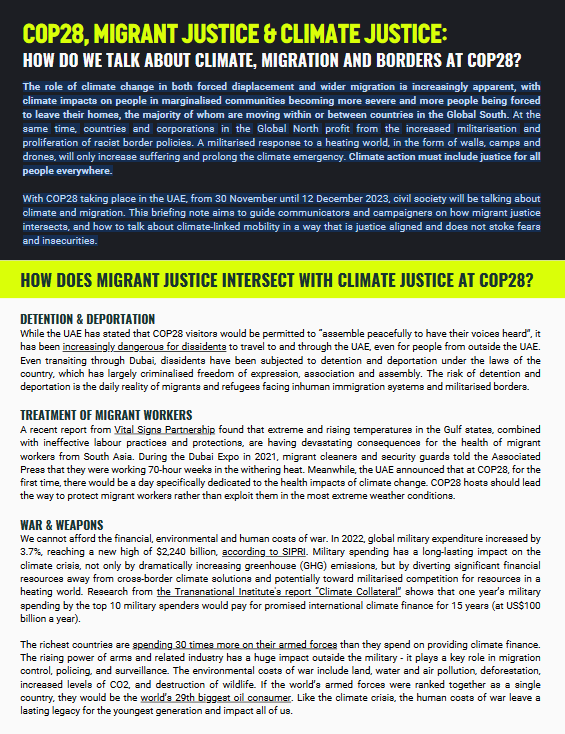 The role of climate change in both forced displacement and wider migration is increasingly apparent, with climate impacts on people in marginalised communities becoming more severe and more people being forced to leave their homes, the majority of whom are moving within or between countries in the Global South. At the same time, countries and corporations in the Global North profit from the increased militarisation and proliferation of racist border policies. A militarised response to a heating world, in the form of walls, camps and drones, will only increase suffering and prolong the climate emergency. Climate action must include justice for all people everywhere.
 Over 2 million Palestinian people have suffered under a 16 year blockade on Gaza and now endure a complete siege, as Israel bombs, starves, and displaces them. Israel has cut off food, water, and electricity to Gaza and has engaged in bombing of residential buildings, markets, schools, health facilities, and mosques – all with the support of the United States and other governments. Palestinians are forced between two decisions, stay and try to survive, or try to flee into exile, but will never see their home again. Our solidarity as environmental justice and human rights defenders globally is vital, as we are witnessing genocide before our eyes. Israel is the largest recipient of U.S. foreign assistance at $3.8 billion a year, totaling more than $260 billion to date.
  There are two very different (and antagonistic) renewable energy models: the utility-centered, centralized energy model—the existing dominant one—and the community-centered, decentralized energy model—what energy justice advocates have been pushing for. Although both models utilize the same technologies (solar generation, energy storage, and so on), they have very different physical characteristics (remote versus local energy resources, transmission lines or not). But the key difference is that they represent very different socioeconomic energy development models and very different impacts on our communities and living ecosystems.
 This site is not the official webpage of the Industrial Workers of the World.