
You are here

green bans

A glimpse of what could be: The NSW BLF, the most radical and innovative union the world has ever seen

By John Tully - Links, March 2019

Fifty years ago, a group of dedicated left-wing activists wrested control of the NSW Builders Labourers’ Federation (BLF) from the corrupt gangster types who had used it to feather their own nests. The militants, who included Jack Mundey, Joe Owens and Bob Pringle, rebuilt the union into a radically democratic, socially progressive and environmentally-aware organisation the likes of which Australia—and the world—had never seen. Today, we live in dark times for trade unionism. Only around 7% of workers in private industry are organised and unionists face ruthless attacks by the bosses and the state. The achievements of the NSW BLF, however, give us a glimpse of the liberating potential of the working class and are a beacon for the future.

It is to the great credit of militant building workers in Australia that almost 50 years ago they nailed their green colours to the mast and insisted that ecology was as much the concern of workers as wages and conditions. Jack Mundey asked “What is the use of higher wages alone, if we have to live in cities devoid of parks, denuded of trees, in an atmosphere poisoned by pollution and vibrating with the noise of hundreds of thousands of units of private transport?”

The union did not claim to be perfect—it was a work-in-progress, inventing itself as it went—but it showed that an alternative kind of unionism was possible. Its innovative radicalism shocked the bosses and conservative politicians, and confounded right-wing union bureaucrats by its daring larrikinism. It shook up Sydney in a way that had only been the stuff of dreams for socialists and surprised many who had written off the working class as a force for progressive change. Sadly, as the years go by, its achievements risk being forgotten under the crushing weight of neoliberal ideology.

As elsewhere in Australia, the BLF covered the unskilled and semi-skilled workers in the building and construction industry: labourers of various types; concrete finishers; jackhammer-men; excavation workers; hoist drivers; steel fixers who placed the steel rods and bars for reinforced concrete; scaffolders; powder monkeys or explosives experts; riggers, who erected cranes, gantries, hoists and other structures, along with structural steelwork and bridges; and dogmen, who slung loads from cranes and “rode the hook” hundreds of metres above the city streets in a spectacular, but hazardous aerial performance. Due to technological change in the industry, much of their work became at least as skilled as that of the traditional craftsmen, who had served traditional apprenticeships, and who were organised in separate unions at that time.

Bringing Back The Lucas Plan

By Felix Holtwell - Notes from Below, March 30, 2018

“We got to do something now, the company are not going to do anything and we got to protect ourselves”, proclaimed a shop steward at Lucas Aerospace when filmed by a 1978 documentary by the Open University.
He was explaining the rationale behind the so-called Alternative Corporate Plan, better known as the Lucas Plan. It was proposed by shop stewards in seventies England at the factories of Lucas Aerospace. To stave off pending layoffs, a shop steward committee established a plan that outlined a range of new, socially useful technologies for Lucas to build. With it, they fundamentally challenged the capitalist conception of technology design.

Essentially, they proposed that workers establish control over the design of technology. This bottom-up attempt at design, where not management and capitalists but workers themselves decided what to build, eventually failed. It was stopped by management, sidelined by struggling trade unions and the Labour Party, and eventually washed over by neoliberalism.

The seventies were a heady time, the preceding social-democratic, fordist consensus ran into its own contradictions and died in the face of a triumphant neoliberalism. With it, experiments such as the Lucas Plan died as well. Today, however, neoliberalism is in crisis and to bury it we should look back to precisely those experiments that failed decades ago.

Worker Solidarity with Camp Makwa and the Movement for Environmental Justice

By the Twin Cities GDC - It's Going Down, December 14, 2017

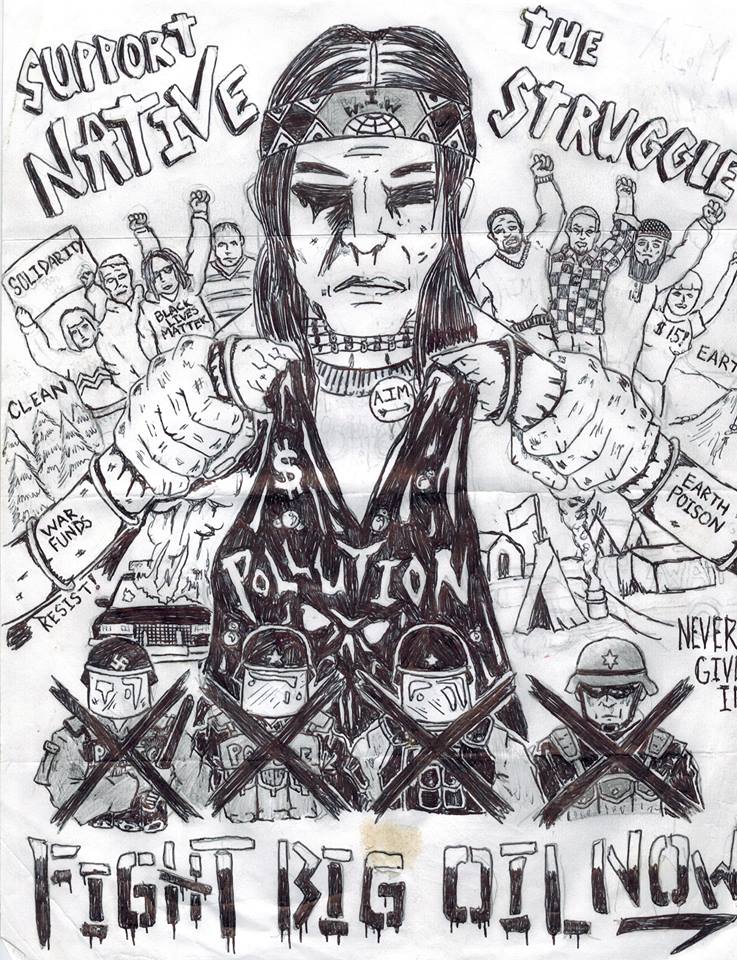
On Tuesday, December 5, 2017, the Twin Cities IWW unanimously passed a resolution reaffirming the IWW’s opposition to the construction of the Dakota Access Pipeline and the Keystone XL Pipeline as well as officially declaring its opposition to the construction of the Enbridge Line 3 Pipeline. The Twin Cities IWW pledged material support to water protectors, rejecting Enbridge’s arguments that the pipeline is necessary for jobs and prosperity for working class people, and put forward a vision of a “Just Transition” to a sustainable economy.
The resolution pledged two donations of $100 each to the legal defense fund and the supply fund of Camp Makwa, a resistance camp using direct action to protect the land and water that Anishinaabe people and other working class Minnesotans depend on. The resolution further endorsed the Black Snake Killaz Circuit, a series of fundraising concerts for Camp Makwa running across the Twin Cities and other towns in Minnesota and Wisconsin throughout the winter.

No Jobs on a Dead Planet

In the resolution, the Twin Cities IWW rejected the attempts by Enbridge and certain unions to paint the pipeline as good for workers. Instead, the resolution focuses on the harm that the oil industry does to its workers, surrounding communities, and the environment.

Enbridge’s existing Line 3 is the cause of the largest inland oil spill in US history, spilling 1.7 million gallons of oil into the Prairie River in 1991. In 2007, tragedy struck in Minnesota again with a pinhole leak explosion in Clearbrook, killing two workers, sparking a large fire, and spilling 15,000 gallons. This spill burned for three days, contaminating the air in the surrounding community. In 2010, Enbridge’s Line 6B pipeline also spilled, releasing around a million gallons of oil into Talmadge Creek and the Kalamazoo River and causing 30,000-50,000 houses to evacuate—and leaving twice as many without clean drinking water. In the aftermath of these spills, union workers have spoken out against Enbridge for failing to clean up their mess which has resulted in birth defects, illness, cancer, and death of both humans and animals in the area of the disaster.

In addition to these specific acts of negligence, the resolution noted the way in which the oil industry exposes working class communities and especially communities of color and indigenous people to the worst risks. These communities are often ignored and their well-being violated during the permitting process for pipelines and other infrastructure projects. For example, pipeline routes often avoid wealthier or majority-white towns and are directed rather through poorer areas, especially near indigenous land. This was the case with the Dakota Access Pipeline, and the same pattern can be seen with Line 3.

The resolution further emphasizes the reality of climate change, an accelerating trend that is already disrupting and destroying lives, economies, ecologies, and communities around the world. As the resolution notes, “there are no jobs on a dead planet.”

Faced with environmental dangers on a local and global scale, and unable to stop the lobbying power of well-connected companies, marginalized communities of workers are left with few choices except direct action. Water protectors face violence from the state and private security to defend the land and the people who live on it from the harm done by the oil industry.

Twin Cities IWW Resolution in Solidarity with Camp Makwa and the movement for environmental justice

Adopted Unanimously by the Twin Cities IWW General Membership Branch - December 5, 2017

Whereas: On March 3rd 1991 the Line 3 pipeline caused the largest inland oil spill in US history, rupturing in Grand Rapids, Minnesota spilling 1.7 million gallons of oil into the Prairie River; and

Whereas: In July 2010, Enbridge also spilled about a million gallons of Dilbit Oil in the Kalamazoo River when the Line 6B pipeline burst and flowed into the Talmadge Creek and then the Kalamazoo before the the spill was contained. On 29 July 2010, the Calhoun County Health Department asked 30 to 50 thousand households to evacuate, and twice as many were advised not to drink their water. Union workers cleaning up the Kalamazoo Spill have spoken against Enbridge for insufficiently cleaning up the spill which has resulted in birth defects, illness, cancer and death of both humans and animals in the area of the disaster; and

Whereas: In 2007, 2 Enbridge workers were killed in Clearbrook, Minnesota when a pinhole leak explosion sparked a huge fire and spilled 15,000 gallons of oil. Enbridge let the spill burn for three days poisoning the air of the surrounding community; and

Whereas: The Oil Industry and many other unsustainable industries sacrifice the health and safety of the working class and poor communities, especially many indigenous and communities of color. These communities are subject to environmental racism and classism and often ignored and violated during the permitting process of such projects; and

Whereas: These communities often are forced to defend themselves with direct action which puts them at greater risk of violence and incarceration from the state and private security; and

Whereas: The construction of these pipelines will contribute to the acceleration of already dangerous levels of currently existing greenhouse gas emissions which are contributing to the already dangerous effects of climate change, which could lead to a dead planet with no jobs; and

Whereas: Camp Makwa was established in August of 2017 to resist the pipeline using direct action to protect the water and natural resources such as the wild rice lakes, fishing and hunting, and farming that the Anishinaabe Tribe and working class in the area depend on. They have taken several direct actions to shut down construction of the Line 3 pipeline in Superior, Wisconsin and will resist the possible expansion in the spring. They are currently still camping during the harsh Minnesota winter.

Whereas: Neither the Line 3 Pipeline Dakota Access Pipeline, or the Keystone XL Pipeline will provide anywhere near the number of permanent union jobs the promoters of these projects promise they will, and

Whereas: More permanent union jobs can be created at union wages by decommissioning oil pipelines and upgrading water pipeline infrastructure, such as in Flint, Michigan. LIUNA and many labor unions currently have jobs working in the renewable energy sector such as solar, wind, and hydroelectric and could organize for a rapid transition of energy production and manufacturing to be safe for the workers, the surrounding communities and the environment. Though these renewable energy jobs are currently, typically non-union, trade unions if so determined, could easily develop a successful green energy organizing program, using solidarity unionism, that would revitalize the currently struggling labor movement. Far more jobs currently exist in the growing renewable energy sector than in the declining fossil fuel sector. Also these pipeline projects will not deliver the promised "energy security" or "energy independence" promised by their promoters, including the Building Trades and AFL-CIO Union officials among them and;

Whereas: Many unions, including the IWW, ILWU, ATU, APWU, LIUNA-City Employees Local 236, CWA, UE, SEIU, NNU, Pride at Work, A. Phillip Randolph Institute, the Asian Pacific American Labor Alliance, the Coalition of Black Trade Unionists, the Coalition of Labor Union Women, the Labor Council for Latin American Advancement, Labor for Standing Rock, and many members of other Labor organizations have already publicly stated opposition to the Dakota Access Pipeline and or the Keystone XL Pipeline; and

Whereas: President Donald Trump's executive orders that dismantle environmental regulation and ostensibly "clear a path" for the completion of the aforementioned pipelines are contradictory in nature and are designed primarily to divide workers and environmentalists over the false dichotomy of "jobs versus the environment"; and

Be Resolved that: The Twin Cities IWW reaffirms the IWW’s opposition to the construction of the Dakota Access Pipeline and the Keystone XL Pipeline as well as officially declares its opposition to the construction of the Line 3 Pipeline; and

Be it Also Resolved that: The Twin Cities IWW donates $100 each to both Camp Makwa’s legal and supply fund (Legal | CAMP SUPPLIES FUND) and urges our Union’s members, the Labor Movement, and working class to pass resolutions like this one, donate, join, and organize in solidarity with Camp Makwa, the resistance to Line 3, and the movement for environmental justice, locally and abroad.

Be it also Resolved that: The Twin Cities IWW endorses Black Snake Killaz Circuit, a collection of benefit shows created by organizers, artists, and eco-activists who are standing in solidarity with indigenous water protectors and their accomplices fighting Line 3 to defend Anishinaabe land and water from the extractive industry; and

Be it Further Resolved that: The Twin Cities IWW calls on rank and file members of the Building Trades, Teamsters, and other unions who have declared support for these pipelines and other unsustainable projects to implement Green Bans and take direct action by striking and or slowing down in solidarity with the communities resisting Line 3, additional pipelines, and other projects that are exploitive of the working class and the plant we inhabit.

Be it Additionally Resolved that: The Twin Cities IWW calls on the working class, unions, and the unsustainable companies that employee them, such as Enbridge, as well as their financial supporters to develop and rapidly implement a "Just Transition" plan for workers in unsustainable industries, such as pipeline and oil industry workers, to be trained in and given union jobs in the green energy sector. ; and

Be it Finally Resolved that: The Twin Cities IWW reaffirms our belief and commitment to revolutionary industrial unionism, environmental justice, and community self-defense with our goal to “organize as a class, take possession of the means of production, abolish the wage system, and live in harmony with the Earth.”

Should Unions Strike for a Just Transition?

By Sean Sweeney - Trade Unions for Energy Democracy, October 10, 2017

After more than a decade of tenacious union lobbying of government negotiators, the words “a just transition of the workforce” was written into the preamble of the 2015 Paris Climate Agreement.

But now what? Encouraged by Paris, unions around the world have committed fresh energy towards giving Just Transition some practical significance, otherwise it will remain little more than a moral appeal for fairness in a corporate-dominated world economy where both morality and fairness are increasingly scarce.

This Bulletin features an article by TUED coordinator Sean Sweeney on the recent commitment made by unions in South Africa to strike for a “just transition.” However, the goal of the threatened strike is to halt the plan of the national utility (Eskom) to close 5 coal-fired power stations, a move that threatens 40,000 jobs.  Titled “When Stopping Coal Plant Closures Makes Environmental Sense” the article, which first appeared in the Fall 2017 edition of New Labor Forum, urges environmentalists not to support the closures, but to join with unions in opposing Eskom’s proposed actions.  Supporting the closures, argues Sweeney is “a poisoned chalice,”  that “will separate the environmental movement from the unions with whom it should be allied. And whatever environmental gains the 5 closures might produce at the margins in terms of avoided emissions and pollution levels will be more than offset by the impact of ‘jobs versus environment’ political fragmentation. This is why the Eskom closures should be opposed, but opposed in a way that might lay the political foundations for a more fundamental energy transition.”

Since the article was written, Eskom’s war with the private renewable energy companies has continued, with the utility pushing back against high-cost of power purchase agreements for wind and solar power. TUED union NUMSA and also the new South African Federation of Trade Unions (SAFTU) have called for a socially owned renewables sector in order to allow for a just energy transition from the present coal-dominated power system to one that can take advantage of South Africa’s abundant supplies of wind and sunshine.

List of Green Bans, 1971-1974

By Steven - Libcom.Org, June 17, 2017

References: BLF (NSW) 15 June 1973; 22 October 1973; 5 June, 1974; Joe Owens Deposit, Noel Butlin Archive, ANU

To Executive Members and Fulltime Workers:- A list of our Green Bans and other community actions in support of residents. The following is the list:

1. Kelly’s Bush
2. The Rocks
3. Victoria Street
4.Congregational Church
5. Opera House Car Park
6. Theatre Royal
7. Moore Park (Centennial Park Sports’ Complex)
8. Cook Road (Centennial Park)
9. Mt. Druitt
10. North-West Expressway
11. “Lyndhurst” – Glebe
12. Ryde – Dunbar Park
13. Darlinghurst
14. Helen Kellar House – Woollahra
15. Woolloomooloo
16. Royal Australasian College of Physicians – Macquarie St
17. Pyrmont and Ultimo (NW Freeway)
18. Fowler-Ware Industries – Merrylands
19. Jeremy Fisher
20. Diethnes
21. East End – Newcastle
22. Rileys Island
23. Colonial Mutual Building
24. Dr. Busby’s Cottage
25. Eastern Hill – Manly
26. Eastlakes

27. A.N.Z. Bank – Martin Place
28. National Mutual Building – Martin Place
29. C.M.L. Building – Martin Place
30. Mascot High-Rise
31. Newcastle Hotel
32. Regent Theatre
33. Redfern Aboriginal Centre
34. Eastern Freeway
35. Botany High Rise
36. Motorway – Newcastle
37. St. George’s Hill
38. Kings Cross
39. South Sydney
40. St. John’s Park
41. New Doctors Dwellings
42. Tomaree Peninsula
43. Burwood
44. Western Expressway
45. Freeways
46. Soldiers Garden Village
47. Education Department – North Newtown
48. Port Kembla
49. East Woonona
50. Botany Municipality
51. Sydney University Women’s Course
52. Port Macquarie
53. Waterloo
54. Newcastle Motorway

The 1970s Struggle to Save the Vic Market

By staff - Earthworker Cooperative, June 2017; artwork by Sofia Sabbagh

Remembering the struggle to save the Vic Market from the threat of redevelopment in the 1970s. Earthworker recognises itself as part of this tradition of defending public and community space. 

The Vic Market is a vital public space in the heart of Melbourne. Many of us who live in and around Melbourne appreciate the Market as a place to work, eat, meet and enjoy company with friends and family.

Not many know that in the 1970s, pressure began to mount for the “redevelopment” of the Queen Victoria Market into a combined trade and hotel precinct. Even fewer know the truth about the role that a militant trade union, namely the Builders Labourers’ Federation (BLF), played in protecting the Vic Market from this threat.

This is an excerpt from Vic Market’s own website: “The separation of the Wholesale Market from the Retail Market lead to a plan to redevelop the Queen Victoria Market site into a trade centre, office and hotel complex in the 1970s. However, public outcry prevented this and resulted in the Market being classified by the National Trust. Later, the Market site and its buildings were listed on the Historic Buildings Register.”

Not a word about a union. Yet if you talk to the older stall holders today they all know people who came before them who were involved in that period, and who are proud of the union-declared ban on development work at the Vic market. This action was only one in a series of bans that the BLF put on development sites that were deemed socially or environmentally harmful. This strategy was collectively termed “Green Bans”.

Here’s some words from Dave Kerin, co-founder of Earthworker and one of those involved in the victory to protect the Vic Market in the 1970s:

“Our community is there; our kids grew up with the Market as a formative community influence; and importantly thanks to John Cummins (previous Victorian secretary of the BLF), the Green Ban remains on the Vic Market. In the early 1990’s the stall holders approached Cummo to discuss yet another proposal to build inappropriately on Market land. Cummo reassured everybody that as far as he was concerned “The Green Ban was never lifted!” The Green Ban still holds and yet goes unacknowledged by the Market’s Administration. This ahistorical presentation of events must change.”

History is repeating, and we now see that the Vic Market is under threat again. But, if we know our history, we can assert with confidence “We’ve saved it before, we’ll save it again!”.

A new concept of unionism: the New South Wales Builders Labourers' Federation 1970-1974 (Meredith Burgmann)

Originally posted by Aunty Jack - Libcom.Org, March 10, 2017

Meredith Burgmann's pioneering work on the history of the New South Wales branch of the Australian Builders Labourers' Federation. During the 1960s and 1970s the NSWBLF introduced limited tenure of office for union officials, tied officials' pay to the minimum industry wage, introduced highly democratic forms of decision-making, and pursued militant industrial tactics. The union was also notable for its aggressive support of other social groups, most notably through the placing of "Green Bans" where members prevented work from taking place on environmentally or socially destructive projects.

Chapters 1-12 deal primarily with the period 1970-1974 when the NSWBLF was at the height of its industrial power and radicalism. The appendixes cover the period from 1950-1970 when rank and file workers struggled to democratise the union and wrest control from the corrupt right-wing forces that then held power.

The Lucas Plan: how Greens and trade unionists can unite in common cause

By David King - Breaking the Frame, November 2, 2016

Forty years ago workers at Lucas Aerospace created a detailed plan to transition out of the arms industry and into green, sustainable products and technologies, writes David King. it never happened, yet the Lucas Plan provides a blueprint for similar initiatives today to build a deep-rooted, broad-based movement for social, economic and ecological progress.

One problem that environmental campaigns against harmful industries such as nuclear power and weapons, fracking, arms, etc. often face is opposition from trade unions and local people concerned about the impact on jobs.

But as an inspiring initiative by workers themselves in the 1970s showed, it doesn't have to be that way. 2016 is the 40th anniversary of the Lucas Plan.

No, there's no connection to the eponymous Green MP! It was a plan by workers at the Lucas Aerospace arms company to convert the company's production to socially useful products. Amongst their ahead-of-their-time ideas were wind turbines, heat pumps, and hybrid car engines, which are now in widespread use.

At a conference in November trade unionists, environmentalists and peace activists are coming together to celebrate the anniversary and take forward more recent workers' plans like the Million Climate Jobs campaign. We hope the conference will give new impetus towards a 'people's transition' to sustainability with social justice.

Socially useful production

The Lucas Plan came about not as the result of activism from the peace movement, but as a positive response by the Lucas workers themselves, to save their jobs, in the face of recession and planned government defence spending cuts. In the early 1970s the workers at Lucas had organised themselves into a cross-union Combine Committee, which had already been extremely effective in fighting redundancies.

The Combine Committee worked on the plan throughout 1975, when it circulated questionnaires to the workforce requesting product suggestions which answered a social need and could be produced using the workforce's existing skills and technology. Emphasis was also to be put on the way the products were to be made, making sure that workers were not to be deskilled in the process of producing them.

150 product ideas were put forward by the workforce. From them, products were selected to fall into six categories: medical equipment, transport vehicles, improved braking systems, energy conservation, oceanics, and telechiric machines.

Public Servants or Corporate Security? An Open Letter to Law Enforcement and National Guard in North Dakota

By Winona LaDuke, Ann Wright and Zoltan Grossman - CounterPunch, November 2, 2016

So you joined law enforcement or the National Guard because you wanted to uphold the law, protect innocent civilians against the bad guys, and help your community in times of need. Instead, they’re having you blockade unarmed people who are trying to hold a prayer vigil, chasing them with armored vehicles and ATVs, raiding their tipis and sweat lodges at gunpoint, and shooting them (and their horses) with pepper spray, concussion grenades, tasers, and rubber bullets. You thought you’d be the cop on the beat or the citizen soldier, and they’ve made you into the cavalry riding in with Custer.

If you signed up for the National Guard, you swore a solemn oath to “support and defend the Constitution of the United States…against all enemies, foreign and domestic.” This is a good time to read the text of that Constitution, including the First Amendment that prohibits abridging the free exercise of religion, or “the freedom of speech, or of the press; or the right of the people peaceably to assemble, and to petition the Government for a redress of grievances.” Article Six of the Constitution defines “all Treaties made” (including those with Native nations) as “the supreme Law of the Land.”

The religious rights of Native people are further enshrined in the Indian Religious Freedom Act and the Native American Graves Protection and Repatriation Act, both of which have been literally plowed under by the Dakota Access Pipeline. Energy Transfer Partners and Enbridge even hired private security goons, who on September 3 unleashed attack dogs on Native people praying to “petition the Government for a redress of grievances.” On October 27, praying people holding tobacco and sage had their arms stomped until they released the offerings. Impersonal numbers were written on the arms of the arrestees, who were held in dog kennels. Genuine law enforcement or military wouldn’t take sides or turn a blind eye to these shameful violations of constitutional rights, but protect the lives and property of all residents, whether Native or non-Native. If you deny others their humanity, you lose your own humanity.

Yes, some of the water protectors are trespassing on private property and locking themselves to pipeline construction equipment. Their actions are part of a long tradition of nonviolent civil disobedience in the face of tyranny, from Henry David Thoreau to Martin Luther King Jr. Remember the Boston Tea Party, in which rebellious Americans posing as Indians took direct action against British tea taxes? The only real difference at Standing Rock is that they’re not posing as Indians. When we visited there, we met many prayerful people who were justifiably angry—what if an explosive oil pipeline or train threatened your home, your drinking water, or your kids’ school?

Yes, many of the water protectors are from out of state, but they were invited by the Standing Rock Sioux Tribe, with one of the conditions that they don’t have weapons. The state of North Dakota has invited out-of-state armed police and unaccountable private security thugs, all to defend a corporation from Texas. Some of the police have come as far as Ohio and Wisconsin (and what self-respecting Packers fan would side with a corporate franchise based in Dallas?). Why is that that armed white militia members, from out of state and uninvited, are acquitted in Oregon, but invited, unarmed Native people are being criminalized and assaulted in North Dakota?

The trend of state security forces being turned into private corporate security is hardly unique to North Dakota. In his book Resource Rebels, Al Gedicks documents how Nigeria set up a special internal security force to crush Ogoni protests against oil leaks and pipeline explosions. Shell Oil not only admitted funding and arming the military force, but provided access to its boats and helicopters. The commander of the force wrote that Shell operations would be “impossible unless ruthless military operations are undertaken for smooth economic activities to commence.” When Ijaw women led protests against Chevron’s oil pollution, the company flew in police and military personnel that killed unarmed protesters.

Gedicks also documented how in Colombia, “human rights abuses have risen dramatically in the areas with the most intense oil activity,” such as death squad killings and disappearances. BP and Occidental contracted with military units and private security firms to guard their oil pipelines, and BP gave photos and videotape of Indigenous community organizers to Colombian military units, which proceeded to arrest and kidnap them as “subversives.” One army unit even sported a shoulder patch with an oil derrick.

In Ecuador, police and military units have recently repressed protests by Amazon Indigenous communities against oil drilling and oil access roads in the Yasuní rainforest reserve. The repression echoes previous governments’ militarization around ARCO and Texaco drilling operations, including detention without charge and torture. Are these the kind of security forces that you’d be proud to be part of, merely appendages of Big Oil? These governments criminalize dissent not because they’re afraid of illegality; it’s because they’re afraid of legal dissent winning the day. They know, just as North Dakota Governor Dalrymple knows, that if the movements grow and gather support, they have the power to stop oil pipelines from damaging their land and water.

It seems impossible that the mostly-built $3.7 billion Dakota Access Pipeline could be defeated. But that’s what happens when industries go into decline–corporations lose some of their enormous profits. The Bakken oil fracking boom is already starting to bust, from lower oil prices and declining well yields. When the nuclear power industry similarly went bust in the 1980s after the Three Mile Island accident, utilities abandoned mostly-built reactors worth up to $2.5 billion ($6 billion in today’s dollars). Why violate treaties and the Constitution for a pipeline that may carry less oil than anticipated, and eventually none at all? In a so-called “free enterprise” system, it’s not your job to prop up energy companies and guarantee returns for their shareholders. It’s your duty to defend the Constitution.

In North Dakota, National Guard personnel are ordered to staff checkpoints, with concrete barriers and lights modeled on Traffic Control Points in war zones like Iraq. At least one of the private security firms guarding the pipeline, TigerSwan, has also worked in Iraq and Afghanistan. Police officers are given trainings that demonize citizens exercising their First Amendment rights as the enemy, and are deployed to prevent legal demonstrations from taking place, even on public property. Outside agencies come in with hyped-up intel briefings and sensationalized scary videos that blow a few of the pipeline confrontations out of proportion.

But guess what? If the Native water protectors continue to be injured or worse, the conflict will only polarize and escalate, and you (and your department) will be left holding the bag. After the outside briefers fly home, you’ll be left with the public relations disasters, crippling security costs, and expensive lawsuits. And are you absolutely certain that your own department won’t hang you out to dry, by refusing to stand behind its “bad apples” who violently violated constitutional rights?

For Guard personnel, the Uniform Code of Military Justice (Article 92) establishes a duty to obey lawful orders, but also a duty to disobey unlawful orders to that are clearly contrary to the Constitution. “I was just following orders” is not a legal defense for harming or violating the rights of civilians. If you feel you are being given an unlawful order to do so, you can legally send an “appeal for redress” to Congress that is protected under the Military Whistleblower Protection Act. You probably know quiet, creative ways to “work-to-rule,” and share vital information about unlawful actions, to help slow down the madness. And if in doubt, you can always kneel and pray for guidance.

You’re probably being kept in a bubble of skewed briefings and biased media coverage. But it is our hope that this letter will be shared widely so it reaches you through your friends and family (DoD Directive 1325.6 allows military personnel to possess one copy of unauthorized printed material that is “critical of government policies or officials”). We hope that you read it with an open mind, and act according to your conscience. As the German playwright Bertolt Brecht wrote on the eve of World War II, “General, your tank is a powerful vehicle. It smashes down forests and crushes men. But it has one defect: It needs a driver….General, man is very useful. He can fly and he can kill. But he has one defect: He can think.”

Pages

The Fine Print I:

Disclaimer: The views expressed on this site are not the official position of the IWW (or even the IWW’s EUC) unless otherwise indicated and do not necessarily represent the views of anyone but the author’s, nor should it be assumed that any of these authors automatically support the IWW or endorse any of its positions.

Further: the inclusion of a link on our site (other than the link to the main IWW site) does not imply endorsement by or an alliance with the IWW. These sites have been chosen by our members due to their perceived relevance to the IWW EUC and are included here for informational purposes only. If you have any suggestions or comments on any of the links included (or not included) above, please contact us.

The Fine Print II:

Fair Use Notice: The material on this site is provided for educational and informational purposes. It may contain copyrighted material the use of which has not always been specifically authorized by the copyright owner. It is being made available in an effort to advance the understanding of scientific, environmental, economic, social justice and human rights issues etc.

It is believed that this constitutes a 'fair use' of any such copyrighted material as provided for in section 107 of the US Copyright Law. In accordance with Title 17 U.S.C. Section 107, the material on this site is distributed without profit to those who have an interest in using the included information for research and educational purposes. If you wish to use copyrighted material from this site for purposes of your own that go beyond 'fair use', you must obtain permission from the copyright owner. The information on this site does not constitute legal or technical advice.