You are here

nuclear power

The work-technology nexus and working-class environmentalism: Workerism versus capitalist noxiousness in Italy’s Long 1968

By Lorenzo Feltrin and Devi Sacchetto - Theory and Society, March 5, 2021

This article traces the trajectory of theory and praxis around nocività or noxiousness – i.e., health damage and environmental degradation – drawn by the workerist group rooted in the petrochemical complex of Porto Marghera, Venice. While Porto Maghera was an important setting for the early activism of influential theorists such as the post-workerist Antonio Negri and the autonomist feminist Mariarosa Dalla Costa, the theories produced by the workers themselves have been largely forgotten. Yet, this experience was remarkable because it involved workers employed by polluting industries denouncing in words and actions the environmental degradation caused by their companies from as early as 1968, when the workerists had a determining influence in the local factories.

The Porto Marghera struggles against noxiousness contradict the widespread belief that what is today known as working-class environmentalism did not have much significance in the labour unrest of Italy’s Long 1968. The Porto Marghera group’s original contribution was based on the thesis of the inherent noxiousness of capitalist work and an antagonistic-transformative approach to capitalist technology. This led to the proposal of a counterpower able to determine “what, how, and how much to produce” on the basis of common needs encompassing the environment, pointing to the utopian prospect of struggling for a different, anti-capitalist technology, compatible with the sustainable reproduction of life on the planet.

Read the text (Link).

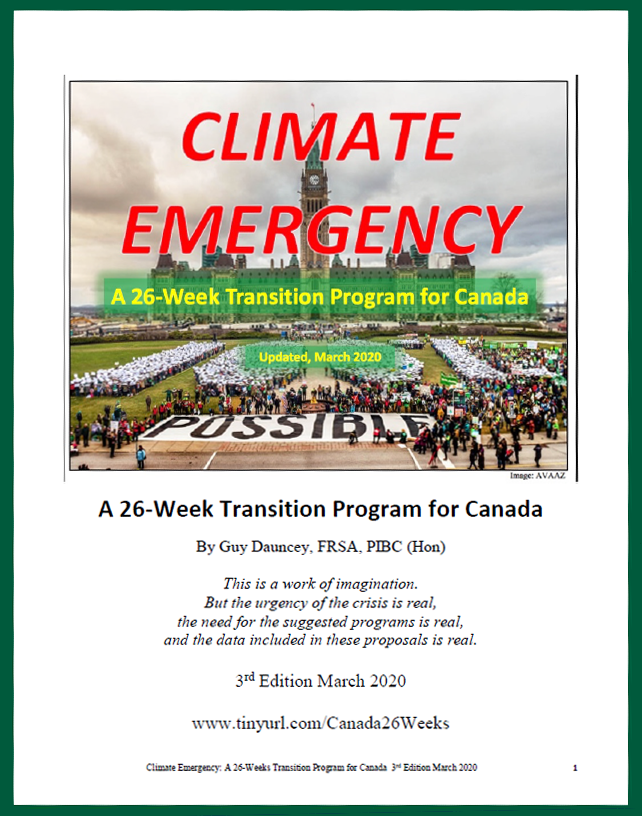
Climate Emergency: A 26-Week Transition Program for Canada

By Guy Dauncy - Canada 26 Weeks, March 2020

This is a work of imagination. But the urgency of the crisis is real, the need for the suggested programs is real, and the data included in these proposals is real.

What could the government of Canada do if its Ministers, MPs and civil servants really understood the severity of the climate emergency, and the urgency of the need? This paper shows how we could target a 65% reduction in emissions by 2030 and 100% by 2040. It proposes 164 new policies and programs, financed by $59 billion a year in new investments, without raising taxes or increasing public sector borrowing. The new programs and policies are announced every Monday morning between January and the end of June. To learn what they are, read on.

Read the text (PDF).

Texas: grids, blackouts, and green new deals

By Jonathan Neale - The Ecologist, February 17, 2021

The failure of the electricity grid in Texas, USA, and the rolling blackouts in the Midwest, are one more consequence of climate breakdown.

The root problem is that the Arctic is growing warmer. As it does so, paradoxically, there is less of a barrier preventing very cold weather in the far north from moving south. This extremely cold weather then blankets cities and downs where people live. 

Download Fight the Fire for free now.

The electricity grid in Texas simply cannot supply enough power for all the extra demands on heating. This is a problem what will grow much worse, and not just in Texas.

Complexity

But Fox News and the Governor of Texas are blaming the failure of the grid on the Green New Deal and renewable energy. That’s silly.

There is no Green New Deal in Texas. There are some wind turbines, that have apparently frozen. But the wind turbines in Canada and Antarctica have not frozen.

This is a problem caused by fossil fuels and privatized energy, not wind trubines.

But environmentalists have to be careful here, and we have to be up to speed on the full complexity of what a Green New Deal will mean for electricity grids.

That’s why The Ecologist is posting here the chapter on supergrids from my new book, Fight the Fire: Green New Deals and Global Climate Jobs.

Power

In what follows, I explain the difficulties in integrating 100 percent renewable energy into the grid, and how it can be done. I also show why that will be impossible if renewable energy and electricity supply are owned by private corporations.

The chapter is about supergrids around the world, but many of the examples come from the United States.

A rewired world does not mean that all energy will come from renewables. But it does mean that most energy will come from electricity, and all that electricity will come from renewables.

That will not be an easy thing to construct. We will need new national and international supergrids to integrate all these new kinds of power into new electrical supply systems. These will be qualitatively new undertakings.

The challenge of mixing together power from renewable energy is different in kind from mixing together energy from fossil fuels – and far more complex.

What’s ahead for Canadian climate and energy policy in 2021?

By Elizabeth Perry - Work and Climate Change Report, January 18, 2021

The Canadian government has a full climate change agenda ahead when it reconvenes Parliament on January 25, not the least of which will be the debate and passage of Bill C-12, the Net-Zero Emissions Accountability Act , analyzed by the Climate Action Network here. After its introduction in November, C-12 was criticized for lacking urgency and specific plans – for example, in an article by Warren Mabee in The Conversation which calls for three per cent to four per cent GHG reductions “every year, starting now.”

On December 11, the government released its latest climate plan, A Healthy Environment and a Healthy Economy, previously discussed in the WCR and noted primarily for its proposed carbon tax hike to $170 per tonne by 2050. According to “The good, the bad and the ugly in Canada’s 2030 climate plan” (The National Observer, Jan. 18): “The good news is that …The government’s recently announced A Healthy Environment and a Healthy Economy plan contains enough new climate policy proposals that, if implemented, will allow Canada to reach its 2030 target. The bad news is….Climate laws enacted by Canadian politicians to date don’t come anywhere close to meeting our 2030 target. With time running out and a gigantic emissions gap to close, Canada needs to enact climate laws now.”

The Biden Climate Plan: Part 2: An Arena of Struggle

By Jeremey Brecher - Labor Network for Sustinability, December 8, 2020

The climate plan released by Joe Biden in August presents a wide-ranging program for reducing greenhouse gas (GHG) emissions. The previous commentary, “The Biden Climate Plan: What it Proposes–Part 1” summarizes that plan. This commentary identifies the points of conflict on climate policy and related social policies that are likely to emerge within a Biden administration. It concludes by assessing how advocates of a Green New Deal can take advantage of the Biden program to fight for a climate-safe, worker-friendly, socially-just outcome. To read this commentary, please visit: this page.

The Road Towards a Carbon Free Society: A Nordic-German Trade Union Cooperation on Just Transition

By Dr Philipp Fink - Friedrich Ebrt Stiftung, December 2020

This project, “The Road Towards a Carbon Free Society A Nordic-German Trade Union Cooperation on Just Transition”, is a collaboration between the Council of Nordic Trade Unions (NFS), the Friedrich-Ebert Stiftung (FES) and the German Trade Union Confederation (DGB).
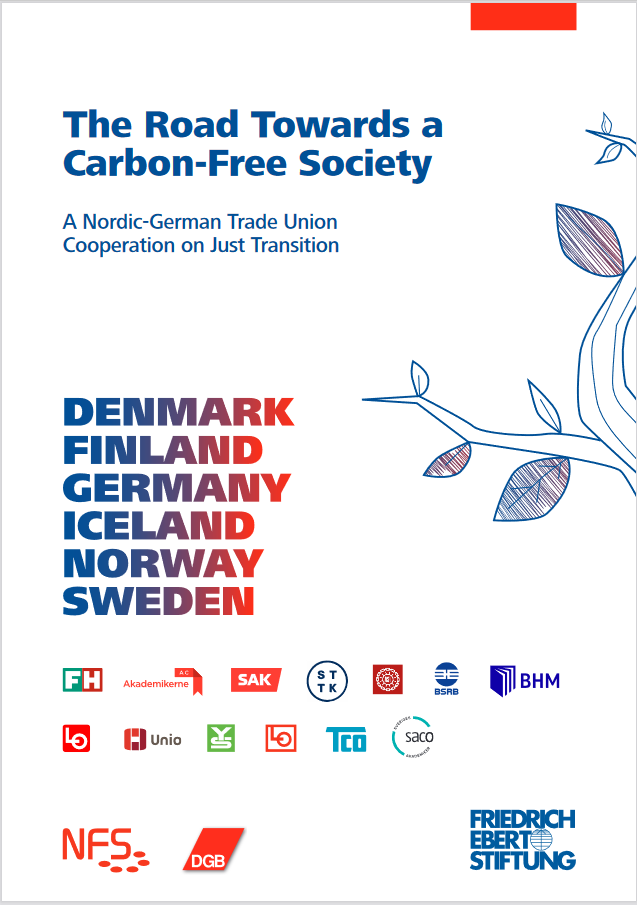
Represented by the Council of Nordic Trade Unions (NFS) in the project are 13 national Trade Union Confederations within NFS, from five Nordic Countries: Denmark (FH, Akademikerne), Finland (SAK, STTK), Iceland (ASÍ, BSRB, BHM), Norway (LO-N, Unio, YS) and Sweden (LO-S, TCO, Saco).

About the reports

A total of six country reports on the Just Transition path of the participating countries (Denmark, Finland, Germany, Iceland, Norway, and Sweden) have been formulated.

Each contains an analysis of the climate policies, economic and societal consequences, an evaluation of the respective national instruments and offers European perspectives.

The main findings of the country reports are brought together in a synthesis. It features policy recommendations that aim to help guide the transition to a decarbonised society and an economy that is just and sustainable. The reports and their results are presented and discussed in a series of events nationally as well as in terms of Nordic and European cooperation and at the international level.

Synthesis

A Just Transition towards a carbon neutral future is the most urgent environmental, social and economic issue of our times. This project aims to develop strategies and requirements from a trade union perspective on how to manage the process to a carbon free society.

The participating labour organisations are united in their vision that this goal can only be reached if the social costs of this transition process are socially mitigated.

This means harmonising efforts to combat climate change with the aim of ensuring decent working and living conditions.

To this end, the participating labour organisations have not only analysed their respective countries’ transition path towards a fossil free future but have also formulated joint policy recommendations for the national and European arenas, jointly adopted by the NFS and the DGB in November and December 2020.

The ensuing discussions and debate have strengthened the cooperation and dialogue between the Nordic and the German trade union movements on common challenges and solutions.

Read the text (Link).

The Biden Climate Plan: Part 1: What It Proposes

By Jeremey Brecher - Labor Network for Sustinability, December 1, 2020

This commentary by Jeremy Brecher analyzes Joe Biden’s “Plan for Climate Change and Environmental Justice” released in August. The following commentary, “The Biden Climate Plan: Part 2: An Arena of Struggle,” will consider the struggles that are likely to emerge over what parts of the plan can and should be implemented. To read this commentary, please visit: this page.

Karen Silkwood: A Radioactive Angel

NUMSA condemns NERSA for granting Eskom a tariff increase

By Irvin Jim - NUMSA, December 18, 2017

The National Union of Metalworkers of South Africa condemns the National Energy Regulator of South Africa (NERSA) for granting Eskom a 5.2% tariff increase. Last month NUMSA and the United Front participated in public consultations on Eskom’s request for a 19.9% price increase in the 2018/2019 financial year, where we rejected the request. Below are five reasons why NUMSA rejects any increase in the cost of electricity:

  1. NUMSA is dismayed by NERSA’s decision to grant Eskom an above inflation 5.2% price increase. By doing so the energy regulator is demonstrating it does not act in the interests of the working class majority and the public in general. Most companies big and small simply cannot afford it. The tariff hike is likely to result in plant closures which will lead to more job losses and stifle growth in the economy.
  2. For the working class, access to electricity, like water, is a human right and therefore we demand free electricity for the working class and the poor, and affordable electricity for industry. The working class majority and the poor cannot afford to pay and the state should not commodify this basic human necessity.
  3. Eskom is poorly led and its senior management team is drowning in scandals. The management team has shown that it cannot be trusted to clean up the power utility. The outcome of the disciplinary hearing of Matshela Koko, the suspended acting CEO shows proves this. Koko was disciplined for failing to declare a conflict of interest regarding his step-daughters ownership of shares in a company which was awarded more than a billion rand in contracts by an Eskom division which he led. He was cleared of all charges and the chairperson has reinstated him. This is despite the fact that the hearings have been discredited because of allegations of board interference, and threats of intimidation.
  4. Furthermore in a period of just two years Eskom has had three CEO’s. It’s CFO has been suspended under a cloud of corruption and mismanagement.  Clearly the participation of private companies such as KPMG, Mackenzie and Trillian in the looting of Eskom resources, and the undue influence of the Gupta family in allegations of state capture, is a clear indication that paying more for electricity means endorsing this blatant theft of our country’s resources.
  5. NERSA has demonstrated that it is completely oblivious to the suffering of the working class majority. StatsSA has confirmed that more than half the population lives in abject poverty; more than 36% of the working population is unemployed and the gap between the rich and poor is ever widening. To make matters worse the economy is in junk status and growth prospects are very low. The majority of the working class cannot afford to pay for electricity. Therefore an above inflation increase of 5.2% will compound all these problems and increase the chances of a violent explosion in the country.

NUMSA together with the United Front will be holding regular demonstrations and pickets across the country next year to highlight these issues. What we need is free, safe and accessible energy for the working class and the poor. We reject any price increase because it will put electricity out of economic reach of the majority of people in the country.

NUMSA and United Front Joint Memorandum on the Eskom tariff increase

By Irvin Jim, Trevor Ngwane, and Lindiwe Malindi - NUMSA, December 1, 2017

The National Union of Metal Workers (NUMSA) and the UNITED FRONT (UF) are extremely dismayed by the opportunistic call made by the Eskom board and its management to increase the electricity tariff by 19.9%. We view this demand by Eskom as nothing more than a gross abuse of power, and an attempt by the State Owned Entity (SOE) to hold the entire country and the economy hostage. This is being done by an entity which has been moving from one scandal to another with absolutely no leadership. In fact, it is extremely shocking that in a period of just two years, Eskom has changed CEO’s three times, and its CFO, Anoj Singh, has been suspended under a cloud of corruption and mismanagement allegations. But the same company and its board have the audacity to make an outrageous demand for a 19.9% tariff increase. They have no regard for the catastrophic implications which will trigger a national crisis of plant closures of small, medium and large companies; as well as causing retrenchments in all big companies. It will in fact destroy all opportunities to stimulate real economic growth and jobs.

Socio-Economic Situation

NUMSA and the UF are of the view that the economy has been in a technical recession for several months which means the working class of this country are facing a job-loss blood bath across all sectors. Currently more than 36% of the working population is unemployed, and the numbers are increasing. More than 30.4 million of the population lives in abject poverty; the average worker supports at least 5 dependents on his/her meagre income, and at least 26 million South Africans go to bed hungry. Any change in the price of electricity will compound all these problems and increase the chances of a violent explosion in the country.

It is against this backdrop that NUMSA and the United Front reject Eskom’s outrageous demand for a 19.9% tariff increase. The Eskom board are clearly completely deaf and blind to the suffering of the working class because they decided to make this proposal in spite of the fact that there is glaring evidence that the working class majority simply cannot afford an increase in the electricity rate. The United Front and NUMSA have decided to hold this demonstration to express our anger with Eskom for wanting to increase the suffering of the working class, by requesting a tariff increase.

Pages

The Fine Print I:

Disclaimer: The views expressed on this site are not the official position of the IWW (or even the IWW’s EUC) unless otherwise indicated and do not necessarily represent the views of anyone but the author’s, nor should it be assumed that any of these authors automatically support the IWW or endorse any of its positions.

Further: the inclusion of a link on our site (other than the link to the main IWW site) does not imply endorsement by or an alliance with the IWW. These sites have been chosen by our members due to their perceived relevance to the IWW EUC and are included here for informational purposes only. If you have any suggestions or comments on any of the links included (or not included) above, please contact us.

The Fine Print II:

Fair Use Notice: The material on this site is provided for educational and informational purposes. It may contain copyrighted material the use of which has not always been specifically authorized by the copyright owner. It is being made available in an effort to advance the understanding of scientific, environmental, economic, social justice and human rights issues etc.

It is believed that this constitutes a 'fair use' of any such copyrighted material as provided for in section 107 of the US Copyright Law. In accordance with Title 17 U.S.C. Section 107, the material on this site is distributed without profit to those who have an interest in using the included information for research and educational purposes. If you wish to use copyrighted material from this site for purposes of your own that go beyond 'fair use', you must obtain permission from the copyright owner. The information on this site does not constitute legal or technical advice.