




You are here
May Day
By Lynx - Ideas and Action, May 1, 2018
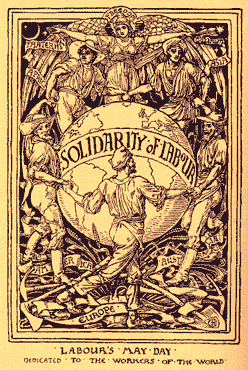 May Day as we know it began as ancient pagan commemoration of the start of spring, the season in which we reap the bounty of the Earth through cultivation of the soil, and rejoice in fertility and the beauty of life born anew after winters onerous cold. The Roman festival of the Floralia, in contrast to others dominated by the high-born and aristocratic, was raucous and licentious, drenched in the spirit of the plebeians, and was paid for by the fines levied for disturbing or trespassing on public lands. Even prostitutes and slaves were allowed participation.
As Europe was Christianized and finally secularized, these pagan holidays took on new meaning and expression, but retained much of the old symbolism. May 1st eventually became a feast day for St. Joseph the Worker, and although Pope Pius IX’s prayer written for that day contains admonitions to unquestioning obedience that most anarchists and revolutionary socialists would rightly find contemptible, the Judeo-Christian tradition that the West inherited contains within it the seeds of antiauthoritarian philosophy. Indeed Bakunin called Christianity “the first intellectual revolt of the proletariat”.
Today we circle the streets in lieu of the Maypole, celebrating the martyrs of Haymarket Square and all that have fallen and sacrificed their freedom fighting for a society based on free, non-hierarchical structures. Today we struggle to hasten the end of a system that is wreaking havoc upon our planet, and in the ruthless pursuit of profit is depriving us of our sacred birthright as human beings to manage the fruits of the commons in a just and sustainable way.
The demonstrators in Haymarket Square in 1886 were struggling for the 8 hour workday, something many people take entirely for granted. The repressive acts that followed catalyzed an international struggle, nurtured solidarity, and shaped the revolutionary consciousness of those who were to become important labor figures of the early twentieth century, like Emma Goldman who called the reaction, “The events that had inspired my spiritual birth and growth.” For fifty years after the Haymarket Affair, state violence directed at the labor movement alongside an extravagant propaganda campaign to demonize those who identified with the ideas of socialism and trade-unionism was incredibly effective.
The spontaneous, radical unionism and organizing during the Depression scared the owners and state managers, and there was palpable fear that the capitalist system itself would collapse. The New Deal Coalition’s recognition of labor unions and the National Labor Relations board created to settle disputes, “would channel the workers’ insurrectionary energy into contracts, negotiations, union meetings, and try to minimize strikes, in order to build large, influential, even respectable organizations” as Howard Zinn wrote. This led to the co-opting and blunting of the radical energy that won the major labor struggles of the early 1900’s, and consequently to the paralysis, bureaucratization, and class collaborationism we see in mainstream American labor now. The postwar period of American history has seen increasing state repression and surveillance at home, continuous war abroad enriching the defense industrial base, and the deregulation and internationalization of capital, pitting a disorganized American working class against an incredibly organized ruling class intent on maintaining its privilege.
The dominant systems of the twentieth century, corporate capitalism and state socialism, have both proven wasteful, unsustainable, and hostile to human dignity. Now is the time for the working people of the world to figure out what kind of world we want to live in, dismantle the primitive edifice of domination and authority, and reap the shared harvest of our planet and our labor in peace.
For a world without bosses, bureaucrats and states!
Workers Solidarity Alliance
https://workersolidarity.org
Disclaimer: The views expressed here are not the official position of the IWW (or even the IWW’s EUC) and do not necessarily represent the views of anyone but the author’s.
The Fine Print I:
Disclaimer: The views expressed on this site are not the official position of the IWW (or even the IWW’s EUC) unless otherwise indicated and do not necessarily represent the views of anyone but the author’s, nor should it be assumed that any of these authors automatically support the IWW or endorse any of its positions.
Further: the inclusion of a link on our site (other than the link to the main IWW site) does not imply endorsement by or an alliance with the IWW. These sites have been chosen by our members due to their perceived relevance to the IWW EUC and are included here for informational purposes only. If you have any suggestions or comments on any of the links included (or not included) above, please contact us.
The Fine Print II:
Fair Use Notice: The material on this site is provided for educational and informational purposes. It may contain copyrighted material the use of which has not always been specifically authorized by the copyright owner. It is being made available in an effort to advance the understanding of scientific, environmental, economic, social justice and human rights issues etc.
It is believed that this constitutes a 'fair use' of any such copyrighted material as provided for in section 107 of the US Copyright Law. In accordance with Title 17 U.S.C. Section 107, the material on this site is distributed without profit to those who have an interest in using the included information for research and educational purposes. If you wish to use copyrighted material from this site for purposes of your own that go beyond 'fair use', you must obtain permission from the copyright owner. The information on this site does not constitute legal or technical advice.
 This site is not the official webpage of the Industrial Workers of the World.