You are here

Inflation Reduction Act (IRA)
The Lithium Problem: An Interview with Thea Riofrancos

By Alyssa Battistoni and Thea Riofrancos - Dissent, Spring 2023

Can we rapidly reduce carbon emissions while minimizing the damage caused by resource extraction?

After years of outright climate denial and political intransigence, the development of renewable energy is finally underway. When it comes to transportation—the number one source of U.S. carbon emissions—the strategy for decarbonization has focused heavily on replacing gas-powered cars with rechargeable electric vehicles. The Inflation Reduction Act offers billions of dollars of subsidies for both producers and consumers of EVs, including a $7,500 tax credit for buying new EVs made in the United States. The infrastructure bill passed in late 2021 included $5 billion to help states build a network of EV recharging stations. New York and California have announced bans on the sale of vehicles with internal combustion engines beginning in 2035. Half of this year’s Superbowl car ads touted electric vehicles. By 2030, it is estimated that electric vehicles will make up half of U.S. car sales.

For our reliance on privatized transportation to remain the same, everything else will have to change. We’re already seeing concerns about shortages of “critical minerals” necessary for batteries and other renewable technologies. Based on current consumption patterns, for example, U.S. demand for the lithium used in batteries would require three times the existing global supply—which comes primarily from Australia, Latin America, and China—by 2050. In anticipation of booming demand, a flurry of new mining operations has begun around the world—and so have protests by those worried that mines will disturb ecosystems, contaminate water supplies, generate toxic waste, and disrupt local livelihoods.

What does the current trajectory of the “green energy transition” mean for global environmental justice? What other options are there? Is it possible to rapidly reduce carbon emissions while also minimizing extraction and maintaining—or even increasing—people’s ability to move freely and safely?

A new report from the think tank Climate and Community Project presents the data behind different visions of the green future. A scenario in which the United States reduces car dependency by improving public transit options, density, and walkability could see a 66 percent decrease in lithium demand compared to a business-as-usual model. Even just reducing the size of U.S. vehicles and batteries could potentially reduce lithium use by as much as 42 percent in 2050. In other words, the choices Americans make about domestic transportation, housing, and development matter worldwide. In this interview, the report’s lead author, political scientist Thea Riofrancos, explains the implications of its findings for climate and environmental politics in the United States and around the planet.

The IRA Is an Invitation to Organizers

By Kate Aronoff - Dissent, Spring 2023

The Inflation Reduction Act presupposes a private sector–led transition. But battles over its implementation could build the political constituencies and expertise needed to take on the fossil fuel industry.

The Inflation Reduction Act would not have happened without the movement for a Green New Deal, but it shouldn’t be confused for one. The climate left (broadly defined) now faces a novel problem: how to deal with having won something—and keep fighting for more.

It’s understandably hard for those who supported Green New Deal proposals for transformative investments in public goods to see the IRA—a bundle of tax credits whose benefits accrue largely to corporations—as a consolation prize. For the many climate hawks galvanized by Bernie Sanders’s bid for the Democratic nomination in 2020, it’s also a far cry from what, for a moment, looked to be within striking distance: governing power.

In some ways the IRA’s passage—and Republicans taking back the House a few months later—marks a return to normal for the climate left. But Democratic Party politics have changed. Top Democratic policymakers openly discuss the need for industrial policy (what one International Monetary Fund paper dubs “the policy that shall not be named”), and hundreds of billions of dollars will soon go out the door to build up domestic supply chains for things like battery storage and critical minerals. In practice, however, that means letting the public sector shoulder the risks of an energy transition while the private sector reaps the rewards. By all accounts the White House seems to imagine climate policy as the project of turning clean energy technologies into a more attractive asset class for investors.

None of this obviates the need for a Green New Deal. Every path to staving off runaway climate catastrophe runs through enormous investments to scale up zero-carbon energy and a simultaneous, brutal confrontation with the fossil fuel industry. Even given unlimited resources, the former simply won’t overpower the latter fast enough. Trillions of dollars in future revenue—coal, oil, and gas that has yet to be dug up and burned—need to be made worthless, even when the market disagrees. Only the state can keep a company from doing what is profitable.

The Green New Deal’s basic political calculus for making the state do that still holds, too: getting to zero emissions requires giving people a reason to be excited about the awe-inspiring project of decarbonization and to come to its defense at the ballot box and beyond. Decarbonization should make the kinds of changes in people’s lives that inspire them to name children after the president they deem responsible. No one will name their kid Biden because they got a $7,500 rebate on a Chevy Bolt.

If winning a Green New Deal is still necessary (it is), then the path to it will be a strange one. A product of the left having shifted the debate on climate and economic policy is that it’s also created a new organizing challenge for itself: how do you build durable democratic majorities for climate action as political elites align around a fundamentally undemocratic vision for what decarbonization should look like?

Biden's clean energy factory jobs may elude U.S. union workers

By Nichola Groom - Reuters, March 6, 2023

March 6 (Reuters) - President Joe Biden has pledged that fighting climate change will deliver millions of middle-class jobs with good wages to Americans with union membership cards.

But in the six months since passage of Biden's signature climate change law, a large majority of the $50 billion of announced investments in domestic manufacturing to support the clean energy transition has been in states with laws that make it harder for workers to unionize, according to a Reuters analysis of corporate and state announcements.

Biden's Inflation Reduction Act (IRA) includes tax credits for businesses that produce clean energy components in the United States, and provides higher credits for developers of renewable energy projects if they use products made domestically.

Of the more than 50 EV battery, solar panel and other factories announced since passage of the Act in August, 83% are located in so-called right to work states, which bar companies from requiring workers to pay union dues as a condition of employment, according to a Reuters review of company announcements.

Those facilities represent $43.5 billion in investment, or 88% of the total amount companies have said they will invest.

Reuters came up with the list of projects by crosschecking data compiled by researcher Jack Conness with official company announcements and information on right to work states.

The Path to a Green New Deal Must Involve a Series of Separate Bills

By C.J. Polychroniou - Truthout, March 6, 2023

The Infrastructure Investment and Jobs Act and the Inflation Reduction Act are two landmark bills with the potential to carry significant economic and environmental benefits. They also speak volumes of the role that progressive voices and organizations can play in helping to create sustainable and equitable economic growth and in powering a safer future. Of course, they are imperfect bills, points out National Director of the Green New Deal Network Kaniela Ing in this exclusive interview for Truthout, but they are important stepping stones toward a Green New Deal and advancing justice for frontline and BIPOC (Black, Indigenous, people of color) communities. For now, however, the most immediate concern, Ing says, is making sure that “the full benefits of the Inflation Reduction Act and Infrastructure Investment and Jobs Act reach communities across the country and have a positive impact on the planet and its people.”

Ing was a founding member of the Green New Deal Network (GNDN) as the climate justice director for People’s Action, where he led campaigns to combat climate change. While at People’s Action, Ing co-created and led mass mobilizations around the People’s Bailout and THRIVE Agenda, which largely shaped the suite of federal legislation.

C.J. Polychroniou: Last year, the United States Congress passed the largest federal investment to tackle climate change, the Inflation Reduction Act of 2022. This was preceded by Congress passing the Infrastructure Investment and Jobs Act of 2021, another bill breaking spending records to restore and modernize our infrastructure. What role did the Green New Deal Network and other movement organizations have in passing these bills?

Kaniela Ing: The historic levels of investments passed in the last two years is a direct result of communities across the country fighting for climate, care, jobs and justice. Coalitions like mine have built on the decades of work by leaders and activists, advocating that everyone have access to essential goods and services, be protected from crises, and have the opportunity to thrive.

Since 2020, organizations and activists within the Green New Deal Network (GNDN) have fought for Congress to pass a package that tackles the overlapping crises facing our nation: climate chaos, economic instability, racial injustice, outdated infrastructure and corporate influence over our government. The Green New Deal Network — and its 15 national organizations and 24 state coalitions — crafted the THRIVE Act, a $10 trillion climate, care, jobs and justice bill that would create enough jobs to end unemployment; build modern, reliable infrastructure; and invest in community resources while ensuring labor and justice protections.

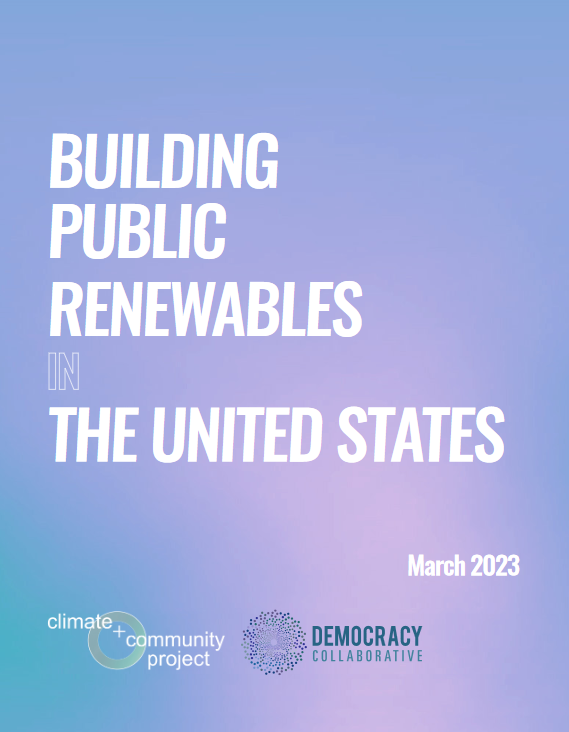
New Report: Building Public Renewable Energy

By Johanna Bozuwa, Sarah Knuth, Grayson Flood, Patrick Robbins, and Olúfẹ́mi O. Táíwò - Climate & Community Project, March 2023

The Inflation Reduction Act provides tax incentives for corporate investment in renewable energy — but what if “we the people” created our own publicly owned and community controlled renewable energy system?

Building Public Renewables in the United States, a new report from the Climate and Community Project, proposes a “Federal Public Power Program [that] would inject straightforward, public investment into the electricity system.”

The report proposes to “counter the monopolized, fossil-fueled, and profit-driven status quo of today” with a federal program that would invest in:

  • Existing publicly owned and cooperative utility energy providers

  • Tribal Nations

  • Newly authorized Regional Power Authorities

  • Grants for democratic development and transparency

The report says, “The transition to renewable energy requires far more than just a technological swap driven by private companies. It requires reordering the electricity system so that it values good-paying jobs, justice, and democracy.”

A federal program could require projects to provide good jobs, prioritize funds to disadvantaged communities, and demand real accountability to the community.

Download this document (PDF).

White Energy Workers of the North, Unite? A Review of Huber's Climate Change as Class War

By Michael Levien - Historical Materialism, March 2023

Review of Matthew Huber, (2022) Climate Change as Class War: Building Socialism on a Warming Planet, London: Verso.
The year-long American saga that culminated in the Inflation Reduction Act (IRA) underscored the difference between two ways of mitigating climate change at the national level. The first is elite climate policy in which wonks and technocrats come up with the smartest policies to incentivise private capital to invest in the right technologies. This is, ultimately, what we got with the IRA, which has been accurately characterised as the triumph of ‘green industrial policy’.1 The second is popular climate politics which seeks to build a broad political coalition for decarbonisation by tying it to social programmes that directly improve people’s lives. This is the idea behind the Green New Deal, which to a surprising extent made its way into the initial Build Back Better bill before Joe Manchin got his hands on it. Matthew Huber’s book Climate Change as Class War provides a powerful critique of the first while advancing a labour-centred version of the second.

Huber lands many good punches against what he calls professional-class climate politics. Building on the Ehrenreichs’ concept of the professional managerial class (PMC),2 Huber argues that PMC climate politics characteristically over-emphasises that class’ stock-in-trade: education and credentials. In their hands, climate politics thus becomes a matter of knowledge (communicating the science) more than one of power (tackling the class power of the fossil-fuel industry). PMC policy technocrats further internalise neoliberal logic with their obsession with pricing carbon – a policy that ultimately balances the carbon budget on the backs of working-class consumers. In its more radical manifestations, PMC environmentalism – degrowth being the main target here – espouses an ascetic ‘politics of less’ that has no resonance with working-class people who already do not have enough. This type of environmental politics, Huber argues, explains why the right has been able to mobilise the working class against the environment.

By way of alternative, Huber advances a theory of working-class climate politics which he dubs ‘proletarian ecology’. The starting point, developed over Chapters 1 and 2, is to recognise that industrial fossil capital is responsible for the vast majority of emissions. As Huber sketches with discussions of the cement and fertiliser industries – for the latter, Huber draws on some interviews with managers of a fertiliser plant in Louisiana – their carbon intensity is not a matter of greed but of the structural imperative to produce surplus value, and therefore will not be halted (as opposed to greenwashed) by any amount of shaming. Thus, ‘Climate change requires an antagonistic approach towards owners of capital in the “hidden abode” of production’ (p. 106). The problem is that ‘the climate movement today – made up of professional class activists and the most marginalized victims of climate change – is too narrowly constructed to constitute a real threat to the power of industrial capital’ (p. 69).

This brings us to the bold and controversial claim of Climate Change as Class War: it is the working class (and organised labour in particular) that must be the main agent of radical climate politics, not the diverse coalitions of ‘marginalised groups’ – which includes Indigenous movements against pipelines and Black-led environmental justice organisations – who are currently the vanguard of the climate justice movement. What Huber calls ‘livelihood environmentalism’ only sees the working class as having environmental interests when their communities’ land, water or health are directly threatened (p. 195). Huber’s theory of proletarian ecology, by contrast, proceeds from the broader recognition that ‘a defining feature of working-class life under capitalism is profound alienation from the ecological conditions of life itself’ (p. 188). Thus ‘a working-class interest in ecology will emerge not from the experience of environmental threats, but from a profound separation from nature and the means of subsistence’ (pp. 181–2). Rather than defending bodies or landscapes, it will focus on the working class’s material interest in decommodifying the means of subsistence (p. 196).

As Oil Companies Stay Lean, Workers Move to Renewable Energy

By Clifford Krauss - New York Times, February 27, 2023

Solar, wind, geothermal, battery and other alternative-energy businesses are adding workers from fossil fuel companies, where employment has fallen.

Emma McConville was thrilled when she landed a job as a geologist at Exxon Mobil in 2017. She was assigned to work on one of the company’s most exciting and lucrative projects, a giant oil field off Guyana.

But after oil prices collapsed during the pandemic, she was laid off on a video call at the end of 2020. “I probably blacked out halfway,” Ms. McConville recalled.

Her shock was short-lived. Just four months later, she landed a job with Fervo, a young Houston company that aims to tap geothermal energy under the Earth’s surface. Today she manages the design of two Fervo projects in Nevada and Utah, and earns more than she did at Exxon.

“Covid allowed me to pivot,” she said. “Covid was an impetus for renewables, not just for me but for many of my colleagues.”

Oil and gas companies laid off roughly 160,000 workers in 2020, and they maintained tight budgets and hired cautiously over the last two years. But many renewable businesses expanded rapidly after the early shock of the pandemic faded, snapping up geologists, engineers and other workers from the likes of Exxon and Chevron. Half of Fervo’s 38 employees come from fossil fuel companies, including BP, Hess and Chesapeake Energy.

Executives and workers in energy hubs in Houston, Dallas and other places say steady streams of people are moving from fossil fuel to renewable energy jobs. It’s hard to track such movements in employment statistics, but the overall numbers suggest such career moves are becoming more common. Oil, gas and coal employment has not recovered to its prepandemic levels. But the number of jobs in renewable energy, including solar, wind, geothermal and battery businesses, is rising.

There’s a big pot of climate bill money waiting to be seized: activists can’t miss the opportunity

By Jeff Ordower and Daniel Hunter - Waging Nonviolence, February 22, 2023

The Inflation Reduction Act wasn't written for climate justice, but there’s a ton of money for organizers and movement players to access.

Yes, the Inflation Reduction Act is the most consequential piece of climate legislation in the U.S. Yes, it’s also the only federal legislation. Yes, it’s imperfect. Yes, parts of it are downright vile. Yes, the negotiations exacerbated tensions between insider green organizations and those on the frontlines. 

But let’s be real, nothing more is going to pass at the federal level in the foreseeable future. So now that the IRA is the law of the land, how do organizers and movement players work with it? 

As long-time organizers and climate justice activists, we see organizing opportunities in the roughly $390 billion in climate funding available. As an analysis from Just Solutions points out, the bill was not written for climate justice. But there’s a ton of money that suddenly we can access for poor and disenfranchised communities — and it would be a wasted opportunity to leave that money on the table.

With all its limitations, the IRA can further our campaigns if we use the opportunity.

Renewables industry should engage community colleges to address labor shortage: development official

By Diana DiGangi - Utility Dive, February 16, 2023

Renewable energy developers must meet registered apprenticeship requirements to qualify for certain Inflation Reduction Act tax credits, but they struggle to find workers, an attorney said.

The clean energy industry is booming, but the labor supply remains low. Partnering with community colleges to offer pathways to employment could help the industry meet its increasing demand for workers, said a workforce development official with the Foundation for California Community Colleges. He was speaking at a workforce development session at Intersolar North America on Tuesday.

Community colleges are a source of “untapped talent” and are “built to be nimble” in a way that other sources of higher education may not be, Tim Aldinger, executive director of workforce development for the FCCC, said at the event.

“For the last year and a half, we’ve had more jobs posted than people looking for them. And we are also in a decade-long process where people [nationwide] are opting out of the labor market,” Aldinger said. “And this is particularly prevalent, actually, among working-age men, particularly in jobs that were called ‘blue-collar’ work.”

Though the renewable energy sector has become a significant generator of new jobs, and the Inflation Reduction Act bolstered this growth with tax credits that incentivized new projects and registered apprenticeship programs, the wind energy industry reported difficulty finding qualified applicants in a November report.

'Only the Beginning': Democrats' IRA Set to Create 100,000+ US Green Jobs

By Brett Wilkins - Common Dreams, February 6, 2023

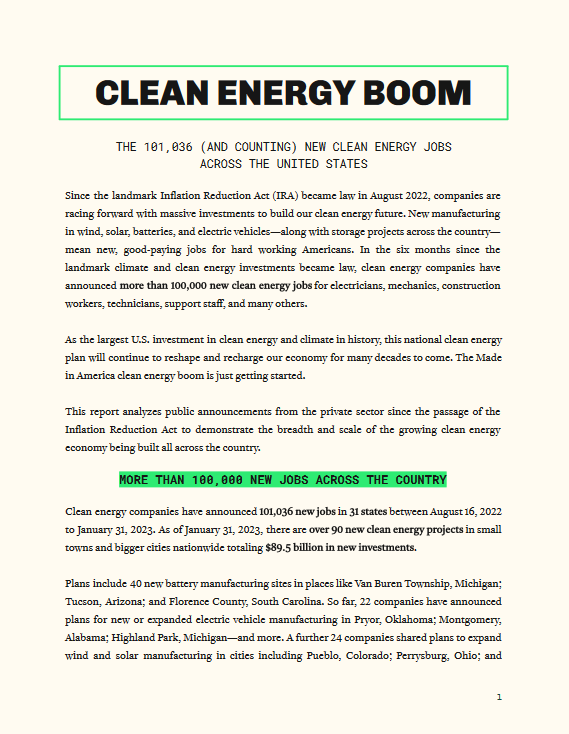
A leading climate action group on Monday published a report revealing that the 94 clean energy projects announced since U.S. President Joe Biden signed the Inflation Reduction Act into law last August are set to create more than 100,000 green jobs.

Climate Power—which published the report as part of a new six-figure national ad campaign touting the growing green economy—said that since the IRA became law without any Republican support last year, "companies are racing forward with massive investments to build our clean energy future."

"New manufacturing in wind, solar, batteries, and electric vehicles—along with storage projects across the country—mean new, good-paying jobs for hard-working Americans," the group continued. "In the six months since the landmark climate and clean energy investments became law, clean energy companies have announced more than 100,000 new clean energy jobs for electricians, mechanics, construction workers, technicians, support staff, and many others."

"As the largest U.S. investment in clean energy and climate in history, this national clean energy plan will continue to reshape and recharge our economy for many decades to come," Climate Power added.

While green groups have generally praised the IRA's historic $369 billion investment in renewable energy production and innovation, activists have condemned provisions including fossil fuel tax credits and mandatory lease sales on public lands and at sea.

The 94 new clean energy projects in the Climate Power report—which are spread across 31 states and have a combined investment value of $89.5 billion—include:

Forty new battery manufacturing sites in places like Van Buren Township, Michigan; Tucson, Arizona; and Florence County, South Carolina. So far, 22 companies have announced plans for new or expanded electric vehicle manufacturing in Pryor, Oklahoma; Montgomery, Alabama; Highland Park, Michigan—and more. A further 24 companies shared plans to expand wind and solar manufacturing in cities including Pueblo, Colorado; Perrysburg, Ohio; and Georgetown, Texas. The majority of the projects are in seven states—Arizona, Georgia, Michigan, Ohio, South Carolina, Tennessee, and Texas.

"Thanks to President Biden's affordable clean energy plan, businesses are investing in manufacturing like never before, and planning to create good-paying jobs in every corner of the country," Climate Power executive director Lori Lodes said in a statement.

"This is only the beginning—we're months after the passage of the Inflation Reduction Act and we're already at the precipice of a renewed manufacturing, made-in-America boom that will create opportunities for millions of Americans, all while reducing toxic emissions that harm the health and wellbeing of our communities," Lodes added.

Last month, the International Energy Agency said in a report that "the world is at the dawn of a new industrial age—the age of clean energy technology manufacturing," and that green manufacturing jobs will more than double by the end of the decade if countries worldwide live up to their climate and energy pledges—a huge "if" given that global emissions remain at record levels.

Read the report (Link).

Pages

The Fine Print I:

Disclaimer: The views expressed on this site are not the official position of the IWW (or even the IWW’s EUC) unless otherwise indicated and do not necessarily represent the views of anyone but the author’s, nor should it be assumed that any of these authors automatically support the IWW or endorse any of its positions.

Further: the inclusion of a link on our site (other than the link to the main IWW site) does not imply endorsement by or an alliance with the IWW. These sites have been chosen by our members due to their perceived relevance to the IWW EUC and are included here for informational purposes only. If you have any suggestions or comments on any of the links included (or not included) above, please contact us.

The Fine Print II:

Fair Use Notice: The material on this site is provided for educational and informational purposes. It may contain copyrighted material the use of which has not always been specifically authorized by the copyright owner. It is being made available in an effort to advance the understanding of scientific, environmental, economic, social justice and human rights issues etc.

It is believed that this constitutes a 'fair use' of any such copyrighted material as provided for in section 107 of the US Copyright Law. In accordance with Title 17 U.S.C. Section 107, the material on this site is distributed without profit to those who have an interest in using the included information for research and educational purposes. If you wish to use copyrighted material from this site for purposes of your own that go beyond 'fair use', you must obtain permission from the copyright owner. The information on this site does not constitute legal or technical advice.