You are here

cooperatives

Seedlings of Solidarity: PASA 2026

By Lindsey Disler and Mat Forth - Industrial Worker, April 16, 2026

Members who attend educational and organizing events share what they learned with the members whose dues funded their attendance. This model seeks to recognize and follow the “each one teach one” philosophical tradition rooted in the cooperative and agricultural work of George Washington Carver, who believed that practical knowledge shared freely was the foundation of community survival. With that in mind, here is what I brought home from the 2026 Pennsylvania Association for Sustainable Agriculture, or PASA.

PASA “supports sustainable farms and equitable food systems through farmer-driven education, research, and community.” I particularly admire their focus on online and in-person workshops and events grounded in research on sustainable environmental practices. I’ve attended classes and field days they’ve hosted, such as tractor safety and small engine repair, or walking through the basics of chicken tractors, rotational grazing, and other practices that benefit both soil health and the broader environment.

One of the best parts of PASA is their yearly gathering in Lancaster, PA, where people from throughout the food system come together to compare notes on what they saw and learned over the past year, sharing what’s working in sustainable agriculture and what’s helping build more equitable food systems in their communities. February, though, is mostly a time for planning and getting ready for the next season; things are at least a little slower, and that gathering becomes a rare chance to socialize with other workers you otherwise wouldn’t meet or barely get to see.

One of the reasons we’ve started our organizing in sustainable agriculture, cooperative, and food sovereignty spaces is not only because we care about non-extractive, even regenerative, practices for the environments in which we live, work, and grow, but also how that relates to non-extractive, even regenerative, practices in workplaces and communities. It’s not hard, in conversation with others in these spaces, to draw the same parallels of environmental sustainability toward labor sustainability: that the same principles calling us toward sustainable, non-extractive, even regenerative relationships with the land also apply to how we structure work and treat the people doing it.

Working-Class Environmentalism

Bypassing the Culture Wars to Energize Rural-led Climate Solutions

A Public, Renewable Power Future: Moving Beyond Monopoly, Fossil-Fueled Utilities

The IRA Is an Invitation to Organizers

By Kate Aronoff - Dissent, Spring 2023

The Inflation Reduction Act presupposes a private sector–led transition. But battles over its implementation could build the political constituencies and expertise needed to take on the fossil fuel industry.

The Inflation Reduction Act would not have happened without the movement for a Green New Deal, but it shouldn’t be confused for one. The climate left (broadly defined) now faces a novel problem: how to deal with having won something—and keep fighting for more.

It’s understandably hard for those who supported Green New Deal proposals for transformative investments in public goods to see the IRA—a bundle of tax credits whose benefits accrue largely to corporations—as a consolation prize. For the many climate hawks galvanized by Bernie Sanders’s bid for the Democratic nomination in 2020, it’s also a far cry from what, for a moment, looked to be within striking distance: governing power.

In some ways the IRA’s passage—and Republicans taking back the House a few months later—marks a return to normal for the climate left. But Democratic Party politics have changed. Top Democratic policymakers openly discuss the need for industrial policy (what one International Monetary Fund paper dubs “the policy that shall not be named”), and hundreds of billions of dollars will soon go out the door to build up domestic supply chains for things like battery storage and critical minerals. In practice, however, that means letting the public sector shoulder the risks of an energy transition while the private sector reaps the rewards. By all accounts the White House seems to imagine climate policy as the project of turning clean energy technologies into a more attractive asset class for investors.

None of this obviates the need for a Green New Deal. Every path to staving off runaway climate catastrophe runs through enormous investments to scale up zero-carbon energy and a simultaneous, brutal confrontation with the fossil fuel industry. Even given unlimited resources, the former simply won’t overpower the latter fast enough. Trillions of dollars in future revenue—coal, oil, and gas that has yet to be dug up and burned—need to be made worthless, even when the market disagrees. Only the state can keep a company from doing what is profitable.

The Green New Deal’s basic political calculus for making the state do that still holds, too: getting to zero emissions requires giving people a reason to be excited about the awe-inspiring project of decarbonization and to come to its defense at the ballot box and beyond. Decarbonization should make the kinds of changes in people’s lives that inspire them to name children after the president they deem responsible. No one will name their kid Biden because they got a $7,500 rebate on a Chevy Bolt.

If winning a Green New Deal is still necessary (it is), then the path to it will be a strange one. A product of the left having shifted the debate on climate and economic policy is that it’s also created a new organizing challenge for itself: how do you build durable democratic majorities for climate action as political elites align around a fundamentally undemocratic vision for what decarbonization should look like?

How worker ownership builds community wealth and a more just society

By Pamela Haines - Waging Nonviolence, February 3, 2023

Community wealth building initiatives are taking hold in cities across the world, strengthening worker pay, local economies and democracy.

A recent help-wanted ad for a laundry worker in Cleveland contained some unusual language, asking prospective candidates: “Have you ever wanted to work for a company that is 90 percent employee-owned? What about a company that offers a program to help you become a homeowner?” The ad went on to identify Evergreen Cooperative Laundry as the only employee-owned commercial laundry firm in the country, citing a commitment to building the wealth and careers of its employees.

Founded in Cleveland in 2009, Evergreen laundry lies at the heart of a movement that has now spread around the world. This attention to community wealth building is providing a 21st century model for Gandhi’s “constructive program,” which — along with nonviolent direct action — powered his overall campaign to overcome the political and economic oppression of colonialism.

The cooperative movement in the Rust Belt city of Cleveland has deep roots in community struggle for shared wealth. Its earliest origins are in the Mondragon co-op movement of the Basque Country in northern Spain, where tens of thousands of workers are organized into a vast co-op network that has flourished since the 1950s. Here in the U.S., when steel companies were closing down throughout the Ohio Valley in the 1970s — and moving to non-union, lower-wage regions in the south, and then overseas — a small band of activists promoted the idea of worker ownership.

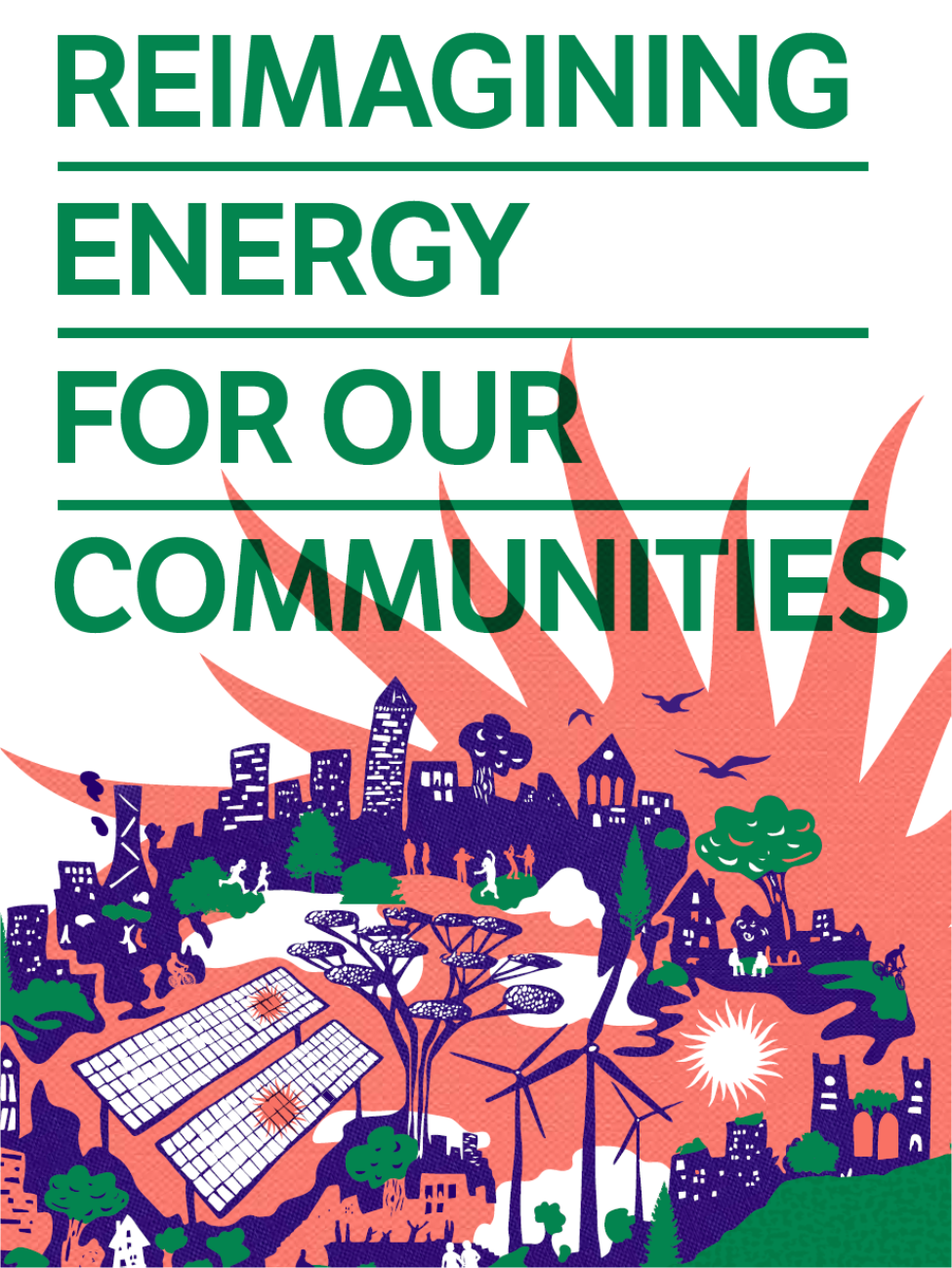
Reimagining Energy For Our Communities

By Crystal Huang, Jessica Tovar, Nora Elmarzouky, Ruth Santiago, and Al Weinrub - The Energy Democracy Project, February 2023

The energy systems in place today, in which energy development, control, ownership, and decision-making resides within Wall Street and corporate electric utilities, negatively impact the health and safety of communities, and fail to provide the energy needed to live, especially in the face of climate disaster.

A product of deep collaboration between grassroots organizations, the REFOCUS zine is a graphic tool meant to be shared with community, teams, and anyone interested in understanding the path towards energy justice.

Download the zine to learn how Energy Democracy work is connected from Alaska to Puerto Rico, and build a movement for energy democracy with your community! 

Download a copy of this publication here (PDF).

NC’s Industrial Commons creates thriving new communities from the ashes of old industries

By Jeffrey Howard - Shareable, June 23, 2022

In the foothills of western North Carolina, the small town of Morganton is home to a growing co-op movement that’s reinvigorating the region’s once-struggling textile and furniture manufacturing industries, and refashioning them around egalitarianism and localism. 

This expanding collective of frontline workers and artists is changing the way people there view industry and the nature of work. 

From sharing to solidarity

The birthplace of bluegrass and home to the oldest mountain range east of the Mississippi River, Southern Appalachia is not only fertile soil for the sharing economy, but a co-op-driven movement known as the solidarity economy. 

Aimed at generating locally rooted wealth and ensuring its equitable distribution, the solidarity economy is fiercely democratic. 

For Sara Chester, co-executive director and founder of The Industrial Commons (TIC), a 501(c)3 organization that fosters employee ownership, in a solidarity economy “workers are appreciated not just for their labor but their ideas, insights, and innovations. Workers are not just a piece of the business, they are the reason the business exists.”

Sometimes referred to as the co-op model, this approach is about creating prosperous and resilient communities by emphasizing worker agency and ownership, environmental sustainability, and the value of place. 

The Power of Community Utilities

By Thomas Hanna, Johanna Bozuwa, and Raj Rao - The Climate and Community Project, April 2022
Publicly and cooperatively owned electric utilities (community utilities) have the potential to demonstrate what an equitable, clean energy system looks like in the United States. They could become powerful “anchor institutions” in their community by grounding their decisions in democratic governance and community partnership, affordable energy and community wealth building, and access to renewable energy.

The United States urgently needs to transition off of fossil fuels and onto clean sources of energy (especially renewable energy) to maintain a livable climate. As of 2020, only around 20% of US electricity generation is from renewable energy sources. Energy utilities – the companies that run our power systems – have enormous control over the scope and scale of the transition, but have often dragged their feet or even fought against clean energy. Not only does their inaction imperil the very future of humanity, but it directly harms families – often Black, Indigenous, low income, or otherwise marginalized – who live in the shadow of toxic power plants. The current US energy system is dirty and expensive. 31% of households in the country have to make the choice between buying groceries or paying their energy bills. In response, communities across the country are beginning to mobilize to demand an energy transition.

We have a powerful tool to accelerate the energy transition in a way that builds community wealth and energy justice in our communities: publicly and cooperatively- owned energy utilities. In this report, we refer to these types of utilities as “community utilities” because they are owned by the local community. Around thirty percent of households in the United States get their energy from community utilities. This is no small part of our energy system. As non-profit utilities without faraway shareholders that are ultimately accountable to the local community, these utilities have the potential to be an example for what an equitable, clean, and democratic energy system could look like. Collective action and organizing to push community utilities toward the intersections of clean/ renewable energy and community development can be more tractable than in corporate utility areas because community utilities’ mandate is to provide a public good, not to maximize profits for shareholders.

Community utilities and cooperatives have a radical history. In the early days of electrification one hundred years ago, residents across the country rose up against profiteering private utilities who provided poor (or nonexistent) service at high prices by creating their own publicly and cooperatively owned utilities. In the state of Nebraska, for instance, they kicked all private utilities out of the state for good. To this day, there are no private utilities providing electricity to Nebraskan homes. This cause was, in turn, taken up by national leaders. For instance, Franklin D. Roosevelt started the Rural Electrification Administration (REA) after rural communities pushed for access to light in their regions. Before that, corporate actors didn’t want to enter rural areas because they didn’t see how they could profit from such unpopulated land. The REA program took electrification from ten to ninety percent in ten years as groups of farmers banded together to start their own electric cooperatives, run on cooperative principles. However, today some community utilities have forgotten their past and are not living up to their potential. Many still rely on fossil fuel energy and some have even pushed back against important climate resiliency approaches like rooftop solar. In some places, democratic governance structures have deteriorated (or been manipulated by powerful interests) and residents don’t even know that they actually own their utility. It is time to reignite the radical history of community utilities to herald the transition to a genuinely democratic, equitable, and clean energy system.

Download a copy of this publication here (PDF).

Co-ops, Climate, and Capital

By RK Upadhya - Science for the People, March 2022

Cooperatives are generally seen as a radical and upstart form of organization, and a way for progressives and leftists to immediately implement democratic and egalitarian ideas on how the economy ought to be run. Thus, at first glance, rural electric cooperatives (RECs) seem to be one of the most promising institutions in the modern United States. Over 900 of these localized, nonprofit, democratically-governed, and consumer-owned utilities exist across virtually the entirety of the American countryside. These RECs control nearly half of the country’s power distribution system, which delivers electricity to their roughly 40 million members.1 Such a vast network should be well positioned to become the backbone of a society that has moved beyond capitalism and its compulsions for ever-greater profits, ever-increasing concentrations of wealth, and ever-deepening social and economic inequalities.

Furthermore, in contrast to most other types of co-ops, RECs are natural monopolies; due to the prohibitive costs of building independent power lines, as well as government regulations, the rights of power distribution in any given area are generally held by a single utility. In most cases, anybody who wants electricity in the service territory of a REC must become a member of the co-op. Insulated from capitalist competition, and with guaranteed yearly revenues in the millions, RECs are thus in a substantially more stable situation than the typical small metropolitan co-op.2 Indeed, with their stability and scope, RECs resemble local governments more than anything else, further underscoring their potential as a vehicle of radically democratic and collective practices around technology and local economic development—a potential that is ever more urgent today, given the role of electricity in the climate crisis.3

And yet, as thoroughly analyzed in Abby Spinak’s 2014 PhD dissertation, RECs have largely not lived up to this vast promise. Most RECs are indistinguishable in their day-to-day operations and guiding visions from their for-profit counterparts: they see themselves as single-issue businesses run by competent managers and specialized workers, whose sole purpose is to provide electricity.4 Democracy figures little in this vision, and broader socioeconomic and political ambitions even less so—a fact reflected in abysmally low voting rates, and in how RECs not only depend disproportionately on fossil fuels, but have actively lobbied against climate action and clean power regulations.5

Part of the reason for why RECs act as technocracies rather than as community institutions lies in their history, where they were developed and shaped by the US government more as forces of capitalist entrenchment, rather than as proper cooperatives built by and for local communities. Furthermore, as the dynamics of recent campaigns around RECs show, the forces of capitalism tend to exclude ordinary working-class people from social movements and democratic and cooperative institutions. For RECs and similar organizations to truly flourish and unlock their radical potential, it is necessary for them to actively push back against capital and its anti-democratic and anti-cooperative impulses.

Pages

The Fine Print I:

Disclaimer: The views expressed on this site are not the official position of the IWW (or even the IWW’s EUC) unless otherwise indicated and do not necessarily represent the views of anyone but the author’s, nor should it be assumed that any of these authors automatically support the IWW or endorse any of its positions.

Further: the inclusion of a link on our site (other than the link to the main IWW site) does not imply endorsement by or an alliance with the IWW. These sites have been chosen by our members due to their perceived relevance to the IWW EUC and are included here for informational purposes only. If you have any suggestions or comments on any of the links included (or not included) above, please contact us.

The Fine Print II:

Fair Use Notice: The material on this site is provided for educational and informational purposes. It may contain copyrighted material the use of which has not always been specifically authorized by the copyright owner. It is being made available in an effort to advance the understanding of scientific, environmental, economic, social justice and human rights issues etc.

It is believed that this constitutes a 'fair use' of any such copyrighted material as provided for in section 107 of the US Copyright Law. In accordance with Title 17 U.S.C. Section 107, the material on this site is distributed without profit to those who have an interest in using the included information for research and educational purposes. If you wish to use copyrighted material from this site for purposes of your own that go beyond 'fair use', you must obtain permission from the copyright owner. The information on this site does not constitute legal or technical advice.