You are here

California

Workers are dying from extreme heat. Why aren’t there laws to protect them?

By Jana Cholakovska and Nate Rosenfield - Grist, October 19, 2023

This story is co-published with The Guardian and produced in partnership with the Toni Stabile Center for Investigative Journalism and the Mailman School of Public Health at Columbia University. It is part of Record High, a Grist series examining extreme heat and its impact on how — and where — we live.

Jasmine Granillo was eager for her older brother, Roendy, to get home. With their dad’s long hours at his construction job, Roendy always tried to make time for his sister. He had promised to take her shopping at a local flea market when he returned from work. 

“I thought my brother was coming home,” Granillo said. 

Roendy Granillo was installing floors in Melissa, Texas, in July 2015. Temperatures had reached 95 degrees Fahrenheit when he began to feel sick. He asked for a break, but his employer told him to keep working. Shortly after, he collapsed. He died on the way to the hospital from heat stroke. He was 25 years old. 

A few months later, the Granillo family joined protesters on the steps of Dallas City Hall for a thirst strike to demand water breaks for construction workers. Jasmine, only 11 years old at the time, spoke to a crowd about her brother’s death. She said that she was scared, but that she “didn’t really think about the fear.” 

“I just knew that it was a lot bigger than me,” she said.

UAW revs up historic strike; Rally in Rancho Cucamonga

By Héctor Rivera - Tempest, October 17, 2023

As the UAW strike against the big three automakers entered week four, the labor upsurge shows no signs of slowing down. On Monday, October 9 the strike expanded to the Volvo-owned Mack Trucks after 73 percent of workers voted to reject a tentative agreement and brought out 4,000 workers on strike. On Wednesday, October 11, the UAW announced a strike at Ford’s biggest plant globally, bringing out 8,700 union members in Kentucky. At the end of week the UAW organized rallies in several key sites across the country including in Chicago and outside of Los Angeles in Rancho Cucamonga.

The rallies were bolstered by news from Shawn Fain that General Motors (GM) had agreed to bring battery production for electric vehicles under the UAW’s national master agreement with the company. Fain announced this shift as a victory and a sign that the strike is bringing results at the bargaining table since GM had previously refused to move EV production under the UAW contract. Given this concession the union did not strike at GM’s assembly plant in Arlington, Texas. Thus far, the strike has expanded to six assembly plants of the Big Three and 38 parts depots operated by GM and Stellantis.

Biden Funding for Hydrogen Hubs Threatens Communities, Exacerbates Climate Crisis

By Patrick Sullivan, Center for Biological Diversity; Karen Feridun, Better Path Coalition; Peter Hart, Food and Water Watch; Maya van Rossum, Delaware Riverkeeper Network - Carbon Capture and Storage (CCS) Facts, October 13, 2023

WASHINGTON, D.C. – The Biden administration announced today that it will fund seven hydrogen hubs with $7 billion in taxpayer dollars to rapidly expand the production, transport, and use of hydrogen across the nation – sacrificing communities, worsening localized pollution and water crises, doubling down on national sacrifice zones, and perpetuating our reliance on fossil fuels. 

“Throwing billions at hydrogen hubs deepens our dependence on fossil fuels and worsens the climate emergency,” said Maggie Coulter, an attorney at the Center for Biological Diversity’s Climate Law Institute. “President Biden should be urgently investing in proven and increasingly affordable solar and wind energy. It’s wasteful and misguided to fund false solutions like hydrogen that only further burden frontline communities.”

The Department of Energy’s announcement to fund regional hydrogen hubs in the Mid-Atlantic, Appalachia, the Gulf Coast, California, the Midwest, the Dakotas/Minnesota, and the Pacific Northwest flies in the face of the numerous adverse impacts such hubs will have on communities. Billions of dollars in funding for the planned hydrogen buildout subjects already disproportionately adversely affected communities to more pollution and dangerous infrastructure.

“Today’s announcement is a pledge of allegiance to dirty energy by the Biden administration. It is at once a betrayal of environmental justice communities that have been suffering at the hands of the same polluting industries that will now benefit from this misappropriation of taxpayer dollars and of future generations who will suffer the climate chaos hydrogen hub development guarantees,” said Karen Feridun, Co-founder of the Better Path Coalition in Pennsylvania.

Earlier this year, over 180 regional and national climate, community and environmental groups urged the Department of Energy to reject the “hydrogen hype” and ditch funding to expand hydrogen-based technologies touted as climate solutions by the fossil fuel industry. In fact, the vast majority of hydrogen is generated from fossil fuels, and it itself is an indirect greenhouse gas. 

“The build out of massive hydrogen infrastructure is little more than an industry ploy to rebrand fracked gas. The Biden Administration has clearly fallen for this scam hook, line and sinker. This multi-billion dollar bet on greenwashed dirty energy will undermine efforts to address the climate crisis, while increasing pollution of our air and water, and milk taxpayers for billions in new fossil fuel subsidies,” said Jim Walsh, Policy Director of Food & Water Watch. 

“The avalanche of funding from the Infrastructure Law to create Hydrogen Hubs threatens to doom our national commitment to keep the earth from global climate catastrophe. Efforts to replace greenhouse gas emitting energy sources with renewable and truly clean energy will be undone by these subsidies to support methane and other polluting fuels that will make matters worse. Our government must stop investing in dirty energy and instead launch a full-on campaign for non-polluting renewables,” said Maya van Rossum, the Delaware Riverkeeper, leader of Delaware Riverkeeper Network.

Hydrogen production requires massive amounts of water; takes more energy to produce than it generates; is more likely to explode and burns hotter than conventional fossil fuels; and is more corrosive to pipelines – increasing threats in already overburdened communities, and extending our nation’s reliance on fossil fuels. 

“We need an ambitious transition away from dirty energy, not another taxpayer subsidy that enables Big Oil to repackage fossil fuels as so-called clean energy,” said Sarah Lutz, Climate Campaigner at Friends of the Earth US. “The Biden Administration should not be funding hydrogen infrastructure that will lock in decades more of dirty energy production in frontline communities already overburdened with pollution.”

Environmental Justice Equity Principles for Green Hydrogen in California

By various - California Environmental Justice Alliance, October 13, 2023

We represent heavily polluted communities throughout the State of California. Our communities border oil refineries, gas-fired power plants, industrial farming operations, fossil fuel extraction facilities, waste processing centers, ports, transportation corridors and other polluting operations. These cumulative sources of pollution cause a wide range of adverse health outcomes in working class communities of color. Our communities share a common fence with facilities and operations that emit toxins, foul smells, and noise and cause nuisance impacting people’s quality of life at all hours of the day and night.

The State of California intends to expand the use of hydrogen as a fuel, and to this end, we offer these guiding principles, which are essential to respect and protect our communities.

The following principles represent our collective values and positions to support communities as hydrogen energy is utilized across the state.

These principles were developed in 10 workshops and learning sessions for environmental justice partners across California between March and September of 2023. The learning sessions examined the current science, including risks, benefits, and unknowns, and shed light on each stage of the hydrogen cycle, including production, delivery, storage, and use. The workshops allowed our organizations to discuss different perspectives, build consensus, and reflect on how hydrogen may impact our communities. 

We adamantly oppose all non-green hydrogen proposals and projects. We insist that new projects protect communities first and do not perpetuate the injustices that polluting infrastructures impose on fence-line communities today. Each stage of the hydrogen life cycle—production, delivery, storage, and end use—can present unique risks and harms to environmental justice communities and to all Californians.

Discussions about building new green hydrogen infrastructure must involve the community, and its members should be meaningfully engaged. Siting green hydrogen infrastructure should also take into account the cumulative impacts of environmental justice communities and the risks associated with hydrogen.

Let them eat steak; UAW Pickets at G.M. in Rancho Cucamonga

By Dana Cloud - Tempest, October 3, 2023

On the afternoon of September 26, I visited a UAW picket line at a G.M. parts distribution center in Rancho Cucamonga, CA. The workers there belong to Local 6645. Because the center only employs sixty workers, and they are deployed to the picket lines in rotating shifts, there were only about six people walking the line that afternoon. I spoke to five workers at length about the strike, the reasons behind it, and what they hoped to achieve.

On the question of tiers

Everyone agreed that the biggest issue is a tiered wage structure that starts and caps newer employees’ salaries unfairly low relative to longer-term employees.

A worker who asked to be called Sarah M. is a picker in the facility. Although she has worked there for six years, she earns just 17 dollars an hour and maxes out, given her occupying a lower tier, at $25. “We’re out here to get rid of tiers,” she said.

Michael Reed, a machine driver, told me, “You got some people doing the same thing as me, driving the machine around. They can pay people who’ve been around 37 [dollars an hour], and another person will get 24. You don’t want to be doing the same work as somebody over there and getting half your pay.”

Workers emphasized how the tier system is not only unjust, it also divides the workforce. Charles Dones, a worker with 46 years on the job, told me, “Traditionally, when you hired in and you did your 90-day probation, then you were equal to the guy who had five years. You were all one family. Now the disparity in pay creates an innate friction.”

The picketers were clear in blaming the company for the tension created by the tier system. Lou Varga, president of the Local, commented, “It’s kind of like a divide-and-conquer strategy. They use every tactic in the book to keep us divided. Tiers are unfair in principle. But they also keep people divided from one another.”

Francis (no surname provided) echoed this thought: “The thing about it is that you can’t have people doing the same job and getting different money, because then you get a little bit of animosity going on. That’s just unfair.”

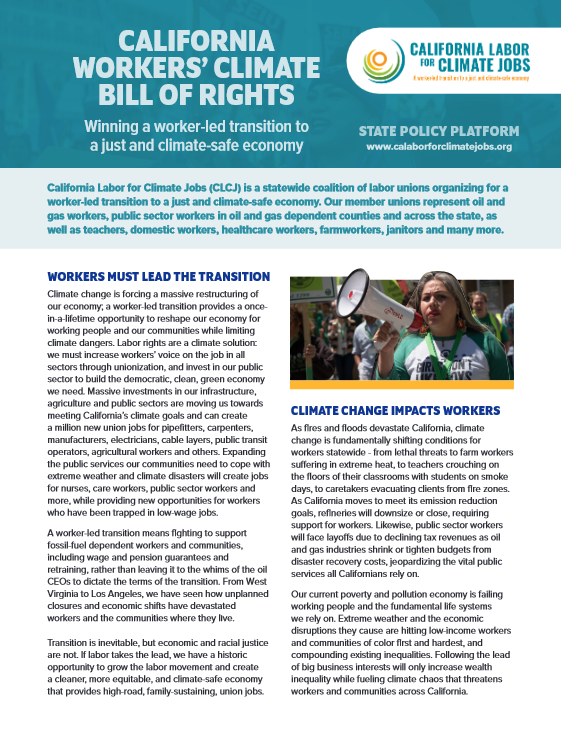
California Workers’ Climate Bill of Rights

By staff - California Labor for Climate Jobs, October 2023

Climate change is forcing a massive restructuring of our economy; a worker-led transition provides a once- in-a-lifetime opportunity to reshape our economy for working people and our communities while limiting climate dangers. Labor rights are a climate solution: we must increase workers’ voice on the job in all sectors through unionization, and invest in our public sector to build the democratic, clean, green economy we need. Massive investments in our infrastructure, agriculture and public sectors are moving us towards meeting California’s climate goals and can create a million new union jobs for pipefitters, carpenters, manufacturers, electricians, cable layers, public transit operators, agricultural workers and others. Expanding the public services our communities need to cope with extreme weather and climate disasters will create jobs for nurses, care workers, public sector workers and more, while providing new opportunities for workers who have been trapped in low-wage jobs.

A worker-led transition means fighting to support fossil-fuel dependent workers and communities, including wage and pension guarantees and retraining, rather than leaving it to the whims of the oil CEOs to dictate the terms of the transition. From West Virginia to Los Angeles, we have seen how unplanned closures and economic shifts have devastated workers and the communities where they live.

Transition is inevitable, but economic and racial justice are not. If labor takes the lead, we have a historic opportunity to grow the labor movement and create a cleaner, more equitable, and climate-safe economy that provides high-road, family-sustaining, union jobs.

Download a copy of this publication here (PDF).

Nighttime Harvests Protect Farmworkers From Extreme Heat, but Bring Other Risks

By Amy Mayer - Civil Eats,September 27, 2023

In the summer months, Flor Sanchez and the members of her harvest crew rise before dawn and arrive at a cherry orchard in Washington state’s Yakima Valley when there is only the slightest hint of daylight.

“We use headlamps,” she says, to carry ladders to the trees. Climbing up into the branches to harvest the ripe fruit in near-darkness, she says, “seems a little dangerous.” Headlamps cast shadows that can make it difficult to see the fruit. Setting up ladders in the dark also poses a danger.

Elizabeth Strater, director of strategic campaigns with United Farm Workers, says for field crops like onions and garlic, harvesting at night by headlamp or flood lights poses less risk than picking tree fruit because ladders aren’t needed, the short plants don’t create shadows, and workers know exactly what to pick even if they can’t completely see what they’re doing. The produce itself is also more durable. Winegrape harvest also often takes place at night.

Across super-hot regions, nocturnal harvest, as Strater calls the practice, has become increasingly common. As climate change pushes summer temperatures higher on more consecutive days, and scientists are forecasting even warmer years ahead, more workers may find themselves in the field at night and in the early morning hours. And while some safety measures have been put in place, more data is needed to assess the challenges workers face.

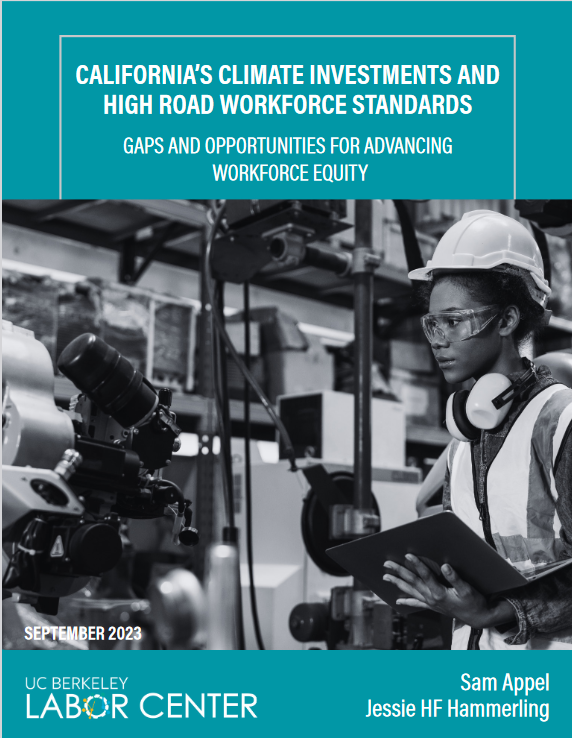
California’s Climate Investments and High Road Workforce Standards: Gaps and Opportunities for Advancing Workforce Equity

By Sam Appel and Jessie HF Hammerling - UC Labor Center, September 20, 2023

California continues to lead the nation in charting a path to economy-wide decarbonization. On this path, the state has committed to pursuing a high road transition that prioritizes the development of a sustainable economy grounded in equity for workers and communities.

In our 2020 report Putting California on the High Road: A Jobs and Climate Action Plan for 2030 (JCAP), commissioned by the California Legislature in Assembly Bill 398 (Garcia, 2017), the UC Berkeley Labor Center offered guidance for policymakers on how to ensure an equitable energy transition for workers in California. That report describes clear, proven strategies for maximizing the creation of high-quality jobs across the low-carbon economy, broadening opportunities for workers of color and workers from historically marginalized communities, delivering the skilled workforce needed to achieve California’s climate targets, and protecting workers in transitioning industries.

This report presents a current snapshot of the state’s progress in implementing several of these strategies by examining the integration of high road workforce standards across California’s climate investments. Specifically, we review existing high road standard policies in California, and assess the reach of high road standards across the state’s proposed climate investments in California’s 2022-23 state budget.

Download a copy of this publication here (PDF).

Workers vs Heat

By Staff - Labor Network for Sustainability, August 30, 2023

UPS Workers Win Heat Protections Faced with a threatened strike – including “practice picket lines” — by its 340,000 union employees, UPS has agreed to a contract that provides major gains in wages and working conditions for its Teamsters’ members. The contract includes elimination of a “two-tier” wage rate; significant wage increases, especially for the lowest paid workers; and combining part-time jobs to provide new full-time jobs.

Sometimes lethal heat conditions have been a central issue for UPS workers. UPS has promised to equip all new package cars with air-conditioning and to install fans on older package cars. Section 14 of the contract states: 

All vans, pushbacks, fuel trucks, package cars, shifting units, and 24-foot box vans after January 2024 shall be equipped with A/C. Single fans will be installed in all package cars within 30 days of ratification and a second fan will be installed no later than June 1, 2024. Air-conditioned package cars will first be allocated to Zone 1 which is the hottest area of the country. All model year 2023 and beyond package cars and vans will be delivered with factory-installed heat shields and air induction vents for the package compartment. Within 18 months of ratification, all package cars will be retrofitted with heat shields and air induction vents. A Package Car Heat Committee will be established within 10 days of ratification for the purpose of studying methods of venting and insulating the package compartment. A decision must be made by October, 2024 or the issue will be submitted to the grievance procedure. The company will replace at least 28,000 package cars and vans during the life of the contract. 

The contract was overwhelmingly ratified by UPS union members on August 22.

The Green New Deal from Below Means Jobs

Pages

The Fine Print I:

Disclaimer: The views expressed on this site are not the official position of the IWW (or even the IWW’s EUC) unless otherwise indicated and do not necessarily represent the views of anyone but the author’s, nor should it be assumed that any of these authors automatically support the IWW or endorse any of its positions.

Further: the inclusion of a link on our site (other than the link to the main IWW site) does not imply endorsement by or an alliance with the IWW. These sites have been chosen by our members due to their perceived relevance to the IWW EUC and are included here for informational purposes only. If you have any suggestions or comments on any of the links included (or not included) above, please contact us.

The Fine Print II:

Fair Use Notice: The material on this site is provided for educational and informational purposes. It may contain copyrighted material the use of which has not always been specifically authorized by the copyright owner. It is being made available in an effort to advance the understanding of scientific, environmental, economic, social justice and human rights issues etc.

It is believed that this constitutes a 'fair use' of any such copyrighted material as provided for in section 107 of the US Copyright Law. In accordance with Title 17 U.S.C. Section 107, the material on this site is distributed without profit to those who have an interest in using the included information for research and educational purposes. If you wish to use copyrighted material from this site for purposes of your own that go beyond 'fair use', you must obtain permission from the copyright owner. The information on this site does not constitute legal or technical advice.