You are here

Marxism

“Total, BP or Shell will not voluntarily give up their profits. We have to become stronger than them...”

By Andreas Malm - International Viewpoint, September 12, 2022

Andreas Malm is a Swedish ecosocialist activist and author of several books on fossil capital, global warming and the need to change the course of events initiated by the burning of fossil fuels over the last two centuries of capitalist development. The Jeunes Anticapitalistes (the youth branch of the Gauche Anticapitaliste, the Belgian section of the Fourth International) met him at the 37th Revolutionary Youth Camp organized in solidarity with the Fourth International in France this summer, where he was invited as a speaker.

As left-wing activists in the climate movement, we sometimes feel stuck by what can be seen as a lack of strategic perspectives within the movement. How can we radicalize the climate movement and why does the movement need a strategic debate in your opinion?

I share the feeling, but of course it depends on the local circumstances – this Belgian “Code Red” action, this sort of Ende Gelände or any similar kind of thing, sounds promising to me, but you obviously know much more about it than I do. In any case, the efforts to radicalize the climate movement and let it grow can look different in different circumstances.

One way is to try to organize this kind of big mass actions of the Ende Gelände type, and I think that’s perhaps the most useful thing we can do. But of course, there are also sometimes opportunities for working within movements like Fridays for Future or Extinction Rebellion for that matter and try to pull them in a progressive direction as well as to make them avoid making tactical mistakes and having an apolitical discourse. In some places, I think that this strategy can be successful. Of course, one can also consider forming new more radical climate groups that might initially be pretty small, but that can be more radical in terms of tactics and analysis, and sort of pull others along, or have a “radical flank” effect. So, I don’t have one model for how to do this – it really depends on the state of the movement in the community where you live and obviously the movement has ups and downs (it went quite a lot down recently after the outbreak of the pandemic, but hopefully we’ll see it move back up).

Finally, it’s obviously extremely important to have our own political organizations that kind of act as vessels for continuity and for accumulating experiences, sharing them and exchanging ideas. Our own organizations can also be used as platforms for taking initiatives within movements or together with movements.

21st Century Unionism

Who Is Working-Class, and Why It Matters

By Van Gosse - Convergence, April 9, 2022

Many political analysts, including some on the Left, are positing a radically new configuration of class in the United States. Their argument, reduced to its essence, is that the traditional markers of class are no longer relevant, and now the great divide is between those who have graduated from college versus the rest. It is further argued that this new class structure is reshaping our political party system in dramatic ways:  the Democrats are becoming the party of the educated, in addition to traditional constituencies among African Americans and single women. Conversely, the Republicans are becoming a party of the working class—defined as the non-college-educated—across traditional racial and ethnic lines (for a cogent example of this analysis, see Matt Karp’s “The Politics of a Second Gilded Age”).

I think this analysis is wrong in all respects.  We need an analysis of how class functions in the U.S. that is based in our distinct history of stratification (and division) along ethno-racial lines.  Beyond that, we need an accurate reading of the Democratic Party in particular, if we are to advance the struggle for a multiracial democracy against white nationalism.

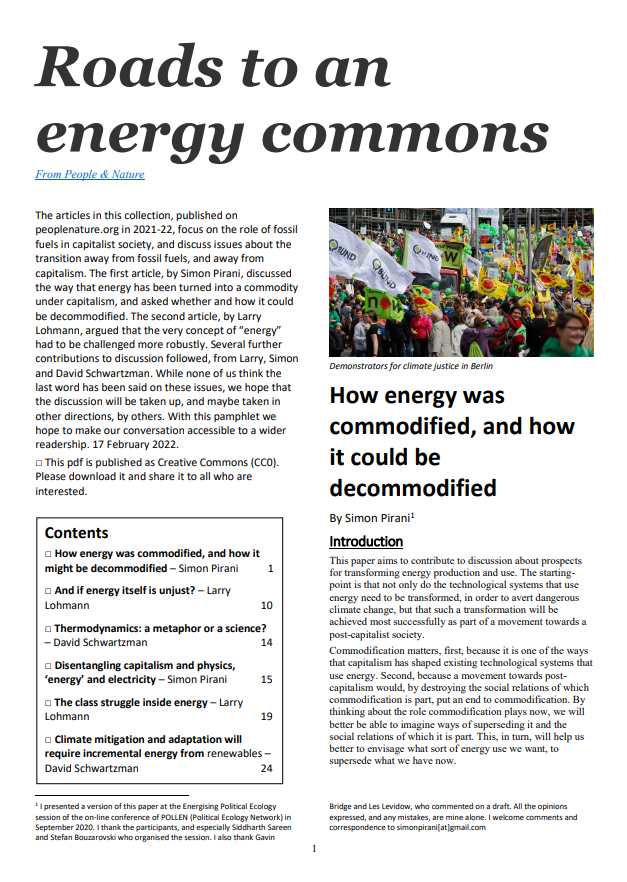
Roads to an Energy Commons

By Simon Pirani, Larry Lohmann, and David W. Schwartzman - People and Nature, February 17, 2022

This publication brings together articles that appeared on peoplenature.org about the role of fossil fuels in capitalist society, and the meaning of “energy” and related concepts. The discussion covered issues about the transition away from fossil fuels, and away from capitalism.

The first article, by Simon Pirani, discussed the way that energy has been turned into a commodity under capitalism, and asked whether and how it could be decommodified. The second article, by Larry Lohmann, argued that the very concept of “energy” had to be challenged more robustly. Further contributions followed, from Larry, Simon and David Schwartzman, who writes on solar energy. The last two articles have been published today, here and here.

While none of us think the last word has been said on these issues, we hope that the discussion will be taken up, and maybe taken in other directions, by others. With the pamphlet we hope to make our conversation accessible to a wider readership. If you wish to contribute, please email peoplenature[at]protonmail.com.

Read the report (PDF).

The Right’s Fantasy of a “Marxist” Threat: A review of Mark R. Levin, American Marxism (2021)

By Wayne Price - Anarkismo, February 14, 2022

This book is popular on the right. Its thesis is that there is a Marxist movement (or set of movements) which is taking over much of U.S. society. Marxists supposedly dominate public schools, universities, the media, teacher unions and other unions, the anti-racist movement, the ecological movement, business boardrooms (!), and the Democratic Party—and therefore the presidency and Congress. This is mad on the face of it, yet American Marxism has been a best seller for weeks. Its author is a Fox tv performer, a former part of the Reagan administration, and the author of a series of books. Personally I find the book poorly written and illogical, stuffed with lengthy quotations from friends and foes, yet obviously many people like it. Therefore it is worth looking at.

There are some things which Mark Levin gets right. Marx’s theories have been used as rationalizations and ideologies justifying “the enslavement, impoverishment, torture, and death of untold millions” (p. 243). It may be argued that this was not Marx’s intention, and that his world view was originally based in radical democracy and the emancipation of the working class—and that there has always been a minority of Marxists who have held to this vision. It may be claimed that his analysis of how capitalism works is highly useful (I agree but Levin strongly dissents). However this may be, Marxism has repeatedly led to bureaucratic-totalitarian states which oppressed and murdered millions of workers, peasants, and others.

Many on the Left have admired and even worshipped these repressive regimes and their Marxist leaders. For example, recently, on July 11th, thousands of Cubans nationwide demonstrated and the Communist state repressed their protests. Yet part of the Left offered its support to the Cuban state (as did the leadership of Black Lives Matter). Some Leftists, such as Bernie Sanders, opposed that state’s crackdown, but many others were silent at best. They “changed the topic” to the evils of the U.S. quarantine. This is an important issue, but the reason Cuba was in the news was the popular demonstrations.To focus solely on the crimes of U.S. imperialism, and not offer solidarity to the Cuban protestors, was shameful. However, this does not justify Levin lumping all oppositional movements together as “Marxist” and authoritarian.

Green Unionism against Precarity

By That Green Union Guy - IWW Environmental Union Caucus, January 1, 2022

Editor's Note: all but one or two of the links in this article link to multiple articles, located on the IWW Environmental Union Caucus site, categorized by topic. Therefore, it is to the reader's interest to explore all of the articles brought forth by each link, at their convenience (and that body of information is ever evolving over time).

An edited version of this article appears in New Politics 72.

In a real sense, under capitalism, all workers are "precarious", meaning that they can be downsized, replaced, deskilled, outsourced, etc. It's simply a matter of degrees.

The ultimate peak in precarity is "gig work" (which has actually always existed; the names simply keep changing, but the concept is the same).

Unions represent a check against precarity, though this occurs on a graduated scale. The stronger the union, the less the workers' precarity.

Union strength manifests in various ways: it can result from a well organized, international, militant democratic union (ideal, but rare, with few real world examples, such as ILWU, and the IWW, of course), though more often than not it's a result of concentration of elite craft workers in skilled trades unions, which represents a strong guard against precarity, but only for workers in the union, in which case, solidarity is limited.

Other checks against precarity include high demand for skilled craft workers in rare supply, High demand for hard to replace workers (such as workers that required skilled credentials, such as teachers or transport workers), or tight labor markets (which exist in our semi-post COVID-19 world, due to a combination of factors spelled out in the Vox article).

This is nothing more than class struggle 101, as expertly phrased by Karl Marx, et. al.

There are new forms of precarity emerging due to climate catastrophe (brought on by capitalism). Workers find themselves facing new health and safety hazards and/or threats to their working environment.

Lesson from COP26: Protecting the climate requires anti-capitalist struggle

By W. T. Whitney Jr. - People's World, November 17, 2021

Dealing with climate change, the United Nations held its “Conference of the Parties”—COP26—in Glasgow Nov. 1-13. Unfortunately, nothing happened likely to slow down progression toward a catastrophic outcome. The nations failed to reach even a non-binding agreement on reducing fossil fuel emissions that disturb the climate. In the wake of the conference, the theme “system change not climate change” gains new relevance.

With smooth words obscuring a grim reality, a New York Times reporter described “a major agreement…calling on governments to return next year with stronger plans to curb their planet-warming emissions.” But then comes the admission: COP26 left “unresolved the crucial question of how much and how quickly each nation should cut its carbon dioxide and other greenhouse gases over the next decade.”

The conference’s hesitant approach originates from past difficulties in reaching collective and binding agreements. In recognition of such, the 2015 COP meeting ruled that henceforth nations need only submit goals for voluntarily reducing emissions.

The delegates at COP26 decided to renew a previous agreement, still unfulfilled, to provide poor nations with an inadequate $100 billion annually to assist them in “transition…recovery…and adaptation.” Rich nations were urged to double their funding by 2025. COP26 did not address phasing out coal production.

Prior to the gathering, publicity centered on “Keep 1.5 (degrees C) alive.” The slogan expressed determination not to allow dangerous levels of atmospheric warming to exceed 1.5°C above pre-industrial levels, as promised by the 2015 COP meeting. A conservative estimate foresees a 50% probability that, at the current rates of emissions, greenhouse house gases will spike to that level in just 15 years.

Climate scientists associated with the UN’s Intergovernmental Panel on Climate Change (IPCC) periodically issue Assessment Reports. Part I of the current version, reporting on the “physical science basis of climate change,” predicts that “Global warming of 1.5°C and 2°C will be exceeded during the 21st century.” Consensus exists that temperature elevations of the order of 3°C will lead to exponentially accelerating planetary changes that will be irreversible.

The dim prospect of nations and the international community mobilizing effectively has unsettled all quarters of society. References to short-sightedness, disregard for the truth, opportunism, and immorality are standard. What’s in order for the protection of humanity is a gigantic rising-up of the concerned and afflicted, but it’s not on the horizon.

Book Review: The Tragedy of the Worker

By Aragorn Eloff - New Frame, October 5, 2021

A radical collective committed to change in the face of climate collapse calls for global solidarity and a turn to the worker to revolutionise how we relate to the world.

The tone of The Tragedy of the Worker: Towards the Proletarocene is set in the opening paragraph with a sobering addendum to the Communist Manifesto’s most well-known sentences: “Workers of the world unite, you have nothing to lose but your chains. You have a world to win. What if the world is already lost?”

This important new book, written by the Salvage Collective – of which well-known science fiction author China Miéville is a member – is a manifesto-like cry to countenance the state of our social and ecological lifeworlds, and to grapple with the question of how “we imagine emancipation on an at best partially habitable planet”. Herein, for Salvage, lies the titular concern of the book, which unashamedly wears its politics on its sleeve: the tragedy of the worker is that “she was put to work for the accumulation of capital, from capitalism’s youth, amid means of production not of her choosing, and with a telos of ecological catastrophe”.

How do we think about progressive – even revolutionary – forms of politics when we live “at a point of history where the full horror of the methods of fossil capitalism is becoming clear”, and where, even if capitalism were overthrown tomorrow, we would “inherit productive forces inextricable from mass, trans-species death”?

As we are relentlessly reminded throughout the text, the situation is not good. The current confluence of accelerating ecological crises, most popularly termed the “Anthropocene” or the “sixth mass extinction crisis” is, as Salvage describes, “a megaphase change taking place in microphase time”.

Death or Renewal: Is the Climate Crisis the Final Crisis?

By Wayne Price - Anarkismo, July 13, 2021

Classical socialists, both anarchists and Marxists, have written of the eventual end of capitalism--either through a popular revolution creating a new society or through the self-destruction of capitalism. Global warming raises the question of whether humanity is now facing such a possible total crisis, of choosing between socialism or social ruin.

Recently a friend sent me an article by Simon Lewis, a professor of global change science at the University College of London. Its title (Lewis 2021) was, “Canada is a warning: more and more of the world will soon be too hot for humans” and its subtitle was, “Without an immediate global effort to combat the climate emergency, the Earth’s uninhabitable areas will keep growing.

This led me to think of the apocalyptic warnings of the socialist tradition, the most well-known, perhaps, being Rosa Luxemberg’s “socialism or barbarism.” In 1878, Friedrich Engels wrote that the bourgeoisie was “a class under whose leadership society is racing to ruin…If the whole of modern society is not to perish, a revolution in the mode of production and distribution must take place, a revolution which will put an end to all class distinctions.” (Engels 1954; 217-8) Capitalism’s “own productive forces…are driving the whole of bourgeois society towards ruin or revolution.” (228)

Marx began his 1848 Communist Manifesto by claiming, “The history of all hitherto existing society is the history of class struggles…that each time ended, either in a revolutionary re-constitution of society at large, or in the common ruin of the contending classes.” (2013; 60-61) So, there is an historic choice between “revolutionary re-constitution” or “common ruin.” (This raising of two possible outcomes seems to be contradicted by the Manifesto’s later statement—about the capitalist class, “Its fall and the victory of the proletariat are equally inevitable.” [73] I will not discuss whether Marx was a determinist, and, if so, of what kind.)

This was also an anarchist concept, integrating the problems of capitalism and its state. In 1898, Peter Kropotkin concluded The State--Its Historic Role, "Death--or renewal! Either the State for ever, crushing individual and local life, taking over in all fields of human activity, bringing with it all its wars and domestic struggles for power...which only replace one tyrant by another, and inevitably at the end of the development there is--death! Or the destruction of States, and new life starting again in thousands of centers on the principle of the lively initiative of the individual and groups and that of free agreement. The choice lies with you!” (1987; 60)

Breaking Things at Work: An Interview with Gavin Mueller

Gavin Mueller interviewed by Harry Holmes - Viewpoint Magazine, May 27, 2021

[Bright Green] Culture editor Harry Holmes interviews Gavin Mueller, author of the newly released Breaking Things at Work from Verso Books. Gavin Mueller is a lecturer in New Media and Digital Culture at the University of Amsterdam and a member of the editorial collective of Viewpoint Magazine.

So first, for those who won’t have read it yet, can you tell us a bit about the book?

The book is essentially thinking about technology from the perspective of labour struggle. The left was in this accelerationist moment for a few years where there was an idea that technologies, particularly those tied to automation in the workplace, were leading to a ‘post-work’ or ‘post-capitalist’ future based on their own course of development. I was troubled by this discourse, which set me off on the research that led to this book.

From my perspective, and what I argue in the book, is that actually quite a lot of these technologies are not leading to a ‘post-work’ future. They are certainly not leading to a ‘post-capitalist’ future. Instead, they are actually weapons that make it difficult for workers to struggle, to establish autonomy at work, and to move the economy in a more egalitarian direction.

I wrote this book to show there is a different way of thinking about technology, one that I argue is more closely aligned to the political self-activity of workers. It also suggests that for those who care about more egalitarian futures we must start politicising technology and having a critical approach to it, rather than assuming it’s developing in a progressive way on its own.

In actually existing struggles both in our contemporary moment and in history, a critical perspective on technology has been there all along. This is why I start the story with the Luddites, who are famous, in quite a pejorative way, for opposing technology. I think there is quite a lot we can understand once we learn their history a little better and relate it to our present condition.

How much is this Luddite approach a strategic one about being able to be in solidarity with workers currently at the sharp end of technology’s impact, for example in an Amazon warehouse, or do you see it as part of a wider approach to technology in general? Is it an opposition to technology per se or a more qualified position based on current workplace struggles?

My political and intellectual influences are these ‘from below’ histories and thinking about struggle from that perspective, as well as being very alive to when there are tensions within the workers’ movement between rank-and-file struggles and the leadership, whether trade union, political party, or intellectual. It’s important to know this history because we have to learn from it.

So I think that’s where I always start, but politics is a sophisticated thing, I don’t think that all politics is oriented on the shop floor. We have to mediate to different levels, but I want to keep that kernel of struggle in our perspective.

We are seeing a lot of encouraging and exciting things. I don’t consider myself that old, but things that have never happened in my life before are happening – like lots of people identifying as socialist. We see these impressive electoral challenges, but they don’t quite ever get over the finish line. One reason for this is the base is still quite depoliticised and fragmented.

My idea of how you solve that problem is really to recognise the ways in which people are already engaged in struggle, particularly people in these incredibly exploited positions. There’s always resistance. But that resistance doesn’t always get amplified, it doesn’t always get connected or articulated with other forms of resistance. To me, that’s something that has been missing from these left-wing political challenges.

Maybe launching out a lot of policy proposals can be very exciting and interesting, but it doesn’t seem to quite do what we’ve hoped it would do. One reason for this is it still has this top-down perspective of ‘we are going to help you out.’ A lot of people don’t relate to that, they don’t believe in it, or they don’t hear those messages because I don’t think we’ve done the work of really building a base that will then get attached to policies and start actually informing policies. So that’s one reason I really orient the politics of the book in these struggles, because it is important to do at this moment.

My belief is we need to meet people where they are, which for most people is in the everyday struggles they have at work and in their wider life. Technology is a huge part of that, and often something many people already have already a critical approach to. They don’t like the way it is, they want things to be changed. They don’t want to hear a science fiction story about the robots allowing them to stay at home all day. I don’t think that will resonate. So that is a big motivation for the book. It’s an intellectual perspective I have, but I do think there is political value in it as well.

Pages

The Fine Print I:

Disclaimer: The views expressed on this site are not the official position of the IWW (or even the IWW’s EUC) unless otherwise indicated and do not necessarily represent the views of anyone but the author’s, nor should it be assumed that any of these authors automatically support the IWW or endorse any of its positions.

Further: the inclusion of a link on our site (other than the link to the main IWW site) does not imply endorsement by or an alliance with the IWW. These sites have been chosen by our members due to their perceived relevance to the IWW EUC and are included here for informational purposes only. If you have any suggestions or comments on any of the links included (or not included) above, please contact us.

The Fine Print II:

Fair Use Notice: The material on this site is provided for educational and informational purposes. It may contain copyrighted material the use of which has not always been specifically authorized by the copyright owner. It is being made available in an effort to advance the understanding of scientific, environmental, economic, social justice and human rights issues etc.

It is believed that this constitutes a 'fair use' of any such copyrighted material as provided for in section 107 of the US Copyright Law. In accordance with Title 17 U.S.C. Section 107, the material on this site is distributed without profit to those who have an interest in using the included information for research and educational purposes. If you wish to use copyrighted material from this site for purposes of your own that go beyond 'fair use', you must obtain permission from the copyright owner. The information on this site does not constitute legal or technical advice.