You are here

Judi Bari

Monkeywrenching

By Judi Bari - Earth First! Journal, Brigid (February 1), 1994; reprinted in Timber Wars, © 1994 Common Courage Press.

Retreating into the hills after their impressive takeover of four towns in southern Mexico, the Zapatista army of National Liberation dropped two power lines and called on their supporters to engage in other acts of sabotage.

Who Bought Steve Talbot?

By Judi Bari - Anderson Valley Advertiser, May 29, 1991; reprinted in Timber Wars, © 1994 Common Courage Press.

Steve Talbot has a winning personality. He used to be a child actor on the "Leave It To Beaver" show. He played Gilbert, one of the Beav's friends, and when Talbot smiles that little smile, it gives people this subliminal comfortable 1950's feeling. He can get cops to tell him state secrets and hippies to show him their marijuana patch. So we had high hopes for his documentary "Who Bombed Judi Bari?" Bruce Anderson even promo'd it in advance as "The Definitive Mendo Movie." Talbot had us all convinced that he was a leftist and a supporter, and that he was going to produce a piece that would finally tell the truth about what's going on up here.

He should have left it to Beaver because instead of the hard-hitting expose he had promised, Talbot produced a liberal piece in the format of Unsolved Mysteries, that focuses in on the activists and little people while completely ignoring the timber corporations and letting the FBI and police slide by.

Talbot does a good job establishing my and Darryl's innocence, and I guess we should thank him for that. Thank you, Steve. But he lets the FBI and Oakland police off easy for their role in lying about the evidence and covering their lie. He shows the bombed-out car with the entire seat and floorboard removed, but he doesn't mention that they are missing because the FBI blowtorched them out and sent them to D.C., thereby concealing the evidence that would have proved they were lying about the bomb's location. He also fails to mention that the Oakland police left the car out in the rain unprotected for 10 days, destroying its value as evidence.

Talbot questions the FBI with kid gloves on. When the FBI spokesman lies in his face and says they are not investigating environmentalists, Talbot shows the viewers evidence that the FBI has actually been investigating and disrupting Earth First! for 10 years. But he never confronts Mr. FBI Liar with this evidence. And he never, in his entire discussion with or about the FBI, mentions the fact that the man in charge of our case is Richard Held himself, grand old man of COINTELPRO, famous for causing assassinations and frame-ups of leaders in the Black Panthers, American Indian Movement, and Puerto Rican Indepententistas. That's a pretty incredible omission, considering how similar the tactics used against us here are to those used by Held in other COINTELPRO operations.

Another equally incredible omission in Steve Talbot's documentary is any mention of the timber corporations in whose interest I was bombed. In fact, to watch this show you would think that all we have up here are mom and pop loggers. And it is 34 minutes into the show before Talbot even talks about them. The word Maxxam does not come up once in this entire documentary. Georgia-Pacific is mentioned only as the site of one of our demos, and Louisiana-Pacific only as the victim of a pipe-bomb attack at their mill. Nowhere is their role in inciting a lynch-mob mentality against us even hinted at. And Talbot certainly had the info to do it.

Green Unionism Done Right in Richmond: A Brief Review of the "Roadmap to Contra Costa County Refinery Transition"

By That Green Union Guy - IWW Eco Union Caucus, July 30, 2025

The Contra Costa Refinery Transition Partnership (CCRTP) includes United Steelworkers District 12, United Steelworkers Local 5, the Asian Pacific Environmental Network, UA Plumbers & Steamfitters Local 342, and the Contra Costa Central Labor Council, with support from the United Steelworkers International Union, the California Federation of Labor Unions, UC Berkeley Labor Center, and the BlueGreen Alliance Foundation. It is the culmination of several decades of organizing effort jointly conducted by many of these organizations, dating back to the mid 1990s (for some background, see the introduction and first chapter from the anthology, Power Lines: Building a Labor-Climate Justice Movement.

The roadmap offers 31 practical and specific recommendations on how to provide a managed decline of the remaining four oil refineries in the Bay Area (three in Contra Costa County, specifically Martinez, Rodeo, and Richmond; and one in Solano County, specifically Benicia.)

These include both environmental justice demands, many of which include community input on refinery conversions as well as reparations for impacted communities. Simultaneously, the roadmap includes numerous demands union workers might make in contract negotiations, including provisions for making workers adversely affected by refinery transitions “whole”, including everything from early retirement without penalty, to right of transfer to other still operating facilities by the company, to paid retraining, with seniority rights being a determining factor in who gets first dibs. Indeed, this document reads as a joint contract negotiated by the workers and the community that can serve as a model for similar cases globally.

Event: Bay Area IWW Celebrates Judi Bari Day

The Bay Area IWW invites everyone to join us in honoring Judi Bari Day (May 24th) to honor our late comrade and fellow worker Judi Bari. Judi Bari was a revolutionary ecologist active in Earth First! and a member of the IWW, her story is detailed here, here, and here.

Marking the Moment: 11:30 AM - 12:30 PM, May 24, 2025 - Gather near Oakland High School on Park Blvd near East 34th Street in Oakland;

IWW Social: 4:00 - 7:00 PM - Gather at the Bay Area IWW Union Hall (Grassroots House), 2022 Blake Street at Shattuck Avenue in Berkeley for a social (food & beverages will be provided), a showing of the documentary, "Who Bombed Judi Bari?" and a (brief) discussion about Judi Bari's green unionism, revolutionary ecology, and their relevance to current organizing campaigns.

Steve Ongerth on the Bombing of Judi Bari and Redwood Summer

By Cone Cat and Steve Ongerth - It's Going Down, July 24, 2024

On this episode of the It’s Going Down podcast, we speak with Industrial Workers of the World (IWW) organizer and historian Steve Ongerth, author of Redwood Uprising: From One Big Union to Earth First! and the Bombing of Judi Bari, about the Earth First! and IWW organizer Judi Bari, who in May of 1990, was almost assassinated in Oakland, CA. Many believe that Bari and another Earth First! organizer, Darryl Cherney, were directly targeted for their organizing in defense of redwood forests in northern California, work that included building alliances with timber workers.

Memory Against Forgetting: The Story of Judi Bari w/ Earth First!er Karen Pickett

Chapter 38 : Conclusion

By Steve Ongerth - From the book, Redwood Uprising: Book 1

Download a free PDF version of this chapter.
In spite of the bombing, Bari had lived, which was a huge miracle by itself, and it is clear that whomever planted the bomb in her vehicle had not intended for her to have done so. The bomber had also not planned on Cherney’s presence in the vehicle (his decision to ride with Bari had been unplanned and made at the last possible moment). The bomb had been meant to kill Bari and her alone, and leave behind a mystery, a discredited leader, and fractured and broken movement. Cherney’s having also been there and having gone through the trauma had created the unintended consequence of providing Bari with a witness who could independently verify and corroborate her every word (which, as it turned out, he did) thus further undermining any case that could be made for her guilt. Nevertheless, the bombing was nothing short of a huge tragedy for Judi Bari, due to the physical and emotional trauma and the intense pain and suffering she endured afterwards. While it may be something of a stretch to say that the bombing ultimately led to Bari’s death (in March 1997 due to breast cancer) even that is not out of the question, and the loss of her life was a major setback to those who would challenge business as usual.

Bari’s and Cherney’s legal triumph was a victory, but not the final victory. The question of who bombed them still remains unsolved, but assuming that Bari and Cherney and their supporters (and to be certain the author is one) are correct, and the bombing was indeed a conspiracy involving both Corporate Timber and the FBI, the answer to the question, “Why?” bears little mystery at all.

Clearly someone was trying to disrupt, discredit, and misdirect the coalescing radical, grassroots opposition to Corporate Timber on the North Coast, whether they participated in the bombing or not. Certainly, the bombing was itself designed to do that, so it makes sense to conclude that the bombing and the disruption were part of a single, multifaceted effort. If asked, “cui bono?” the most likely answer is a combination of Corporate Timber (namely representatives from all three of the major corporations, Georgia-Pacific, Louisiana-Pacific, and Pacific Lumber) with the help of the FBI with the tacit (or perhaps approval) of the Bush (senior) Administration. The FBI had gone to great lengths to try and discredit Earth First! already in Arizona, and clearly the same telltale signs of a COINTELPRO operation are evident in the Bari and Cherney bombing. If G-P was involved somehow, there is no direct evidence, but evidence of L-P’s involvement is quite readily apparent. As for Pacific-Lumber, Bari and Cherney later discovered a cordial “chummy” letter to FBI Director William Sessions from a Maxxam board member. [1] There is ample indirect evidence and a clear motive linking all three to the bombing.

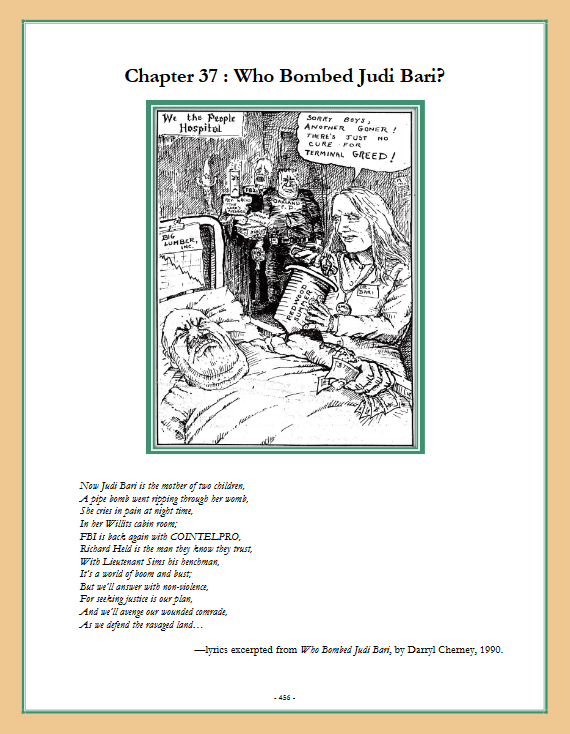
Chapter 37 : Who Bombed Judi Bari?

By Steve Ongerth - From the book, Redwood Uprising: Book 1

Download a free PDF version of this chapter.

Now Judi Bari is the mother of two children,
A pipe bomb went ripping through her womb,
She cries in pain at night time,
In her Willits cabin room;
FBI is back again with COINTELPRO,
Richard Held is the man they know they trust,
With Lieutenant Sims his henchman,
It’s a world of boom and bust;
But we’ll answer with non-violence,
For seeking justice is our plan,
And we’ll avenge our wounded comrade,
As we defend the ravaged land…

—lyrics excerpted from Who Bombed Judi Bari, by Darryl Cherney, 1990.

Redwood Summer began and moved forward more or less as planned—in spite of all that happened surrounding the bombing—and Bari and Cherney were not charged and eventually freed. Yet organizers and supporters of Redwood Summer were left wondering who the bomber was, and if they were part of a well organized plot, either by right wing fanatics, Corporate Timber, the FBI, or a combination of all of them. Gary Ball admonished everyone not to jump to conclusions about who planted the bomb, stating, “We’re not getting into conspiracy theories at this point. We’re saying that the police have made an obvious mistake and that they need to do a real investigation to find the criminal who planted that bomb and who is still on the loose.” [1] Although many supporters of Redwood Summer were convinced that the bombing was a conspiracy, there were enough people in Mendocino County reactionary and crazy enough to have acted alone, and the county had a long tradition of such lunatics. As Rob Anderson described it:

“What outsiders (and many insiders, for that matter)—members of the media, politicians, FBI agents, etc.—don’t understand about Mendocino County is its peculiar hothouse political atmosphere—a combination of poor law enforcement, obtuse political leadership, cowboy capitalism, and religious extremism. In this atmosphere, all kinds of twisted and malignant creatures flourish. In fact, at various times, Jim Jones, Charles Manson, Leonard Lake, Tree Frog Johnson, and Kenneth Parnell have all lived and flourished in Mendoland.” [2]

Judi Bari herself had agreed that “Mendocino County, as we all know, is known as the largest outpatient ward in America and we who live there are completely used to this stuff…” [3]

Indeed, one week after the bombing, an anonymous letter writer, calling himself (or herself) “The Lord’s Avenger” wrote a letter to the Santa Rosa Press Democrat full of Biblical quotations claiming credit for planting the bomb. [4] On the surface, it was entirely plausible that the bombing was motivated by Christian Fundamentalist anger towards Judi Bari, because of her stances on abortion. It is unlikely, however, that this issue was the primary reason for the bombing—since Bari had been far more vocal about timber and labor issues. [5] There was a strong Christian Fundamentalist streak particularly among the most reactionary representatives of the US Forest Service as well as the least enlightened (and most rapacious) gyppos. [6] Misogyny was no doubt embedded in the bundle of reasons for targeting Bari as well, evidenced by the fact that one of her death threats described her (and her fellow women) as “whores”, “lesbians”, and “members of NOW”. [7] Yet, as will be demonstrated, the Lord’s Avenger letter was more than likely a false lead.

There was also some wild speculation that Darryl Cherney might have planted the bomb himself (unbeknownst to Bari) out of resentment because of their recent breakup as romantic couple, but this theory falls to pieces on the prima facie evidence alone. [8] According to the FBI’s own ballistics evidence, the bomb had a switch, timer, and motion sensor, which meant that it was designed to detonate while the car was in motion during a specific time. It is just as ridiculous to think that Cherney would have knowingly consented to ride in a car containing a live bomb, which he had supposedly armed and positioned, for the purposes of revenge as it is to think that Bari and Cherney would have done so for the purposes of terrorism. In any case, Cherney, who was not mechanically inclined, was not capable of constructing such a device. [9] As Bari related to Bruce Anderson:

“Darryl, first of all, has some of the least mechanical skills of anyone I’ve ever known. I once tried to hire him to hang sheet rock and found him to be unemployable, because he didn’t know how to hammer. And, secondly, whatever else I know about Darryl—Darryl and I have been broken up as a romantic couple for several months now but I love Darryl and Darryl loves me, and there is no question in my mind that Darryl would never, ever do such a thing.” [10]

Veterans of the environmental movement who also had prior involvement with organizations that had been subject to COINTELPRO and COINTELPRO-like infiltration suspected foul play. [11] Dave Foreman, who spoke from first-hand experience, was convinced that it was, and noted the similarities between the bombing of Bari and Cherney and his own legal entanglement over the Arizona 5 case. [12] Certainly, the FBI and corporate timber had several motives. These included:

“Providing police an excuse to search homes and offices associated with the environmental movement in Mendocino County and the Bay Area, removing two of the most high-profile organizers challenging corporate power in California, and contaminating the public image—not only of Redwood Summer, but also of (Forest Forever) and the environmental movement in general with the stigma of violence and lawlessness.” [13]

Four attorneys from Humboldt and Mendocino Counties, Rodney Jones, David Nelson, Steven J. Antler, and Ron Sinoway, calling themselves Northern California Lawyers for an Unbiased Investigation accused the Oakland Police and FBI of incompetence and prejudice against Bari and Cherney. [14] They issued a white paper called “A Position Statement and Legal Evaluation of the Bari-Cherney Car Bombing, which exposed the countless weaknesses in the state’s case against the two. The statement made a convincing case that the bombing was, in fact, a sophisticated plan by the opponents of Redwood Summer to undermine it, perhaps with the complicity of law enforcement agencies. [15]

Chapter 36 : A Pipe Bomb Went Rippin’ Through Her Womb

By Steve Ongerth - From the book, Redwood Uprising: Book 1

Download a free PDF version of this chapter.

“I knew it was a bomb the second it exploded. I felt it rip through me with a force more powerful and terrible than anything I could imagine. It blew right through my car seat, shattering my pelvis, crushing my lower backbone, and leaving me instantly paralyzed. Slumped over in my seat, unable to move, I couldn’t feel my legs, but desperate pain filled my body. I didn’t know such pain existed. I could feel the life force draining from me, and I knew I was dying. I tried to think of my children’s faces to find a reason to stay alive, but the pain was too great, and I couldn’t picture them.”[1]

—Judi Bari’s recollection of the bombing, February 2, 1990.

“I heard a ‘crack’, and my head began to ring like a sitar…like ‘nnnnnnnnnrrrrrrrrrrrrrr’, and the car came to a screeching halt. The first thought in my mind was, ‘Oh no, not again!’ because last August we had been rear-ended by a logging truck without ever seeing it coming, and here we are again, me and Judi in a car. But this time, my head was bleeding and I knew I had a seat belt on, and I couldn’t figure out how come my head was bleeding if I hadn’t hit the windshield. Then I heard somebody scream out. ‘It’s a bomb, there was a bomb!’ And then it all made sense; somebody had tried to kill us.”[2]

—Darryl Cherney’s account of the bombing, May 24, 1990.

At this point, Cherney looked over at Bari where, “she was slumped in her seat, screaming in pain, but as far as I could tell, her body was in one peace.”[3] Bari recalls only being able to make guttural sounds in an attempt to say “help” and vaguely recalls that Cherney kept repeating “I love you,” to her, and that she was going to live, in spite of what had happened.[4]

The blast distorted Bari’s white 1981 Sabaru GL car’s unibody frame, tore out its left side and sent debris and heavy blue-grey smoke flying into the air. It blew out some of the windows and left a trail of fragments on Park Boulevard.[5] The shattered, smoking car veered 100 feet down the road, clipping parked cars and light poles along the way, and hit another vehicle—a delivery truck driven by 40-year-old Ken Rich from Castro Valley—before coming to a stop against a curb in front of Oakland High School, where students were jogging as part of their physical education class.[6] Had the explosion occurred just forty minutes later, it might have injured the students crossing the road to patronize the local shops for lunch. The nearby public school’s officials would keep the students inside campus buildings for several hours until the blast area was declared safe.[7] Rich’s vehicle then hit a woman pedestrian who had a heart attack.[8] He had happened to have been driving the other way, and noticed the smoke billowing from Bari’s vehicle just before it hit his own.[9]

The explosion startled the workers and owners at nearby businesses. “It sounded like they dropped a bomb from a jet or something,” recalled the manager of a nearby Oil Changers, “the whole street just shook.”[10] One of the garage mechanics, who identified himself as “Charles”, added, “It sounded like a cherry bomb in a tin can. It was pretty loud. I kind of felt it in my body, and I was inside.”[11] Sokhi Dosanjli, the clerk at a local convenience store reported that the smoke was so thick that, “You couldn’t see anything for awhile”, including the nearby MacArthur Freeway.[12]

Shannon Mar was immediately aware that something had gone horribly wrong. Since she was leading the way, she did not immediately see the blast, but she quickly heard it and smelled the residue of explosives. She recalled, “The car shook, heat rushed through the windows, and I smelled sulfur. I looked in the rear-view mirror, and (all I could see was) smoke.” Bari’s car rolled past her own just before hitting Ken Rich’s vehicle and then hitting the curb. Marr immediately came to a stop, exited her car, and ran to Bari’s bombed-out vehicle (where Ken Rich was already standing) to determine the condition of her friends. Marr said, “Judi was stuck in her seat. She kept saying, ‘It hurts. It hurts. I can’t breathe.’ Darryl had a gash over one eye and it was gushing blood.”[13]

Meanwhile, Dave Kemnitzer had fallen slightly behind, but by now he had arrived near the intersection of MacArthur and Park Boulevards. He emerged from his vehicle screaming, “It’s the loggers! The loggers are trying to kill us!” At that moment, Ken Rich ran to Bari’s car and saw Cherney emerge. He recalled, “I’ve been in Vietnam and I’ve seen bombed out cars before. This one took a heavy hit. I’m amazed the people are still alive.”[14] Rich had been trained in first aid, but he described Bari’s car as “so mangled” that he felt it would be more effective, “to let the paramedics treat the victims.” He then recalled Marr running up to him, exclaiming, “They’re my friends!”[15]

Bob Vandemeer, the president of a San Rafael demolitions company, just happened to have been driving behind Bari on his way to an Oakland A’s baseball game.[16] The force of the explosion made him bounce up in the seat of his pickup truck. He then noticed, “a big blue cloud of smoke (which) smelled like gunpowder. (Then) things started falling from the air—parts of (Bari’s) car.”[17] After the explosion, he immediately summoned police from his mobile telephone.[18] He then approached the vehicle where Rich, Marr, and Kemnitzer were congregating. He, like Rich, reported, “(Bari) was unconscious, and sort of smashed up against the door on the driver’s side…As I approached, (Cherney) popped up, bleeding pretty bad all over. He started yelling, “Help! Get me out of here!”[19]

We don’t need a “Plethora of tactics”, We need a climate strategy

By Anarchy Nouveau - Freedom, February 21, 2024

In the spirit of starting a debate and dialogue, we republish this article from Conspiracy of the People in response to Matthew Azoulay’s article in Freedom:

In Freedom Anarchist Journal’s Winter 2023-2024 issue, Matthew Azoulay submitted an article introducing readers to Murray Bookchin’s ideas of the communalist assembly, which disturbed and surprised me because of how outdated it was. The means it proposes to achieve ecologically revolutionary ends are lacking, stagnant, and fall back on modes of thinking that seem directly inherited from the anti-globalisation and Occupy era, which the anarchist movement cannot afford to normalise as we continue to enter an exponentially growing ecological collapse. While there are decent ideas to take from both Murray Bookchin and Peter Gelderloos, as Matthew Azoulay has, they are both rather flawed in their own ways. There are some well thought out points and ideas within the article, so my criticisms are entirely constructive, and I aim to avoid sectarianism. But that this is what Freedom News is publishing in their own journal on climate struggle has me very concerned, to say the least.

The lack of revolutionary strategic thinking on ecological struggles will be both humanity and the planet’s downfall if the revolutionary movement doesn’t get its act together soon. If a diversity of tactics was all it took to overcome the limits of social movements, as Matthew Azoulay suggests in this article (and Peter Gelderloos in The Solutions are Already Here), then comrades worldwide would not be facing defeat after defeat in what are ultimately defensive struggles for the ecology. These insurrectionary limits are visible internationally, from the massive years-long and ongoing fight to defend Weelaunee/Atlanta forest from destruction in the “Stop Cop City” movement, the French struggles in the ZAD’s and against the ecocidal Basin megaprojects, German struggles for forest defence and against ecocidal development such as the Tesla “gigafactory” and the mass movement against coal mining. In the global South, anti-extractivist movements have similarly hit wall after wall since the global descent into neoliberalism and fascism from the 70s to today. Many valiant stands have been made against imperialist extraction projects, but the power of capital has more often than not prevailed against the power of the organised and rebellious masses, except where said rebellion has reached every layer of the popular masses and turned into an all-out insurrection. For example, the recent social explosion in Panama against a proposed mining project, the Zapatista movement’s struggle for autonomy across indigenous territories in so-called Mexico, or the 1991 struggle from revolutionaries in Bougainvillea against the Papua New Guinea government, the Rio Tinto mining corporation and the “Australian” navy.

Pages

The Fine Print I:

Disclaimer: The views expressed on this site are not the official position of the IWW (or even the IWW’s EUC) unless otherwise indicated and do not necessarily represent the views of anyone but the author’s, nor should it be assumed that any of these authors automatically support the IWW or endorse any of its positions.

Further: the inclusion of a link on our site (other than the link to the main IWW site) does not imply endorsement by or an alliance with the IWW. These sites have been chosen by our members due to their perceived relevance to the IWW EUC and are included here for informational purposes only. If you have any suggestions or comments on any of the links included (or not included) above, please contact us.

The Fine Print II:

Fair Use Notice: The material on this site is provided for educational and informational purposes. It may contain copyrighted material the use of which has not always been specifically authorized by the copyright owner. It is being made available in an effort to advance the understanding of scientific, environmental, economic, social justice and human rights issues etc.

It is believed that this constitutes a 'fair use' of any such copyrighted material as provided for in section 107 of the US Copyright Law. In accordance with Title 17 U.S.C. Section 107, the material on this site is distributed without profit to those who have an interest in using the included information for research and educational purposes. If you wish to use copyrighted material from this site for purposes of your own that go beyond 'fair use', you must obtain permission from the copyright owner. The information on this site does not constitute legal or technical advice.