You are here

environmental justice

Young Workers and Just Transition

By Staff - Labor Network for Sustainability, August 26, 2020

In case you missed it, on Wednesday, Aug. 26, at 8 p.m. Eastern, the Labor Network for Sustainability and friends hosted "Young Workers and Just Transition," the fourth in a series of webinars as part of the Just Transition Listening Project.

Moderated by Climate Justice Alliance Policy Coordinator, Anthony Rogers -Wright, the panel featured young workers in the labor and climate justice movements: 

  • Celina Barron, International Brotherhood of Electrical Workers Local 11 RENEW
  • Eboni Preston, Greening for Youth; Georgia NAACP, Labor and Industry Chair
  • Judy Twedt, United Auto Workers, Local 4121
  • Ryan Pollock, International Brotherhood of Electrical Workers Local 520
  • Yolian Ogbu, This is Zero Hour

Watch this event now to glean insight into who the challenges these young movement leaders face when initiating dialog around transitioning to a sustainable economy that offers equitable and just opportunities for future workers. Also learn about LNS' Young Worker Project and to hear what's next:

Special thank you to the following on the Labor Network for Sustainability team: Joshua Dedmond, Veronica Wilson and Leo Blain; and Vivian Price, Professor of Interdisciplinary Studies, California State University Dominguez Hills for their organizing and technical support before and during this important conversation.

Just Recovery Workshop: Another World is Possible

Letter from USW Local 675 on Orphan Wells

By Philip Baker and David Campbell - United Steelworkers Local 675, August 5, 2020

We write to support an important economic recovery opportunity that will create jobs, provide tremendous health and environmental benefits to frontline communities, and advance a just transition away from fossil fuels: the accelerated remediation of oil and gas wells in California.

California law already requires that oil and gas operators fully fund the cost of oil and gas well remediation in California.

The job creation from this work is substantial. A recent national study estimated a total of 15.9 total jobs (direct, indirect, and induced) per million dollars spent.

Remediation of Oil and Gas Wells Must be Accelerated in Tandem with a Halt on Permitting New Wells and a Managed Phaseout of Oil and Gas Extraction.

Read the text (PDF).

The justice and equity implications of the clean energy transition

By Sanya Carley and David Konisky - Nature Energy, August 2020

The transition to lower-carbon sources of energy will inevitably produce and, in many cases, perpetuate pre-existing sets of winners and losers. The winners are those that will benefit from cleaner sources of energy, reduced emissions from the removal of fossil fuels, and the employment and innovation opportunities that accompany this transition. The losers are those that will bear the burdens, or lack access to the opportunities. Here we review the current state of understanding—based on a rapidly growing body of academic and policy literature—about the potential adverse consequences of the energy transition for specific communities and socio-economic groups on the frontlines of the transition. We review evidence about just transition policies and programmes, primarily from cases in the Global North, and draw conclusions about what insights are still needed to understand the justice and equity dimensions of the transition, and to ensure that no one is left behind.

Read the text (PDF).

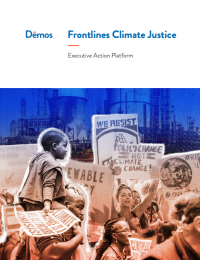
Frontlines Climate Justice Executive Action Platform

By staff - Demos, July 22, 2020

As communities across the country, as well as countless people all over the world, face accelerating impacts and risks of climate change, federal, state, and local leadership in the United States is critically important for advancing immediate and aggressive climate action in public policy.

The science shows we no longer have the luxury to act incrementally. We must rapidly transform every sector of society if we are to limit global warming to 1.5 degrees Celsius. But urgent action on climate change cannot come at a price of expedience and further sacrifice for frontline communities. Frontline communities are primarily communities of color, indigenous communities, and struggling working-class communities most impacted by fossil fuel pollution and climate change—which are all the more vulnerable due to historic and continuing racism, segregation, and socioeconomic inequity.

In tackling the urgency of the climate crisis, prioritizing the most impacted communities for the protections and benefits of an economy-wide renewable energy transition is a moral imperative. This is, in large part, the meaning of a “just transition.” The economic transition we need to reverse the climate crisis must not leave behind impacted communities and workers. Racial and economic equity must be at the core of all climate solutions.

The executive branch can set the stage for a transformative climate justice agenda by taking immediate action at this intersection of climate, racial justice, and economic transformation. The Frontlines Climate Justice Executive Action Platform speaks to this opportunity by identifying regulatory rulemakings and other executive actions to advance an equitable climate agenda from day one. While major legislation in many areas will ultimately be needed to advance a bold federal agenda of climate action, this platform proposes a set of actions the executive branch can take without new legislation, major new appropriations, or other Congressional authority. However, many of the proposed executive actions can be harmonized with, be complementary to, or set a direction for statutory advancement of transformative climate action when that becomes possible.

This platform identifies actions in 4 basic categories that speak to the policy work and movement-building that frontline leaders in the climate movement have developed over many years, as they have forged a clear vision of equitable and resilient social and economic transformation:

  1. Environmental Justice: Protecting frontline communities from continuing harms of fossil fuel, industrial, and built environment pollution.
  2. Just Recovery: Ensuring just and equitable recovery from, and resiliency against, climate disasters.
  3. Climate Equity Accountability: Elevating equity and stakeholder decision-making in federal climate rules and programmatic investments.
  4. Energy Democracy: Remaking the monopoly fossil fuel energy system as a clean, renewably-sourced, and democratically-controlled commons.

In each of these areas, the platform presents a policy outline of possible rulemakings, executive orders, or other presidential actions that, taken together, aim to put frontline needs and priorities at the center of climate policy, including empowering grassroots stakeholders to be decision-makers in the process.

Read the summary (PDF).

Read the text (PDF).

Toxic Relationship: How refineries affect climate change and racial and economic injustice

By Jean Tepperman - East Bay Express - July 22, 2020

California should begin gradually reducing output from its oil refineries in order to avoid climate catastrophe and to make the transition to clean energy as equitable as possible. That's the conclusion of a major new report released July 6 by Communities for a Better Environment (CBE), endorsed by more than 40 environmental and social justice organizations.
While most people agree on the need to use less fossil fuel, many fear that requiring refineries to reduce production could lead to higher gasoline prices and a big economic hit for workers and communities that depend on refineries for income. Report-author Greg Karras responded, "If we start now, doing it gradually, it will give us the time to replace refinery-dependent economics." The report calls for cutting production 4 to 7 percent a year, starting in 2021.

California has set targets for cutting carbon emissions between now and 2050: the state's share of global cuts needed to keep temperature increases below catastrophic levels. Because the carbon that causes climate change builds up in the atmosphere, California has a carbon "budget"—the total amount it can emit from now until 2050. According to Decommissioning California Refineries, California will have to refine much less oil per year to avoid blowing through this carbon "budget" by about 2037.

"California is the biggest oil-refining center in Western North America," Karras said. "Oil refined here emits more carbon than all other activities in the state combined." Even if all other sources of carbon are reduced on schedule, Karras said, "we must refine much less oil if we hope to meet the state's carbon limit."

"We have to break free from our toxic relationship with oil before it takes us over a cliff," Karras said. "When you're in a car heading toward a cliff, it matters when you start putting on the brakes."

The sooner we start, the more likely we are to escape the worst impacts of climate change.

The issue is not just climate, said Andres Soto of CBE. He pointed out that refinery pollution is concentrated in communities like Richmond, centers of racial and economic injustice.

"Only 20 percent of Richmond is Euro-American," he said.

And the health consequences of having a refinery as a neighbor are severe.

Rodeo, another Contra Costa refinery town, "is in the 98th percentile for asthma," said resident Maureen Brennan, and it has high rates of skin disease, autoimmune disease and cancer—all linked to refinery-generated pollution.

Retired refinery worker Steve Garey, past president of a United Steelworkers local in Washington state, said starting now to plan for reduced refinery production could actually benefit refinery workers, since "the movement away from fossil fuels and toward renewables is going to accelerate. It's an economic reality. Renewables are cheaper than fossil fuel and getting cheaper all the time."

Recently when the pandemic cut demand for gasoline, Garey said, the Marathon refinery in Martinez shut down, leaving the workers and community stranded.

The current drop in oil use, Karras said, gives us a once-in-a-lifetime opportunity to turn away from the cliff and build a cleaner and more equitable recovery.

Towards a Global Climate Strike

By John Molyneux - Global Ecosocialist Network - July 13, 2020

The IWW has not yet decided whether to endorse this call. This is posted here for information purposes only.

The Global Ecosocialist Network (GEN) is asking its members and affiliated organisations to popularise the idea of a global climate strike coinciding with the COP 26 Conference in Glasgow in November 2021.
To avoid misunderstanding it should be said at the outset that GEN is not itself presuming to call such a strike but we hope to spread the idea and be part of assembling a broad coalition that can issue such a call. Also the idea of a strike in November next year is not counter posed to any actions or struggles that may develop in the meantime but would complement them.

What follows are some comments on why I think this is a good idea and on some of the political thinking behind it.

First, the obvious. The issue of climate change has been overshadowed by the Covid pandemic but in fact the scientific evidence shows catastrophic climate change, particularly in the form of bouts of extreme heat, is developing even faster than the experts had predicted and making existing responses even more inadequate than they already were. It is vital that we put this question back at the centre of political debate.

Second, the mere fact that COP 26 was postponed for over a year shows that this issue is not really an urgent priority for the world’s rulers and therefore it is essential to build the mass popular movement to put them under pressure.

So why a global strike? The broad environmental movement will invest a great deal of energy into COP 26 both in terms of trying to exert influence within the Conference and in terms of mobilizing people to be on the streets of Glasgow and at various counter summits etc. But the fact is that the mass of ordinary people in Latin America, Africa, Asia, Oceania and even in Europe, will not be going to Glasgow and the idea of a climate strike offers a framework within which people can become engaged everywhere.

The idea of a climate strike next November provides a strategic goal which we can work towards in a multitude of ways over the next year. There will be innumerable conferences and organising meetings held by bodies ranging from NGOs and Charities (War on Want etc) to Extinction Rebellion and ecosocialist groups to radical political parties in the coming period. The goal of a global climate strike day can be canvassed at all of them in order to build momentum. It is something which, hopefully, everyone except the most conservative wing of the movement can support and combined with numerous other forms of action relevant to particular countries and situations.

Is it possible? It is, of course, by no means guaranteed but it IS possible. In the not too distant past the idea of a global strike on anything, let alone climate, would have seemed outlandish and akin to those tiny left sects that repeatedly called general strikes to zero effect. But times have changed. Most obviously we have seen the inspirational school strike movement launched by Greta Thunberg On 15 March 2019, the schools strikes exploded internationally. Here are some of the high points: Australia – 150,000; Germany – 300,000; France – 195,000; Italy – 200,000; Canada – 150,000; UK – 50,000; Austria – 30,000; Luxemburg – 15,000; Ireland – 16,000. There were also smaller strikes and protests in places as far flung as Reykjavik, Slovenia, Cape Town, Hong Kong and Bangkok. Overall, about 2,200 events took place in about 125 different countries, with more than a million participating worldwide. In 2019 there were strikes in the USA by McDonald’s workers against sexual harassment and prison strikes against unpaid labour. In India in 2016 an estimated 160 to 180 million public sector workers went on a 24 hour general strike against privatisation and government economic policies. It was hailed as the largest strike in history. In Spain on International Women’s Day, 2019, approximately 5 million held a strike against gender inequality and sex discrimination and this strike was initiated by feminists outside the official trade union movement. In the course of the fight for abortion rights there were important right-to-choose strikes in both Poland and Ireland. And there are Black Lives Matter strikes planned for the US on 20 July.

The proletarianisation of white collar work, the globalisation and multicultural diversification of the working class has facilitated the adoption of the quintessentially working class form of struggle – the strike – by people a long way from the traditional stereotype of the industrial worker.

Defending Tomorrow: The climate crisis and threats against land and environmental defenders

By staff - Global Witness, July 2020

For years, land and environmental defenders have been the first line of defence against climate breakdown. Yet despite clearer evidence than ever of the crucial role they play, far too many businesses, financiers and governments fail to safeguard their vital and peaceful work. 

The climate crisis is arguably the greatest global and existential threat we face. As it escalates, it serves to exacerbate many of the other serious problems in our world today – from economic inequality to racial injustice and the spread of zoonotic diseases.

For years, land and environmental defenders have been the first line of defence against the causes and impacts of climate breakdown. Time after time, they have challenged those companies operating recklessly, rampaging unhampered through forests, skies, wetlands, oceans and biodiversity hotspots.

Yet despite clearer evidence than ever of the crucial role they play and the dangers they increasingly face, far too many businesses, financiers and governments fail to safeguard their vital and peaceful work. 

Our annual report into the killings of land and environmental defenders in 2019 shows the highest number yet have been murdered in a single year. 212 land and environmental defenders were killed in 2019 – an average of more than four people a week.

Read the text (PDF).

A Pathway to a Regenerative Economy

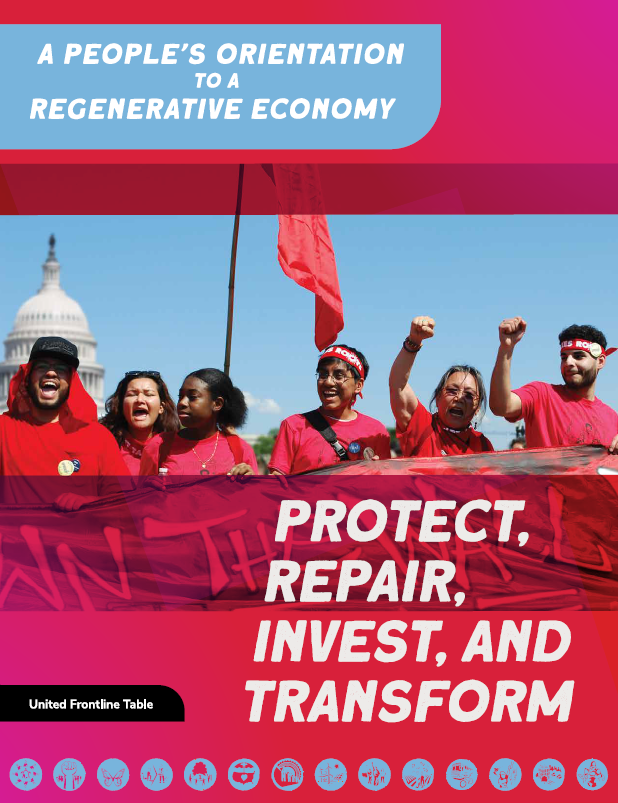
By various - United Frontline Table, June 2020

The intersecting crises of income and wealth inequality and climate change, driven by systemic white supremacy and gender inequality, has exposed the frailty of the U.S. economy and democracy. This document was prepared during the COVID-19 pandemic which exacerbated these existing crises and underlying conditions. Democratic processes have been undermined at the expense of people’s jobs, health, safety, and dignity. Moreover, government support has disproportionately expanded and boosted the private sector through policies, including bailouts, that serve an extractive economy and not the public’s interest. Our elected leaders have chosen not to invest in deep, anti-racist democratic processes. They have chosen not to uphold public values, such as fairness and equity, not to protect human rights and the vital life cycles of nature and ecosystems. Rather, our elected leaders have chosen extraction and corporate control at the expense of the majority of the people and the well-being and rights of Mother Earth. Transforming our economy is not just about swapping out elected leaders. We also need a shift in popular consciousness.
There are moments of clarity that allow for society to challenge popular thinking and status quo solutions. Within all the challenges that this pandemic has created, it has also revealed what is wrong with the extractive economy while showcasing the innate resilience, common care, and original wisdom that we hold as people. Environmental justice and frontline communities are all too familiar with crisis and systemic injustices and have long held solutions to what is needed to not only survive, but also thrive as a people, as a community, and as a global family. We cannot go back to how things were. We must move forward. We are at a critical moment to make a downpayment on a Regenerative Economy, while laying the groundwork for preventing future crises.

To do so, we say—listen to the frontlines! Indigenous Peoples, as members of their Indigenous sovereign nations, Asian and Pacific Islander, Black, Brown and poor white marginalized communities must be heard, prioritized, and invested in if we are to successfully build a thriving democracy and society in the face of intersecting climate, environmental, economic, social, and health crises. A just and equitable society requires bottom-up processes built off of, and in concert with, existing organizing initiatives in a given community. It must be rooted in a people’s solutions lens for a healthy future and Regenerative Economy. These solutions must be inclusive—leaving no one behind in both process and outcome. Thus, frontline communities must be at the forefront as efforts grow to advance a Just Transition to a Regenerative Economy.

A People’s Orientation to a Regenerative Economy offers community groups, policy advocates, and policymakers a pathway to solutions that work for frontline communities and workers. These ideas have been collectively strategized by community organizations and leaders from across multiple frontline and grassroots networks and alliances to ensure that regenerative economic solutions and ecological justice—under a framework that challenges capitalism and both white supremacy and hetero-patriarchy—are core to any and all policies. These policies must be enacted, not only at the federal level, but also at the local, state, tribal, and regional levels, in US Territories, and internationally.

Read the text (PDF).

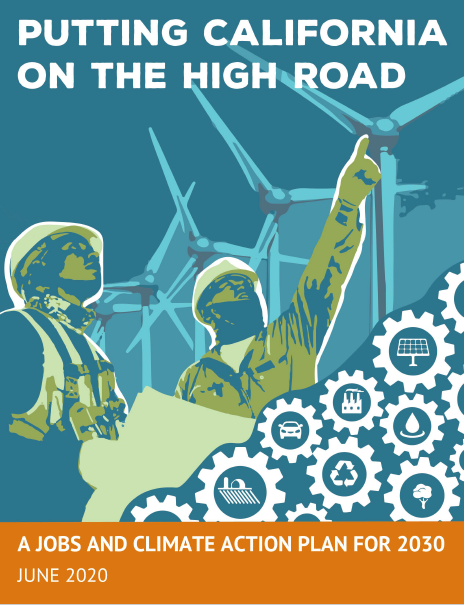
Putting California on the High Road: a Jobs and Climate Action Plan for 2030

By Carol Zabin, et. al. - University of California, Berkeley Center for Labor Research and Education, June 2020

Over the last 15 years, California has emerged as a national and world leader in the fight to avoid climate disaster, passing a comprehensive and evolving suite of climate measures to accelerate the transition to a carbon- neutral economy. The state has also emerged as a national leader in embracing economic equity as a goal for state policy, charting a path towards a new social compact for shared prosperity in a rapidly changing world. Meaningful commitment to both of these goals—ensuring that all Californians thrive in the transition to a carbon-neutral economy—requires the development and implementation of a bold agenda that aligns California’s ambitious climate and workforce action plans. This report presents a framework for California to advance that agenda.

Assembly Bill 398 (E. Garcia, Chapter 135, Statutes of 2017) required that the California Workforce Development Board (CWDB) present a report to the Legislature on strategies “to help industry, workers, and communities transition to economic and labor-market changes related to statewide greenhouse gas emissions reduction goals.” To fulfill this mandate, the CWDB commissioned the Center for Labor Research and Education at the University of California, Berkeley, to review the existing research in the field and prepare this report. The summary presented here describes the key concepts, findings, and recommendations contained in UC Berkeley’s full work.

The statutory language of AB 398 makes clear that this report should address workforce interventions to ensure that the transition to a carbon-neutral economy:

  • Creates high-quality jobs;
  • Prepares workers with the skills needed to adapt to and master new, zero- and low-emission technologies;
  • Broadens career opportunities for workers from disadvantaged communities; and
  • Supports workers whose jobs may be at risk.

This report presents a comprehensive strategy that identifies roles for state and local climate, economic development, and workforce development agencies in achieving these goals, alongside key partners such as business, labor, community, and education and training institutions. All recommendations align with the CWDB’s Unified Strategic Workforce Development Plan, which has put forth a set of actions to leverage and coordinate the state’s myriad workforce and education programs to support high-quality careers for Californians. In keeping with the statutory directive, the report discussion is further enriched by comments provided to the CWDB through a series of stakeholder meetings held in July and August 2018.

This report builds upon the framework established in California’s 2017 Climate Change Scoping Plan (Scoping Plan), which presents a roadmap of policies and programs to reach the climate protection target in Senate Bill 32 (Pavley, Chapter 42, Statutes of 2016) of a 40 percent reduction in greenhouse gas emissions by 2030 from 1990 levels. The Scoping Plan is organized into sectors based on the state’s major sources of greenhouse gas emissions and corresponding climate action measures: Transportation, Industry, Energy, Natural and Working Lands (including Agricultural Lands), Waste, and Water. This report organizes the available information from existing academic research, economic models, and industry studies for the Scoping Plan sectors and presents for each of them:

  • Information about current labor conditions and the impact on jobs of the major climate measures;
  • Guidance for policymakers, agencies, and institutions that implement climate and/or workforce policy on how to best generate family-supporting jobs, broaden career opportunities for disadvantaged workers, deliver the skilled workforce that employers need to achieve California’s climate targets, and protect workers in declining industries; and
  • Examples of concrete, scalable strategies that have connected effective climate action with workforce interventions to produce good outcomes for workers.

Pages

The Fine Print I:

Disclaimer: The views expressed on this site are not the official position of the IWW (or even the IWW’s EUC) unless otherwise indicated and do not necessarily represent the views of anyone but the author’s, nor should it be assumed that any of these authors automatically support the IWW or endorse any of its positions.

Further: the inclusion of a link on our site (other than the link to the main IWW site) does not imply endorsement by or an alliance with the IWW. These sites have been chosen by our members due to their perceived relevance to the IWW EUC and are included here for informational purposes only. If you have any suggestions or comments on any of the links included (or not included) above, please contact us.

The Fine Print II:

Fair Use Notice: The material on this site is provided for educational and informational purposes. It may contain copyrighted material the use of which has not always been specifically authorized by the copyright owner. It is being made available in an effort to advance the understanding of scientific, environmental, economic, social justice and human rights issues etc.

It is believed that this constitutes a 'fair use' of any such copyrighted material as provided for in section 107 of the US Copyright Law. In accordance with Title 17 U.S.C. Section 107, the material on this site is distributed without profit to those who have an interest in using the included information for research and educational purposes. If you wish to use copyrighted material from this site for purposes of your own that go beyond 'fair use', you must obtain permission from the copyright owner. The information on this site does not constitute legal or technical advice.