You are here

environmental justice

Transforming Eskom: Working Class Climate Justice

Transforming Eskom: Africa’s Biggest Polluter

Transforming Eskom: Youth Securing a Just Climate Future

A Green New Eskom: Transforming Power, Transforming South Africa

By staff - Climate Justice Coalition, November 2021

The campaign for a Green New Eskom is being led by the Climate Justice Coalition, a coalition of South African civil society, grassroots, trade union, and community-based organisations. We are calling for a rapid and just transition to a more socially owned, renewable energy powered economy, providing clean, safe, and affordable energy for all, with no worker and community left behind in the transition.

The Problem: Eskom’s old, unreliable and polluting coal power stations plunge us into rolling blackouts i.e. load-shedding or load reductions. Eskom has been mired in corruption, which has driven it deep into debt, sent electricity prices soaring, and robbed the public purse of trillions of rands.

Looking at Eskom now, it can be hard to think that it can be part of the solution to our problems rather than the cause of them. It can be hard to think of Eskom as anything but a headache, a drain on the taxpayer, and one of the gravest threats to our economy and environment.

The Solution: A better Eskom is possible. One that provides affordable, reliable and clean energy. An Eskom that drives a just transition to a more socially-owned renewable energy future that empowers and benefits communities, workers, businesses and all South Africans.

Not only is a transformed Eskom possible, it is absolutely vital. We simply cannot ensure a prosperous and sustainable future for South Africa without fixing Eskom. This may be one of the biggest and most important tasks in creating a better South Africa for all.

Read the entire statement (PDF).

Clean Power to the People

By Al Weinrub - Organizing Upgrade, October 27, 2021

As predicted, the climate has been screaming out with intensified ferocity at the assault on the earth by the global fossil fuel economy. Extreme weather conditions are wreaking havoc on communities across the world, leading many climate activists in the U.S. and elsewhere to declare a climate emergency, requiring an urgent, intensified transition from fossil fuels to renewable energy.

But thinking of this transition as mainly a shift in energy technology, as de-carbonizing the economy, is to misunderstand the deep roots of the climate crisis in an extractive economic system based on racialized social and economic inequality.

Emphasizing de-carbonization of energy without broad institutional transformation—an approach called carbon fundamentalism—leaves us still at the mercy of the corporate energy establishment. That approach, as we shall see, is actually amplifying the already devastating impacts of the climate crisis. “It ignores the specific needs of people of color, it promotes programs that force low-income people to pay unfairly for carbon reduction, it exposes our communities to increased risks, and it sacrifices justice in the urgent rush to reduce carbon,” says Jessica Tovar of the Local Clean Energy Alliance. “Time and again, it ends up throwing people of color under the bus.”

We need more than clean energy to address the climate crisis. We need to move from a large, centralized private utility model to a locally based, decentralized energy model. We need an energy system centered on democracy and justice.

Hoodwinked in the Hothouse: Examining False Corporate Schemes advanced through the Paris Agreement

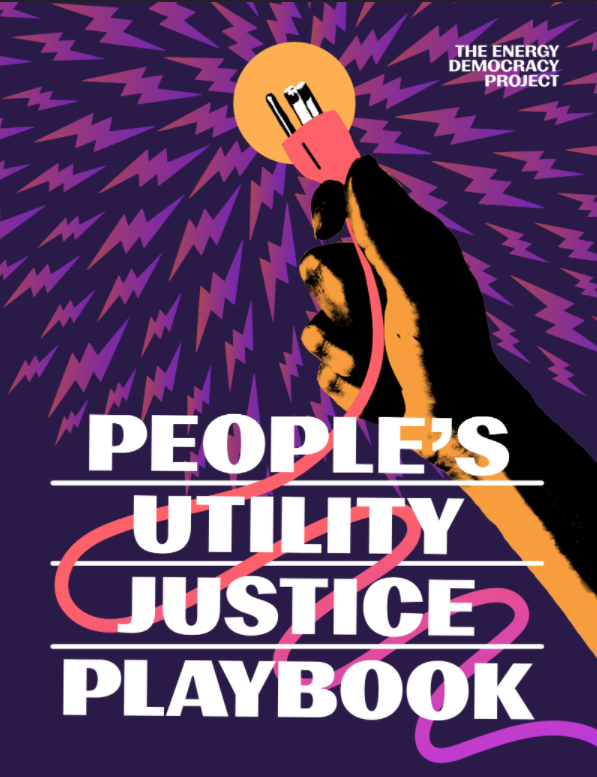
People's Utility Justice Playbook​

By Yesenia Rivera and Johanna Bozuwa - Energy Democracy Project, October 2021

Have you ever wondered who is in charge of your electricity? And why?

The People’s Utility Justice Playbook has two components:

  1. a “History of Utilities” report to summarize the history of utilities for everyone to understand how our current energy system originated.
  2. a “People’s Utility Justice Playbook” to expose the tactics from electric utilities that are undermining community’s efforts, so we can build our organizing strength—to not only fight back but also to build the democratic energy system for climate justice.

This is the basic information we need to fight back against energy utilities attempting to slow or stop progress toward economic and climate justice.

History of Utilities​

Electric utilities have expanded into almost every aspect of our lives to become one of the most powerful and concentrated industries on Earth. To have a better understanding of what we’re fighting against, we first need to learn about the history of energy utilities! This PDF summarizes the entire timeline and how the rise of energy democracy came about.

People's Utility Justice Playbook

In order to fight the industry-owned utilities’ tactics, we need our own strategies for combat!

We have our very own playbook sourced from energy justice activists on the ground. They suggest strategies and tactics they employ when fighting against utilities that anyone fighting against utilities could use!

Read the History (PDF).

Read the Playbook (PDF).

Social Justice and Trade Union statements at the PreCOP in Milano

By Gina Cortes Valderrama - Women Gender Climate, September 30, 2021

Thank you, my name is Gina Cortes Valderrama and I speak on behalf of five diverse rights-based constituencies- Women and Gender, Trade unions, Indigenous Peoples, Youth, the Climate Action Network, and Demand Climate Justice. We are speaking collectively to demand ambition, justice, and people-powered solutions. Together, we represent over 3000 organizations in more than 160 countries.

Let’s start with reality:

  • In 2020, five years after Paris promised to uphold human rights in all climate actions, a record number of activists were murdered as they worked to protect the environment
    and land rights.
  • The recent UNFCCC NDC synthesis report warns emissions will be 16 percent above the 2010 level by 2030 - even after the latest mitigation pledges -, while science tells us we need to halve emissions until then.
  • In addition, according to the OECD figures, 2019 climate finance remained $20bn below the target for 2020. And it is virtually certain that the $100bn will not be met in 2021.
  • In all circumstances, the connection between climate impacts and inequality are abundantly clear. These inequities are further exacerbated when a few rich nations have yet refused a TRIPS waiver and ensured vaccine equity with adequate support...

Read the entire text (PDF).

LA County Board of Supervisors Passes Historic Measure to Begin Phase-Out of Oil Drilling

By Gabby Brown - Sierra Club, September 15, 2021

Los Angeles, CA -- Today, the Los Angeles County Board of Supervisors voted unanimously in support of a measure to begin the process of phasing out oil drilling on unincorporated Los Angeles County land. There are more than 1,600 wells in unincorporated LA County, with the majority located in the Inglewood Oil Field, the largest urban oil field in the country.

Today’s vote puts LA County on the path to being the first in the country to ban and phase out existing drilling. The Board also voted to create a program to ensure that wells are properly closed and cleaned up, and to expand the county's task force focused on a just transition for fossil fuel workers and communities. 

Culver City voted in June to phase out oil production and require the cleanup of well sites in the city’s portion of the Inglewood Oil Field within five years. The City of Los Angeles is also working on developing its own policy to phase out oil drilling.

Environmental justice, climate, faith, labor, and public health groups have long called for an end to neighborhood oil drilling in Los Angeles, citing serious health risks for nearby communities and the need to stop fossil fuel extraction to avert the worst of the climate crisis. Ahead of the vote, groups submitted letters signed by 150 organizations and more than 4,000 petitions and comments to the Board urging them to protect Los Angeles communities by supporting the phase-out of dangerous oil drilling. 

“We have an opportunity and responsibility as the home of the largest urban oil field in the nation to lead by example in creating an equitable path for phasing out oil drilling. Collectively, the motions that passed today center the needs of the communities and workers most impacted by oil drilling and build on Los Angeles County’s momentum in fighting climate change and sunsetting oil and gas operations,” said Supervisor Holly J. Mitchell. “I applaud the Board for continuing to move LA County forward on this critical issue and the countless advocates that have helped get us to this point. Our work is far from done but this is a promising step for environmental justice.”

"Responsibly phasing out oil drilling and cleaning up old wells is critical to ensuring we protect public health as part of a just transition in LA County," said April Verrett, President of SEIU 2015. "We applaud the Board of Supervisors for taking this historic vote, and hope that it can represent a model for the rest of the state to protect both workers and public health."

Energy Justice Statement on Rooftop Solar and Distributed Generation in California

By Alexis Sutterman, et. al. - CAUSE, Environmental Health California, APEN, CEJA, the Greenlining Institutem and Leadership Council for Justice and Accountability, September 2021

Communities are being bombarded by cumulative and intersecting energy pressures: an affordability crisis, rising rates, major utility debt, economic insecurity, and ongoing power outages. In the face of intensifying climate impacts and the need for rapid decarbonization, Net Energy Metering (NEM) policies have supported tremendous growth of distributed solar resources, making California a national leader and helping to dramatically improve the economics of distributed generation and rooftop solar. Due to the intersectional impacts of redlining, California’s inequitable energy policies, and ongoing oppression, however, environmental justice (EJ) communities have experienced structural barriers in accessing and benefiting from NEM. Data shows that NEM disproportionately benefits wealthier, white, single-family homeowners. By its very design, NEM has not enabled rooftop solar to adequately penetrate EJ communities. Despite representing 25% of the State’s population, only 11-12% of households living in disadvantaged communities (DACs) in California are on NEM rates.

Read the text (PDF).

Pages

The Fine Print I:

Disclaimer: The views expressed on this site are not the official position of the IWW (or even the IWW’s EUC) unless otherwise indicated and do not necessarily represent the views of anyone but the author’s, nor should it be assumed that any of these authors automatically support the IWW or endorse any of its positions.

Further: the inclusion of a link on our site (other than the link to the main IWW site) does not imply endorsement by or an alliance with the IWW. These sites have been chosen by our members due to their perceived relevance to the IWW EUC and are included here for informational purposes only. If you have any suggestions or comments on any of the links included (or not included) above, please contact us.

The Fine Print II:

Fair Use Notice: The material on this site is provided for educational and informational purposes. It may contain copyrighted material the use of which has not always been specifically authorized by the copyright owner. It is being made available in an effort to advance the understanding of scientific, environmental, economic, social justice and human rights issues etc.

It is believed that this constitutes a 'fair use' of any such copyrighted material as provided for in section 107 of the US Copyright Law. In accordance with Title 17 U.S.C. Section 107, the material on this site is distributed without profit to those who have an interest in using the included information for research and educational purposes. If you wish to use copyrighted material from this site for purposes of your own that go beyond 'fair use', you must obtain permission from the copyright owner. The information on this site does not constitute legal or technical advice.