You are here

extractivism

One day longer. One day stronger. One year later

By Kim Kelly - The Real News, April 13, 2022

It was supposed to be a terrible day. Thousands of United Mine Workers of America (UMWA) members and supporters were scheduled to convene in Tuscaloosa County, Alabama, on the morning of April 6, 2022, to commemorate the one-year anniversary of the beginning of the Warrior Met Coal strike. But, much like the coal bosses themselves, the forecast was not cooperating. The weather report, in typical fickle Alabama fashion, had been fluctuating between rain, more rain, and certain waterlogged doom; the union had bought ponchos in bulk to prepare. As UMWA International President Cecil E. Roberts said before the rally, “A little bad weather isn’t going to slow us down.”

By the time I arrived at Tannehill State Park that morning, I was fully prepared to spend my day stuck in the mud impersonating a drowned rat. I was not surprised to see that the day’s schedule had been moved up in a bid to outrun the rain. The original start time was slated for 11AM, but the rally was already in full swing by 10:30AM. Like all UMWA rallies, this one opened with a prayer, and I’m sure I wasn’t the only person in the crowd hoping (or praying) that the universe would see fit to send us some good luck after all.

Buses were still arriving as speakers took the stage; according to an emailed UMWA press release, at least 1,200 UMWA members and retirees had bused in from Illinois, Pennsylvania, Ohio, Kentucky, and West Virginia, and they were joined by union members from across the South. It was a family reunion, with a greater purpose—when the call for solidarity went out, folks listened. They came to pay their respects by the hundreds, traveling across rivers and valleys and up from hills and hollers to be there alongside their afflicted siblings.

Who Is Working-Class, and Why It Matters

By Van Gosse - Convergence, April 9, 2022

Many political analysts, including some on the Left, are positing a radically new configuration of class in the United States. Their argument, reduced to its essence, is that the traditional markers of class are no longer relevant, and now the great divide is between those who have graduated from college versus the rest. It is further argued that this new class structure is reshaping our political party system in dramatic ways:  the Democrats are becoming the party of the educated, in addition to traditional constituencies among African Americans and single women. Conversely, the Republicans are becoming a party of the working class—defined as the non-college-educated—across traditional racial and ethnic lines (for a cogent example of this analysis, see Matt Karp’s “The Politics of a Second Gilded Age”).

I think this analysis is wrong in all respects.  We need an analysis of how class functions in the U.S. that is based in our distinct history of stratification (and division) along ethno-racial lines.  Beyond that, we need an accurate reading of the Democratic Party in particular, if we are to advance the struggle for a multiracial democracy against white nationalism.

Movement Generation Works to Usher in a Sustainable Just Transition

By Aric Sleeper - CounterPunch, April 4, 2022

In the mid-2000s, when the documentary featuring former Vice President Al Gore, “An Inconvenient Truth,” first alerted viewers that human activity was drastically altering the environment, and global warming would insidiously thaw the North and South poles and raise the sea levels, urban organizers like Mateo Nube heard the warning loud and clear. Nube quickly banded together with other activists in the San Francisco Bay Area to educate their communities about humanity’s devastating impacts on the environment and what needed to be done to try to abate the eventual irreparable changes by shifting people’s views about the economy, which was contributing to the environmental degradation.

“At that time, most of my peers in urban organizing weren’t even discussing climate change,” says Nube. “Once we started digging into it, we realized our peers organizing in Miami might be underwater 50 years from now, and that climate change was a symptom of a much deeper set of interlocking crises rooted in industrial extractivism.”

In 2006, Nube and his colleagues co-founded the Movement Generation Justice and Ecology Project to create an analytical foundation for organizers interested in the relationship between ecology and social justice, and as a hub for strategic organizing efforts through workshops, retreats and campaign development.

More than 15 years later, with undeniable signs of climate change becoming more apparent in the form of extreme weather events, which are being experienced with growing frequency every year, and the ongoing COVID-19 pandemic, Nube and other longtime organizers are trying very hard not to say, “I told you so.”

“Fifteen years ago [just after we started Movement Generation], a lot of our work was about being a proactive Chicken Little of sorts, telling folks that things are really dramatic, but now we’re way past that,” says Nube. “In the last five years, it’s easy to see that change is afoot.”

Movement Generation’s first weeklong retreat in 2007 united Bay Area activists to simply unpack the climate crisis and its origins. Nube found that the initial retreat’s participants were shocked by the information, and ready to act, but they didn’t know what the abatement of climate change looked like in practice.

“To use a ‘Matrix’ parallel, folks came out of the retreat saying, ‘We’ve eaten your red pill, so what’s next?’” says Nube. “But the retreat was a grand experiment, and the outcome was to really start thinking about what the work of creating a just transition looks like on the ground.”

Since then, Movement Generation’s annual weeklong retreat has become its flagship program. Other organizations have branched off from Movement Generation’s efforts, like the Climate Justice Alliance and Seed Commons, which all have their frameworks based in the philosophy and practices of a just transition. For those unfamiliar with the concept, a just transition is the process of shifting from an extractive economy to a regenerative economy.

“To put it another way, a just transition is moving from a banks and tanks economy to a sharing and caring economy, or moving from a me and I stance to a we and us stance, as we digest and process a very dramatic reality [resulting from the climate crisis] on the planet Earth,” says Nube.

One key strategy to ensure a just transition in the scope of the environment, according to Nube, is to relocalize, which Movement Generation facilitates through their programs like Earth Skills and regionally focused EcoSchools workshops. Meanwhile, Movement Generation’s four-part workshop series Course Correction examines the origins of the COVID-19 pandemic and what it means to move forward within the framework of a just transition.

“In January 2020, when the pandemic started to become serious, we realized that this outcome had been a part of our instructional course material for some time,” says Nube. “If you’re continually paving over vibrant ecosystems and constraining the capacity for the species in an ecosystem to thrive, one of the things that will happen is that a virus will jump and spread. The industrial economy and corporate capitalist globalization have created a system of viral superhighways.”

Nube and others at Movement Generation moved their workshops primarily online and soon found that they were reaching thousands instead of hundreds of people. They also realized how economic inequities were highlighted in the context of the pandemic, and that large-scale social support is possible when backed by political resolve.

“We saw how easy it could be to build something else and transform systems when the political will is there,” says Nube. “There’s a lot of potential in the knowledge that all systems are human creations and can be changed. They’re not ordained and fixed by a deity. That’s a gift that the pandemic gave us, with the contradiction of what it means to have a pandemic that’s so destructive.”

Nube points out that the pandemic and all other environmental crises humanity currently endures were created by outdated economic systems and attitudes founded in racism and exploitation, and enforced with violence. One of the critical flaws in the mainstream environmental movement, according to Nube, is to think of conservation as something that is outside the influence of human systems.

“The military infrastructure that enforces white supremacy and anti-Blackness is the same system that facilitates the… [destruction] of the Earth. You can’t disconnect one from the other,” says Nube.

'Coal Country' Mines Seam of Class Anger in West Virginia Explosion

By Alain Savard - Labor Notes, April 4, 2022

If Don Blankenship were a fictional character, critics would say he was a cartoon evil capitalist. Unfortunately, he’s real. One of his lesser crimes was to dump toxic coal slurry into disused mineshafts, poisoning the water of his neighbors, all to save $55,000. While they sickened, he piped his own water from the nearby town of Matewan. Yes, that Matewan. He has characterized strikes as “union terrorism.”

As chair and chief executive of Massey Energy, he received production reports from Upper Big Branch mine every half hour, including weekends. And no wonder, Blankenship’s compensation was tied to production, and UBB produced $600,000 worth of top-quality coal every day in a mile-deep operation near Whitesville, West Virginia.

That is, until it exploded in a completely preventable disaster that killed 29 miners on April 5, 2010.

The workers knew something bad was bound to happen. Methane readings were too high, the ventilation and air control systems were a shambles. One day the mine was sweltering, the next freezing cold. They operated in a fog of coal dust and exhaustion. Management threatened anyone who spoke up.

“Coal Country,” a play recently re-opened at Cherry Lane theater in New York, tells the story of the disaster through the words of the miners and their families. They are backed up by stunning original songs by Texas songwriter Steve Earle, who accompanies himself on guitar or banjo from the corner of the stage. “The devil put the coal in the ground,” he growls, and you can believe it. Jessica Blank and Erik Jensen created the play, and Blank directs it.

Performance Coal, the subsidiary of Massey that ran Upper Big Branch, was created specifically to exclude the union. Gary Quarles (played by Thomas Kopache), recalls that when he first hired into the mine, he couldn’t believe how management shouted at the men. That wasn’t tolerated on his union jobs. Unrelieved overtime was another difference.

Managers brought in experienced miners like Quarles for their knowledge about extracting coal, but dismissed their knowledge about how to run a safe mine. Union mines are safer according to Phil Smith of the United Mineworkers of America, "because workers elect their own safety committees and they know they can report hazards without fear of retribution.”

Can a Just Energy Transition Occur Under Capitalism?

The Danger of Fossil Fascism

By Martin Empson - Climate & Capitalism, March 26, 2022

Understanding the growing combination of racism, climate science denial, and fossil fuel promotion.

Andreas Malm and the Zetkin Collective
WHITE SKIN, BLACK FUEL
On the Danger of Fossil Fascism

Verso Books, 2021

As regular readers of my blog will be aware, I think that Andreas Malm, even where I disagree with key points of his argument, is one of the most stimulating Marxist authors on environmental politics. So it was with eager anticipation that I looked forward to this new publication “one the dangers of fossil fascism” that Malm has co-authored with the network the Zetkin Collective, a group of scholars and activists “working on the political ecology of the far right.”

The book does multiple things. It opens with a study of the far-right and fascist movements and looks at their “anti-climate politics” and asks “what would it mean to live in a world both hotter and further to the right” than it is today. It argues that the far-right’s fixation with anti-climate views is closely tied to its anti-immigration perspective and the way that developing capitalism associated technology (and particularly fossil fuel technologies) with white supremacy. The authors argue in the introduction:

“[The book] traces lineages of resurfacing ideas and contends that white skin and black fuel have been coupled for long time — indeed, machines powered by fossil fuels were infused with racism from the very first moment of their global deployment. The European incubator for skin and fuel was an empire… It is out contention that one cannot understand recent developments [of the far right] or their possible continuation and aggravation, without such a longer view.”

Much of the first part of White Skin, Black Fuel is a study of the reality of far-right politics. This links various aspects of conspiracy theory (white replacement) and Islamic takeover, with wider hatreds of immigrants and Muslims with anti-scientific and views that can only be described as pro-fossil fuel industry on climate change. The discussion of the specifics of these ideas are detailed and for anti-fascist readers they are at times depressing ∞ detailing the extent to which they have become mainstream. Shockingly the growth of the far right and the mainstreaming of their arguments around climate and immigration have pulled the center left towards them. The authors note, for instance, that in Denmark, the social democrats “came close to another line of reasoning: in a warming world, it is even more imperative to patrol borders and send people home” as a result of the growth of the far-right.

End the addiction to fossil fuel- support the Ukrainian resistance

By Alan Thornett - Red Green Labour, March 24, 2022

Putin’s merciless invasion of Ukraine – which is his next step in the restoration of the Russian empire – has been stalled by the remarkable popular resistance that has been mounted against it. The southern port city of Mariupol is been flattened by Russian artillery and is facing a humanitarian catastrophe but has refused to surrender. On the other hand, the invaders have been pushed back on several fronts.
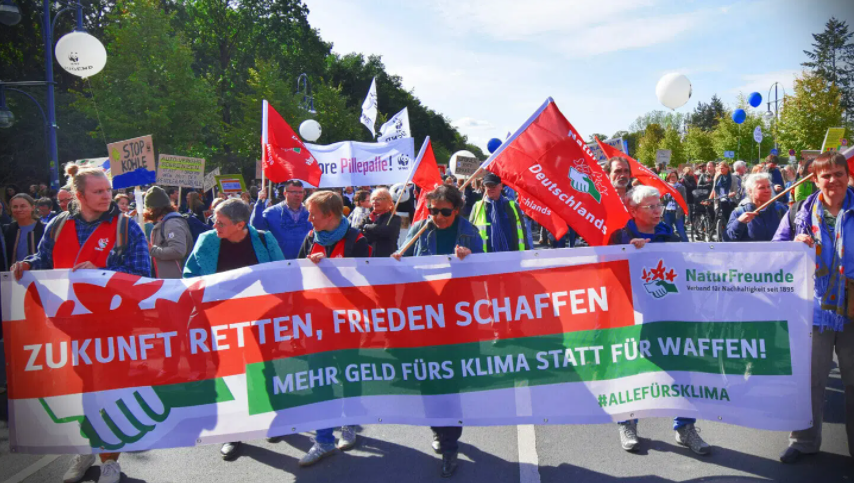
The Ukrainian resistance has relied heavily on both Western economic sanctions and Western military aid including hand-launched anti-tank and surface to air missiles without which Putin’s blitzkrieg might have been unstoppable. The economic sanctions have not just put Putin under pressure at home, but they have given the population the confidence to resist such an overwhelming force.

As the Russians have met much stronger resistance than they expected they have resorted to ever more indiscriminate, long-range bombardment of the civilian population with missiles launched from ships in the Black Sea and from Russia itself. The result of which has been a rapid escalation of civilian casualties. Putin has thousands of planes and missiles, of course, and could wipe Ukraine off the map. But whether that would be politically sustainable (or survivable for him at home) is another matter.

Russia is now a brutal kleptocracy, with Putin as the new Stalin. Anti-war demonstrators facing up to 16 years in jail and opposition politicians, who oppose war, driven into exile. Ten million people, a quarter of the population, are internally displaced and with almost five million already refugees abroad. Many thousands, mostly civilians, are dead. EU countries, to their credit, have opened their borders, suspended visa requirements, and taken in millions of people. This is in sharp contrast to Boris Johnson’s miserable Little Englander government that has been running around in circles in a (very successful) attempt to give refuge to as few people as possible.

How can the climate and anti‑war movements come together?

By Christian Zeller - Red Green Labour, March 23, 2022

Translated from the German- originally published here.
Exit from the fossil economy and rearmament, solidarity with the Ukrainian resistance

We live in a time of abrupt turns. [1]

Global warming is accelerating. The climate is changing faster than previously thought. The Russian war of aggression against Ukraine is largely aimed at the territorialconquest of a neighbouring state, the destruction of its army and the overthrow of its government. [2] This is something that has not existed in Europe in this way since 1945.

Even before this assault, the NATO countries, Russia and China started an arms race. The antagonisms between the various imperialisms intensified enormously. [3]The wave of rearmament that was already being prepared and launched before the war in Ukraine is an expression of intensifying competion for access to scarce resources that are so urgently needed in connection with the energy transition.

Global warming, this war and the danger of wars to come are interconnected and should be understood in a common context.

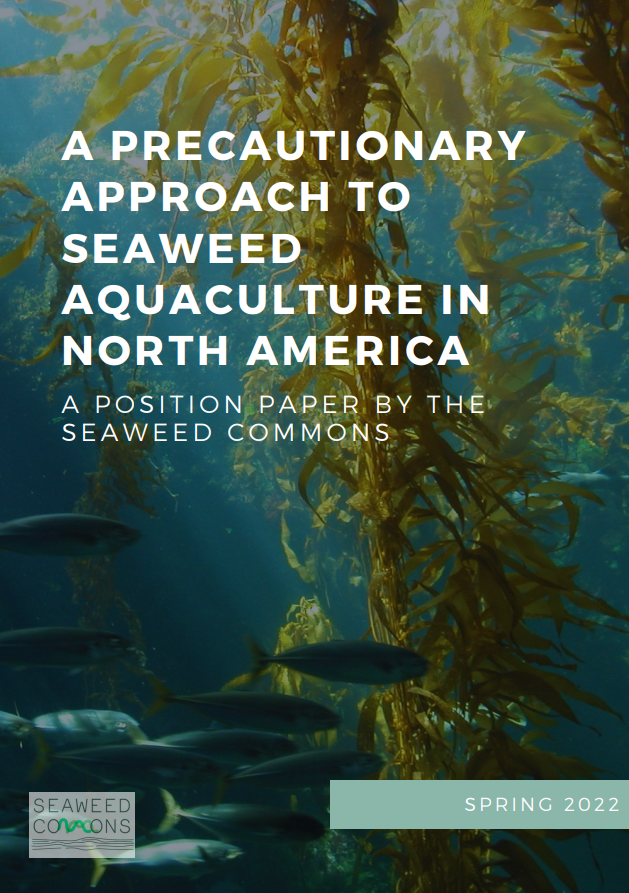
A Precautionary Approach to Seaweed Aquaculture in North America

By Elena Bird, Sarah Holdeman, et. al. - Seaweed Commons, Spring 2022

We are an international collective of seaweed growers, lifelong harvesters, scientists and advocates. We believe that the seaweed aquaculture industry should be developed with a precautionary approach: conservation-minded, at an appropriate scale, and with local ownership and control. Farms should be small-scale until knowledge gaps can be satisfactorily filled and the impact on wild coastal ecosystems and coastal communities is shown to be minimal.

History has shown that allowing corporations to scale up without appropriate regulations often results in far-reaching detrimental effects on both the environment and the socio-economic health of the communities where they operate. Hence, allowing corporations to monopolize where and how seaweed is farmed risks devastating impacts on coastal ecologies, economies, and cultures. Without locally adapted and controlled regulatory frameworks, seaweed could become the next boom and bust crop that was supposed to “save the world.”

In order to support biodiversity, economically sustainable coastal communities, cultural vitality, and climate change resiliency, we ask collaborators to support the due process of scientifically evaluating best seaweed farming practices in North America. We seek regulatory frameworks based on those results before allowing corporations to build large-scale seaweed farms.

In the face of a rapidly growing seaweed industry, we are collectively issuing a warning call and demand for regulatory updates to mitigate risks to coastal ecosystems, the commons of the sea, the biodiversity of kelp forests, and the well-being of our human communities. We aim to achieve a more comprehensive understanding of how seaweed farming and harvesting impacts all of the above.

Download a copy of this publication here (PDF).

Shifting Narratives and Practices to Achieve Gender Just Climate Transitions

Pages

The Fine Print I:

Disclaimer: The views expressed on this site are not the official position of the IWW (or even the IWW’s EUC) unless otherwise indicated and do not necessarily represent the views of anyone but the author’s, nor should it be assumed that any of these authors automatically support the IWW or endorse any of its positions.

Further: the inclusion of a link on our site (other than the link to the main IWW site) does not imply endorsement by or an alliance with the IWW. These sites have been chosen by our members due to their perceived relevance to the IWW EUC and are included here for informational purposes only. If you have any suggestions or comments on any of the links included (or not included) above, please contact us.

The Fine Print II:

Fair Use Notice: The material on this site is provided for educational and informational purposes. It may contain copyrighted material the use of which has not always been specifically authorized by the copyright owner. It is being made available in an effort to advance the understanding of scientific, environmental, economic, social justice and human rights issues etc.

It is believed that this constitutes a 'fair use' of any such copyrighted material as provided for in section 107 of the US Copyright Law. In accordance with Title 17 U.S.C. Section 107, the material on this site is distributed without profit to those who have an interest in using the included information for research and educational purposes. If you wish to use copyrighted material from this site for purposes of your own that go beyond 'fair use', you must obtain permission from the copyright owner. The information on this site does not constitute legal or technical advice.
