You are here

extractivism

Global union launches campaign against world copper mining giants

By staff - MorningStar, September 2021

GLOBAL union confederation IndustriALL is taking on a copper mining company, calling for an end to its exploitation of workers.

It has its sights set on the Chilean franchise of the Anglo-Australian BHP multinational company, accusing it of using its corporate muscle to shape laws to work in its favour.

IndustriALL brought together Chilean BHP unions in an online workshop to explore issues of human rights abuses in global supply chains as well as health and safety.

Workers there have been forced to seek redress through the courts, however there are limited mechanisms offering protection to those working in the BHP-operated mines.

“Environmental, social and governance issues are today seen as the biggest risk to the mining industry.

“BHP can no longer evade these issues. It must show respect for workers, communities and the country as a whole,” IndustriALL spokesman Glenn Mpufane said.

Chile is the world’s largest copper producer, yet at least 61 per cent of BHP workers are contractors with precarious employment conditions.

IndustriALL argues that they should be treated more fairly by the multinational company, with copper becoming a crucial resource in the global economy, in high demand for the energy transition.

“As a result, BHP shareholders enjoy attractive returns, but what are the returns for workers, communities and the country as a whole?” Mr Mpufane said.

In August matters spilled over as government-mediated pay talks stalled and workers threatened to ballot for strike action.

The dispute worried world copper markets, despite the price of the metal rocketing to record highs earlier this year.

They wished to avoid a repeat of the 44-day walkout in Escondia, the world’s largest copper mine, in 2017.

IndustriALL’s global campaign urges BHP to enter negotiations “to address its poor record of ill treatment of workers, communities and environmental degradation across its global operations.”

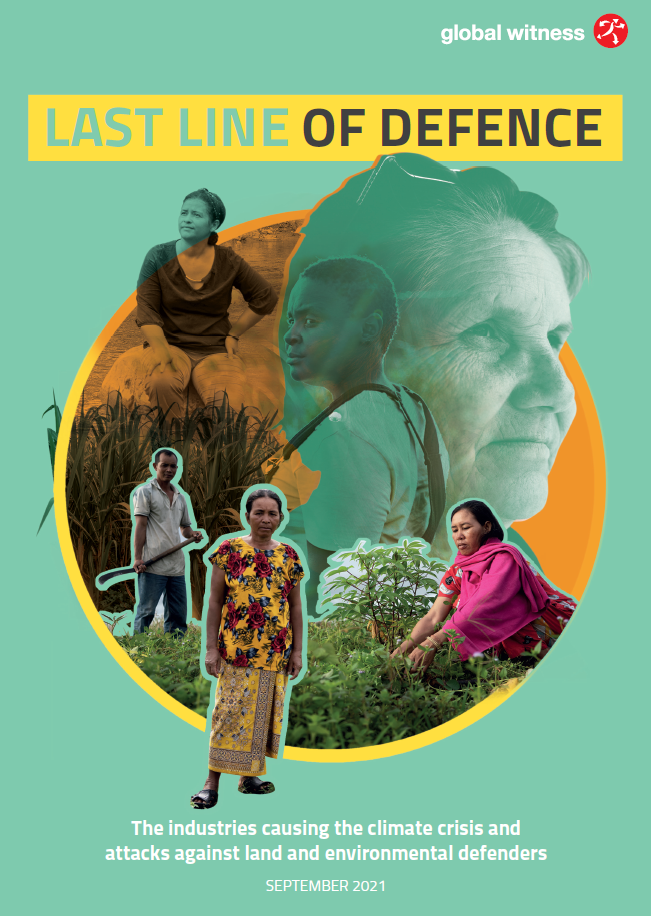
Last line of Defence

By staff - Global Witness, September 2021

The climate crisis is a crisis against humanity.

Since 2012, Global Witness has been gathering data on killings of land and environmental defenders. In that time, a grim picture has come into focus – with the evidence suggesting that as the climate crisis intensifies, violence against those protecting their land and our planet also increases. It has become clear that the unaccountable exploitation and greed driving the climate crisis is also driving violence against land and environmental defenders.

In 2020, we recorded 227 lethal attacks – an average of more than four people a week – making it once again the most dangerous year on record for people defending their homes, land and livelihoods, and ecosystems vital for biodiversity and the climate.

As ever, these lethal attacks are taking place in the context of a wider range of threats against defenders including intimidation, surveillance, sexual violence, and criminalisation. Our figures are almost certainly an underestimate, with many attacks against defenders going unreported. You can find more information on our verification criteria and methodology in the full report.

Read the text (PDF).

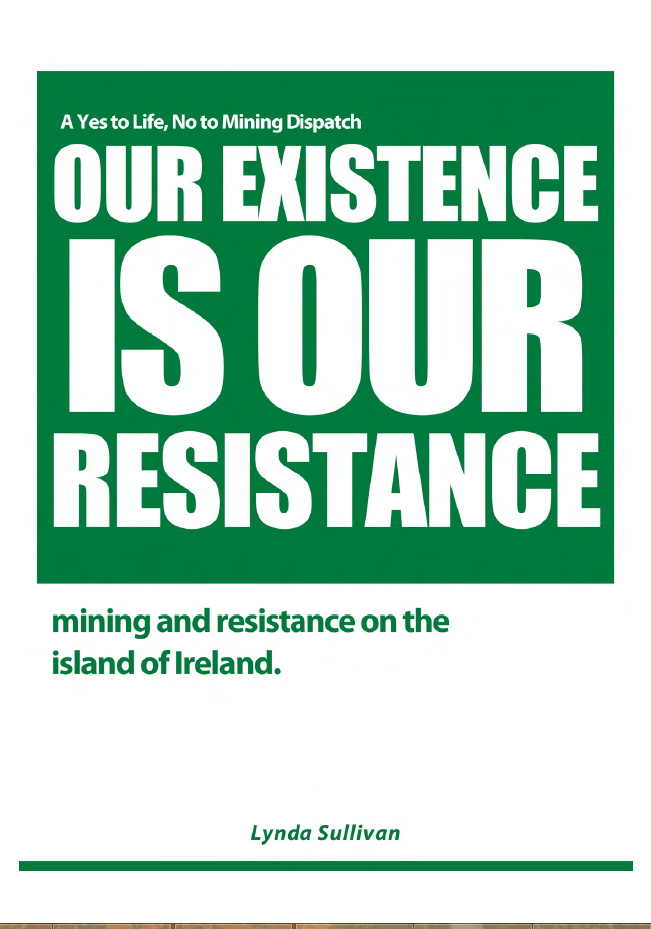
Our Existence is Our Resistance: Mining and Resistance on the Island of Ireland

By Lydia Sullivan - Yes to Life, No to Mining, September 2021

This report from Yes to Life, No to Mining Network (YLNM) explores how and why many nations – and the mining industry – are re-framing mining as a solution to climate change in order to facilitate domestic extraction of so-called ‘strategic’, ‘critical’ and ‘transition’ minerals required for renewable energy, military and digital technologies. 

This analysis of geological and permitting data shows that a staggering 27% of the Republic of Ireland and 25% of Northern Ireland are now under concession for mining.

YLNM’s new research examines state and corporate claims that mining in Europe represents a gold standard of regulation and corporate practice that justifies creating new mining sacrifice zones in the name of climate action.

Without exception, the authors – in all nations – report a vast gap between this rhetoric and the realities of mining at Europe’s new extractive frontiers, highlighting systemic rights violations and ecological harm.

Read the text (PDF).

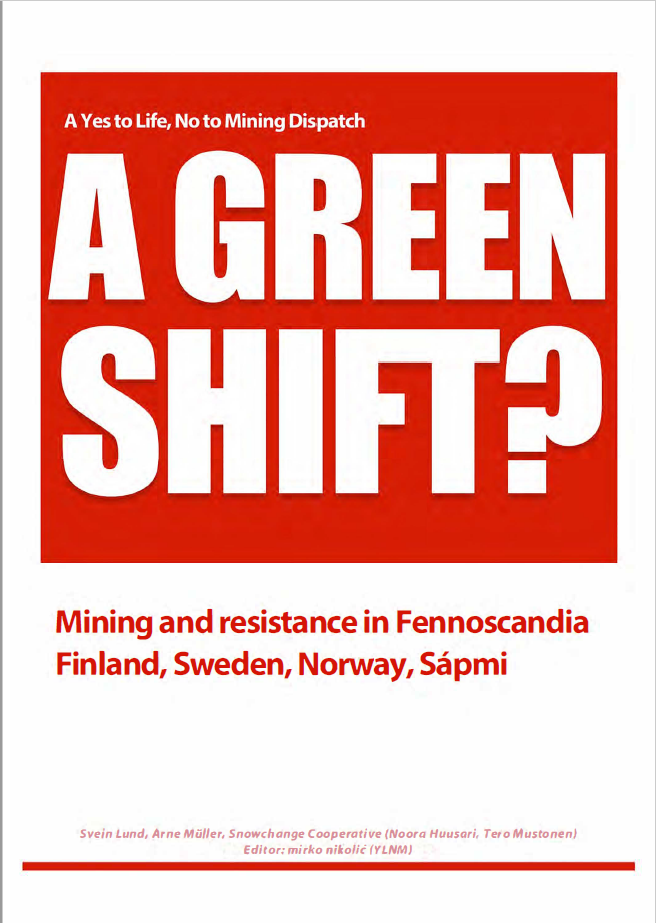
A Green Shift? Mining and Resistance in Fennoscandia, Finland, Sweden, Norway, and Sápmi

Mirko Nikolic, Editor, et. al. - Yes to Life, No to Mining, September 2021

This report from Yes to Life, No to Mining Network (YLNM) explores how and why many nations – and the mining industry – are re-framing mining as a solution to climate change in order to facilitate domestic extraction of so-called ‘strategic’, ‘critical’ and ‘transition’ minerals required for renewable energy, military and digital technologies. 

Finnish, Norwegian and Swedish authorities have granted concessions for tens of thousands of hectares of land, with mining pressure increasing particularly dramatically in Sápmi – the home territory of the Indigenous Sámi Peoples. 

YLNM’s new research examines state and corporate claims that mining in Europe represents a gold standard of regulation and corporate practice that justifies creating new mining sacrifice zones in the name of climate action.

Without exception, the authors – in all nations – report a vast gap between this rhetoric and the realities of mining at Europe’s new extractive frontiers, highlighting systemic rights violations and ecological harm.

Read the text (PDF).

One Million Rounds: The Battle of Blair Mountain

By Vince Ceraso - The Socialist, August 29, 2021

When you think of violent labor disputes, which come to mind? For some, it may be the infamous 1886 Haymarket Affair, 1912 Lawrence textile strike (famously known as Bread & Roses), 1894 Pullman Strike, or something as modern as the 1991 Justice for Janitors police riot. But not many will recall the Battle of Blair Mountain, a week-long civil war that took place in West Virginia during the late summer of 1921. Some 13,000 mineworkers took on 3,000 law enforcement officials, military personnel, and the usual local scabs. Rather than take oppression sitting down, these miners put on their hard hats and geared up for war. However, despite the numbers, the miners suffered a crushing defeat and what resulted was the near collapse of the United Mineworkers of America. But how did it all begin?

In the spring of 1912, West Virginian mineworkers, who all lived in small towns near their respective coal fields, attempted to negotiate contracts with the mining companies to give them higher pay raises and union dues that would be automatic. As you might expect, negotiations fell through, resulting in 7,500 workers going on strike throughout West Virginia. Even local supporters who were not mineworkers joined in. This caught the unwanted attention of the Baldwin-Felts Detective Agency, a private police force that was called to the task of using brutality, fear, and intimidation to break up strikes. To really send the message, the agents began evicting miners from their homes, for unionizing with the UMWA.

Eventually, Mary Harris “Mother” Jones, co-founder of the revolutionary Industrial Workers of the World, joined the strikers, but was later arrested for her involvement in the Paint Creek-Cabin Creek strike of 1912. In the early months of the year-long said strike, the miners issued their own declaration of war against the West Virginian government. Several instances of guerilla-style conflicts began to explode in Kanawha County, WV. Things got so bad that WV Governor William E. Glasscock placed the region under martial law. After a year of bloody combat, more than 50 people were reported dead. The Paint Creek-Creek Cabin strike was the beginning of a 9-year labor conflict, now famously referred to as the West Virginia Mine Wars.

Fast-forward to 1920. The Baldwin-Felts agents were at it again, ransacking homes and evicting miners and their families at the Pocahontas Coalfield in the town of Matewan in Mingo County, West Virginia. This time around, they came face to face with Sid Hatfield, the Matewan police chief and beloved labor organizer. Unlike the vast majority of cops in West Virginia, Chief Hatfield was very outspokenly pro-union, using his position of authority to protect striking workers. He confronted the Baldwin-Felts agents and threatened to arrest them, prompting the agents to brag about their own arrest warrants against Hatfield.

Over the years, the circumstances of what happened next have been debated, but according to official court transcripts published in David Alan Corbin’s Gun Thugs, Rednecks & Radicals: A Documentary History of the West Virginia Mine Wars, an eyewitness testified that Cabell Testerman, the mayor of Matewan, said outright that the detectives’ warrants were “bogus,” triggering an angry Albert Felts, one of the heads of the Baldwin-Felts agency, to pull a firearm from his briefcase and shoot the mayor, who died of his wounds minutes later. Immediately after, Hatfield began firing, and a firefight between him and the agents ensued. When the dust settled, one miner, an innocent bystander, seven Baldwin-Felts agents and Mayor Testerman lay dead, while several other townsfolk were wounded in the crossfire.

In the Coal Mines, Workers Are Dying to Make a Living: Mining companies increasingly rely on cheaper contractors who face longer hours and higher risk of accidents

By Kari Lydersen - In These Times, August 18, 2021

Trebr Lenich always called his mother before his drive home from overnight shifts at Mine No. 1, operated by Hamilton County Coal in Hamilton County, Ill. The call she answered the morning of Aug. 14, 2017, worried her. 

“He said, ​‘Mom, I am just so exhausted, so wore out,’ ” Teresa Lenich says. 

Her son routinely worked long hours on consecutive days. That day, he never made it home.

Coworkers following Trebr said his driving was erratic and suspected he was falling asleep, Teresa says. Heading back to the West Frankfort home he shared with his parents, girlfriend and baby daughter, Trebr drove into a ditch and hit an embankment. According to the sheriff’s report, his engine then caught fire. 

Like many young miners, Trebr was employed through a contracting company that provides temporary workers for mines with no promise that they’ll be hired on permanently.

This staffing structure — and the disappearance of labor unions from Illinois mines — has made work less safe and more grueling for miners, according to advocates and multiple studies. Without job security, temporary workers are reluctant to complain about potentially unsafe conditions (including long work hours) and to report accidents. And because temporary workers may have inadequate experience in a particular mine, they might not understand that mine’s specific risks.

Where We Mine: Resource Politics in Latin America

Thea Riofrancos interviewed by Annabelle Dawson - Green European Journal, August 12, 2021

As the drive to expand renewable energy capacity speeds up, there is a rush for lithium and other materials around the world. What will the expansion of rare earth mining in Latin America mean for the indigenous communities and workers who have historically borne the harms of extractivism? Thea Riofrancos, author of Resource Radicals (Duke University Press, 2020), explains how the energy transition in the Global North risks being anything but just without structural changes to supply chains and the governance of extractive industries.

Annabelle Dawson: Your work explores the politics of resource extraction in Latin America, from oil in Ecuador to lithium in Chile. How do you define resource politics or extractivism?

Thea Riofrancos: Resource politics refers to any social or political activity – whether conflict, collaboration, political economy or social mobilisation – that’s attributed to the extraction of resources, and in some cases to stop resource extraction. Scholarship tends to see resource politics as primarily related to elites like state officials and corporate actors. This is pivotal, for example, to the concept of the resource curse, which holds that dependency on resource rents leads to authoritarianism. However, this focus overlooks a range of resource politics such as social movements that oppose extractive projects or demand better regulation and indigenous rights.

Extractivism is a little thornier to define. My research has explored how in Latin America social movements, activists and even some bureaucrats in the case of Ecuador began to use this term to diagnose the problems that they associated with resource extraction. This happened in the context of the 2000 to 2014 commodity boom – a period of intense investment in resource sectors driven by the industrialisation of emerging economies like China – and the Left’s return to power across Latin America during the “Pink Tide”. Activists, left-wing intellectuals and some government officials began to see extractivism as an interlocking system of social and environmental harm, political repression, and corporate and foreign capital domination. So, the concept originates from political activity rather than scholarship [read more about extractivism in Latin America].

We tend to associate resource extraction with notoriously dirty commodities like coal, oil, and certain metals. How are green technologies implicated in all of this?

The transition to renewable energies is often thought of as switching one energy source for another: fossil fuels for renewables. That’s part of it, but this transition fits into a much bigger energy and socio-economic system. You can’t just swap energy sources without rebuilding the infrastructures and technologies required to harness, generate, and transmit that energy. All this has a large material footprint and requires materials such as lithium, cobalt, nickel and rare earth metals [read more about the central role and impact of these rare metals]. More traditional extractive sectors like copper are also very important for decarbonisation.

One very bad outcome would be if the harms related to fossil fuel capitalism were reproduced in new renewable energy systems, subjecting particular communities to the harms of resource extraction in the name of fighting climate change. We need a new energy system quickly – especially in the Global North given the historic emissions of the US and Europe. But in this rush, there’s a real risk of reproducing inequalities and environmental damage. This is especially so with some mining sectors where a boom in the raw materials for green technologies like wind turbines, electric vehicles and solar panels is predicted.

Striking Alabama Coal Miners Want Their $1.1 Billion Back

By Luis Feliz Leon - Labor Notes, August 10, 2021

History repeated itself as hundreds of miners spilled out of buses in June and July to leaflet the Manhattan offices of asset manager BlackRock, the largest shareholder in the mining company Warrior Met Coal.

Some had traveled from the pine woods of Brookwood, Alabama, where 1,100 coal miners have been on strike against Warrior Met since April 1. Others came in solidarity from the rolling hills of western Pennsylvania and the hollows of West Virginia and Ohio.


Ninety-year-old retired Ohio miner Jay Kolenc was retracing his own steps from 1974, when Kentucky miners came to fight Wall Street in the strike behind the film Harlan County USA. “Coal miners have always had to fight for everything they’ve ever had,” Kolenc said. Photo: Luis Feliz Leon.

Among them was 90-year-old retired Ohio miner Jay Kolenc, in a wheelchair at the picket line—retracing his own steps from five decades ago. It was 1974 when Kentucky miners and their supporters came to fight Wall Street in the strike behind the film Harlan County USA.

“Coal miners have always had to fight for everything they’ve ever had,” Kolenc said. “Since 1890, when we first started, nobody’s ever handed us anything. So we’re not about to lay our tools down now.”

The longest that miners ever went on strike was for 10 months in 1989 against the Pittston Coal Company in West Virginia, defending hard-won health care benefits and pension rights. Some 3,000 miners got arrested in that strike. AFL-CIO President Richard Trumka, who passed away on August 5, was president of the Mine Workers (UMWA) at the time.

In Manhattan, mixed in the sea of camouflage T-shirts outside BlackRock was a smattering of red and blue shirts—retail, grocery, stage, and telecom workers. The miners and supporters circled the inner perimeter of four police barricades, chanting “Warrior Met Coal ain’t got no soul!” and whooping it up.

Postal and sanitation trucks honked in solidarity. “You’re in New York City,” Mine Workers President Cecil Roberts told the crowd. “When somebody comes by driving a trash truck, they’re in a union. Chances are, somebody comes along with a broom in their hand, they’re in a union.”

It states that every corner of the planet is already being affected and it could get far worse if the remaining slim chance to stop heating over 1.5C is not immediately grasped.

As well as making clear the damage that climate change is doing and will do to the planet, the report makes it clear that the climate crisis is unequivocally caused by human activities.

The 42 page summary of the report has been agreed, line-by-line, by every government on the planet.

IPCC Report is Reality Check; But False Solutions Must be Rejected

By Anne Petermann - Global Justice Ecology Project, August 9, 2021

9 August 2021–Today, on the International Day of the World’s Indigenous Peoples, the UN Intergovernmental Report on Climate Change (IPCC) released a press release announcing the publication of their new Sixth Assessment Report. The document is the scientific consensus on the state of climate change, created by 234 authors from 66 countries. The need for consensus means that while the report is predictably dire, it is also conservative in its findings.

Previously, the IPCC declared that a fundamental systemic transformation was crucial if we were to address climate change and have a liveable future.

This report echoes these sentiments. “This report is a reality check,” said IPCC Working Group I Co-Chair Valérie Masson-Delmotte. “We now have a much clearer picture of the past, present and future climate, which is essential for understanding where we are headed, what can be done, and how we can prepare.”

Unfortunately, the report was written under the baseless premise that our so-called world leaders will solve the problem for us–specifically referencing the upcoming UN Climate Conference (COP26) this November in Glasgow.

1,100 Union Miners in Alabama Are Now in Their Fifth Month on Strike

By Nora De La Cour - Jacobin, August 6, 2021

Although coal-mining jobs comprise a rapidly shrinking share of the US economy, they became potent symbolic fodder during the 2016 and 2020 presidential campaigns. Candidates from both major parties devoted considerable airtime to the subject, with varying degrees of success. And yet, as 1,100 metallurgical coal miners in Brookwood, Alabama, entered their fifth month on strike earlier this week, the political establishment remained conspicuously silent.

The miners, represented by the United Mine Workers of America (UMWA), first hit the picket lines on April 1 after contract talks broke down with their employer, Warrior Met Coal. Last week they took their protest to Wall Street, where they gathered outside the headquarters of BlackRock, the world’s largest asset manager and Warrior Met’s most powerful shareholder.

The miners, who extract the coking coal used to make steel, contend that BlackRock is wresting profits from their community with little regard for workers’ well-being.

Warrior Met Coal, Inc., was formed to purchase the remains of Walter Energy after the company declared bankruptcy in 2016. Bankruptcy court proceedings, which tend to value company assets over workers’ well-being, established that Walter Energy’s holdings would be sold “free and clear,” meaning Warrior Met need not honor the commitments its predecessor had made to miners and their union. In a bid to keep the mines open and save the pensions and health coverage of retirees, UMWA members in Brookwood accepted a subpar contract mandating excruciating sacrifices.

Coal mining is one of the most physically hazardous professions in the United States, with high rates of life-altering injuries and diseases like silicosis and black lung. Unionized miners have fought hard for premium health insurance to alleviate the physical toll of their work. Under the contract with Warrior Met, miners saw their 100 percent coverage downgraded to an 80/20 system with massive out-of-pocket costs for members. Pay was slashed by between $6 and $8 dollars per hour, bringing it well below the industry standard for unionized miners. Hard-earned pensions were replaced with shabby 401Ks.

Warrior Met’s scheduling and firing practices became increasingly draconian even as workers’ ability to earn overtime pay was gutted. Miners were expected to work shifts as long as sixteen hours, for as many as seven days a week. “You could be scheduled seven, ten, twenty days straight,” says Haeden Wright, president of the auxiliary for two striking UMWA locals.

Read the entire article here.

Pages

The Fine Print I:

Disclaimer: The views expressed on this site are not the official position of the IWW (or even the IWW’s EUC) unless otherwise indicated and do not necessarily represent the views of anyone but the author’s, nor should it be assumed that any of these authors automatically support the IWW or endorse any of its positions.

Further: the inclusion of a link on our site (other than the link to the main IWW site) does not imply endorsement by or an alliance with the IWW. These sites have been chosen by our members due to their perceived relevance to the IWW EUC and are included here for informational purposes only. If you have any suggestions or comments on any of the links included (or not included) above, please contact us.

The Fine Print II:

Fair Use Notice: The material on this site is provided for educational and informational purposes. It may contain copyrighted material the use of which has not always been specifically authorized by the copyright owner. It is being made available in an effort to advance the understanding of scientific, environmental, economic, social justice and human rights issues etc.

It is believed that this constitutes a 'fair use' of any such copyrighted material as provided for in section 107 of the US Copyright Law. In accordance with Title 17 U.S.C. Section 107, the material on this site is distributed without profit to those who have an interest in using the included information for research and educational purposes. If you wish to use copyrighted material from this site for purposes of your own that go beyond 'fair use', you must obtain permission from the copyright owner. The information on this site does not constitute legal or technical advice.