You are here

extractivism

Resisting Green Extractivism: The Unjust Cost of the Energy Transition: Mineral Extraction

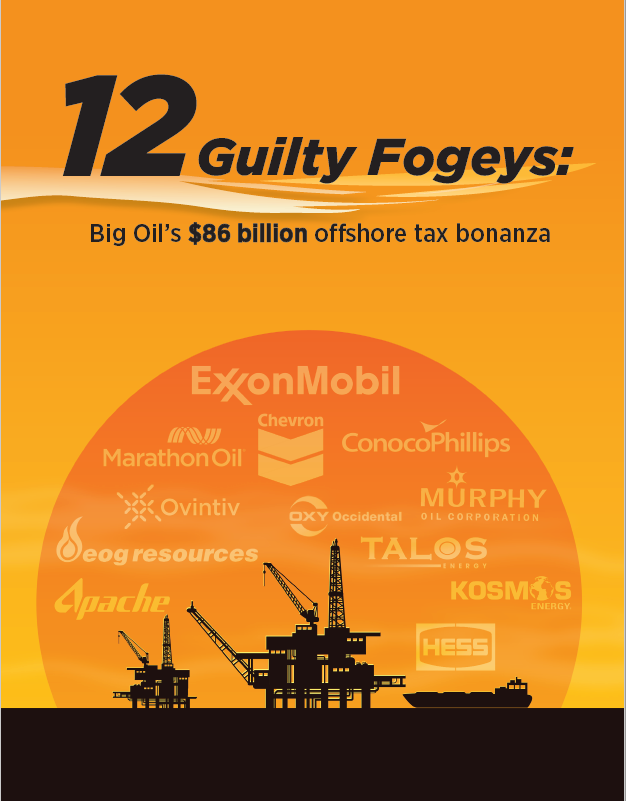
12 Guilty Fogeys: Big Oil’s $86 billion offshore tax bonanza

By staff - Friends of the Earth, Bailout Watch, and Oxfam, September 2021

Few letter-soup acronyms in Washington bureaucratese are so aptly pronounced as GILTI and FOGEI, two esoteric provisions in the tax code worth tens of billions of dollars to Big Oil’s multinational majors.

Under the Trump Administration’s radical 2017 tax law, companies that extract oil and gas overseas enjoy special exemptions within the Global Intangible Low-Tax (GILTI) regime covering Foreign Oil and Gas Extraction Income (FOGEI).

It is a fitting accident of nomenclature: FOGEI’s GILTI carveout helps prop up the fossil firms most culpable for the climate crisis — to the tune of $84 billion. An additional international tax loophole enjoyed by Big Oil is worth at least another $1.4 billion, for a grand total of over $86 billion in offshore tax giveaways.

Read the text (PDF).

Protecting Some Old Growth Isn’t Enough. BC Needs a Forest Revolution

By Grand Chief Stewart Phillip, Arnold Bercov, Torrance Coste and Ben Parfitt - The Tyee, November 12, 2021

Governments have mismanaged the sector for decades. Now communities and First Nations should lead.

No one should be surprised that the British Columbia government’s plan to consider deferring logging in 26,000 square kilometres of old-growth forest angered many and pleased few.

First Nations’ leaders were highly critical of the incredibly short 30-day period the government imposed on them to respond to the deferral proposals, the paltry funding provided by the province to offset consultation costs, and the economic implications for their members.

The Council of Forest Industries, representing the province’s biggest logging, lumber and pulp and paper operations, warned of an impending economic apocalypse in which 18,000 workers would lose their jobs, while skirting around the tens of thousands of industry jobs already lost.

And environmental leaders noted that many tracts of old growth remained unprotected and would likely be logged even more intensely as the government took the next couple of years to decide whether or not the proposed deferral areas would actually receive formal protection.

All of this was predictable, and all of it largely ignored the elephant in the room.

What the deferral decision underscored is the abominable point to which this government and governments before it have brought us.

Successive provincial governments actively encouraged the logging industry, which is dominated by a few very powerful companies, to cut down more and more forest without any coherent plan for how healthy, resilient ecosystems — which are the bedrock of healthy communities — were to be maintained.

Perpetuating logging rates that anyone with an iota of common sense knew could not go on was guaranteed to have brutal consequences, including old-growth forests so fragmented from logging that they are no longer capable of supporting caribou and vibrant songbird populations; community watersheds where once-clean drinking water has turned to mud; drastically reduced or eradicated salmon stocks; and 41,000 direct jobs lost in the forest industry in just 20 years.

Counting the Job Cost of Halting Old-Growth Logging

By Andrew MacLeod - The Tyee, November 10, 2021

The province says 4,500, industry says 18,000. Critics say government has left too many unanswered questions.

The BC Council of Forest Industries and the United Steelworkers union say protecting old-growth forests could cost four times as many jobs as the government is predicting.

But whatever the actual number, any decline in employment will be part of a long-term trend that has seen fewer people working in the sector even as the volume of trees logged each year remained steady.

Last week Katrine Conroy, the minister of forests, lands, natural resource operations and rural development, announced the B.C. government plans to defer logging 2.6 million hectares of the most at-risk old-growth forests in the province for two years while it discusses possible permanent protection with the Indigenous nations whose territories the forests are on.

Conroy said the ministry estimates up to 4,500 jobs could be affected and promised a suite of programs aimed at helping workers and their families transition to other work.

The Council of Forest Industries, however, believed the government’s estimate is far too low.

“Our initial analysis indicates that these deferrals would result in the closure of between 14 and 20 sawmills in B.C., along with two pulp mills and an undetermined number of value-added manufacturing facilities,” Susan Yurkovich, president and CEO of the council, said in a statement released Nov. 2.

That translates to about 18,000 “good, family-supporting jobs lost” and about a $400-million reduction in government revenue each year, she said.

A day later the United Steelworkers, the union representing about 12,000 of B.C.’s forestry workers, put out a statement backing COFI’s figures over the government’s.

“If even half of the 2.6 million hectares identified by the government are removed, jobs will be lost as multiple sawmills, value-added operations and pulp mills close permanently,” it quoted USW Wood Council Chair Jeff Bromley.

“In the past three years, eight operations with USW workers across B.C. closed and 1,000 good-paying, family-supporting jobs were lost,” he continued. “The impact from this process will almost certainly multiply across the province.”

For comparison, there were nearly 2.7 million people employed in all sectors in B.C. in October. B.C. added 10,400 jobs in October according to the Labour Force Survey numbers StatsCan released last week.

Exploitation of Workers in DR Congo Taints Electric Vehicles

By Arthur Svensson - Industri Energi, November 8, 2021

The acceleration of electrical vehicles (EV) production is crucial for the transition to a low-carbon economy, yet it appears to be linked to serious labour rights abuses. New research released today reveals dire conditions, discrimination and extremely low pay at some of the world’s largest industrial cobalt mines operated by multinational mining companies in the Democratic Republic of Congo. Cobalt is considered an essential mineral in the lithium-ion batteries that power electric vehicles. Over 70% of the world’s cobalt is extracted in Congo.

Cobalt is everywhere. It is a silvery-blue mineral used in the rechargeable batteries that power our mobile phones, laptops and tablets, and in larger quantities, the electric vehicles that will soon dominate our roads. It is a strategic mineral in the plan to decarbonise and move away from fossil fuels towards renewable energy. Accelerating this switch is one of the priorities to tackle the climate crisis and industry experts forecast that electric vehicle sales will skyrocket in the next 10 years. This will require a dramatic increase in cobalt production. The booming demand for cobalt has a dark side, however.

The 87-page report"The Road to Ruin? Electric vehicles and workers’ rights abuses at Congo’s industrial cobalt mines” by by corporate watchdog Rights and Accountability in Development (RAID), and Centre d’Aide Juridico-Judiciaire (CAJJ), a Congolese legal aid centre specialised in labour rights, exposes a system of widespread exploitation. Congolese workers at five industrial mines in Congo where cobalt is produced: Kamoto Copper Company (KCC), Metalkol RTR, Tenke Fungurume Mining (TFM), Sino-Congolaise des Mines (Sicomines) and Société Minière de Deziwa (Somidez) were interviewed for the research. They said they received very low pay and were subjected to excessive working hours, degrading treatment, violence, discrimination, racism, unsafe working conditions, and a disregard for even basic health provision.

Some workers described being kicked, slapped, beaten with sticks, insulted, shouted at, or pulled around by their ears. Others reported severe discrimination and abuse at Chinese-operated mines. One worker said, “Our situation is worse than before. The Chinese come and impose their standards and culture. They don’t treat Congolese well. This is new colonisation.”

The Road to Ruin? - Electric vehicles and workers’ rights abuses at DR Congo’s industrial cobalt mines

By staff - Rights and Accountability in Development (RAID) and the Centre d’Aide Juridico-Judiciaire (CAJJ), November 2021

Cobalt is everywhere. It is a silvery-blue mineral used in the rechargeable batteries that power our mobile phones, laptops and tablets, and in larger quantities, the electric vehicles that will soon dominate our roads. It is a strategic mineral in the plan to decarbonise and move away from fossil fuels towards renewable energy. Accelerating this switch is one of the priorities to tackle the climate crisis and industry experts forecast that electric vehicle sales will skyrocket in the next 10 years. This will require a dramatic increase in cobalt production.

The booming demand for cobalt has a dark side, however. The Democratic Republic of Congo, one of Africa’s poorest nations, holds the lion’s share of the world’s cobalt reserves. In 2020, 70% of the world’s cobalt was extracted from within its borders with tens of thousands of workers labouring in large-scale industrial mines to dig up the ore. Multinational mining companies that own many of Congo’s mines, eager to demonstrate their “green” and “responsible” credentials, say they produce “clean” and “sustainable” cobalt, free from human rights abuses, and that their operations contribute to good jobs and economic opportunities.

This report, based on extensive research over two years, paints a very different picture. It shows dire conditions for many Congolese workers in the industrial mines, often characterised by widespread exploitation and labour rights abuses. Many workers do not earn a “living wage” – the minimum remuneration to afford a decent standard of living – have little or no health provision, and far too often are subjected to excessive working hours, unsafe working conditions, degrading treatment, discrimination and racism.

In recent years attention has mainly focused on Congo’s artisanal mining sector, partly because of the risks of child labour it creates, whereas the conditions for workers in the large-scale industrial mines have gone largely unnoticed. This report examines workers’ rights at Congo’s industrial mines where the large majority of cobalt is coming from, producing some 80% of the cobalt exported from the country (in contrast to the 20% produced in artisanal mines).

The findings presented in this report are based on detailed research over 28 months by UK-based corporate watchdog Rights and Accountability in Development (RAID) and the Centre d’Aide Juridico- Judiciaire (CAJJ), a Congolese legal aid centre specialised in labour rights. The research team carried out extensive field research in and around Kolwezi, a mining town where many of Congo’s cobalt and copper mines are located. It is informed by 130 interviews of workers and former workers at five mining companies, as well as interviews with subcontractors, union representatives, lawyers, Congolese local authorities, medical staff and industry experts.

Read the text (PDF).

Climate Jobs: Building a Workforce for the Climate Emergency

By Suzanne Jeffery, editor, et. al - Campaign Against Climate Change, November 2021

This report was written by the Campaign Against Climate Change Trade Union Group (CACCTU). It builds on and develops the earlier work produced by CACCTU, One Million Climate Jobs (2014). The editorial group and contributors to this report are trade unionists, environmental activists and campaigners and academics who have collaborated to update and expand the previous work. Most importantly, this updated report is a response to the urgency of the climate crisis and the type and scale of the transition needed to match it.

This report shows how we can cut UK emissions of greenhouse gases to help prevent catastrophic climate change. We explain how this transformation could create millions of climate jobs in the coming years and that the public sector must take a leading role. Climate jobs are those which directly contribute to reducing emissions. This investment will give us better public transport, warmer homes, clean air in our cities and community renewal in parts of the country which have long been neglected. Most importantly, it will give us a chance for the future, avoiding the existential threat of climate breakdown.

Read the text (Link).

COP26: Trade Unions Must Fight for a Socialist Transition to Renewables

By Chris Baugh - The Bullet, October 26, 2021

The UK government is hosting the 26th United Nations Climate Change “Conference of the Parties” (COP26) in Glasgow from 31 October to 12 November 2021.

The Intergovernmental Panel on Climate Change (IPCC) was formed in 1988. Its latest report to the UN in August of this year contains even starker warnings for the Earth’s climate than previously, unless decisive action is taken to cut greenhouse emissions. Without this, there is little prospect of keeping an average global temperature increase below the 1.5 to 2 degrees Celsius target in the 2015 COP21 Paris Agreement.

This was the first time an agreement had been reached on target reductions but it excluded major polluting industries like aviation and shipping and was devoid of any mechanism for implementing the targets. This reflects the global capitalist consensus that it is market mechanisms that will make the adjustment from fossil fuels to a zero carbon economy. This is despite the warning of Lord Stern who famously described climate change as “the biggest market failure in human history.”

Articles in the pages of The Socialist and Socialism Today have pointed out that it is capitalism’s insatiable pursuit of profit that has led us to this situation. Capitalism has shown itself unwilling and an actual impediment to the action on the timescale and scope required. An article published by Trade Unions for Energy Democracy (TUED) gives recent evidence of how renewable energy companies are “party to a race to the bottom, capitalist dynamic.”

It cites the use of forced Uyghur labour in China-based solar companies and the ‘off-shoring’ of manufacturing for the Scottish wind industry. The large wind and solar companies prop up a market architecture that is sucking in huge amounts of public money to guarantee profit margins. The report is quoted as saying “these companies have not just gone over to the political dark side, they helped design it.”

While richer governments of US and Europe talk up their climate commitments, the solutions proposed will not fix the climate crisis. UK plans to transition to renewable energy are reliant upon an unprecedented wave of resource extraction from ‘Global South’ countries. Intensifying the mining of so-called transition metals and minerals used to produce green technologies such as solar panels, wind turbines and electric vehicle batteries, is devastating communities from Chile to China.

Book Review: The Tragedy of the Worker

By Aragorn Eloff - New Frame, October 5, 2021

A radical collective committed to change in the face of climate collapse calls for global solidarity and a turn to the worker to revolutionise how we relate to the world.
The tone of The Tragedy of the Worker: Towards the Proletarocene is set in the opening paragraph with a sobering addendum to the Communist Manifesto’s most well-known sentences: “Workers of the world unite, you have nothing to lose but your chains. You have a world to win. What if the world is already lost?”

This important new book, written by the Salvage Collective – of which well-known science fiction author China Miéville is a member – is a manifesto-like cry to countenance the state of our social and ecological lifeworlds, and to grapple with the question of how “we imagine emancipation on an at best partially habitable planet”. Herein, for Salvage, lies the titular concern of the book, which unashamedly wears its politics on its sleeve: the tragedy of the worker is that “she was put to work for the accumulation of capital, from capitalism’s youth, amid means of production not of her choosing, and with a telos of ecological catastrophe”.

How do we think about progressive – even revolutionary – forms of politics when we live “at a point of history where the full horror of the methods of fossil capitalism is becoming clear”, and where, even if capitalism were overthrown tomorrow, we would “inherit productive forces inextricable from mass, trans-species death”?

As we are relentlessly reminded throughout the text, the situation is not good. The current confluence of accelerating ecological crises, most popularly termed the “Anthropocene” or the “sixth mass extinction crisis” is, as Salvage describes, “a megaphase change taking place in microphase time”.

People's Utility Justice Playbook​

By Yesenia Rivera and Johanna Bozuwa - Energy Democracy Project, October 2021

Have you ever wondered who is in charge of your electricity? And why?

The People’s Utility Justice Playbook has two components:

  1. a “History of Utilities” report to summarize the history of utilities for everyone to understand how our current energy system originated.
  2. a “People’s Utility Justice Playbook” to expose the tactics from electric utilities that are undermining community’s efforts, so we can build our organizing strength—to not only fight back but also to build the democratic energy system for climate justice.

This is the basic information we need to fight back against energy utilities attempting to slow or stop progress toward economic and climate justice.

History of Utilities​

Electric utilities have expanded into almost every aspect of our lives to become one of the most powerful and concentrated industries on Earth. To have a better understanding of what we’re fighting against, we first need to learn about the history of energy utilities! This PDF summarizes the entire timeline and how the rise of energy democracy came about.

People's Utility Justice Playbook

In order to fight the industry-owned utilities’ tactics, we need our own strategies for combat!

We have our very own playbook sourced from energy justice activists on the ground. They suggest strategies and tactics they employ when fighting against utilities that anyone fighting against utilities could use!

Read the History (PDF).

Read the Playbook (PDF).

Pages

The Fine Print I:

Disclaimer: The views expressed on this site are not the official position of the IWW (or even the IWW’s EUC) unless otherwise indicated and do not necessarily represent the views of anyone but the author’s, nor should it be assumed that any of these authors automatically support the IWW or endorse any of its positions.

Further: the inclusion of a link on our site (other than the link to the main IWW site) does not imply endorsement by or an alliance with the IWW. These sites have been chosen by our members due to their perceived relevance to the IWW EUC and are included here for informational purposes only. If you have any suggestions or comments on any of the links included (or not included) above, please contact us.

The Fine Print II:

Fair Use Notice: The material on this site is provided for educational and informational purposes. It may contain copyrighted material the use of which has not always been specifically authorized by the copyright owner. It is being made available in an effort to advance the understanding of scientific, environmental, economic, social justice and human rights issues etc.

It is believed that this constitutes a 'fair use' of any such copyrighted material as provided for in section 107 of the US Copyright Law. In accordance with Title 17 U.S.C. Section 107, the material on this site is distributed without profit to those who have an interest in using the included information for research and educational purposes. If you wish to use copyrighted material from this site for purposes of your own that go beyond 'fair use', you must obtain permission from the copyright owner. The information on this site does not constitute legal or technical advice.