You are here

extractivism

Calls for sustainable and responsible mining for the clean energy transition

By Elizabeth Perry - Work and Climate Change Report, May 6, 2021

An important Special Report by the International Energy Association was released in May: The Role of Critical Minerals in Clean Energy Transitions. Reflecting a mainstream view of the importance of the raw materials for clean technologies such as electric vehicles and energy storage, the IEA provides “ a wealth of detail on mineral demand prospects under different technology and policy assumptions” , and discusses the various countries which offer supply – including Canada. The main discussion is of policies regarding supply chains, especially concerning responsible and sustainable mining, concluding with six key recommendations, including co-ordination of the many international frameworks and initiatives in the area. The report briefly recognizes the Mining Association of Canada’s Towards Sustainable Mining (TSM) protocols as internationally significant, and as one of the first to require on-site verification of its standards. The Towards Sustainable Mining (TSM) initiative was established in 2004, requiring member companies to “demonstrate leadership by reporting and independently verifying their performance in key environmental and social areas such as aboriginal and community engagement, biodiversity conservation, climate change, tailings management.”

On May 5, the Mining Association of Canada updated one of its TSM protocols with the release a new Climate Change Protocol, a major update to its 2013 Energy Use and GHG Emissions Management Protocol. It is designed “to minimize the mining sector’s carbon footprint, while enhancing climate change disclosure and strengthening the sector’s ability to adapt to climate change.” The Protocol is accompanied by a new Guide on Climate Change Adaptation for the Mining Sector, intended for mine owners in Canada, but with global application. The Guide includes case studies of such mines as the Glencore Nickel mine in Sudbury, the notorious Giant Mine in the Northwest Territories, and the Suncor Millennium tailings pond remediation at its oil sands mine in Alberta. The membership of MAC is a who’s who of Canadian mining and oil sands companies / – including well-known companies such as ArcelorMittal, Barrick Gold, Glencore, Kinross, Rio Tinto, Suncor, and Syncrude. Other documentation, including other Frameworks and progress reports, are compiled at a dedicated Climate Change Initiatives and Innovations in the Mining Industry website.

The demand for lithium, cobalt, nickel, and the other rare earth minerals needed for technological innovation has been embraced, not only by the mining industry, but in policy discussions – recently, by Clean Energy Canada in its March 2021 report, The Next Frontier. The federal ministry of Natural Resources Canada is also supportive, maintaining a Green Mining Innovation Initiative through CanmetMINING , and the government joined the U.S.-led Energy Resource Governance Initiative (ERGI) in 2019 to promote “secure and resilient supply chains for critical energy minerals.”

Alternative points of view have been pointing out the dangers inherent in the new “gold rush” mentality, since at least 2016 when Amnesty International released its 2016 expose of the use of child labour in the cobalt mines of the Democratic Republic of Congo. Most recently, in February 2021, Amnesty released Powering Change: Principles for Businesses and Governments in the Battery Value Chain, which sets out specific principles that governments and businesses should follow to avoid human rights abuses and environmental harm. Other examples: MiningWatch Canada has posted their April 2021 webinar Green Energy, Green Mining, Green New Deal?, which states: “The mining sector is working hard to take advantage of the climate crisis, painting mining as “green” because it supplies materials needed to support the “green” energy transition. But unless demand for both energy and materials are curtailed, environmental destruction and social conflicts will also continue to grow.” MiningWatch Canada published Turning Down the Heat: Can We Mine Our Way Out of the Climate Crisis? in 2020, reporting on a 2019 international conference which focused on the experience of frontline communities. Internationally, the Business & Human Rights Resource Centre maintains a Transition Minerals tracker, with ongoing data and reports concerning human and labour rights in the mining of “transition minerals”, and also compiles links to recent reports and articles. Two recent reports in 2021: Recharge Responsibly: The Environmental and Social Footprint of Mining Cobalt, Lithium, and Nickel for Electric Vehicle Batteries (March 2021, Earthworks) and A Material Transition: Exploring supply and demand solutions for renewable energy minerals from the U.K. organization War on Want.

New Analysis Estimates an Equitable Energy Economy will Require $33 Billion to $83 Billion Investment in Workers

By staff - Utility Workers Union of America, May 4, 2021

As the Biden administration considers federal resources for coal workers and their communities, the Utility Workers Union of America (UWUA) and the Union of Concerned Scientists (UCS) urge a set of comprehensive supports estimated to cost between $33 billion over 25 years to $83 billion over 15 years. The analysis, Supporting the Nation’s Coal Workers and Communities in a Changing Energy Landscape, underscores that a fair and equitable shift to a low-carbon economy requires intentional, robust, and sustained investments in coal workers, their families, and their communities.

Coal-fired electricity is down to 20 percent today from about half of the nation’s electricity generation a decade ago. With more closures on the horizon, a sustained and comprehensive set of supports is needed to ensure individuals who have powered America for generations can stay in their communities, prepare for new careers with family-sustaining wages, and can retire with dignity.

“For decades, the coal industry has simply locked its doors and forgotten the individuals and communities who rely on the coal industry and who exist in almost every state across the country,” said UWUA President James Slevin. “Approaching these closures with the right set of economic supports offers a better alternative to the chaos and devastation we’re seeing today.”

Recognizing coal and mining facilities often directly employ hundreds of individuals and many more indirectly across several counties, the economic and social infrastructure of a region undergoes lasting changes when facilities close.

“The economic upheaval resulting from the dramatic job losses in the coal industry over the last decade has uprooted families, deepened economic anxiety, and left community leaders scrambling to keep schools open and social services in place,” said report co-author Jeremy Richardson, a UCS senior energy analyst who comes from a family of coal miners. “But solutions are readily available with forward-looking and visionary action by policymakers.”

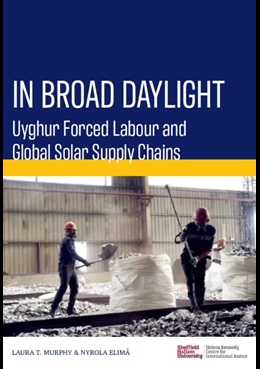
In Broad Daylight: Uyghur Forced Labour and Global Solar Supply Chains

By Laura T Murphy and Nyrola Elima - Sheffield Hallam University, May 2021

The People’s Republic of China (PRC) has placed millions of indigenous Uyghur and Kazakh citizens from the Xinjiang Uyghur Autonomous Region (XUAR or Uyghur Region) into what the government calls “surplus labour” (富余劳动力) and “labour transfer” (劳动力转移)programmes. An official PRC government report published in November 2020 documents the “placement” of 2.6 million minoritised citizens in jobs in farms and factories within the Uyghur Region and across the country through these state-sponsored “surplus labour” and “labour transfer” initiatives. The government claims that these programmes are in accordance with PRC law and that workers are engaged voluntarily, in a concerted government-supported effort to alleviate poverty. However, significant evidence – largely drawn from government and corporate sources – reveals that labour transfers are deployed in the Uyghur Region within an environment of unprecedented coercion, undergirded by the constant threat of re-education and internment. Many indigenous workers are unable to refuse or walk away from these jobs, and thus the programmes are tantamount to forcible transfer of populations and enslavement.
It is critical that we examine the particular goods that are being produced as a result of this forced labour regime. This paper focuses on just one of those industries – the solar energy industry – and reveals the ways forced labour in the Uyghur Region can pervade an entire supply chain and reach deep into international markets. We concluded that the solar industry is particularly vulnerable to forced labour in the Uyghur Region because:

  • 95% of solar modules rely on one primary material – solar-grade polysilicon.
  • Polysilicon manufacturers in the Uyghur Region account for approximately 45% of the world’s solar-grade polysilicon supply.
  • All polysilicon manufacturers in the Uyghur Region have reported their participation in labour transfer programmes and/or are supplied by raw materials companies that have.
  • In 2020, China produced an additional 30% of the world’s polysilicon on top of that produced in the Uyghur Region, a significant proportion of which may be affected by forced labour in the Uyghur Region as well.

In the course of this research, we identified:

  • 11 companies engaged in labour transfers
  • 4 additional companies located within industrial parks that have accepted labour transfers
  • 90 Chinese and international companies whose supply chains are affected

This report seeks to increase the knowledge base upon which the solar industry determines its exposures to forced labour in the Uyghur Region. We investigated the entire solar module supply chain from quartz to panel to better understand the extent to which forced labour in the Uyghur region affects international value chains. The examples of engagement in these programs are meant to provide stakeholders with the evidence base upon which to judge risk of exposure to forced labour in the solar supply chain.

Read the Report (PDF).

Does Shale Gas Extraction Grow Jobs?

We have no answers; we have questions. Urgent ones

By John Holloway - ROAR, May 1, 2021

We live in a failed system. It is becoming clearer every day that the present organization of society is a disaster, that capitalism is unable to secure an acceptable way of living. The COVID-19 pandemic is not a natural phenomenon but the result of the social destruction of biodiversity and other pandemics are likely to follow. The global warming that is a threat to both human and many forms of non-human life is the result of the capitalist destruction of established equilibria. The acceptance of money as the dominant measure of social value forces a large part of the world’s population to live in miserable and precarious conditions.

The destruction caused by capitalism is accelerating. Growing inequality, a rise in racist violence, the spread of fascism, increasing tensions between states and the accumulation of power by police and military. Moreover, the survival of capitalism is built on an ever-expanding debt that is doomed to collapse at some point.

The situation is urgent, we humans are now faced with the real possibility of our own extinction.

How do we get out of here? The traditional answer of those who are conscious of the scale of social problems: through the state. Political thinkers and politicians from Hegel to Keynes and Roosevelt and now Biden have seen the state as a counterweight to the destruction wreaked by the economic system. States will solve the problem of global warming; states will end the destruction of biodiversity; states will alleviate the enormous hardship and poverty resulting from the present crisis. Just vote for the right leaders and everything will be all right. And if you are very worried about what is happening, just vote for more radical leaders — Sanders or Corbyn or Die Linke or Podemos or Evo Morales or Maduro or López Obrador — and things will be fine.

The problem with this argument is that experience tells us that it does not work. Left-wing leaders have never fulfilled their promises, have never brought about the changes that they said they would. In Latin America, the left-wing politicians who came to power in the so-called Pink Wave at the start of this century, have been closely associated with extractivism and other forms of destructive development. The Tren Maya which is Mexican president López Obrador’s favorite project in Mexico at the moment is just the latest example of this. Left-wing parties and politicians may be able to bring about minor changes, but they have done nothing at all to break the destructive dynamic of capital.

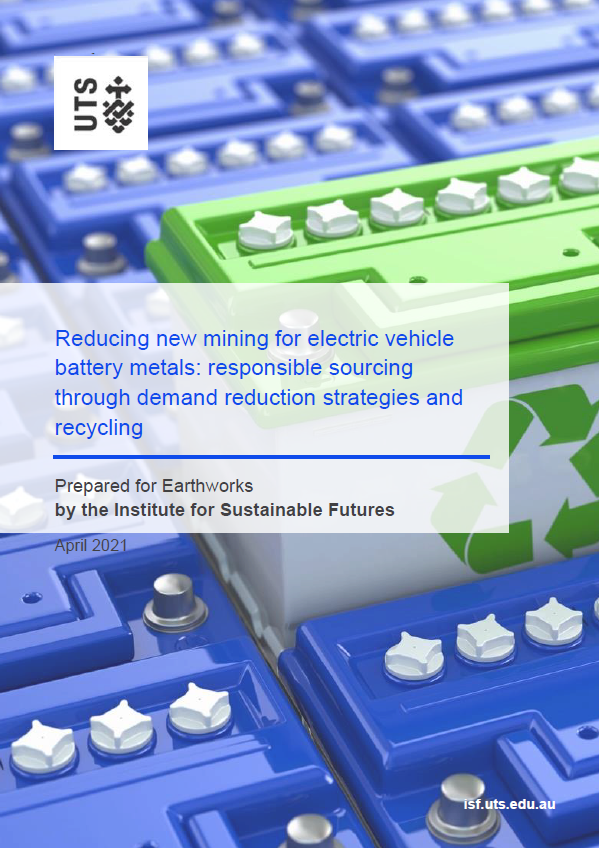
Reducing new mining for electric vehicle battery metals: responsible sourcing through demand reduction strategies and recycling

By Elsa Dominish, Nick Florin, and Rachael Wakefield-Rann - Earthworks, April 27, 2021

This research investigates the current status and future potential of strategies to reduce demand for new mining, particularly for lithium-ion battery metals for electric vehicles. This study is focused on four metals which are important to lithium-ion batteries: cobalt, lithium, nickel and copper.

In order to meet the goals of the Paris Climate agreement and prevent the worst effects of catastrophic climate change, it will be essential for economies to swiftly transition to renewable energy and transport systems. At present, the technologies required to produce, store and utilize renewable energy require a significant amount of materials that are found predominantly in environmentally sensitive and often economically marginalized regions of the world. As demand for these materials increase, the pressures on these regions are likely to be amplified. For renewable energy to be socially and ecologically sustainable, industry and government should develop and support responsible management strategies that reduce the adverse impacts along the material and technology supply chains.

There are a range of strategies to minimize the need for new mining for lithium-ion batteries for electric vehicles, including extending product life through improved design and refurbishment for reuse, and recovering metals through recycling at end of life. For example, we found that recycling has the potential to reduce primary demand compared to total demand in 2040, by approximately 25% for lithium, 35% for cobalt and nickel and 55% for copper, based on projected demand. This creates an opportunity to significantly reduce the demand for new mining. However, in the context of growing demand for electric vehicles, it will also be important that other demand reduction strategies with lower overall material and energy costs are pursued in tandem with recycling, including policy to dis-incentivize private car ownership and make forms of active and public transport more accessible. While the potential for these strategies to reduce demand is currently not well understood; this report provides insights into the relative merits, viability, and implications of these demand reduction strategies, and offers recommendations for key areas of policy action.

Read the text (Link).

The Red Deal: Indigenous action to save our Earth

By The Red Nation - ROAR Mag, April 25, 2021

The Red Deal is a manifesto and movement — borne of Indigenous resistance and decolonial struggle — to liberate all peoples and save our planet.

Colonialism has deprived Indigenous people, and all people who are affected by it, of the means to develop according to our needs, principles and values. It begins with the land. We have been made “Indians” only because we have the most precious commodity to the settler states: land. Vigilante, cop and soldier often stand between us, our connections to the land and justice. “Land back” strikes fear in the heart of the settler. But as we show here, it’s the soundest environmental policy for a planet teetering on the brink of total ecological collapse. The path forward is simple: it’s decolonization or extinction. And that starts with land back.

In 2019, the mainstream environmental movement — largely dominated by middle- and upper-class liberals of the Global North — adopted as its symbolic leader a teenage Swedish girl who crossed the Atlantic in a boat to the Americas. But we have our own heroes. Water protectors at Standing Rock ushered in a new era of militant land defense. They are the bellwethers of our generation. The Year of the Water Protector, 2016, was also the hottest year on record and sparked a different kind of climate justice movement.

Alexandria Ocasio-Cortez, herself a water protector, began her successful bid for Congress while in the prayer camps at Standing Rock. With Senator Ed Markey, she proposed a Green New Deal in 2019. Standing Rock, however, was part of a constellation of Indigenous-led uprisings across North America and the US-occupied Pacific: Dooda Desert Rock (2006), Unist’ot’en Camp (2010), Keystone XL (2011), Idle No More (2012), Trans Mountain (2013), Enbridge Line 3 (2014), Protect Mauna Kea (2014), Save Oak Flat (2015), Nihígaal Bee Iiná (2015), Bayou Bridge (2017), O’odham Anti-Border Collective (2019), Kumeyaay Defense Against the Wall (2020), and 1492 Land Back Lane (2020), among many more.

Each movement rises against colonial and corporate extractive projects. But what’s often downplayed is the revolutionary potency of what Indigenous resistance stands for: caretaking and creating just relations between human and other-than-human worlds on a planet thoroughly devastated by capitalism. The image of the water protector and the slogan “Water is Life!” are catalysts of this generation’s climate justice movement. Both are political positions grounded in decolonization—a project that isn’t exclusively about the Indigenous. Anyone who walked through the gates of prayer camps at Standing Rock, regardless of whether they were Indigenous or not, became a water protector. Each carried the embers of that revolutionary potential back to their home communities.

Water protectors were on the frontlines of distributing mutual aid to communities in need throughout the pandemic. Water protectors were in the streets of Seattle, Portland, Minneapolis, Albuquerque and many other cities in the summer of 2020 as police stations burned and monuments to genocide collapsed. The state responds to water protectors — those who care for and defend life — with an endless barrage of batons, felonies, shackles and chemical weapons. If they weren’t before, our eyes are now open: the police and the military, driven by settler and imperialist rage, are holding back the climate justice movement.

Two new reports call for end to subsidies and phase-out of Canada’s oil and gas industry

By Elizabeth Perry - Work and Climate Change Report, April 19, 2021

Two new reports expose Canada’s continuing financial support of the fossil fuel industry and call for a phase-out. These appeared in the same week as the federal government reported Canada’s latest National Inventory of Emissions to the United Nations’ UNFCC, showing that the oil and gas industry is the top source of carbon emissions in Canada.

The first report, by Environmental Defence, is Paying Polluters: Federal Financial Support to Oil and Gas in 2020 , released on April 15. It estimates that the government has provided or promised at least $18 billion to the oil and gas sector in 2020 alone, including $3.28 billion in direct subsidy programs and $13.47 billion in public financing. Paying Polluters decries the lack of transparency – especially for funding through Export Development Canada – but nevertheless attempts to list the tax subsidies and direct spending programs, in an Appendix at the end of the report. In addition to obvious subsidies, the tally includes loans for pipeline construction, research into new technologies for cleaner processes, job subsidies for reclamation of oil wells, and even policing costs for pipeline construction – think $13 million taxpayer dollars paid to the Royal Canadian Mounted Police to protect the construction site of the Coastal GasLink pipeline.

Environmental Defence concludes with five recommendations, including a call for greater transparency, and for “a roadmap to achieve Canada’s commitment to phase out inefficient fossil fuel subsidies before 2025, and shift these investments and public finance towards supporting a path to resilient, equitable zero-carbon societies.” It should be noted that the government first pledged to phase out these subsidies in 2009. The report is summarized, with reactions, by Sarah Cox in The Narwhal, on April 16.

A second report, Correcting Canada’s “One-eye shut” Climate Policy, was released on April 16 by the Cascade Institute. It summarizes Canada’s history of fossil fuel production, and refutes those who argue that we are a small country whose emissions don’t compare to those of China or the U.S. Calling on Canada to accept its global responsibility, the authors state that “Canada’s 2021-2050 oil and gas production would exhaust about 16 percent of the world’s remaining carbon budget. Canada is indeed a “carbon bomb” of global significance.” This is the first of many hard-hitting, frank statements in the report, including a highly critical discussion of the “fool’s gambit” of hydrogen production, and an assessment that “A highly resourced and well-organized “regime of obstruction” has developed in Canada to block effective climate action and ensure increased fossil fuel extraction.”

For an ecosocialist transition that breaks from capitalism: Arguments and proposals

By Claude Calame - Global Ecosocialist Network, April 13, 2021

The 149 proposals issued by the French Citizens’ Convention on Climate last June, with the goal of achieving at least a 40% reduction in greenhouse gases by 2030 compared to 1990, manifestly belong to a thoroughly reformist approach. Nevertheless, Emmanuel Macron, only days after environmentalist candidates made gains in municipal elections, rejected three of those proposals:

  • the reduction of the motorway speed limit to 110 km/h (what else could one expect from the Finance Minister under Hollande who wanted to create competition between buses and trains?);
  • a 4% tax on dividends (the rejection of this proposal is consistent with the President’s abolition of the wealth tax among his first acts after being elected, in line with the demands of Medef);
  • the inclusion of ecology in the preamble to the Constitution (this proposal is clearly contrary to the principles of the President’s neoliberal worldview, which sees ‘nature’ itself only as something to be turned into a commodity to be submitted to the market and exploited for profit).

Roadmap to a Canadian Just Transition Act: A path to a clean and inclusive economy

By Dr Sibo Chen - LSE Review of Books, March 31, 2021

In recent years, there has been a steady growth of studies on the ‘Pink Tide’ experience in Latin America — the notable turn towards left-wing governments in Latin America around the start of the twenty-first century — and its implications for regional political economy and social-environmental conflicts. Following this trend, author Thea Riofrancos examines how conflicting visions of resource extraction have divided the Ecuadorian Left in Resource Radicals: From Petro-Nationalism to Post-Extractivism in Ecuador. Drawing upon a wide range of sources gained from fifteen months of fieldwork, the book presents an in-depth analysis of internecine struggles between the Ecuadorian government, which focuses on economic development via resource nationalism, and grassroots anti-extractivism activists, who strongly oppose the government’s lean toward extractive industries due to social and environmental concerns.

The book’s narrative begins in 2007, when Rafael Correa was elected as the 45th President of Ecuador with support from a disparate group of leftist organisations. Correa’s victory marked a fundamental break from Ecuador’s past economic policies. During his tenure (2007–17), Ecuador rejected neoliberalism and attempted to replace it with a series of progressive reforms that sought to improve the country’s economic equality and living standards. Resource extraction still served as the primary funding source for these reforms. Through strong state presence and information campaigns promoting the public benefits of resource development, the Correa government sought to de-politicise resource extraction and frame it as a technical affair, which offers a viable path toward a redistributive post-neoliberal state.

Unsurprisingly, Correa’s reforms were opposed by foreign corporations and domestic elites. What complicated the political struggle, however, was fierce resistance to these reforms among many social activists who had resisted neoliberalism for decades and supported Correa’s leftist election platform. Accordingly, the central question that Resource Radicals seeks to address is how the radical politicisation of resource extraction led to the Ecuadorian dispute between a self-described socialist government and many grassroots activists who helped bring it to power.

Pages

The Fine Print I:

Disclaimer: The views expressed on this site are not the official position of the IWW (or even the IWW’s EUC) unless otherwise indicated and do not necessarily represent the views of anyone but the author’s, nor should it be assumed that any of these authors automatically support the IWW or endorse any of its positions.

Further: the inclusion of a link on our site (other than the link to the main IWW site) does not imply endorsement by or an alliance with the IWW. These sites have been chosen by our members due to their perceived relevance to the IWW EUC and are included here for informational purposes only. If you have any suggestions or comments on any of the links included (or not included) above, please contact us.

The Fine Print II:

Fair Use Notice: The material on this site is provided for educational and informational purposes. It may contain copyrighted material the use of which has not always been specifically authorized by the copyright owner. It is being made available in an effort to advance the understanding of scientific, environmental, economic, social justice and human rights issues etc.

It is believed that this constitutes a 'fair use' of any such copyrighted material as provided for in section 107 of the US Copyright Law. In accordance with Title 17 U.S.C. Section 107, the material on this site is distributed without profit to those who have an interest in using the included information for research and educational purposes. If you wish to use copyrighted material from this site for purposes of your own that go beyond 'fair use', you must obtain permission from the copyright owner. The information on this site does not constitute legal or technical advice.