You are here

extractivism

The Biden Climate Plan: Part 2: An Arena of Struggle

By Jeremey Brecher - Labor Network for Sustinability, December 8, 2020

The climate plan released by Joe Biden in August presents a wide-ranging program for reducing greenhouse gas (GHG) emissions. The previous commentary, “The Biden Climate Plan: What it Proposes–Part 1” summarizes that plan. This commentary identifies the points of conflict on climate policy and related social policies that are likely to emerge within a Biden administration. It concludes by assessing how advocates of a Green New Deal can take advantage of the Biden program to fight for a climate-safe, worker-friendly, socially-just outcome. To read this commentary, please visit: this page.

Workers and Just Transition: A Global View

By various - Labor Network for Sustainability, December 5, 2021

With the election of a President who acknowledges the threats of climate change and of ongoing economic devastation for working people, we have an opportunity to seriously address how to make a transition to a climate-safe, socially-just, worker-friendly society. The primary objective of the Just Transition Listening Project (JTLP) is to ensure workers and community voices are central to the conversation of a Green New Deal and other climate policies. 

On Saturday, Dec. 5 at 12 p.m. Eastern, the Labor Network for Sustainability and the JTLP Organizing Committee will bring together labor and policy leaders to share perspectives, stories, and strategies from the frontlines of the struggle for a just transition globally. This will be the sixth webinar in the JTLP series. In addition to the webinar series we conducted interviews with more than 100 community leaders and workers to learn of their experiences and perspectives on Just Transition. Our report from these interviews will be available in January.

From the experiences of metalworkers in South Africa to the coal miners in Spain, to workers across sectors in Latin America and across the world, the struggle for a just transition is truly global. In order to effectively address the worldwide transitions we are facing in our jobs, environments, and homes, we must demand a worldwide response. Join us on Saturday, Dec. 5 as we learn from each other and set the stage for finalizing and distributing our report to help us win the struggle to protect jobs, communities and the right to thrive as we work toward a society that is ecologically sustainable and just. 

Green growth vs degrowth: are we missing the point?

By Beth Stratford - Open Democracy, December 4, 2020

It’s time to stop talking past each other and unite against the real enemies of environmental justice.

The row about ecological limits to growth is back with a vengeance. On one side are those who are deeply sceptical about the idea of ‘infinite growth on a finite planet’. They argue that to be sure of offering a good life for all within planetary boundaries, we need to kick our addiction to consumption growth (in wealthy countries at least). These ‘green growth sceptics’ include those advocating for ‘degrowth’, ‘prosperity without growth’, ‘steady state economics’, ‘doughnut economics’ and ‘wellbeing economics’.

In the opposite corner are ‘green growth’ advocates who believe that the historical relationship between GDP and environmental impact can be not just weakened but effectively severed. For green growthers, the key to maintaining a habitable planet is decoupling — reducing the environmental impact associated with each pound or dollar of GDP. By deploying new technologies, and shifting the nature of our consumption, they argue we can do our bit for the environment while continuing to grow GDP, even in wealthy countries.

Green growth sceptics do not dispute the need for decoupling, but observe that the faster we grow the faster we have to decouple. Even a modest goal like 2% growth per year implies doubling the scale of consumption every 35 years. Unfortunately, we have never approached the rates of decoupling that would be necessary for rich countries to get back within their fair share of ecological space while maintaining that kind of exponential growth.

Green growth advocates tend to respond that the historical record shouldn’t be taken as a guide to what is possible in future. Pessimism about future technological breakthroughs will be self-fulfilling, they say.

For some this is a compelling and entertaining debate. But it is not going to be settled in a timeframe that is useful for maintaining a habitable planet. In the meantime, these adversaries are in danger of delivering a major own goal. Because the more time we spend in nerdy (and sometimes venomous) exchanges about decoupling, the less time we have to build the broad-based movement we need to take on the vested interests who benefit from the status quo.

The Biden Climate Plan: Part 1: What It Proposes

By Jeremey Brecher - Labor Network for Sustinability, December 1, 2020

This commentary by Jeremy Brecher analyzes Joe Biden’s “Plan for Climate Change and Environmental Justice” released in August. The following commentary, “The Biden Climate Plan: Part 2: An Arena of Struggle,” will consider the struggles that are likely to emerge over what parts of the plan can and should be implemented. To read this commentary, please visit: this page.

The Hydrogen Hype: Gas Industry Fairy Tale or Climate Horror Story?

By Belén Balanyá, Gaëtane Charlier, Frida Kieninger and Elena Gerebizza - Corporate Europe Observatory, December 2020

Industry’s hydrogen hype machine is in full swing. An analysis of over 200 documents obtained through freedom of information rules reveals an intense and concerted lobbying campaign by the gas industry in the EU. The first goal was convincing the EU to embrace hydrogen as the ‘clean’ fuel of the future. Doing so has secured political, financial, and regulatory support for a hydrogen-based economy. The second task was securing support for hydrogen derived from fossil fuels as well as hydrogen made from renewable electricity. Successful lobbying means the gas industry can look forward to a lucrative future, but this spells grave danger for the climate as well as the communities and ecosystems impacted by fossil fuel extractivism.

IndustriALL sets out union goals for decent work in the battery supply chain, organizing in Green Tech

By Elizabeth Perry - Work and Climate Change Report, November 20, 2020

IndustriALL Global Union represents workers along the entire battery supply chain, (except in China) through its international affiliates in mining, chemicals, energy, electronics, and the automotive sector. Canada’s Unifor is an affiliate. “Due diligence across the battery supply chain” (November 2020) describes that expanding and complex supply chain, from mining to processing to end-use products for batteries, and outlines the union’s aim to research and map it. IndustriALL’s aim is to “create a social dialogue scheme or platform with key stakeholders to achieve decent work for all throughout the supply chain. IndustriALL is the only global union who can coordinate unions around the world and contribute to the policy to achieve decent work around the battery supply chain. The international trade union movement becomes more important than ever. ” A separate post, “Developing a global trade union battery supply chain strategy” ( November 20) outlines further specifics about the union’s strategy and announces: “IndustriALL has applied for funding for a project starting in January 2021 on the battery supply chain across the industrial sectors. In a pilot project IndustriALL intends to collaborate with companies, NGOs and other associations to find out how such an approach can help to genuinely improve the situation workers along the entire battery supply chain.”

GreenTEch Manifesto for Mechanical Engineering

IndustriALL Global Union convened an online seminar on green technology in the mechanical engineering sector in early November 2020 – summarized here. The seminar was the occasion to launch a GreenTech Manifesto, which defines “Green technology” (GreenTech ) as “ any technology that promotes one or more of the 17 Sustainable Development Goals adopted by the UN summit in 2015, specifically clean water and sanitation, affordable and clean energy, green industry, innovation and infrastructure, responsible consumption and production and climate action.”

At a previous IndustriALL workshop on Mechanical Engineering and GreenTech in December 2018, the President of Austrian trade union PRO-GE and co-chair of the sector, said: “As mechanical engineers and trade unionists, technology is the most important contribution we can make to mitigating climate change. We need hydro, we need wind, we need solar, we need biomass. And we need strong unions to ensure that energy transition is just.”

The new Greentech Manifesto states: “IndustriALL Global Union and its affiliates need to be alert and present so that green jobs become good jobs with appropriate working and living conditions. To this end the participants at this IndustriALL Global Union GreenTech virtual workshop resolve to: § facilitate exchange between affected affiliates in the sector over new trends, especially focusing on GreenTech, digitization and related developments § organize training for trade union organizers and works councils to develop new methods, strategies and services to approach and recruit new employees at green workplaces § involve especially young workers and women in our work § intensify our efforts to increase trade union power in the affected sectors through organizing and recruiting.”

Wind Turbine Blades Don’t Have To End Up In Landfills

By James Gignac - Union of Concerned Scientists, October 30, 2020

This is one of four blogs in a series examining current challenges and opportunities for recycling of clean energy technologies. Please see the introductory post, as well as other entries on solar panels and energy storage batteries. Special thanks to Jessica Garcia, UCS’s Summer 2020 Midwest Clean Energy Policy Fellow, for research support and co-authoring these posts.

Wind turbines have increased in size and quantity to meet clean energy capacity demands

Modern wind power converts the kinetic (movement) energy from wind into mechanical energy. This happens through the turning of large fiberglass blades, which then spin a generator to produce electricity. Wind turbines, as they are known, can be located onshore or offshore.

Wind power is projected to continue growing across the US by 2050. The latest Wind Technologies Market Report prepared by Lawrence Berkeley National Laboratory found that wind energy prices are at all-time lows, and for 2019, 7.3 percent of utility-scale electricity generation in the US came from wind. In this blog post, we will examine land-based wind turbines and the recycling opportunities that exist but are not yet widely implemented for the turbine blades.

Source: Berkeley Lab Electric Markets & Policy (https://emp.lbl.gov/wind-energy-growth)

Building our Energy Future

Extraction Capitalism with The Trillbillies

By Terrance Ray and Tom Sexton - Means TV, October 23, 2020

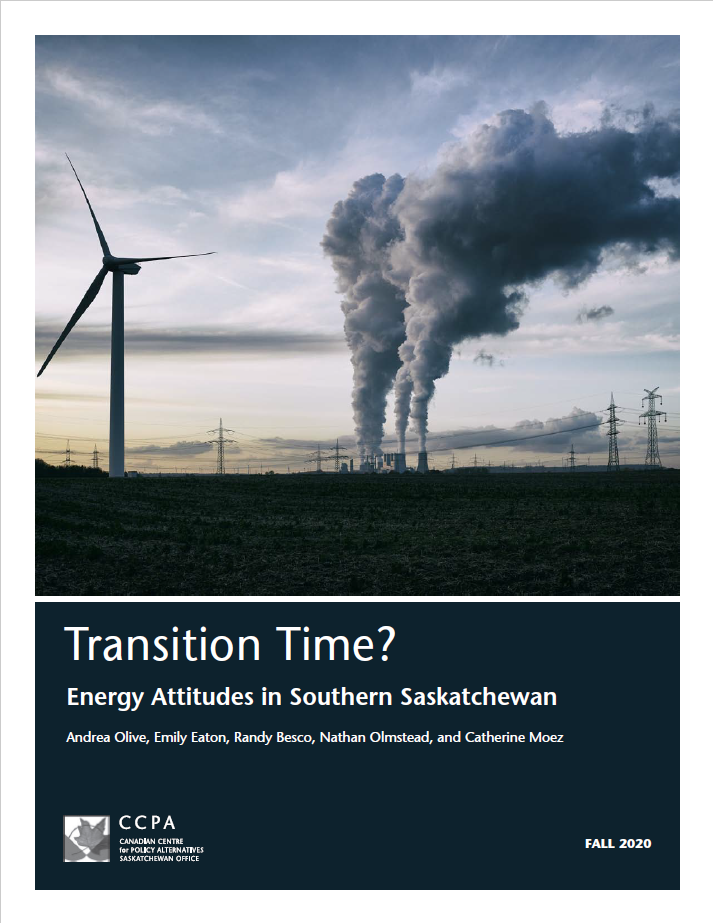
Transition Time?: Energy Attitudes in Southern Saskatchewan

By Andrea Olive, Emily Eaton, Randy Besco, Nathan Olmstead, and Catherine Moez - Canadian Centre for Policy Alternatives, Fall 2020

If you woke up in southern Saskatchewan today, chances are it is windy, and the sun is shining. Regina and Saskatoon are among the sunniest cities in all of Canada, and southern Saskatchewan has some of the highest solar photovoltaic potential in North America (Government of Canada nd). It also has some of the highest wind energy potential on the continent (Saskwind nd). Yet there is little solar or wind energy production occurring in the province — indeed, at present, wind contributes 5% and solar contributes less than 3% of energy consumed. Instead, Saskatchewan is known as an oil and gas economy with a dependence on coal for electricity and a deep opposition to carbon pricing. While high oil prices and a shale oil revolution initially led to a “Saskaboom,” the tides have quickly turned. With the collapse in oil prices in 2014 and the COVID-19 crisis of 2019-2020, boom has turned to bust, and oil and gas communities are hurting.

The problems with a steady reliance on fossil fuels are twofold: economic and environmental. For starters, an oil and gas economy is a volatile economy. As COVID disruptions revealed, any shock to the system can devastate the industry. When demand fell — as airlines cancelled flights and people lived under lock-down — oil prices tumbled to $3.50 USD a barrel in April. Pumps across Saskatchewan went idle. Similar slumps were felt during the 2008 global recession and the 2014 global drop in oil prices. When government revenues are closely tied to oil and gas production the fear of the next bust is always — and rightfully — around the corner.

The environmental externalities of fossil fuels are also ever present. Greenhouse gas emissions from fossil fuels like oil, gas, and coal are the leading cause of climate change, including unpredictable weather patterns, such as extreme heat, droughts, and flooding. In 2017, Saskatchewan’s emissions were 75% higher than they were in 1990. Today, the province’s emissions per capita are the highest in Canada and among the highest in the world (UCS 2018).

Read the text (PDF).

Pages

The Fine Print I:

Disclaimer: The views expressed on this site are not the official position of the IWW (or even the IWW’s EUC) unless otherwise indicated and do not necessarily represent the views of anyone but the author’s, nor should it be assumed that any of these authors automatically support the IWW or endorse any of its positions.

Further: the inclusion of a link on our site (other than the link to the main IWW site) does not imply endorsement by or an alliance with the IWW. These sites have been chosen by our members due to their perceived relevance to the IWW EUC and are included here for informational purposes only. If you have any suggestions or comments on any of the links included (or not included) above, please contact us.

The Fine Print II:

Fair Use Notice: The material on this site is provided for educational and informational purposes. It may contain copyrighted material the use of which has not always been specifically authorized by the copyright owner. It is being made available in an effort to advance the understanding of scientific, environmental, economic, social justice and human rights issues etc.

It is believed that this constitutes a 'fair use' of any such copyrighted material as provided for in section 107 of the US Copyright Law. In accordance with Title 17 U.S.C. Section 107, the material on this site is distributed without profit to those who have an interest in using the included information for research and educational purposes. If you wish to use copyrighted material from this site for purposes of your own that go beyond 'fair use', you must obtain permission from the copyright owner. The information on this site does not constitute legal or technical advice.