You are here

extractivism

The End of Oil? Pandemic Adds to Fossil Fuel Glut, But COVID-19 Relief Money Flows to Oil Industry

Antonia Juhasz interviewed by Amy Goodman- Democracy Now, September 2, 2020

AMY GOODMAN: Longtime Massachusetts senator and Green New Deal champion Ed Markey won his primary against challenger Congressmember Joe Kennedy III Tuesday, marking a victory for progressives and the first time a Kennedy has lost an election in the state of Massachusetts. Senator Markey secured 54% of the vote in a primary race seen by many as a showdown between the Democratic establishment and its new and growing progressive wing. House Speaker Nancy Pelosi endorsed Kennedy, while Markey had the support of New York Congressmember Alexandria Ocasio-Cortez and the youth-led Sunrise Movement. The Sunrise Movement tweeted in response to the victory, quote, “After winning elections across the country, you think we’re gonna stop now? They wish. We will protest outside the halls of Congress while our allies on the inside negotiate the Green New Deal,” they said.

This comes as Democratic presidential candidate Joe Biden said he would not ban fracking during a speech in Pittsburgh. A group of 145 organizations, including Sunrise Movement and Greenpeace, have released a letter calling on Biden to ban fossil fuel interests from his campaign and administration, if he wins. The letter reads, quote, “To advance environmental justice, you must stand up to fossil fuel CEOs, stop the expansion of oil, gas and coal production, and rapidly transition us away from fossil fuels,” unquote.

This comes as the global oil industry is in crisis with falling demand and crashing prices exacerbated by the coronavirus pandemic. Despite this, fossil fuel companies continue to pump out an excess of oil, much of it stored on tankers in the ocean. In May, as 390 million barrels of oil and gas sat in storage on the world’s oceans, Greenpeace activists sailed out along the San Francisco Bay, unfurling a banner saying “Oil Is Over! The Future Is Up to You.”

GREENPEACE ACTIVIST: I’m here in San Francisco Bay, where floating oil storage tankers are now idling, storing oil that no one wants and where we have nowhere to put.

AMY GOODMAN: Despite this, Congress has poured billions of dollars of COVID relief funds into bailing out the fossil fuel industry.

We go now to Boulder, Colorado, where we’re joined by Antonia Juhasz, an oil and energy reporter, a Bertha fellow in investigative journalism. And her recent cover story for Sierra magazine is “The End of Oil Is Near,” along with another report, “Bailout: Billions of Dollars of Federal COVID-19 Relief Money Flow to the Oil Industry.” She’s the author of several books, most recently, Black Tide: The Devastating Impact of the Gulf Oil Spill.

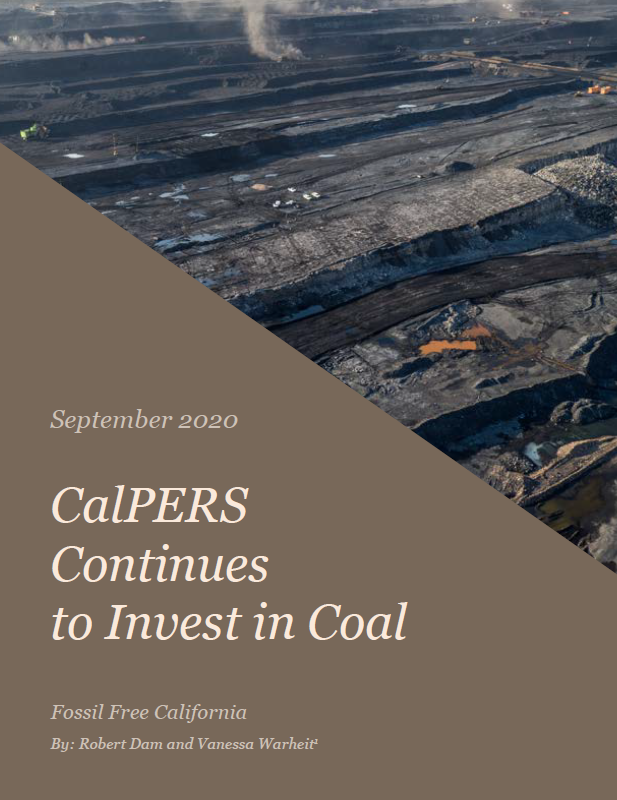
CalPERS Continues to Invest in Coal

By Robert Dam and Vanessa Warheit - Fossil Free California, September 2020

This 14-page report shows that CalPERS continues to hold millions in coal producers that make the majority of their revenue from thermal coal. In fact, CalPERS even increased its investments in Exxaro, a company that qualified for divestment in 2017 but was retained by CalPERS because they said they were investing more in green energy. But Exxaro’s modest clean energy initiatives are dwarfed by its current coal operations in South Africa, and by its intent to seek permits for a six-fold expansion of its coal mining, which could be a tipping point for the climate.

In recognition of coal’s outsized contribution to human-caused climate change, in 2015 California passed a law – SB 185 – requiring CalPERS and CalSTRS to divest from companies making 50% or more of their revenue from the mining of thermal coal.  A 50% share of revenue sets a very high bar that can be reached by only the small number of “pure-play” coal mining companies that remain in business.  Many investors, including BlackRock and the State of New York, define a “coal company” with a much lower threshold of 25% or even 10%.

If CalPERS coal holdings are analyzed more broadly, using the criteria of the Global Coal Exit List, it’s clear that CalPERS holds billions in coal – coal mining companies, coal-fired utilities, coal distribution and services, and large diversified companies with substantial coal operations. Instead of winding down its investments in coal, which was the intent of SB 185, CalPERS actually increased investments in coal by $1.5 billion dollars between 2018 and 2019, for a total of $6.5 billion throughout the whole coal value chain. 

CalPERS’ coal exclusion policy is weak compared to those of many other institutional investors. By failing to set a strong coal exclusion policy, CalPERS has already lost billions in absolute value on its coal investments, and the sector continues to decline. As New York State’s Tom DiNapoli said when he decided to divest 22 thermal coal companies, “After a thorough assessment, the fund has divested from 22 thermal coal mining companies that are not prepared to thrive, or even survive, in the low-carbon economy.”

Download (PDF).

Just Recovery Workshop: Another World is Possible

There May Be No Choice but to Nationalize Oil and Gas—and Renewables, Too

By Sean Sweeney - New Labor Forum, August 2020

Once on the margin of the margins, calls for the nationalization of U.S. fossil fuel interests arebgrowing. Before the Covid-19 pandemic, the basic argument was this: nationalization could expedite the phasing out fossil fuels in order to reach climate targets while ensuring a “just transition” for workers in coal, oil, and gas. Nationalization would also remove the toxic political influence of “Big Oil” and other large fossil fuel corporations. The legal architecture for nationalization exists—principally via “eminent domain”—and should be used.

But the case for nationalization has gotten stronger in recent months. The share values of large fossil fuel companies have tanked, so this is a good time for the federal government to buy. In April 2020, one source estimated that a 100 percent government buyout of the entire sector would cost $700 billion, and a 51 percent stake in each of the major companies would, of course, be considerably less. However, in May 2020 stock prices rose by a third or so based on expectations of a fairly rapid restoration of demand.

But fears of a fresh wave of Covid-19 outbreaks sent shares tumbling downward in June. Nationalizing oil and gas would be a radical step, but this alone would not be enough to deliver a comprehensive energy transition that can meet climate goals as well as the social objectives of the Green New Deal. Such a massive task will require full public ownership of refineries, investor-owned utilities (IOUs), and nuclear and renewable energy interests.

Progressives may feel it’s unnecessary to go that far; why not focus on the “bad guys” in fossil fuels and leave the “good guys” in wind, solar, and “clean tech” alone? But this is not an option. The neoliberal “energy for profit” model is facing a full-spectrum breakdown, and the energy revolution that’s required to reach climate targets poses a series of formidable economic and technical challenges that will require careful energy planning and be anchored in a “public goods” approach. If we want a low carbon energy system, full public ownership is absolutely essential.

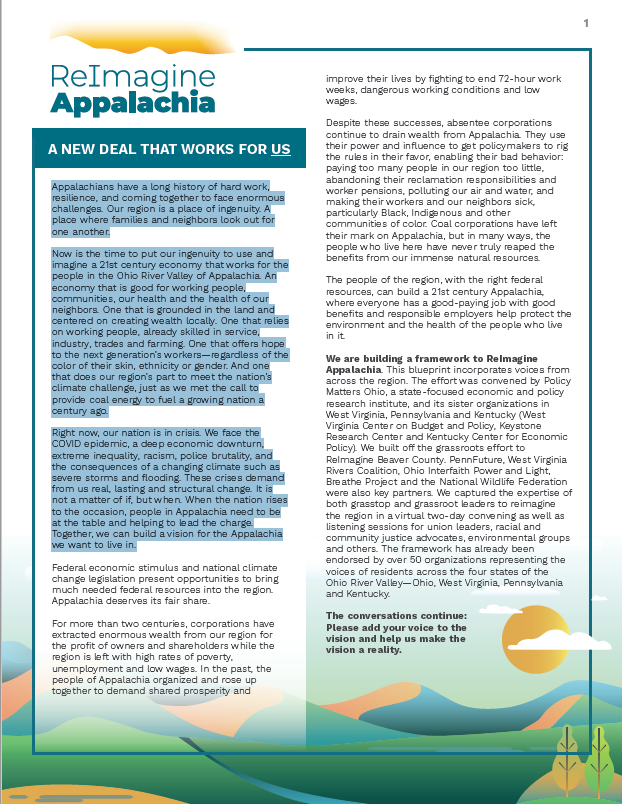
ReImagine Appalachia: a (Green) New Deal That Works for Us

By staff - ReImagine Appalachia, August 2020

Appalachians have a long history of hard work, resilience, and coming together to face enormous challenges. Our region is a place of ingenuity. A place where families and neighbors look out for one another.

Now is the time to put our ingenuity to use and imagine a 21st century economy that works for the people in the Ohio River Valley of Appalachia. An economy that is good for working people, communities, our health and the health of our neighbors. One that is grounded in the land and centered on creating wealth locally. One that relies on working people, already skilled in service, industry, trades and farming. One that offers hope to the next generation’s workers—regardless of the color of their skin, ethnicity or gender. And one that does our region’s part to meet the nation’s climate challenge, just as we met the call to provide coal energy to fuel a growing nation a century ago.

Right now, our nation is in crisis. We face the COVID epidemic, a deep economic downturn, extreme inequality, racism, police brutality, and the consequences of a changing climate such as severe storms and flooding. These crises demand from us real, lasting and structural change. It is not a matter of if, but when. When the nation rises to the occasion, people in Appalachia need to be at the table and helping to lead the charge. Together, we can build a vision for the Appalachia we want to live in.

Read the text (PDF).

Toward A Green New Future

By Thea Riofrancos and Daniel Aldana Cohen - Socialism 2020, July 26, 2020

Join Thea Riofrancos and Daniel Aldana Cohen for a discussion of the Green New Deal and the future we can build out of our crisis-ridden present. This event is part of the Socialism 2020 Virtual conference. See more at socialismconference.org.

Coal Mine Cleanup Works: A Look at the Potential Employment Needs for Mine Reclamation in the West

By Kate French - Western Organization of Resource Councils (WORC), July 2020

The collapse of the coal industry is devastating small communities across the Western United States, but reclaiming these mined lands quickly could create up to 4,800 full-time equivalent jobs per year in the critical two to three year period after mine closure according to our new report, Coal Mine Cleanup Works. The report estimates potential reclamation job creation for four Western coal states (Colorado, Montana, North Dakota, and Wyoming) and provides recommendations for decision makers to ensure cleanup is fully funded and employs the local workforce. 

These findings offer a rare bright light of opportunity for coal communities that are facing massive lay-offs and lost revenue as the coal industry crumbles. Reclamation is one of the few immediately available job opportunities for local workers after a mine shuts down, and the report finds that these jobs are ideally suited for current or former miners.

Coal Mine Cleanup Works key findings include:

  • Surface coal mine reclamation could create up to 4,800 full-time equivalent jobs per year in the critical two to three year period after mine closure. These potential yearly jobs represent up to 65% of the current surface mining workforce in the four-state region. 
  • Reclamation is one of the few immediately available job opportunities for local workers after a mine shut down, and the report finds that these jobs are ideally suited for current or former miners.
  • An important component of a just economic transition is having some immediate job creation solutions, like cleanup jobs, paired with longer-term job solutions.
  • Delayed and underfunded reclamation are the biggest hurdles to getting laid-off miners back on the job doing cleanup work.

Read the text (PDF).

Defending Tomorrow: The climate crisis and threats against land and environmental defenders

By staff - Global Witness, July 2020

For years, land and environmental defenders have been the first line of defence against climate breakdown. Yet despite clearer evidence than ever of the crucial role they play, far too many businesses, financiers and governments fail to safeguard their vital and peaceful work. 

The climate crisis is arguably the greatest global and existential threat we face. As it escalates, it serves to exacerbate many of the other serious problems in our world today – from economic inequality to racial injustice and the spread of zoonotic diseases.

For years, land and environmental defenders have been the first line of defence against the causes and impacts of climate breakdown. Time after time, they have challenged those companies operating recklessly, rampaging unhampered through forests, skies, wetlands, oceans and biodiversity hotspots.

Yet despite clearer evidence than ever of the crucial role they play and the dangers they increasingly face, far too many businesses, financiers and governments fail to safeguard their vital and peaceful work. 

Our annual report into the killings of land and environmental defenders in 2019 shows the highest number yet have been murdered in a single year. 212 land and environmental defenders were killed in 2019 – an average of more than four people a week.

Read the text (PDF).

Can a Just Transition Change Appalachia’s Balance of Power?

By Morgan Hickory and Lydia Patton - Science for the People, Summer 2020

From Volume 23, number 2, People’s Green New Deal

Encuentre una traducción de este artículo en español en nuestro sitio web.

Mining and Nurses

“Biggest thing we got around here is that everything is based off coal. I’m not down on coal, like I said, I’m grateful for it, I love it, and whoever else still wants to do it, more power to you. I’ll back you 100 percent. But we have to find something else around here to support our economy. Mining and nurses the only two things you got. If you don’t put some other type of industrial occupation around here, something that’s not based on coal, then our economy is going to be destroyed. There’s literally nothing left for you to do. Like I said, it’s fast food, making minimum wage, mining, or nursing.”

--David Lee Brett, Jr., former coal miner in Harlan County, KY

A new generation of progressive thinkers, from slightly left-of-center Democrats to committed socialists, is proposing federal legislation for a sweeping economic transition away from fossil fuels. Termed the Green New Deal (GND), this proposal promises to phase fossil fuel industries out of existence and introduce well-paid alternatives for workers in these industries. Any federal project that begins as a policy idea, even if it is enacted by Congress, will encounter challenges on the ground. This is especially true in places like Appalachia, where highly localized systems of power, in place for decades or even centuries, funnel resources into channels controlled by the existing ruling class. Federal injections of money are a periodic occurrence in Central Appalachia, whether distributed through New Deal job creation and infrastructure programs in the 1930s or through humanitarian aid efforts initiated by the War on Poverty in the 1960s.1 Local apex families and entrenched government systems have adapted to take advantage of and benefit from extractive industries such coal. As such, the GND risks floundering in Appalachia if robust local knowledge about its people and politics is not built into the conception and execution of a People’s Green New Deal (PGND).

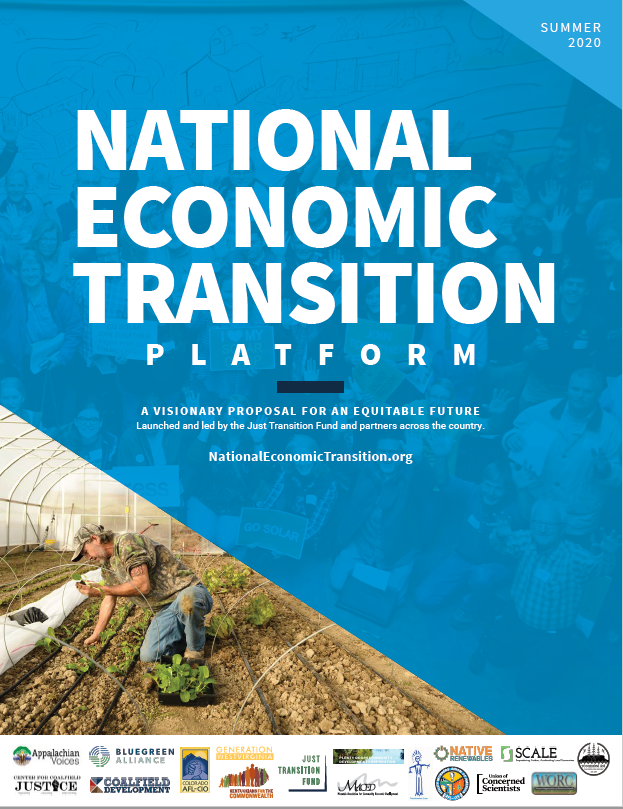
National Economic Transition Platform: A Visionary Proposal for an Equitable Future

By staff - Just Transition Fund, Summer 2020

Workers and families affected by the changing coal economy are facing a profound crisis complicated by unique difficulties. Prior to the COVID-19 pandemic and economic decline, coal facility closures, layoffs, and cuts to vital services were devastating to people and places dependent on the coal economy—many of whom are still struggling following earlier economic declines, the loss of manufacturing jobs, or inequality and widespread poverty.

For low-income communities and communities of color already disproportionately left behind by the status quo, the need for equitable and inclusive economic growth is vital. But, now, with COVID-19, these unique challenges are exacerbated. The closure of even more coal facilities is accelerated, giving communities little time to plan for the disappearance of their largest employer and the erosion of the tax base, which provides critical funding for public services, local education, and health care systems.

Read the text (PDF).

Pages

The Fine Print I:

Disclaimer: The views expressed on this site are not the official position of the IWW (or even the IWW’s EUC) unless otherwise indicated and do not necessarily represent the views of anyone but the author’s, nor should it be assumed that any of these authors automatically support the IWW or endorse any of its positions.

Further: the inclusion of a link on our site (other than the link to the main IWW site) does not imply endorsement by or an alliance with the IWW. These sites have been chosen by our members due to their perceived relevance to the IWW EUC and are included here for informational purposes only. If you have any suggestions or comments on any of the links included (or not included) above, please contact us.

The Fine Print II:

Fair Use Notice: The material on this site is provided for educational and informational purposes. It may contain copyrighted material the use of which has not always been specifically authorized by the copyright owner. It is being made available in an effort to advance the understanding of scientific, environmental, economic, social justice and human rights issues etc.

It is believed that this constitutes a 'fair use' of any such copyrighted material as provided for in section 107 of the US Copyright Law. In accordance with Title 17 U.S.C. Section 107, the material on this site is distributed without profit to those who have an interest in using the included information for research and educational purposes. If you wish to use copyrighted material from this site for purposes of your own that go beyond 'fair use', you must obtain permission from the copyright owner. The information on this site does not constitute legal or technical advice.