You are here

extractivism

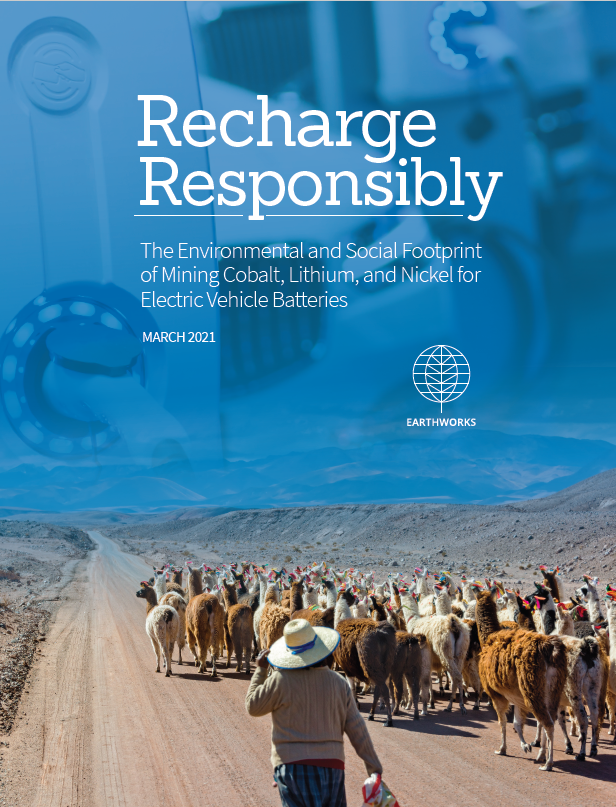
Recharge Responsibly: The Environmental and Social Footprint of Mining Cobalt, Lithium, and Nickel for Electric Vehicle Batteries

By Benjamin Hitchcock Auciello, et. al. - Earthworks, March 31, 2021

It is critical that the clean energy economy not repeat the mistakes of the dirty fossil fuel economy that it is seeking to replace. The pivot from internal combustion engines towards electric vehicles provides an unprecedented opportunity to develop a shared commitment to responsible mineral sourcing. We can accelerate the renewable energy transition and drive improvements in the social and environmental performance of the mining industry by reducing overall demand for new minerals, increasing mineral recycling and reuse, and ensuring that mining only takes place if it meets high environmental, human rights and social standards.
This report is designed to inform downstream battery metal users of key environmental, social, and governance issues associated with the extraction and processing of the three battery metals of principal concern for the development of electric vehicles and low-carbon energy infrastructure—lithium, cobalt and nickel—and to offer guidance on responsible minerals sourcing practices. This report reflects and summarizes some of the key concerns of communities impacted by current and proposed mineral extraction in hotspots around the world: Argentina, Chile and the United States for lithium, Papua New Guinea, Indonesia and Russia for nickel, and the Democratic Republic of Congo for cobalt.

Read the text (PDF).

Pipelines, Pandemics and Capital’s Death Cult: A Green Syndicalist View

By Jeff Shantz - LibCom, March 29, 2021

We can see this within any industry, within any capitalist enterprise. It is perhaps most clearly apparent, in an unadorned fashion, in extractives industries like mining, logging, or oil, where the consumption of nature (as resources) for profit leaves ecosystems ruined, where workers are forced to labor in dangerous, often deadly, conditions, and where it is all is carried out through direct dispossession, invasion, and occupation of Indigenous lands and through processes of mass killing, even genocide. And when it is all done, little remains except the traces of profit that have been extracted and taken elsewhere.

These intersections have come to the forefront with particular clarity under conditions of the Covid-19 pandemic. The death cult of capital on full display in all its variety of ways.

Ecosocialismo: Envisioning Latin America’s Green New Deal

Trade Unions for Energy Democracy: Global Forum on Mexico

By staff - Trade Unions For Energy Democracy, March 25, 2021

Speakers:

  • Heberto Barrios Castillo, Undersecretary, Mexican Energy Ministry- SENER
  • Martín Esparza, General Secretary, Sindicato Mexicano de Electricistas- SME
  • Silvia Ramos Luna, Secretary General, Unión Nacional de Técnicos y Profesionistas Petroleros - UNTyPP
  • Fernando Lopes, trade union consultant in Brazil and former Assistant Secretary General of IndustriALL
  • Ozzi Warwick, Chief Education and Research Officer, Oilfields Workers' Trade Union (OWTU), Trinidad and Tobago

Don’t Nuke the Climate

By collective - Green Anti-Capitalist Media, March 10, 2021

Remembering Fukushima

We all remember the Fukushima Daiichi disaster that took place in Northern Japan on the 11th of March 2011, the aftereffects of which are still being felt as the Japanese government continues to grapple to deal with the tons of radioactive soil, water and waste they need to store or dispose of. The surrounding communities are still suffering from their radiation exposure and displacement as 36,000 people have not returned to their homes (according to Fukushima prefecture) despite government announcements allowing return, and compensation claims are still being processed.

The Fukushima accident was the second worst nuclear accident in the history of nuclear power generation. It was the result of tsunami waves generated by the powerful earthquake that shook Japan on the same day damaging the backup generators of the plant. Japan is an earthquake prone country and tsunami waves of this size have historical precedents in the country. Despite the reactors shutting down, the power loss caused the cooling systems to fail and the reactors’ cores to melt down, release radiation and create holes in their containment vessels exposing the nuclear materials and resulting in explosions in the following days that released further radioactive materials.

At least 600 square km of land was initially evacuated with 47,000 people leaving their homes surrounded by a wider zone where residents were asked to remain indoors. In the following months radiation was found in the local food and drinking water, and ocean water near the plant was discovered to have been contaminated with high levels of iodine-131. An additional corridor of land covering roughly 207 square km was also designated for evacuation in the months following the disaster raising the number of evacuated people to 150,000.

Apart from the contamination of the soil, plants, animals and groundwater in the surrounding areas, the Fukushima disaster is the single largest accidental (in other words excluding bomb testing) release of radioactivity into the ocean the results of which it is too early to tell.

A Santa Cruz Green New Deal: Yes to Social Justice! No to Green Capitalism!

By Ecosocialist Working Group - Santa Cruz Left, March 6, 2021

Proposed as a green jobs and justice program for the next ten years, the Green New Deal is both a social movement to unite diverse social justice struggles and a comprehensive platform for addressing climate change. Alexandria Ocasio-Cortez (D-NY) and Ed Markey (D-MA) introduced it in Congress in 2019, where it failed to gain traction in the Republican-controlled senate. But endorsed by organizations including the Sunrise Movement, the Indigenous Environmental Network, Climate Mobilization, Bernie’s Our Revolution, and DSA, the GND remains a powerful vision to organize around for a world worth living in.

Warning of an unfolding climate holocaust, massive loss of life, suffering, and financial devastation, AOC and Markey’s GND resolution notably joins decarbonization to social justice and equity. It proposes infrastructural renewal, economic investment for the wellbeing of all, and guaranteeing clean air, water, and land, in ways that repair the “historic oppression of indigenous peoples, communities of color, migrant communities, deindustrialized communities, depopulated rural communities, the poor, low-income workers, women, the elderly, the unhoused, people with disabilities, and youth.” In 2019, AOC narrated an amazing short video (brilliantly animated by Molly Crabapple) that pictures what a GND-inspired future might look like.

DSA’s Ecosocialists (national) have added their own priorities, including democratizing control over major energy systems and resources; centering the multiracial working class in the just transition to an economy of societal and ecological care; demilitarizing, decolonizing, and striving for a future of international solidarity and cooperation; and decommodifying survival by guaranteeing living wages, healthcare, and affordable housing for all. As such, they join Indigenous and environmental, and racial justice social movements that stress the need for a bottom-up, inclusive, and democratized approach, rather than top-down governmental policy directives.

Joining the GND to the decolonial Red Deal, as proposed by The Red Nation, also makes compelling sense. As Nick Estes argues in Jacobin, “The GND has the potential to connect every social justice struggle—free housing, free health care, free education, green jobs—to climate change. Likewise, the Red Deal places anti-capitalism and decolonization as central to each social justice struggle as well as climate change. The necessity of such a program is grounded in both the history and future of this land, and it entails the radical transformation of all social relations between humans and the earth.” And while such a program must not only be intersectionalist but also global in scope, it’s less clear what the GND would mean on a local level and how it might offer a useful instrument to connect diverse regional struggles. But it’s on the local scale that we can most meaningfully engage with this all-encompassing struggle, in support of its national and international horizons.

Billionaire or Community Solutions to Climate Chaos?

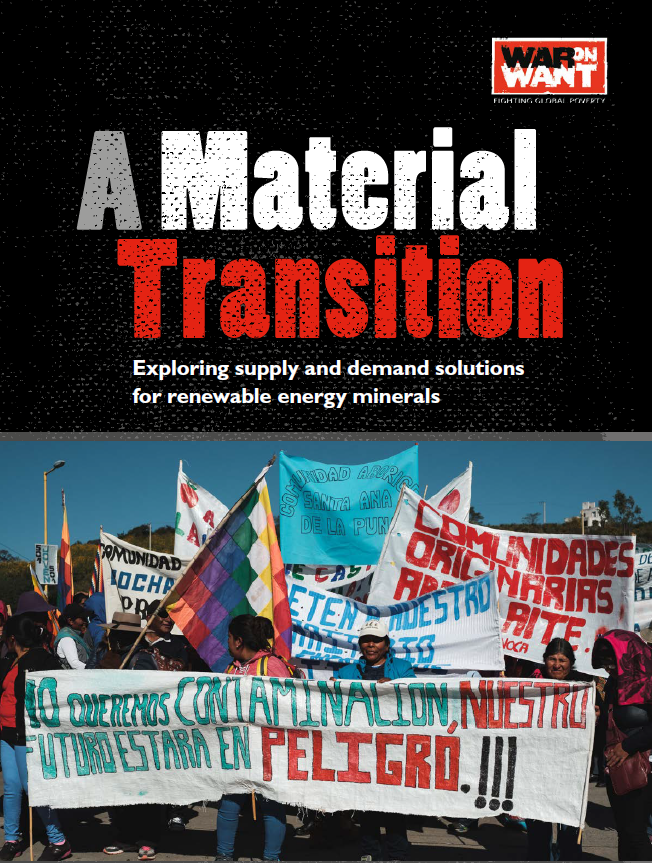
A Material Transition: Exploring supply and demand solutions for renewable energy minerals

By Andy Whitmore - War on Want, March 2021

There is an urgent need to deal with the potential widespread destruction and human rights abuses that could be unleashed by the extraction of transition minerals: the materials needed at high volumes for the production of renewable energy technologies. Although it is crucial to tackle the climate crisis, and rapidly transition away from fossil fuels, this transition cannot be achieved by expanding our reliance on other materials. The voices arguing for ‘digging our way out of the climate crisis’, particularly those that make up the global mining industry, are powerful but self-serving and must be rejected. We need carefully planned, lowcarbon and non-resource-intensive solutions for people and planet.

Academics, communities and organisations have labelled this new mining frontier, ‘green extractivism’: the idea that human rights and ecosystems can be sacrificed to mining in the name of “solving” climate change, while at the same time mining companies profit from an unjust, arbitrary and volatile transition. There are multiple environmental, social, governance and human rights concerns associated with this expansion, and threats to communities on the frontlines of conflicts arising from mining for transition minerals are set to increase in the future. However, these threats are happening now. From the deserts of Argentina to the forests of West Papua, impacted communities are resisting the rise of ‘green extractivism’ everywhere it is occurring. They embody the many ways we need to transform our energy-intense societies to ones based on democratic and fair access to the essential elements for a dignified life. We must act in solidarity with impacted communities across the globe.

This report includes in-depth studies written by frontline organisations in Indonesia and Philippines directly resisting nickel mining in both countries respectively. These exclusive case studies highlight the threats, potential impacts and worrying trends associated with nickel mining and illustrate, in detail, the landscape for mining expansion in the region.

Read the text (PDF).

LNS Calls for Climate-Safe Infrastructure Not Line 3 and Dakota Access Tar Sands Pipelines

By Staff - Labor Network for Sustainability, March 2021

The Labor Network for Sustainability calls for a halt to the Line 3 Pipeline, the Dakota Access Pipeline and other climate-destroying fossil-fuel infrastructure of the past. It calls instead to start creating the jobs of the future building the climate-safe infrastructure of the future.

The U.S. is already building extensive new fossil-free energy infrastructure and is creating more jobs than a similar investment in fossil fuel facilities. Rather than spend a penny more on new fossil fuel infrastructure, it is time to invest in a massive, jobs-rich conversion to a fossil-free energy infrastructure.

The U.S. government, the people of the world, and even major oil companies recognize that the climate emergency requires us to move rapidly to a fossil-free economy. President Joe Biden recently recognized this by cancelling the Keystone XL pipeline. It is time to halt other new fossil fuel infrastructure—urgently, the Line 3 and Dakota Access Pipelines—and use our precious resources for a just transition to climate safety.

A 2013 LNS study compares jobs created by the Keystone XL pipeline to the jobs that could be created by water, sewer and gas repair projects in the five states the pipeline crosses. It finds that meeting unmet water and gas line repair infrastructure needs in the five states along the KXL pipeline route would create:

  • More than 300,000 total jobs across all sectors;
  • Five times more jobs, and better jobs, than KXL;
  • 156% of the number of direct jobs created by Keystone XL per unit of investment.

See the full report: “The Keystone Pipeline Debate: An Alternative Job Creation Strategy”

Workers should not have to pay the price of protecting the climate—they deserve a just transition to a climate-safe future. Cancelation of fossil fuel projects like the tar sands pipelines should be paired with a program to see that every worker whose job may be threatened by climate policies has access to a new job creating the economy of the future.

Fracking boom brings job and income loss to Appalachian communities

By Elizabeth Perry - Work and Climate Change Report, February 23, 2021

A February study examined the economic changes in 22 counties the authors call “Frackalachia” – home to the Utica and Marcellus shale gas industry. The report, Appalachia’s Natural Gas Counties: Contributing more to the U.S. economy and Getting less in return examines the period from 2008 to 2019, a time when the area went from producing a negligible portion of U.S. natural gas to producing 40%. The report summarizes the job forecasts provided by oil and gas industry economic impact studies, (over 450,000 new jobs for Ohio, Pennsylvania, and West Virginia), and shows the actual economic data from the U.S. Bureau of Economic Analysis – a 1.6% increase in jobs – at a time when the number of jobs across the U.S. grew by 9.9%. Detailed statistics demonstrate the differences amongst counties and states – with Ohio faring the worst and Pennsylvania faring the best. The report’s analysis shows that in the entire area represented by the 22 counties, the share of the national personal income fell by 6.3 percent, the share of jobs fell by 7.5 percent, and the share of the national population fell by 9.7 percent , while 90% of the wealth generated from fracking left the local communities.

The report was produced and published on February 10 by the Ohio River Valley Institute, a non-profit think tank based in Pennsylvania, founded in 2020 with the vision of “moving beyond an extractive economy toward shared prosperity, lasting job growth, clean energy, and civic engagement.” This report has been widely reported, including in “Appalachia’s fracking boom has done little for local economies: Study”(Environmental Health News , Feb. 12), which summarizes the report and adds context concerning the health effects of fracking, and the failed attempts to expand production to petrochemicals and plastics using ethane, a by-product of the fracked natural gas.

Pages

The Fine Print I:

Disclaimer: The views expressed on this site are not the official position of the IWW (or even the IWW’s EUC) unless otherwise indicated and do not necessarily represent the views of anyone but the author’s, nor should it be assumed that any of these authors automatically support the IWW or endorse any of its positions.

Further: the inclusion of a link on our site (other than the link to the main IWW site) does not imply endorsement by or an alliance with the IWW. These sites have been chosen by our members due to their perceived relevance to the IWW EUC and are included here for informational purposes only. If you have any suggestions or comments on any of the links included (or not included) above, please contact us.

The Fine Print II:

Fair Use Notice: The material on this site is provided for educational and informational purposes. It may contain copyrighted material the use of which has not always been specifically authorized by the copyright owner. It is being made available in an effort to advance the understanding of scientific, environmental, economic, social justice and human rights issues etc.

It is believed that this constitutes a 'fair use' of any such copyrighted material as provided for in section 107 of the US Copyright Law. In accordance with Title 17 U.S.C. Section 107, the material on this site is distributed without profit to those who have an interest in using the included information for research and educational purposes. If you wish to use copyrighted material from this site for purposes of your own that go beyond 'fair use', you must obtain permission from the copyright owner. The information on this site does not constitute legal or technical advice.