You are here

extractivism

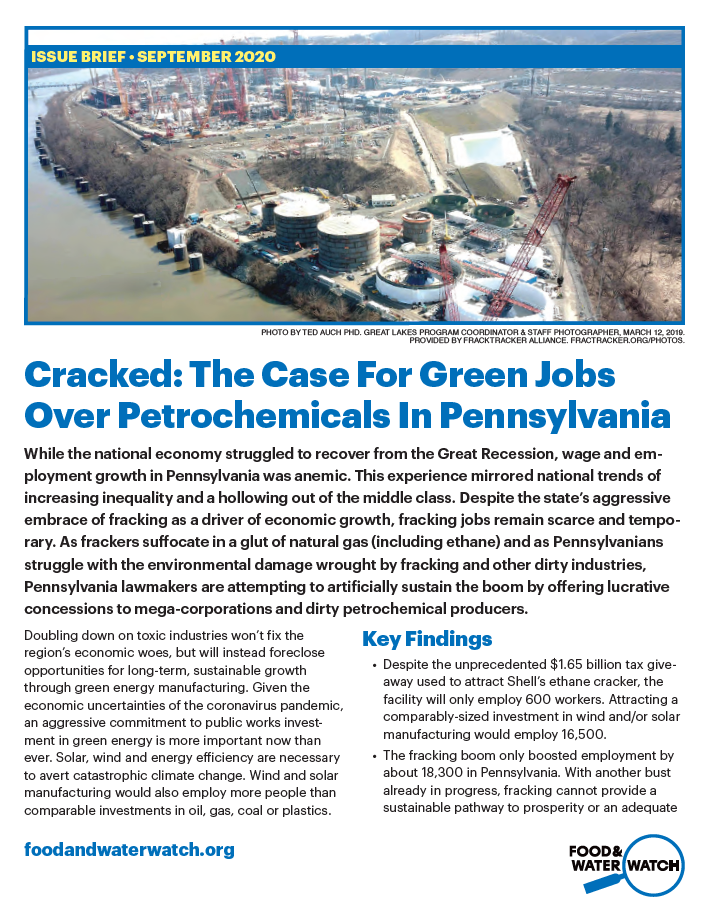
Cracked: The Case for Green Jobs Over Pterochemicals in Pennsylvania

By staff - Food and Water Watch, September 2020

While the national economy struggled to recover from the Great Recession, wage and employment growth in Pennsylvania was anemic. This experience mirrored national trends of increasing inequality and a hollowing out of the middle class. Despite the state’s aggressive embrace of fracking as a driver of economic growth, fracking jobs remain scarce and temporary. As frackers suffocate in a glut of natural gas (including ethane) and as Pennsylvanians struggle with the environmental damage wrought by fracking and other dirty industries, Pennsylvania lawmakers are attempting to artificially sustain the boom by offering lucrative concessions to mega-corporations and dirty petrochemical producers.

Doubling down on toxic industries won’t fix the region’s economic woes, but will instead foreclose opportunities for long-term, sustainable growth through green energy manufacturing. Given the economic uncertainties of the coronavirus pandemic, an aggressive commitment to public works investment in green energy is more important now than ever. Solar, wind and energy efficiency are necessary to avert catastrophic climate change. Wind and solar manufacturing would also employ more people than comparable investments in oil, gas, coal or plastics.

Read the text (Linked PDF).

Care Work Is Essential Work. It's Also Climate Work

Equity, Climate Justice, and Fossil Fuel Extraction: Principles for a Managed Phase Out

By Gregg Muttitt and Sivan Kartha - Oil Change International, April 28, 2020

The Paris Agreement goals require most fossil fuel use to be ended within a generation. This paper looks at where and how to equitably phase out oil, gas and coal, and proposes five principles to help democratic actors work through the equity issues that arise from winding down fossil fuel extraction.

Equity issues have long been debated within international climate politics, focused on fairly distributing reductions in territorial emissions and fossil fuel consumption. There is a growing recognition among scholars and policymakers that curbing fossil fuel supply (as well as demand) can be a valuable part of the climate policy toolbox; this raises the question of where and how the tool should be applied.

This paper explores how to equitably manage the social dimensions of a rapid transition away from fossil fuel extraction. Fossil fuel extraction leads to benefits for some people (such as extraction workers) and harms for others (such as pollution-affected communities). A transition must respect and uphold the rights of both groups, while also staying within climate limits, as climate impacts will fall most heavily on the world’s poor.

This paper begins by reviewing how extraction affects economies and communities and the different transitional challenges they face. Based on that review, it then examines three common equity approaches — economic efficiency, meeting development needs, and effort-sharing. Drawing lessons from the strengths and weaknesses of these approaches, the paper proposes five principles as a basis for equitably curbing fossil fuel extraction within climate limits:

  1. Phase down global extraction at a pace consistent with limiting warming to 1.5°C;
  2. Enable a just transition for workers and communities;
  3. Curb extraction consistent with environmental justice;
  4. Reduce extraction fastest where doing so will have the least social costs;
  5. Share transition costs fairly, according to ability to bear those costs.

Key policy insights:

  • Fossil fuel extraction is unlikely to be a viable path to development because the Paris Agreement goals require most fossil fuel use to be ended within a generation;
  • Extraction should be phased out fastest in diversified, wealthier economies that can better absorb the transitional impacts;
  • Governments of extracting countries should enact ambitious industrial policy to diversify their economies, alongside economic and employment policies to enable a just transition;
  • The costs of a just transition should be borne by those most able to bear it: poorer countries can reasonably demand financial support.

Download (PDF).

Resilient Societies or Fossil Fuel Bailouts?

By staff - Oil Change International - April 22, 2020

The COVID-19 crisis poses a threat to people’s health, their jobs and their lives, and like all crises, exacerbates already existing inequalities. Trillions in public finance will be needed to get through the current pandemic. This briefing outlines why continuing to rely on fossil fuels, in particular oil and gas, is not compatible with long-term recovery. It does not make sense to use the COVID-19 stimulus packages to try to revive a sunsetting industry which will not deliver on economic recovery, only to shut it down a few years later to meet climate goals.

Governments now face a choice: fund a just transition away from fossil fuels that protects workers, communities, and the climate — or continue funding business-as-usual toward climate disaster. Governments should invest in a green recovery that protects and creates long lasting jobs, resilient economies and accelerates climate action. This briefing details why this is the most effective route for recovery and lays out the dos and don’ts for governments in their response to the current crisis.

Key Recommendations (DO’s):

  • Ensure national and international equity and a just transition is at the heart of any government response to the current crisis.
  • Protect workers and communities affected by the crisis, including those in the oil and gas sector, and create long-lasting green jobs by investing in resilient infrastructure and emerging low carbon industries that will continue to create jobs for decades.
  • Ensure Green New Deal frameworks provide the basis for stimulus packages to help rewrite the social contract in a people-centered response to the current crisis. 
  • End fossil fuel subsidies and finance and ensure any carbon price reflects climate and equity imperatives in order to ensure renewables remain competitive and incentivize efficient energy use in light of low oil prices while supporting a just transition.
  • Introduce oil and gas production caps as a first step to limiting emissions. The world is running out of storage capacity and production limits are needed to ensure a managed decline of the industry.
  • Make decision-making processes and response measures transparent in order to allow public scrutiny.
  • Bring the oil and gas industry into public ownership in the right circumstances, as it may be the most straightforward path to ensure a just transition for workers and communities and a managed phase-out.
  • Link any support provided to the industry to a requirement to align with climate goals and plan for a managed decline.
  • Ensure the polluter pays principle is upheld. Broadly speaking, over the past few decades, the financial rewards of the industry have been privatized, while the risks have been socialized.

Key Pitfalls to Avoid (DON’Ts):

  • DON’T bail out oil and gas companies or increase fossil fuel subsidies.
  • DON’T bail out other polluting industries, such as the aviation and shipping industries.
  • DON’T continue the construction or operation of fossil fuel infrastructure at the expense of the health of workers and communities.
  • DON’T roll back existing policies or regulations, or extend licensing agreements.
  • DON’T delay responses to the climate crisis amid the flurry of immediate priorities. If anything, the current pandemic has shown that a crisis demands a timely response to prevent it from escalating further.

While the fossil fuel sector may struggle to return to business as usual, without policies aimed at emerging from the crisis with a cleaner energy system, surviving companies may be in a position to capitalize on rising oil prices as the cycle turns. There are currently no safeguards against a future price spike and subsequent return to the volatile boom-bust cycle. This briefing advises governments to adopt recovery measures that will ensure a just transition off oil and gas, accelerate climate goals and build resilient societies, and center people instead of corporate executives and shareholders — all while tackling today’s parallel health, economic, and climate crises at once.

Read the report (PDF).

The energy crises revealed by COVID: Intersections of Indigeneity, inequity, and health

By Kathleen Brosemer, et. al. - various, Spring 2020

The global COVID-19 pandemic is a health crisis, an economic crisis, and a justice crisis. It also brings to light multiple ongoing, underlying social crises. The COVID-19 crisis is actively revealing crises of energy sovereignty in at least four ways:

  • First, there are many whose access to basic health services is compromised because of the lack of energy services necessary to provide these services.
  • Second, some people are more vulnerable to COVID-19 because of exposure to environmental pollution associated with energy production.
  • Third, energy services are vital to human well-being, yet access to energy services is largely organized as a consumer good. The loss of stable income precipitated by COVID-19 may therefore mean that many lose reliable access to essential energy services.
  • Fourth, the COVID-19 crisis has created a window of opportunity for corporate interests to engage in aggressive pursuit of energy agendas that perpetuate carbon intensive and corporate controlled energy systems, which illuminates the ongoing procedural injustices of energy decision making.

These four related crises demonstrate why energy sovereignty is essential for a just energy future. Energy sovereignty is defined as the right for communities, rather than corporate interests, to control access to and decision making regarding the sources, scales, and forms of ownership characterizing access to energy services. Energy sovereignty is a critical component in the design of a post-COVID-19 energy system that is capable of being resilient to future shocks without exacerbating injustices that are killing the most vulnerable among us.

Download (PDF).

The Future of Alberta's Oil Sands Industry: More Production, Less Capital, Fewer Jobs

By Ian Hussey - Parkland Institute, March 2020

Major restructuring and consolidation of the Alberta-dominated Canadian oil and gas industry has been taking place since 2014 (Hussey et al. 2018), when the lower-for-longer oil price scenario in which the province still finds itself began.
This report explores the employment, capital spending, and operational spending implications of the ongoing restructuring and consolidation of the industry. More specifically, the report explains that oil sands industry maturation—which was significantly advanced over the latest commodity cycle—means there has been a recent shift in the industry from its growth phase (2000–2018) to its mature phase (2019 onward).

Read the report (Link).

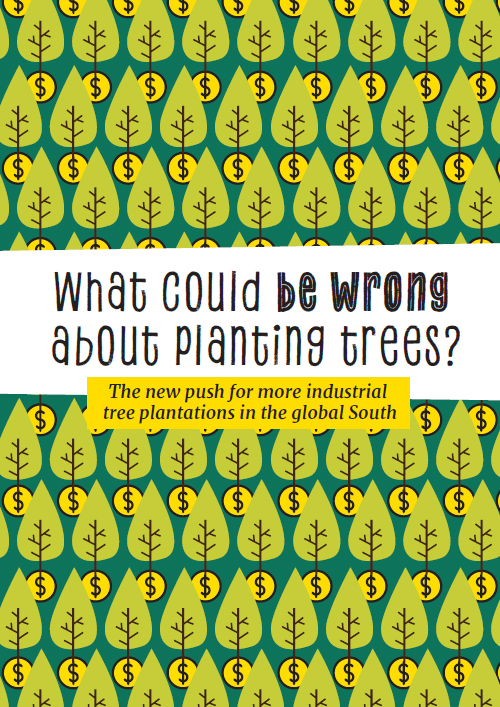
What could be wrong about planting trees?: The new push for more industrial tree plantations in the Global South

By Winfridus Overbeek - World Rainforest Movement, February 2020

What could be wrong about planting trees? Haven’t communities around the world been planting a diversity of trees since the dawn of human civilization?
Yes they have. But in more recent times, companies have also been planting trees, especially in Africa, Asia and Latin America, and the way they do so is very different from that of communities. They cover huge areas with trees from one single species, creating vast industrial or monoculture plantations devoid of biodiversity.

Today, these same companies plan to start a new round of massive expansion. Exploiting growing public awareness and concern about climate change, they argue that monoculture plantations are an excellent option to help solve some of the world’s most urgent problems: loss of forests, global heating and dependence on fossil fuels (oil, coal and gas).

The corporate argument is that plantations will encourage “forest restoration”, can serve as a natural “solution” to the climate emergency, or help foster a “bio-economy”.

The simple truth, however, is that the industries involved want more plantations simply to increase their profit margins. And other industries and polluters are also using such deceptive arguments, in order to hide their contributions to an ever-worsening social and environmental planetary crisis.

In this booklet, WRM aims to alert community groups and activists about the corporate push for a new round of industrial tree plantation expansion. It also reveals why planting trees on such a large scale can be extremely detrimental, in spite of seductive marketing campaigns claiming that these plantations will or could be a “solution” to the climate crisis.

Read the report (PDF).

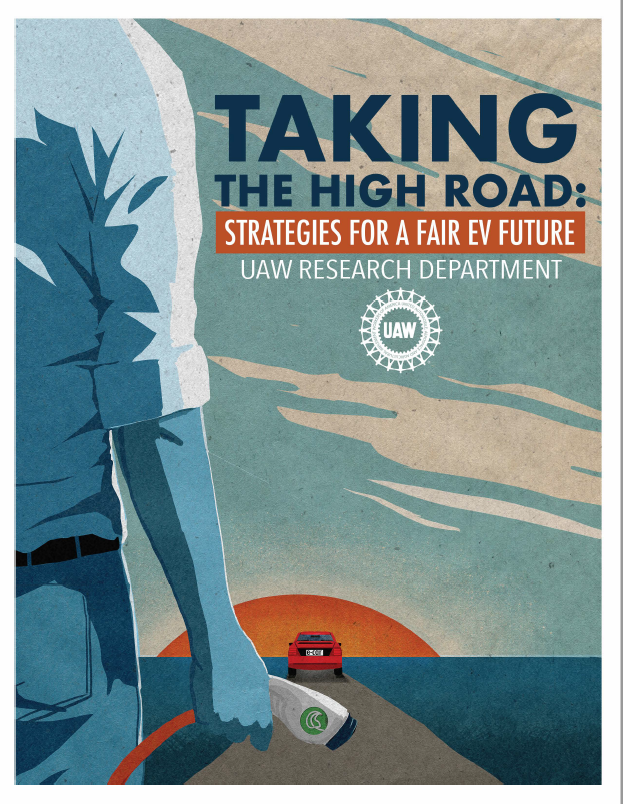
Taking the High Road: Strategies for a Fair EV Future

By staff - UAW Research Department, January 2020

The American automotive industry is constantly evolving and, throughout the union’s history, the United Auto Workers (UAW) has fought to ensure industry changes result in quality jobs that benefit workers and the economy.

The auto industry is facing a new shift in technology with the proliferation of electric vehicles (EVs). This shift is an opportunity to re-invest in U.S. manufacturing. But this opportunity will be lost if EVs or their components are imported or made by low-road suppliers who underpay workers. In order to preserve American jobs and work standards, what is needed is a proactive industrial policy that creates high-quality manufacturing jobs making EVs and their components.

Read the text (PDF).

Bargaining Electric Power: Miners, Blackouts, and the Politics of Illumination in the United States, 1965-1979

By Trish Kahle - Journal of Energy History, December 12, 2019

This article examines how the perils conjured by blackouts in American cities after 1965 became interpreted as a key point of political and bargaining leverage for the nation’s coal miners. The anxieties provoked by these blackouts –sexual deviance, urban unrest, spoiled food, lost productivity, and Cold War incursions– pointed to a broader crisis of American political and social life driven by the massive social changes which had taken place since the end of the Second World War. As the United States entered the 1970s, a long-range energy crisis appeared not only to secure the future of the once-imperiled coal industry in the United States, but also allowed miners to recast their union as a bedrock of national security rather than as one of the main sources of the nation’s labor unrest.

Evoking the threat of coerced darkness in the modern American home which had been designed for bright illumination, they also pointed to the figurative darkness of the coal mining workscape, described by one miner as “beating the devil at a game of hell”: the constant threat of black lung, disablement, and death. A form of collective bargaining leverage thus opened up a broader debate: how, given the deadly work of coal extraction, could energy be produced in a democratic society that guaranteed the right to life, liberty, property, and, increasingly, light? Did “one man” have to “die every day” to keep the nation’s lights on? This paper argues that miners used the framework of lights and darknesses to contend that mines must be made safe and energy democratized in order to stabilize the energy regime in crisis. In so doing, they framed a new politics of illumination which allowed them to navigate a new terrain of collective action.

Read the text (PDF).

Wealth Redistribution, Reparations, and the Green New Deal

Pages

The Fine Print I:

Disclaimer: The views expressed on this site are not the official position of the IWW (or even the IWW’s EUC) unless otherwise indicated and do not necessarily represent the views of anyone but the author’s, nor should it be assumed that any of these authors automatically support the IWW or endorse any of its positions.

Further: the inclusion of a link on our site (other than the link to the main IWW site) does not imply endorsement by or an alliance with the IWW. These sites have been chosen by our members due to their perceived relevance to the IWW EUC and are included here for informational purposes only. If you have any suggestions or comments on any of the links included (or not included) above, please contact us.

The Fine Print II:

Fair Use Notice: The material on this site is provided for educational and informational purposes. It may contain copyrighted material the use of which has not always been specifically authorized by the copyright owner. It is being made available in an effort to advance the understanding of scientific, environmental, economic, social justice and human rights issues etc.

It is believed that this constitutes a 'fair use' of any such copyrighted material as provided for in section 107 of the US Copyright Law. In accordance with Title 17 U.S.C. Section 107, the material on this site is distributed without profit to those who have an interest in using the included information for research and educational purposes. If you wish to use copyrighted material from this site for purposes of your own that go beyond 'fair use', you must obtain permission from the copyright owner. The information on this site does not constitute legal or technical advice.