You are here

extractivism

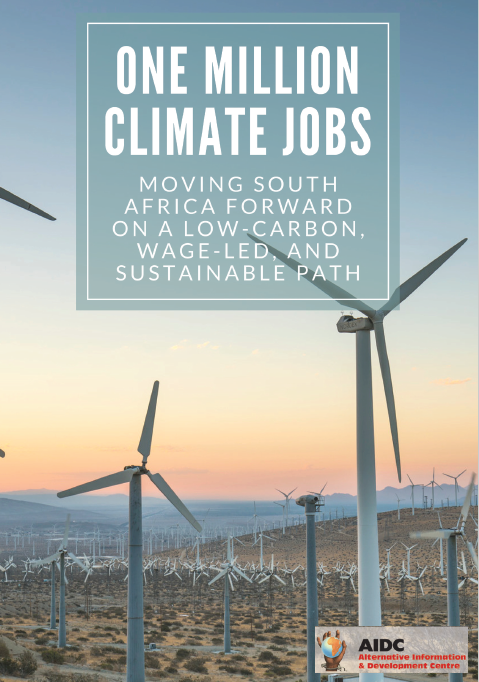
One Million Climate Jobs: Moving South Africa Forward on a Low-Carbon, Wage-Led, and Sustainable Path

By Brian Ashley, et. al. - One Million Climate Jobs - December 2016

The One Million Climate Jobs Campaign is an alliance of labour, social movements and popular organisations in South Africa that is campaigning for the creation of a million climate jobs as part of a collective approach to the crisis of unemployment and climate change. The Campaign was launched in 2011 and since then has been mobilising thousands of South Africans around real solutions to slowing down climate change, protecting the natural environment, improving the quality of life for all and moving towards a sustainable development path. Climate change will exacerbate inequality and poverty because it reduces access to food, water, energy and housing. Thus it is vital that social justice struggles around these issues incorporate struggles around climate change.

This booklet is a follow-up, six years later, to the first booklet that was produced in 2011. It is based on well- researched solutions for how South Africa can immediately begin a just transition, away from the Minerals-Energy Complex that continues to dominate the South African capitalist economy, to a low carbon economy in which the basic needs of communities are met in an equitable, sustainable and affordable way.

It recognizes that in these six years there have been many developments – for instance, renewable energy is now firmly established as part of the energy mix (although still a minor part); retrofitting buildings, and the development of environmentally friendly construction methods, is being developed, and the Rapid Bus Transit system is being slowly implemented in some municipalities.

But most of these solutions are being pursued within the logic of the market. It is not possible, we would argue, within these market parameters, to respond adequately to the enormous challenges facing us – what is needed is a publicly-driven solution for the shift to a sustainable, low-carbon future. The research that this booklet is based on begins to set out what such a transition could look like. We hope that it will be an important contribution to the ongoing work of building a political movement to struggle around these issues.

Download (PDF).

The Standing Rock Split

By Trish Kahle - Jacobin, October 19, 2016

The leadership of the AFL-CIO seems determined to meet the indigenous rebellion at Standing Rock with the most parochial view of trade unionism it can muster.
After Sean McGarvey, president of the building trades, sent a letter declaring those protesting the Dakota Access Pipeline “environmental extremists” and “professional agitators,” AFL-CIO president Richard Trumka quickly followed up with a statement defending the pipeline and lashing out at protesters for “hold[ing] union members’ livelihoods and their families’ financial security hostage to endless delay.” Trying to block each new pipeline, he concluded, was neither an “effective” way to set climate policy nor fair to the workers caught in the middle.

In doing so, Trumka and his ilk have advanced a jobs-versus-planet trope that, however common, is a manufactured falsehood. Accepting his and the building trades’ argument that pipeline construction “provides quality jobs to tens of thousands of skilled workers” prevents us from asking key questions not just about climate change, but about the wellbeing of those skilled workers: how long will these workers be employed? How safe will their workplaces be? What kinds of communities will they live in? And how will their work impact their long-term health?

Construction work is, by its very nature, temporary. On this basis, LiUNA president Terry O’Sullivan has stridently criticized people who have questioned the sustainability of pipeline construction as an employment source. “In our business we go from one temporary job to another temporary job,” O’Sullivan explained last year at an American Petroleum Institute event, “and we string enough temporary jobs together and build proud structures as we do it to create a career.”

But oil pipeline work is its own kind of temporary. Even if we wanted to dredge up every drop of oil from the earth, even if we wanted to build every pipeline possible — and we can’t do either one — an unsustainable industry can’t produce sustainable, lasting careers. And in the meantime, each new method of extraction and transportation introduces new forms of accidents and new fatal risks. Heeding O’Sullivan’s call for unabated pipeline construction would mean continuing to sacrifice workers’ lives on the altar of the fossil-fuel industry.

You wouldn’t know it from O’Sullivan’s histrionic statements, but the volatile compounds workers dig up and ship are far more dangerous than any anti-pipeline protest. Workers in the building trades are nearly three times more likely to die on the job than the average American worker — and that figure is on the rise. In 2014, 874 construction workers were killed on the job — a 5.6 percent increase over the previous year, and the highest number since 2008. Extractive industries are even more lethal: workers in that sector die nearly five times more often than other workers.

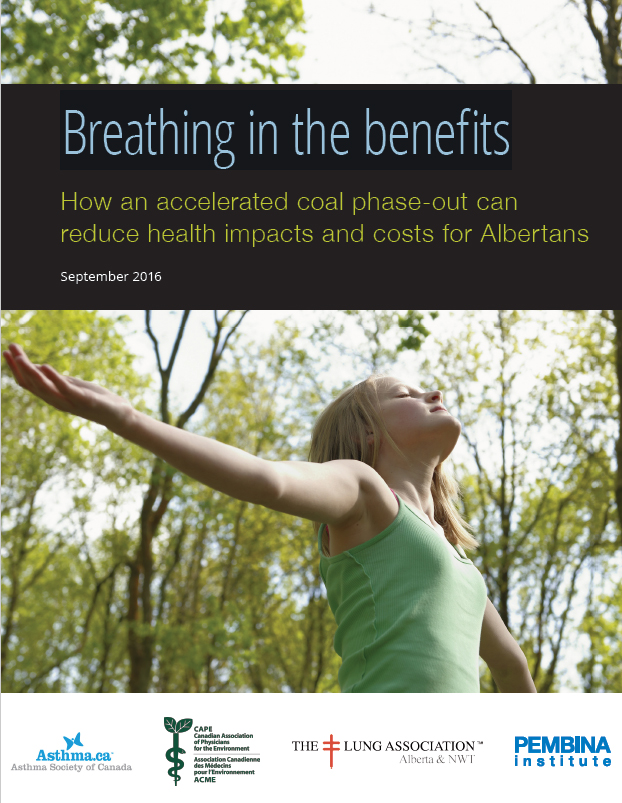
Breathing in the benefits: How an accelerated coal phase-out can reduce health impacts and costs for Albertans

By Benjamin Israël, Kim Perrotta, Joe Vipond, Leigh Allard, and Vanessa Foran - Pembina Institute, September 2016

With the phase-out of coal power announced by the provincein November 2015, Albertans stand to avoid significant health impacts caused by coal pollution. By extension, afurtheraccelerated phase out of coal power facilities would both hastenand amplify those avoided health impacts.The health benefits and costs savings in avoided health outcomes would be significant, and should be consideredin the government’s planning of the coal phase-out from now to 2030.
While the provincial government has announced a coal phase-out, they have not yet released a transition schedule. This analysis assesses the relative benefits of an accelerated stepwise transition away from coal, as proposed by the Pembina Institute,versus the back-loaded phase-out that otheranalyses haveposited.

In 2012, when the federal government finalized its coal regulations that —in effect —reduce electricity generation from coal plants, Environment Canada(as it was called at that time)estimated considerable health impacts would be avoided, usinghighly regarded modelling techniques. Logically, thesesignificantbenefits from reducing coal necessarily mean that the use of coal for power generation causesconsiderablehealth impacts in the first place.

By extrapolating the health benefit results from Environment Canada’s analysis, this report highlights the full impact of coal-fired generation in Albertaand indicates attainable benefits associated with the province’s coal phase- out.When the federal government weakened its proposed coal regulations back in 2012 in response to lobbying from some coal generators, allowing coal plants to continue unabated longer than first proposed,it left health savings on the table. Alberta can now grasp these savings byaccelerating our transition away from coal-fired electricity.

Read the report (PDF).

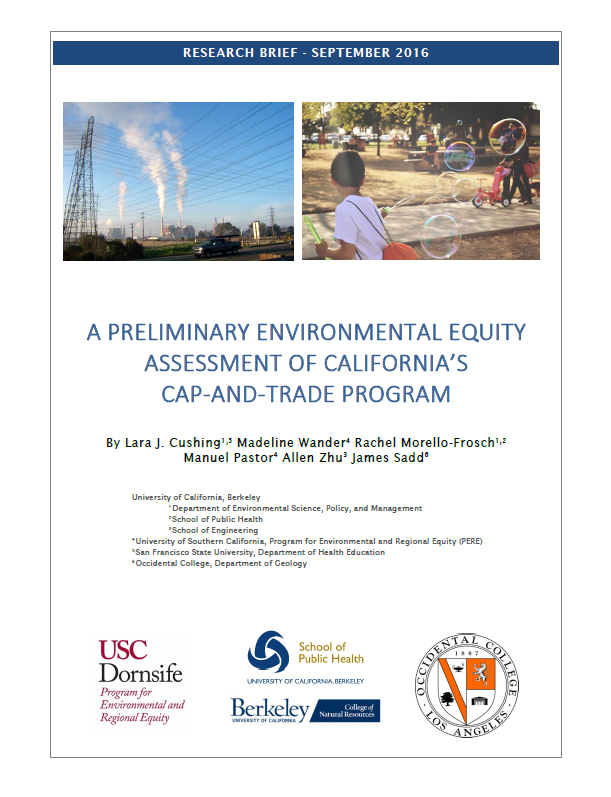
“A Preliminary Environmental Equity Assessment of California’s Cap-And-Trade Program

By Rachel Morello-Frosch, Manuel Pastor, James Sadd, Lara Cushing, Madeline Wander, and Allen Zhu - California Environmental Justice Alliance, September 2016

California’s cap-and-trade program is a key strategy for achieving reductions in greenhouse gas (GHG) emissions under AB32, the California Global Warming Solutions Act. For residents living near large industrial facilities, AB32 offered the possibility that along with reductions in GHGs, emissions of other harmful pollutants would also be decreased in their neighborhoods. Carbon dioxide (CO2), the primary GHG, indirectly impacts health by causing climate change but is not directly harmful to health in the communities where it is emitted. However, GHG emissions are usually accompanied by releases of other pollutants such as particulate matter (PM10) and air toxics that can directly harm the health of nearby residents.

In this brief, we assess inequalities in the location of GHG-emitting facilities and in the amount of GHGs and PM10 emitted by facilities regulated under cap-and-trade. We also provide a preliminary evaluation of changes in localized GHG emissions from large point sources since the advent of the program in 2013. To do this, we combined pollutant emissions data from California’s mandatory GHG and criteria pollutant reporting systems, data on neighborhood demographics from the American Community Survey, cumulative environmental health impacts from the California Environmental Protection Agency’s CalEnviroScreen tool, and information from the California Air Resources Board (CARB) about how regulated companies fulfilled their obligations under the first compliance period (2013-14) of the cap-and-trade program. Our methodology is described in greater detail in the appendix to this report.

In this analysis, we focus primarily on what are called “emitter covered emissions,” which correspond to localized, in-state emissions (derived mostly from fossil fuels) from industries that are subject to regulation under cap-and-trade. The cap-and-trade program also regulates out-of-state emissions associated with electricity imported into the state and, beginning in 2015, began regulating distributed emissions that result from the burning of fuels such as gasoline and natural gas in off-site locations (e.g., in the engines of vehicles and in homes).

We found that regulated GHG-emitting facilities are located in neighborhoods with higher proportions of residents of color and residents living in poverty. In addition, facilities that emit the highest levels of both GHGs and PM10 are also more likely to be located in communities with higher proportions of residents of color and residents living in poverty. This suggests that the public health and environmental equity co-benefits of California’s cap-and-trade program could be enhanced if there were more emissions reductions among the larger emitting facilities that are located in disadvantaged communities. In terms of GHG emission trends, in-state emissions have increased on average for several industry sectors since the advent of the cap-and-trade program, with many high emitting companies using offset projects located outside of California to meet their compliance obligations. Enhanced data collection and availability can strengthen efforts to track future changes in GHG and co-pollutant emissions and inform decision making in ways that incentivize deeper in-state reductions in GHGs and better maximize public health benefits and environmental equity goals.

Read the report (PDF).

Chilcot inquiry: don’t mention the oil

By Greg Muttitt and David Whyte - Red Pepper, August 2016

The anti-war demonstration in London on 15 February 2003 was the biggest protest in British history. And probably the most popular slogan on the placards and banners that day was ‘No blood for oil’. It was a connection that seemed obvious to many on the march but was repeatedly ridiculed by supporters of the invasion of Iraq. Tony Blair said that ‘the oil conspiracy theory is honestly one of the most absurd when you analyse it.’
Why is it so easy to dismiss the idea that access to oil and the interests of those who profit from it may be part of the motive for war? Why, given our experience of wars though the ages, is this not the first question we ask? After all, as the celebrated General Smedley Butler famously observed after completing numerous military campaigns on behalf of the nascent US empire: ‘War is a racket. It always has been.’

By the standards of an official inquiry, Chilcot’s was utterly damning of a government that took the country to war without justification. But compared to the evidence Chilcot had, his conclusions were mild, because the questions he asked were limited. In particular, while noting that there was no convincing case for WMD, even at the time, Chilcot failed to ask how other political and economic motivations affected decisions.

Was it a war for oil?

A year after the February 2003 demonstration, an international opinion poll conducted by US think tank, the Pew Research Centre, asked sample populations from nine countries (the US, Britain, Russia, France, Germany, Pakistan, Turkey, Morocco and Jordan) about the ‘war on terrorism’. The majority in all but two countries (the US and Britain) thought it was ‘to control Mideast oil’. It is worth underlining that the question was not just asking about the invasion of Iraq, but about the motive for a war on terrorism full stop.

When it comes to the Iraq war, they were right. Evidence released with the report shows unequivocally that using Iraqi oil to boost British energy supplies was a central pre-war aim. A February 2002 Cabinet Office paper described the UK’s objectives as ‘preserving peace and stability in the Gulf and ensuring energy security‘. Right up to the withdrawal of British troops in 2009, successive British strategy documents, also released by Chilcot, maintain two consistent objectives: transfer the oil sector from public ownership to multinationals, and ensure that BP and Shell get a large share. Sometimes a third oil objective appears: to make Iraq an advocate of low oil prices within OPEC.

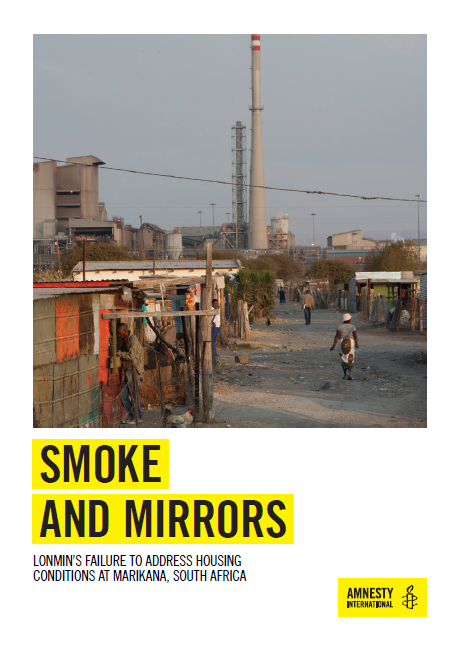
Smoke and Mirrors: Lonmin’s failure to address housing conditions at Marikana, South Africa

By staff - Amnesty International, August 16, 2016

Since 2012 Amnesty International has commented and campaigned on the serious policing failures that led to the deaths at Marikana, calling for full accountability and reparations for the victims and their families. That work continues.
This report examines abuses of the right to adequate housing of mine workers at Lonmin’s Marikana mine operation. Its primary focus is an examination of Lonmin’s response to the findings of the Farlam Commission.

In this regard it looks both at what Lonmin has done and what the company has said about the situation.

Read the text (PDF).

Tunisia: on the frontlines of the struggle against climate change

By Hamza Hamouchene - ROARmag, July 28, 2016

Kerkennah is a group of islands lying off the east coast of Tunisia in the Gulf of Gabès, around 20km away from the mainland city of Sfax. The two main islands are Chergui and Gharbi. When approaching the islands by ferry, one is struck by a curious sight: the coastal waters are divided into countless parcels, separated from one another by thousands of palm tree leaves. This is what Kerkennis call charfia, a centuries-old fishing method ingeniously designed to lure fish into a capture chamber from where they can be easily recovered.
As the land is arid, agricultural activity is limited to subsistence farming. For the islanders fishing is one of the key economic activities, but for big multinational corporations it is the exploitation of oil and gas.

Despite a new article in the Tunisian constitution stipulating state sovereignty over natural resources and transparency in the related contracts, oil and gas companies continue to garner obscene profits and enjoy impunity. At the same time, local communities continue to shoulder the externalized social and environmental costs of this industry.

The Kerkennah archipelago is being doubly dispossessed and doubly threatened: first by the effects of disruptive global warming and second by the extractive operations of oil and gas companies, bent on making super-profits at the expense of the archipelago’s development. Caught in the intricate web of capitalist globalization, the collision between neoliberalism and climate change is potentially disastrous for the people of Kerkennah.

Going to Extremes: The Anti-Government Extremism Behind the Growing Movement to Seize America’s Public Lands

By staff - Center for Western Priorities, July 7, 2016

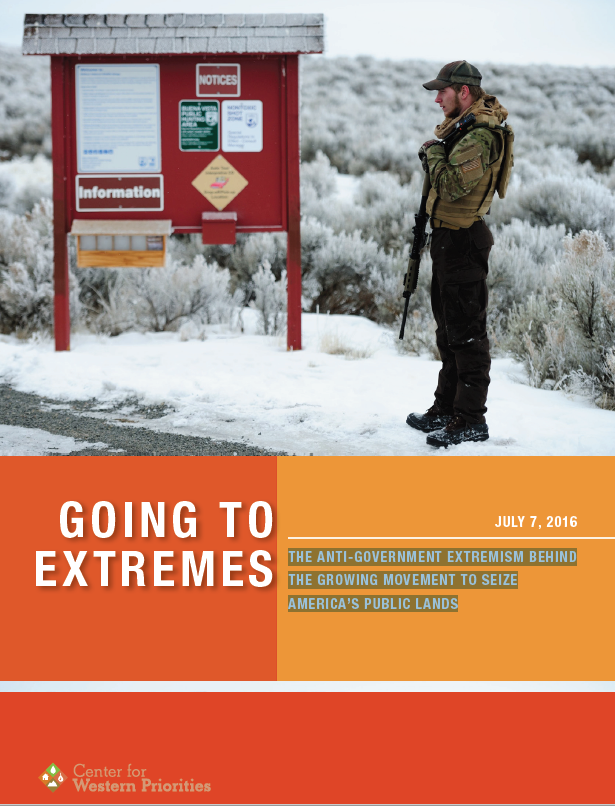
The 2016 armed standoff at the Malheur National Wildlife Refuge in Oregon provided the American public with a ringside seat to a disturbing trend on U.S. public lands: extremist and militia groups using America’s national forests, parks, monuments, and wildlife refuges to advance their anti-government beliefs.
But these far right-wing organizations are not operating in a vacuum. To the contrary, the armed insurrection in Oregon and Nevada before—led by Ammon Bundy and the Bundy family—share the same foundations as land transfer schemes promoted by some elected leaders in states throughout the West. Both rely upon a philosophy based in vehement anti-government ideologies, both have connections to organizations that espouse armed resistance, both employ pseudo-legal theories to justify their actions, and both use scholarly support from conspiracy theorists and discredited academics.

Our nation’s parks and network of public lands are one of our finest democratic achievements. Americans see management of public lands as one of the things our government does best. But over the last four years, politicians and special interest groups in 11 Western states and in Congress have tried to seize many of these places and turn them over to state and private control.

The elected officials supporting state seizure of U.S. public lands couch their arguments carefully, but our research shows their close associations to extreme individuals, groups, and ideology characterized by antigovernment paranoia and a pseudo-legal approach to the Constitution.

Since the beginning of 2015, 54 land seizure bills have been introduced into Western states, including Alaska, Arizona, Colorado, Idaho, Montana, Nevada, New Mexico, Oregon, Utah, Washington, and Wyoming. At least 22 state legislators with direct connections to anti-government ideologies or extremist groups were the primary sponsors on 29 of those bills.

Sitting at the hub of the movement and functioning as the bridge between extremism and the mainstream political debate are Utah Rep. Ken Ivory, Montana Sen. Jennifer Fielder, and their non-profit, the American Lands Council. A close analysis of Rep. Ivory and Sen. Fielder’s activities, and those of other active land seizure proponents at the state level, shows how these efforts are a functional part of an aggressive anti-government movement that will grow more potent if reasonable Americans don’t take action.

Read the report (PDF).

A Deadly Shade of Green: Threats to Environmental Human Rights Defenders in Latin America

By staff - Center for International Environmental Law, et. al., Summer 2016

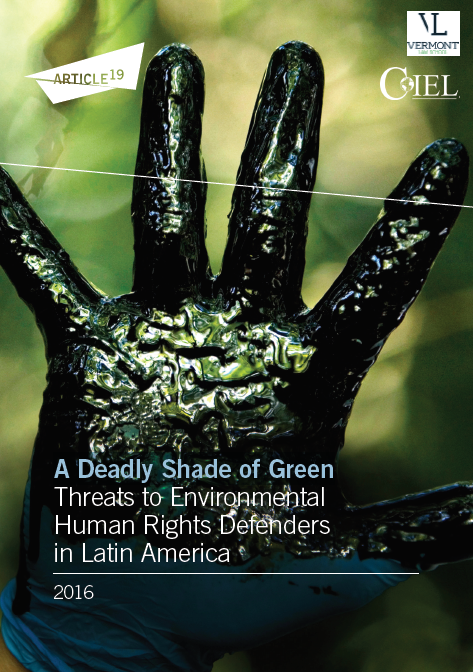
On 3 March 2016, a wave of indignation and repudiation swept the world, condemning the brutal and cowardly assassination of Berta Cáceres, a Honduran environmental activist and community leader who inspired thousands of people through her work promoting the rights of the Lenca people.
Her death came amid a growing number of attacks against human rights defenders, particularly campaigners peacefully defending the environment, the right to land and the rights of indigenous peoples. This situation is not limited to Honduras, but can be seen throughout the continent, in Colombia, Brazil, Peru, Mexico, Guatemala, and Ecuador. This long list is being added to by an increasing number of countries that seem willing to put economic interests before those of people and territories. Reports from numerous organizations confirm a steady deterioration of the situation, highlighting the fact that Latin America has become the most dangerous region in the world for environmental activists.

Various types of attack have been committed against campaigners and their organizations. They range from surveillance campaigns, harassment, and being discredited in the media and social networks, to physical assaults, acts of torture, enforced disappearances and assassinations. In addition, there is widespread corruption and impunity in many countries where relations between state and non-state actors are often ambiguous. We should note, in particular, the attacks against female human rights defenders, who face threats of sexual violence and smear campaigns based on their gender. All of this is exacerbated by the context of increasing criminalization of social protest, and use of the law to suppress dissent in Latin American and Caribbean societies.

Despite the grim outlook, there are reasons to remain optimistic. Civil society has never looked so strong, organized and determined. International solidarity strengthened by the globalization of exchanges between people and organizations makes it possible to bring these struggles out of isolation, and demand accountability to ensure the effective implementation of human rights commitments.

Read the report (EN PDF) | (ES PDF).

Unfair Market Value II: Coal Exports and the Value of Federal Coal

By Clark Williams-Derry - Sightline Institute, June 17, 2016

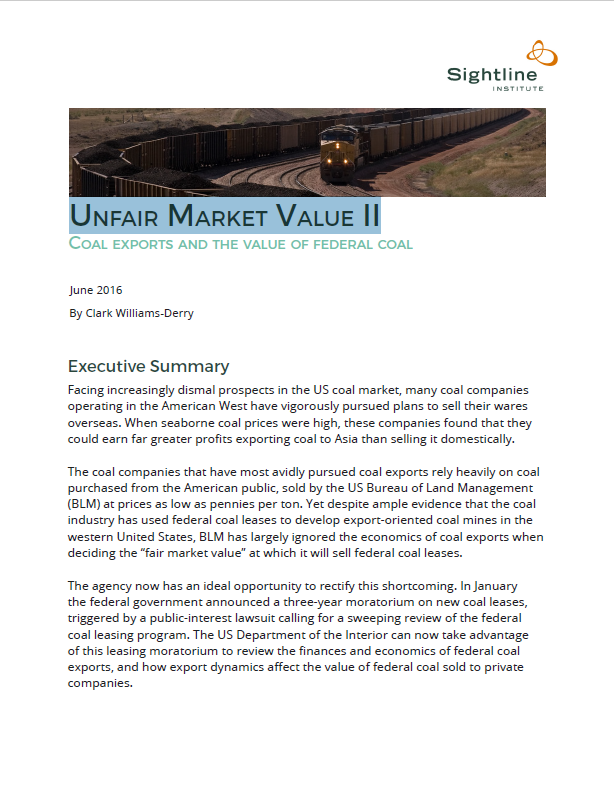
This report documents massive exports of federally owned coal from 2000-15. The US Bureau of Land Management sold private companies the right to mine this coal for a pittance—in some cases, for less than 20 cents per ton. And when Asian demand was red-hot, these companies made massive profits selling millions of tons of federal coal overseas. Nonetheless, the Bureau of Land Management (BLM) has essentially ignored export economics when setting the “fair market value” that it will accept for federal coal leases. Now that the Department of Interior has placed a three-year moratorium on new coal leases pending a thorough review of federal coal policies, BLM has an ideal opportunity for a thorough review of the economics of exports. And our report points to evidence that by ignoring exports, the BLM has been selling many federal coal leases at just a fraction of their true economic value.

Read the report (PDF).

Pages

The Fine Print I:

Disclaimer: The views expressed on this site are not the official position of the IWW (or even the IWW’s EUC) unless otherwise indicated and do not necessarily represent the views of anyone but the author’s, nor should it be assumed that any of these authors automatically support the IWW or endorse any of its positions.

Further: the inclusion of a link on our site (other than the link to the main IWW site) does not imply endorsement by or an alliance with the IWW. These sites have been chosen by our members due to their perceived relevance to the IWW EUC and are included here for informational purposes only. If you have any suggestions or comments on any of the links included (or not included) above, please contact us.

The Fine Print II:

Fair Use Notice: The material on this site is provided for educational and informational purposes. It may contain copyrighted material the use of which has not always been specifically authorized by the copyright owner. It is being made available in an effort to advance the understanding of scientific, environmental, economic, social justice and human rights issues etc.

It is believed that this constitutes a 'fair use' of any such copyrighted material as provided for in section 107 of the US Copyright Law. In accordance with Title 17 U.S.C. Section 107, the material on this site is distributed without profit to those who have an interest in using the included information for research and educational purposes. If you wish to use copyrighted material from this site for purposes of your own that go beyond 'fair use', you must obtain permission from the copyright owner. The information on this site does not constitute legal or technical advice.