You are here

extractivism

NUMSA and allies call for dismantling the ‘mineral energy complex’

By NUMSA - Trade Unions for Energy Democracy, June 19, 2015

Electricity Crisis Conference Declaration

  1. Introduction:

We, as representatives of trade unions that organise in the energy sector and delegates from communities that are struggling around outages, loadshedding, high electricity prices and poor quality of energy services, met for four days (from 02 to 05 June 2015) in the midst of what we consider as a far-reaching electricity crisis in our country. As we met, on the table of the National Energy Regulator of South Africa (Nersa) is an application by South Africa’s electricity utility – Eskom – for a 25.3% increase in the price of electricity for the year 2015/16 to 2017/18. As we met, Nersa had agreed to grant municipalities an above-inflation increase of 12.2% from 01 July 2015 and that nine municipalities were applying for average increases above the Nersa increase guideline of 12.2%. We also gathered when delegates at this conference from two municipalities were unsure whether they will reach their homes at the end of our deliberations still with some power, as Eskom threatened to plunge into darkness their defaulting municipalities today.

The electricity crises that face us worsen with each day that passes. The crisis is multipronged. It is a supply crisis and chronic load-shedding. What we see is a financial meltdown of Eskom; massive cost and time overruns in the build programme of new power plants such Medupi and Kusile; and a worsening governance practices within Eskom as executives come and go, leaving with millions of rands as golden handshakes. We have also seen the downgrading of Eskom within capital markets and a ballooning debt for the utility as municipalities fail to pay their bills to Eskom.

As delegates to this Electricity Crisis Conference, we are enthused that our people are refusing to shoulder the implications and consequences of the crises. Throughout the four days, we heard of gallant battles against unaffordable electricity increases and imposition of prepaid meters that are being waged in different communities who refuse to have the burden of the electricity crises shifted onto them. At the forefront of these battles are women who unfortunately still bear the brunt of reproductive activities in our society. Our people realise that the electricity crises directly affects their children’s ability to learn and to be taught as schools are cut off. Our people realise that as most of their staple diets are electricity intensive, tariff hikes increase food hunger in South Africa. They know that an increase in the price of electricity will lead to retrenchments and short-time for workers.

Protests against Peru’s Tia Maria Mine and International Solidarity

By James Jordan - People's World, June 11, 2015

Disclaimer: The views expressed here are not the official position of the IWW (or even the IWW’s EUC) and do not necessarily represent the views of anyone but the author’s.

What does it take to stop a transnational corporate giant in its tracks when it threatens workers, farmers and communities? The people of Arequipa, Peru have an answer.

Unionists, rural workers, popular movements, and environmentalists are coming together in this region of southern Peru to halt the proposed Tia Maria copper mine. The mine project belongs to Southern Copper Corporation, a subsidiary of Grupo Mexico.

Mine opponents are demanding respect for workers rights, community democracy and involvement in development decisions and protection for the ecosystem and rural farmers. Tia Maria would be a large pit mine projected to have a 20 year life span. Protesters are concerned about the likelihood of contamination of the region's water supply.

The federal government has declared martial law and sent troops into the region. It has also called for a 60-day pause in mine development.

Police forces are under contract with Southern Copper to protect the mine, which places in question their commitment to public safety. So far three protesters have been killed in demonstrations against the mine, and more than 200 have been wounded.

Peru's Tia Maria Mining Conflict: Another Mega Imposition

By Lynda Sullivan - Upside Down World, June 10, 2015

Disclaimer: The views expressed here are not the official position of the IWW (or even the IWW’s EUC) and do not necessarily represent the views of anyone but the author’s.

Peru has been rocked once again by a social conflict which pits the government, looking out for the economic interests of a multinational corporation, against its people. The Tia Maria Mine, an open-pit project of Southern Copper Corporation, controlled by Grupo Mexico, is the latest attempted imposition of a destructive mega-project by big business on rural communities in the interior of the country. To date, the conflict has claimed eight lives: four in 2011 and four more since April of this year. The affected communities have been on an indefinite strike since March 23rd and, as a response, President Ollanta Humala has called a state of emergency, permitting the Armed Forces and the National Police to violate the constitutional rights of the local population in the hope that repression will breed consent. However, the threatened farmers say that they will fight to the end, and the company, making use of the red carpet set down by the Peruvian state, also does not appear to be giving up on its 1.4 billion dollar investment anytime soon.

The conflict dates back to 2009, when the company first produced its Environmental Impact Assessment (EIA) of Tia Maria, a copper extraction project hoping to mine 120 thousand tons of copper cathodes per year during its 18 year life span. It would be situated in the district of Cocachacra, though its effects would also reach the districts of Punta del Bombón, Deán Valdivia and Mejía, regions all belonging to the province of Islay, in the department of Arequipa. The most sensitive and threatened area is the Tambo Valley, which is considered the 'larder' of the Arequipa region, and wider afield. Ninety-seven percent of its agricultural produce and eighty-eight percent of its fishing catch goes to feeding the south of the country. The valley employs more than 15 thousand families and produces a profit of around 320 million soles a year (roughly $100 million) [1].

Tia Maria would consist of two open pits; the largest of which, La Tapada, would be situated just 2.4 km from the Tambo Valley. The second, sharing the name of Tia Maria, would be just 1 km further [2]. The subterranean waters that are connected to the Tambo River would pass just 250 meters from the open pits. The communities along the Tambo Valley, on seeing the project’s dangerous proximity to their fertile lands, formed the Tambo Valley Defense Front, a platform on which to project their voice. In October 2009 the Defense Front lead a popular consultation in the districts of Cocachacra, Punta del Bombón and Deán Valdivia, resulting in an overwhelming rejection of the project with 93.4% voting against it [3].

On Climate Satyagraha: Interview with Quincy Saul

By Javier S Castro - CounterPunch, April 10, 2015

Disclaimer: The views expressed here are not the official position of the IWW (or even the IWW’s EUC) and do not necessarily represent the views of anyone but the author’s. 

The socio-ecological catastrophe that is global capitalism is clear for all to see. We are in dire need of an alternative system which does not ceaselessly destroy nature and oppress and impoverish the vast majority of humankind, including our future generations, whose lives may very well be highly constrained if not outright canceled due to prevailing environmental destructiveness. It is in this sense of contemplating and reflecting on alternatives to capitalist depravity that I was fortunate enough recently to discuss the present moment and some of the possible means of displacing hegemonic power with Quincy Saul of Ecosocialist Horizons (EH). Quincy and the rest of the members of this collective have envisioned a compelling means of overcoming the environmental crisis: that is, through climate Satyagraha.

The latest biological studies show a decline of a full half of animal populations on Earth since 1970, and an ever-burgeoning list of species and classes of vertebrates at immediate risk of extinction: a quarter of all marine species, a quarter of all mammals, and nearly half of all amphibians are on the edge.1 Moreover, two independent studies published in Science and Anthropocene Review in January conclude that the present rate of environmental destruction essentially threatens the fate of complex life on the planet.2 Meanwhile, global carbon emissions continue in relentless expansion, with each new year bringing a new broken record, whether in terms of total greenhouse gas emissions, average global temperatures, or both. Truly, then, this is a critical moment in human history, one which could lead to utter oblivion, as through the perpetuation of business as usual, or alternately amelioration and emancipation, as through social revolution.

Quincy, could you share your assessment of the global climate-justice movements at present, some seven months after the People’s Climate March (PCM)—a development of which you were famously highly critical—and five months after yet another farcical example of the theater of absurd that is the international climate-negotiation process, as seen at the Twentieth Conference of Parties (COP20) in Lima, Peru?

Thank you Javier for compiling those statistics. There’s such an immense range of data out there, and it’s important to hone in on the key information. In terms of the climate-justice movement, the problem I see is that the whole doesn’t add up to the sum of its parts. So you have this amazing, fearless, courageous work that’s happening on local levels, all over the world—too numerous to even start listing. When it comes to resistance struggle, people are resisting mines, pipelines, and destructive development projects from the Altiplano of Peru to central Indian jungles, the Amazon River, indigenous reservations in the U.S., the factory-cities of China, the Niger Delta—uncountable acts of courage that people are taking to defend their ecosystems and their lives, whether climate change is the central issue, or it’s about defense of a single ecosystem. And then on the prefiguration side, there are people on every continent who are working really hard laying the foundations for the next world-system. Seed-saving, agroecologies—people are combining ancestral productive projects with appropriate technologies, building community resilience, and constructing community democracy in the context of war and natural disaster. So this is hopeful and wonderful work that has be encouraged. But somehow it’s not adding up.

Mines, Water, Roads, Borders

By Chaparral - Chaparral Respects No Borders, March 1, 2015

Disclaimer: The views expressed here are not the official position of the IWW (or even the IWW’s EUC) and do not necessarily represent the views of anyone but the author’s.

The Resolution Copper land grab is also a water grab, with a projected use of millions of gallons per year and contamination of more; and during what could be a mega-drought. Water is often compared to gold as its value increases the more scarce it becomes, which means we may soon be fighting not only the increasing privatization of land, but also of water. Despite the fact that the Resolution Copper deal, having been snuck into a defense bill, involves an exchange of land, it is being done to the advantage of a transnational mining corporation and to the detriment of the Chi’Chil’Ba’Goteel/Oak Flat/Apache Leap area and the people who hold it sacred. This land grab represents a continued prioritization of economic development in so-called Arizona, which means more resource-extraction and increased international trade (specifically with or through Mexico). Mining and other industries shaped by trade-related demand bring not only risk to water, but also more roads like Interstate 11 and rail (which require land acquisition), and increased border militarization. US trade policy is largely culpable for the violence on the border and south of the border.
Economic development is portrayed as bringing more jobs, but these “free-market” policies, as in the case of NAFTA, are meant to redistribute wealth to the hands of the rich. Because of their trade relationship and connecting infrastructure, Arizona and Sonora have a shared fate as land, water, safety, indigenous ways of life and sacred sites are all at risk. The state governments enable resource-extraction and other infrastructural projects, lucrative to those who would build them and those who would finance them, through subsidization and protection with our tax dollars.

Arizona's connection to a port in Guaymas, Sonora is crucial to the Arizona mining industry. Copper is one of the fastest growing US exports, and much of what is and would be mined in Arizona would be transported down to where mining companies such as BHP Billiton (of Resolution Copper) and Freeport McMoran do business at this Mexican port on the Sea of Cortez. Guaymas is also significant because shipping companies can have lower standards for working conditions in Mexico versus the US. This port is the southernmost point of the CANAMEX Corridor, the NAFTA trade route connecting Canada and Mexico through five US states including Arizona. The Port of Guaymas has been expanding over the years and brings along its own set of problems in the vicinity, requiring its own energy sources and water, damaging the environment, impacting the local communities, etc. Arizona is counting on the continued growth of the Mexican economy, yet the importance of the Port of Guaymas also signifies that a lot of exports from the US are meant to cross the Pacific ocean (especially if the Trans Pacific Partnership goes into effect), not stay within its favored trade partner's borders.

The First Global Festival for Anti-Capitalist Resistance and Rebellion

By Javier S. Castro - Notes toward an International Libertarian Eco-Socialism, January 26, 2015

Disclaimer: The views expressed here are not the official position of the IWW (or even the IWW’s EUC) and do not necessarily represent the views of anyone but the author’s.

Organized by the Zapatista Army of National Liberation (EZLN) and the National Indigenous Congress (CNI), the first annual Festival Mundial de las Resistencias y Rebeldías contra el Capitalismo, or the Global Festival for Anti-Capitalist Resistance and Rebellion, was held in central and southern Mexico over a two-week period at the end of 2014 and beginning of 2015. The event’s subtitle sums up its purpose well: “While those from above destroy, those from below rebuild.” Taken as a whole, this new Festival recalled the different “intergalactic” meetings hosted by the EZLN in Chiapas in the 1990’s, such as the Intercontinental Encounter for Humanity and Against Neo-Liberalism (1996). According to the statistics made known at the event’s close at CIDECI-Unitierra in San Cristóbal de Las Casas, Chiapas, the number of officially registered participants at the Festival came to over 3400 Mexicans, including 1300 individuals belonging to 20 indigenous ethnicities, and 500 foreigners from 49 countries—though the total number of those who attended the Grand Cultural Festival in Mexico City and the EZLN’s year-end festivities at the Oventik caracol at other points over the course of the Festival must be considered as amounting to several times this total. While the Festival generally focused on the numerous problematics faced by Mexico’s various indigenous peoples amidst the power of capital and State—due in no small part, indeed, to the central participation of the CNI in the event—the distressing case of the 43 students from the Raúl Isidro Burgos Rural Normal School who were forcibly disappeared by police in Iguala, Guerrero, in late September also took central stage throughout the event.

The Anti-Capitalist Festival was inaugurated in Mexico state on 21 December, and the comparticiones (“sharings”) followed for two days afterward in two locations in central Mexico. While I was present for neither, I can here relate the reports made ex post facto at CIDECI regarding the goings-on at these spaces. The launch of the comparticiones took place simultaneously in San Francisco Xochicuautla in Mexico state and in Amilcingo, Morelos. San Francisco Xochicuautla has become an emblem of socio-ecological resistance in Mexico lately, as the local indigenous Ñatho peoples have opposed themselves to the imposed plan of building a new private highway on their territory—a project that implies vast deforestation, and which has to date seen State repression meted out on those in opposition—while, as two Nahua CNI delegates from Morelos explained to me as we waited together outside the Zapatista Good-Government Council’s office at Oventik on New Year’s Eve, the case of Amilcingo reflects the problems of domestic and foreign rackets, extractivism, and profit in Mexico, as these exigencies result in the plundering of territory (despojo) and fundamentally violate indigenous autonomy. In Amilcingo, in accordance with the vision set forth in the “Integral Morelos Plan” (PIM) that has been on the books for years, there has been an attempt to construct a natural gas pipeline that would supply a planned thermal power station, this despite the various dangers posed to the integrity of such structures within such a seismically and volcanically active area as Morelos. In Amilcingo, as in San Francisco Xochicuautla, indigenous Nahuas have mobilized to prevent the construction project from being carried through. At both sites on 22-23 December, representatives from indigenous ethnicities represented in the CNI and affiliates of the National and International Sixth—that is to say, those who subscribe to the EZLN’s Sixth Declaration of the Lacandon Jungle (2005)—made presentations about their struggles, philosophies, and commitments.

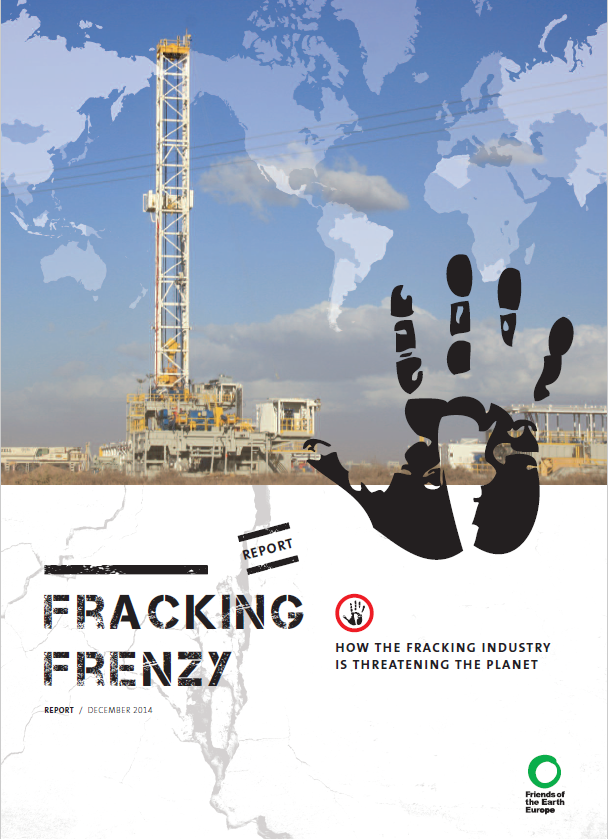
Fracking Frenzy: How the Fracking Industry is Threatening the Planet

By Robert Galbraith, Gin Armstrong, and Kevin Connor - Public Accountability Initiative, February 2015

The global development of ‘unconventional’ fossil fuels (UFF) such as shale gas has provoked much debate involving scientists,industry, political decision-makers, environmental groups and civil society. More than a decade of large- scale development in North America has left a legacy of environmental damage, primarily resulting from the use of high- volume horizontal hydraulic-fracturing (also known as ‘fracking’) to extract the unconventional oil and gas. Despite the controversy surrounding this technique, the numerous unknowns and uncertainties concerning its impacts and the growing number of questions about the economic benefits of this industry, oil and gas operators are eager to identify new opportunities and so are engaged in a battle to make frackingpublicly and socially acceptable worldwide.

Read the report (PDF).

Frackademia in Depth; An analysis of the oil and gas industryʼs case for fracking

By Robert Galbraith, Gin Armstrong, and Kevin Connor - Public Accountability Initiative, February 2015

In the wake of New York Stateʼs decision to ban fracking, drilling proponents have criticized Governor Andrew Cuomo and his administration for basing the decision on “pseudo science”and “junk science.” When asked about the New York fracking ban at his 2015 “State of American Energy” press conference, American Petroleum Institute President and CEO Jack Gerard called for “more thoughtful consideration as to economics, environment, and sound science –because the science is clearly on the side of development and on the side of industry.”

Over the years, some of this science has proven less than reliable. In a trend that became known as “frackademia,”several universities issued industry-friendly fracking studies that the institutions later retracted and walked back due to erroneous central findings, false claims of peer review, and undisclosed industry ties. The studies bore the hallmarks of an industry effort to manipulate and corrupt the scientific debate around fracking, much like the tobacco industry manipulated the scientific debate around the dangers associated with smoking.

This report suggests that those studies, rather than being isolated cases, were consistent with a larger pattern – pro-fracking scholarship is often industry-tied and lacking in scientific rigor. An in-depth look at frackademia reveals that many of these kinds of studies have been produced by industry and its allies in academia, in government, and in the consulting world.

The report approaches this topic by analyzing a broad set of fracking studies that the industry has put forward to help it make its case. Specifically, the report considers an extensive list of over 130 studies compiled by an oil and gas industry group, Energy in Depth. The list was specifically used to convince the government of Allegheny County, Pennsylvania, home of the city of Pittsburgh, to lease mineral rights under its Deer Lakes Park to Range Resources for gas drilling. Though that decision was a relatively minor one in the context of the nationwide fracking debate, the list provides a telling window onto the fracking research that the industry believes is fit for public consumption, and which it uses to make the case that the science around the issue is settled.

The report assesses the relative independence and quality of the studies by identifying and classifying each studyʼs industry ties –through funders, authors, and issuers –and determining whether it was peer-reviewed.

Read the report (PDF).

The Land Grabbers of the Nacala Corridor: A new era of struggle against colonial plantations in Northern Mozambique

By staff - UNAC and GRAIN, February 2015

A report by Mozambique’s National Farmers’ Union (UNAC) and GRAIN shows there is a colonial-style scramble for Africa’s farm lands under way. Politically-connected companies based in offshore tax havens have grabbed hundreds of thousands of hectares of farmland from peasants in Mozambique.

Read the report (PDF).

Noam Chomsky: Are We on the Verge of Total Self-Destruction? If you ask what the world is going to look like, it’s not a pretty picture

By Noam Chomsky - Tom Dispatch, January 19, 2015

Disclaimer: The views expressed here are not the official position of the IWW (or even the IWW’s EUC) and do not necessarily represent the views of anyone but the author’s.

What is the future likely to bring?  A reasonable stance might be to try to look at the human species from the outside.  So imagine that you’re an extraterrestrial observer who is trying to figure out what’s happening here or, for that matter, imagine you’re an historian 100 years from now -- assuming there are any historians 100 years from now, which is not obvious -- and you’re looking back at what’s happening today.  You’d see something quite remarkable.
For the first time in the history of the human species, we have clearly developed the capacity to destroy ourselves.  That’s been true since 1945.  It’s now being finally recognized that there are more long-term processes like environmental destruction leading in the same direction, maybe not to total destruction, but at least to the destruction of the capacity for a decent existence.

And there are other dangers like pandemics, which have to do with globalization and interaction.  So there are processes underway and institutions right in place, like nuclear weapons systems, which could lead to a serious blow to, or maybe the termination of, an organized existence.

Pages

The Fine Print I:

Disclaimer: The views expressed on this site are not the official position of the IWW (or even the IWW’s EUC) unless otherwise indicated and do not necessarily represent the views of anyone but the author’s, nor should it be assumed that any of these authors automatically support the IWW or endorse any of its positions.

Further: the inclusion of a link on our site (other than the link to the main IWW site) does not imply endorsement by or an alliance with the IWW. These sites have been chosen by our members due to their perceived relevance to the IWW EUC and are included here for informational purposes only. If you have any suggestions or comments on any of the links included (or not included) above, please contact us.

The Fine Print II:

Fair Use Notice: The material on this site is provided for educational and informational purposes. It may contain copyrighted material the use of which has not always been specifically authorized by the copyright owner. It is being made available in an effort to advance the understanding of scientific, environmental, economic, social justice and human rights issues etc.

It is believed that this constitutes a 'fair use' of any such copyrighted material as provided for in section 107 of the US Copyright Law. In accordance with Title 17 U.S.C. Section 107, the material on this site is distributed without profit to those who have an interest in using the included information for research and educational purposes. If you wish to use copyrighted material from this site for purposes of your own that go beyond 'fair use', you must obtain permission from the copyright owner. The information on this site does not constitute legal or technical advice.
