You are here

extractivism

Venezuelan Social Movements Converge on Supreme Court, Demand Injunction Against Mining Arc

By Lucas Koerner - Venezuela Analysis, June 5, 2016

Caracas, June 5, 2016 (venezuelanalysis.com) – Activists from grassroots organizations protested outside the Venezuelan Supreme Court Tuesday to demand that the body put a halt to a controversial mega-mining project spearheaded by the Maduro government.

The demonstration was organized by the Platform for the Nullity of the Mining Arc, an alliance of diverse movements and leading public intellectuals that emerged in response to a law authorizing open-pit mining in 12 percent of the nation’s territory. 

In February, Venezuelan President Nicolas Maduro used emergency economic decree powers granted by the Supreme Court to declare nearly 112 square kilometers of the mineral-rich eastern Amazonian state of Bolivar a “strategic development zone”, which will be opened to as many as 150 national and transnational firms for the extraction of gold, iron, diamonds, and coltan.

The government has defended the initiative as a necessary step towards a post-oil productive economy amid a severe economic crisis triggered by the collapse of global crude prices, the principal source of Venezuela’s foreign currency earnings. 

Nonetheless, the project has sparked vocal opposition from prominent leftist academics and former high officials under late President Hugo Chávez, including ex-Environment Minister Ana Elisa Osorio, internationally-renowned sociologist Edgardo Lander, Major General Cliver Alcala, former Minister of Education and Electricity Hector Navarro, Indigenous University of Tauca Rector Esteban Emilio Mosonyi, ex-Commerce Minister Gustavo Marquez, and former 1999 constitutional assembly member Freddy Gutierrez.

Also raising their voices in outrage over the decree are a plethora of indigenous, environmental, eco-feminist, and socialist collectives, who rallied together with the ex-officials outside the Supreme Court in Caracas in order to deliver a formal nullity plea to the body requesting an injunction against the mining project on constitutional grounds.

Post-Growth and Post-Extractivism: Two Sides of the Same Cultural Transformation

By Alberto Acosta; Translated by Dana Brablec - Alternautas, June 4, 2016

Marx said that revolutions are the locomotive of world history. But perhaps things are very different. It may be that revolutions are the act by which the human race travelling in the train applies the emergency brake.

Walter Benjamin (1892-1940)

Mainstream thinking – embedded within capitalist globalisation – leads us to accept the impossibility to imagine an economy that does not promote growth, as much as a world without oil, mining and agribusiness is impossible. Within this mainstream thinking, we can find people from every political stance, from neoliberals to socialists.

Reality, however, is that we must overcome such views, that is the great task of this moment. On the one hand, we must rethink the question of economic growth, and free ourselves from its shackles before we enter into a global socio-environmental debacle with unforeseeable consequences. On the other, it is increasingly urgent to move from an extractivist perspective focused on the demands of capital, towards a view that prioritises a dignified life to its fullest extent and enables the construction of structurally democratic societies. This task puts the capacity of critical thinking to test, as well as the capacities of our societies, states, and that of social and political organisations to engage in innovative and creative thinking.

Closing the door to this debate would entail closing the door on democracy itself.

Stranded Assets and Thermal Coal in Japan: An analysis of environment-related risk exposure

By Ben Caldecott, Gerard Dericks, Daniel J. Tulloch, Lucas Kruitwagen, and Irem Kok - Oxford, May 2016

Deploying a ‘bottom up’ asset-level methodology, we analysed the exposure of all of Japan’s current and planned coal-fired power stations to environment-related risk. Planned coal capacity greatly exceeds that required for replacement - by 191%. This may result in overcapacity and combined with competition from other forms of generation capacity with lower marginal costs (e.g. nuclear and renewables), lead to significant asset stranding of coal generation assets. Stranded coal assets in Japan would affect utility returns for investors; impair the ability of utilities to service outstanding debt obligations; and create stranded assets that have to be absorbed by taxpayers and ratepayers.

Read the report (PDF).

Pitch Black: The Journey of Coal from Colombia to Italy; the Curse of Extractivism

By various - Re:Common, April 2016

By presenting the horrors suffered under the domination of multinational companies, this work by Re:Common will dispel any lingering doubt that the current economic system based on extractivism is a war against the poor (what subcommander Marcos called the “Fourth World War”).

If someone who trusts the mainstream media and academic analyses thinks that at some point colonialism disappeared from the face of the Earth, this work, based on documents and testimonies, demonstrates otherwise.

For those who believe that progress is the most striking characteristic of our times, starting with the post-World War II period, the voices of the missing that populate these pages will convince you that present-day capitalism is a just a revamped version of the Spanish conquest of five centuries ago.

Throughout this work, all the variables of extractivism can be seen: from occupation of the territory and displacement of people to the role of the offshore banking and financial system, as two complementary and inseparable parts of accumulation by theft/dispossession. In the occupied territories, the displacement occurs in the form of war, with the participation of military, paramilitary, guerrilla and the greatest variety of imaginable armed actors.

The victims are always the weak: poor women and their children, elderly men and women, peasants, Indians, blacks, mestizos, the “wretched of the Earth,” as Frantz Fanon calls them. I want to emphasize, though it may seem anachronistic, and without reference to academic sources, how the extractive model coincides with colonialism, despite the different eras. This is not only due to the violent occupation of territories and the displacement of populations, but also to the salient features of the model.

Economically, extractivism has generated enclave economies, as it did in the colonies, where the walled port and plantations with slaves were its masterworks. This colonial/extractive model held populations 6 hostage in both 1500 and 2000.

Extractivism produces powerful political interventions by multinational enterprises, often allied with States, which manage to modify legislation, co-opting municipalities and their governors. It is an asymmetrical relationship between powerful multinationals and weak states, or better, states weakened by their own local elite who benefit from the model.

Like colonialism, the extractive model promotes the militarization of the territories, because it is the only way to eradicate the population, which, recalling Subcommander Marcos, is the real enemy in this fourth world war. Militarization, violence, and systematic rape of women and girls are not excesses or errors; they are part of the model because the population is the military objective.

To understand extractivism, we must consider it not as an economic model, but as a system. Like capitalism. Certainly there is a capitalist economy, but capitalism is not just the economic aspect. Extractivism (as stated by Re:Common) is capitalism in its financial phase and cannot be understood only as an economic variable. It implies a culture that promotes not work but consumption, which has (systemic) corruption as one of its central features. Put in another way, corruption is the extraction mode of governing.

Therefore, extractivism is not an economic actor; it is a political, social, cultural, and of course also economic actor. At this point, it’s crucial that the central part of this work describes human beings and the Earth as the subjects for looting, which is much more than the theft of the commons. Understanding dispossession only as robbery places property ownership at the center of the matter, in the place of people and land; e.g., life.

Read the text (PDF).

What Keeping Oil in the Ground Can Do for Economic Inequality

By Yessenia Funes - Yes! Magazine, March 15, 2016

Our lifestyle is inextricably linked to fossil fuels. We pay the industry to heat our homes and power our cars. Though driving might be optional where public transit is available, heat is not during harsh winters. We know about the effects on the climate of burning oil, gas, and coal for energy, but we don’t know what turning our backs on them will do to our economy. Some worry that closing our oil refineries and shutting down our mines would throw the market into a dangerous vortex. That doesn’t need to be the case. A successful energy transition could actually benefit the economy and reduce inequality.

The economy relies on a number of things, including spending, manufacturing, trade, and personal income. The availability of fossil fuels has largely driven these for 150 years. “[Oil] is the world’s first trillion-dollar industry in terms of annual dollar sales,” environmental author Jack Doyle wrote in 1994. In North Dakota, a major oil- and gas-producing state, an oil boom created the $53.7 billion gross domestic product the state sees today.

But booms often have downsides. When the journal Energy Economics compared six states that produced the vast majority of the West’s crude oil and natural gas, it saw per capita income decrease by as much as $7,000 in counties whose incomes relied most on such development. Also, the crime rates and percentage of adults without a college education increased in those counties. The study offers possible explanations, including an increasing reliance on nonlocal workers and changing wage structures.

The oil and gas industries are the largest industrial sources of volatile organic compound emissions—2.2 million tons a year. These chemicals cause smog, which can increase the risks of asthma and premature death. The industry also produces cancer-causing pollutants: benzene, ethylbenzene, and n-hexane, which are emitted during the refinement process.

Low-income communities of color disproportionately bear this health burden and are also least likely to have access to health care, including preventive medicine, checkups, and prescription drugs. The inequality of care only widens the income gap by adding more financial pressures to an already stressed group.

What about jobs? Extractive industries currently employ nearly 200,000 Americans and pay some employees as much as $42.90 an hour. These jobs are a valid concern. The U.S. unemployment rate is finally down to about 5 percent. Surely we don’t want all those people put out of work.

That won’t happen if we launch the renewable energy sector in sync. Economists at the University of Massachusetts Amherst’s Political Economy Research Institute (PERI) have studied this topic since the early 2000s. Their research shows how a transition to renewables can lead to a post-carbon world and a fairer economy.

Who Wins From “Climate Apartheid”?: African Climate Justice Narratives About the Paris COP21

By Patrick Bond - New Politics, Winter 2006

The billion residents of Africa are amongst the most vulnerable to climate change in coming decades, and of special concern are high-density sites of geopolitical and resource-related conflicts: the copper belt of the Democratic Republic of the Congo and mineral-rich African Great Lakes stretching into northern Uganda, western Ethiopia (bordering the Sudanese war zone), Madagascar and smaller Indian Ocean islands, and the northern-most strip of Africa and West Africa including Liberia and Sierra Leone (recent sites of diamond-related civil war and then Ebola epidemics). In other words, the African terrains hardest hit by war and economic looting are going to be sites of climate stress and socio-political unrest, according to the University of Texas project researching vulnerability for the U.S. Pentagon (Busby et al 2013).

The lost opportunity to change this map at the United Nations Framework Convention on Climate Change (UNFCCC) summit in Paris, December 2015, is tragic. In the 2015 Pew Research world public opinion survey, a near majority of those surveyed—46 percent—identified climate as a threat about which they were “very concerned,” the highest score of any issue in the poll (economic crisis was second). But where it counts most, in the top two polluting countries, the percentage of people who name climate as a major threat is just 42 in the United States and 19 in China (Carle 2015). And even if consciousness rises faster from below, global elites apparently remain too paralyzed to take necessary actions to keep temperature increases below 1.5 degrees Celsius, the point at which runaway, catastrophic climate change is likely to take off (Bond 2012, Klein 2014). Going into the Paris UNFCC Conference of the Parties (the 21st, COP21), the French hosts estimated that the combined declarations of voluntary commitments would warm the planet by 3 degrees Celsius this century, but this is a vast understatement given the likelihood of runaway climate change once a 2-degree tipping point is reached.

The annual UNFCCC Conference of the Parties (COP) has been held in Africa thrice: in 2001 in Marrakech, 2006 in Nairobi, and 2011 in Durban. But the critical moment that defined Africa’s future climate crisis was in December 2009 in Copenhagen. The negotiations at COP15 were diverted one night into a room where five leaders—from the United States and the group of Brazil, South Africa, India, and China (BASIC)—agreed on a side deal, the Copenhagen Accord. That was the source of Africa’s major problems in climate negotiations for years thereafter, including at the Paris COP21.

The fortnight-long COP talk-shops are typically sabotaged by U.S. State Department negotiators, recently joined by brethren governments in Australia and Japan, with Canada a loyal co-polluter prior to the October 2015 election (and probably long after, given the national elites’ commitment to exploiting the Alberta tar sands). Initial hopes that the Brazil-Russia-India-China-South Africa (BRICS) bloc might make a difference in world climate policy as well as address undemocratic global financial governance have since been dashed, not only because of BASIC’s 2009 alliance with Barack Obama (Bond and Garcia 2015). Individually, they are each failing to grapple with new responsibilities to decarbonize their economies.

The world’s largest single emitter is China, even if in per capita terms it is far lower than the Northern countries. Beijing claims to have recently reduced coal consumption are dubious given notorious undercounting (probably by 15 percent). The Communist Party leadership decided upon an upward trajectory of greenhouse gas emissions at least through the 2020s. The Chinese standpoint that they need more emissions to “develop” is contradicted by a stark reality: Recent U.S. and European claims to be slowing their emissions rely upon their corporations and consumers outsourcing large amounts of emissions to new production sites, mostly in East Asia. According to the Intergovernmental Panel on Climate Change, “A growing share of CO2 emissions from fossil fuel combustion in developing countries is released in the production of goods and services exported, notably from upper-middle-income countries to high-income countries” (Hawkins 2014). In the case of China, the amounts of such outsourcing are vast, having risen from 404 million tons of CO2 in 2000 to 1.561 billion tons in 2012.

Moreover, BRICS leaders have all endorsed carbon markets, the capitalist strategy for offsetting local emissions by buying someone else’s carbon allowances. Initially, from 2005-2012, these took the form of United Nations “Clean Development Mechanism” (CDM) opportunities to sell often-corrupt and gimmick-ridden “emissions credits” as contributing to emissions mitigation (Bond, Dada and Erion 2009). 

In recent years, after the BRICS no longer qualified for CDMs, seven Chinese cities started their own carbon markets, with Brazil and South Africa likely to follow in a few years. Moreover, China’s attempts to control emissions in future appear certain to foster faith in dangerous techniques such as nuclear energy, hydropower, and untested carbon-capture-and-storage technology.

The strongest efforts to address climate change from the North are in Europe, where in October 2014 a new goal of 40 percent greenhouse gas reduction from 1990 levels by 2030 (not including the carbon outsourcing of hundreds of millions of tons per year) was sought—far too low according to most scientists, but far ahead of goals set by other historic pollution sites. In a late-2014 deal between China and the United States, the latter’s goal was only 15 percent reduction by 2025 (from 1990 levels).

In short, very little reason for hope on climate or other aspects of environmental stewardship can be found in any of the major countries’ governments. There is, of course, the exception of Cuba, which by compulsion began a strong decarbonization strategy once Russian-subsidized oil became unavailable after 1990. But the good examples that were anticipated in 2008-2011 from left-leaning Latin American countries—Bolivia, Ecuador, and even oil-rich Venezuela—subsequently soured, as each turned to more intense hydrocarbon “extractivism,” albeit with nationalist redistributive ends instead of multinational corporate profiteering. 

When the September 2014 United Nations special leadership summit on climate was preceded by a march of 400,000 people with strong messages of anger about elite procrastination, nothing more than vague promises were offered. The array of global and national power appears as difficult to affect as ever, what with unprecedented corporate influence—including of fossil fuel companies—over policymakers, and with further awareness that major restructuring of vast industries will be needed. 

Going back to 2009, the US+BASIC meeting in Copenhagen not only “blew up the UN,” as Bill McKibben (2009) of 350.org put it, in terms of evading the more democratic process. The Copenhagen Accord also promised only inadequate and voluntary emissions cuts. Japan, Russia, Canada, and Australia subsequently announced they would withdraw earlier commitments made under the Kyoto Protocol. 

By November 2015, the (voluntary) Intended Nationally Determined Contribution (INDC) statement of the G20 countries confirmed huge barriers to reaching the required emissions cuts. According to Climate Action Tracker (2015), “None of the G20 INDCs are in line with holding warming below 2°C, or 1.5°C.” The agency rated the following contributions as “inadequate”: Argentina, Australia, Canada, Indonesia, Japan, South Korea, Russia, Saudi Arabia, South Africa, and Turkey, with the INDCs of another set—Brazil, China, India, the EU, Mexico, and the United States—also “not consistent with limiting warming to below 2°C either, unless other countries make much deeper reductions and comparably greater effort.” 

Beyond Coal: Scaling Up Clean Energy to Fight Global Poverty

By lmi Granoff, et. al. - Overseas Development Institute, 2016

Eradicating global poverty is within reach, but under threat from a changing climate. Left unchecked, climate change will put at risk our ability to lift people out of extreme poverty permanently by 2030, the first target of the Sustainable Development Goals. Coal is the world’s number one source of CO2 emissions. Most historic emissions came from the coal industry in the developed world in the last century, with China joining the biggest emitters at the beginning of this one. It is widely accepted that a rapid and just response to climate change will require the urgent replacement of coal with low-carbon energy sources in rich economies.
Now the coal industry claims that expanding coal use is critical to fighting extreme poverty and improving energy access for billions of people in developing countries. In fact, the opposite is true. The global commitment to eradicate extreme poverty and energy poverty by 2030 does not require such an expansion and it is incompatible with stabilising the earth’s climate. The evidence is clear: a lasting solution to poverty requires the world’s wealthiest economies to renounce coal, and we can and must end extreme poverty without the precipitous expansion of new coal power in developing ones.

This paper explores the role of energy in fighting poverty, arguing that:

  • More coal will not end energy poverty
  • Coal is given too much credit for the reduction of extreme poverty
  • Better energy options exist to lift people out of income poverty
  • More coal will entrench poverty.

Read the report (EN PDF) | (JA PDF) | (ZH PDF).

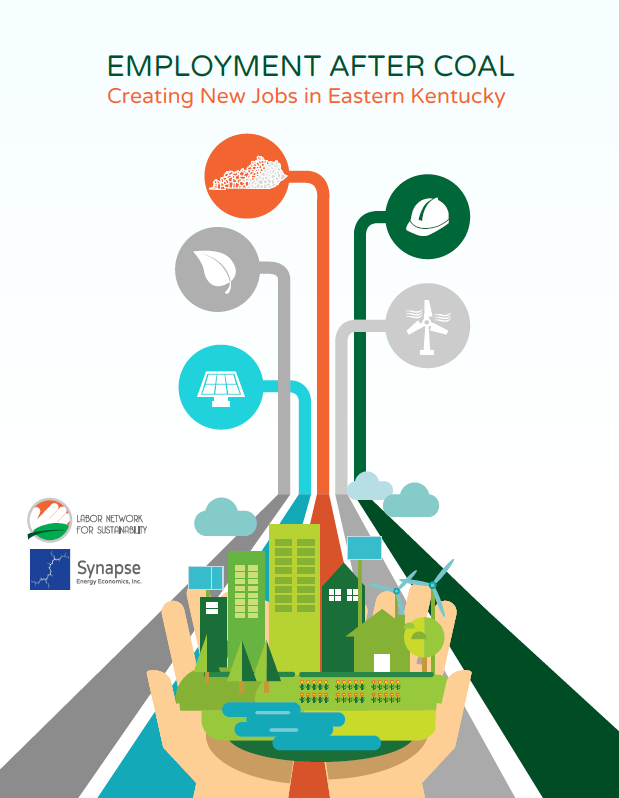
Employment After Coal: Creating new jobs in eastern Kentucky

By Frank Ackerman, PhD and Tyler Comings - MACED, December 30, 2015

The steep, ongoing decline of coal mining has caused the loss of 30,000 coal jobs in eastern Kentucky in the last 30 years. Trends in energy markets and public policy make it clear that a coal‐based economy is not coming back. A successful response to this crisis, replacing the lost kingdom of coal with a sustainable, community‐controlled economy, is crucial to the hopes for forward‐looking economic development in the region.

The issue reverberates far beyond the coalfields, as the national search for clean energy alternatives confronts impassioned claims about the need to protect coal mining jobs. In Kentucky and in the nation, a common but misleading frame on the debate suggests that there is no alternative, that “real” jobs can only be created by traditional industries, even if they are environmentally damaging.

In fact, the narrow, coal‐centered vision of “real” jobs is fading away, and discussion of newer, cleaner alternatives is already underway. Community organizations such as the Mountain Association for Community Economic Development (MACED) and Kentuckians for the Commonwealth (KFTC) have sponsored grassroots job creation initiatives, and have identified key sectors where employment growth should be possible. Both MACED and KFTC advocate for a Just Transition, a bigger picture that combines existing initiatives into a single vision of a working economy, mapping the sustainable occupations and industries that will fill the void left by coal.

Our analysis describes a new pattern of employment that Appalachian Kentucky could aspire to reach by 2030. It is a more challenging and longer‐term goal than is usually found in immediate grass‐roots campaigns. At the same time, it is more limited, detailed and practical than a grand statement of ultimate objectives. It occupies an intermediate level of abstraction, a mid‐range strategic vision of what the regional economy could look like in ten to twenty years.

Read the text (PDF).

Paris climate agreement: a terror attack on Africa

By Patrick Bond - Climate and Capitalism, December 17, 2015

Patrick Bond is director of the Centre for Civil Society at the University of KwaZulu-Natal in Durban, South Africa
Paris witnessed both explicit terrorism by religious extremists on November 13 and a month later, implicit terrorism by carbon addicts negotiating a world treaty that guarantees catastrophic climate change. The first incident left more than 130 people dead in just one evening’s mayhem; the second lasted a fortnight but over the next century can be expected to kill hundreds of millions, especially in Africa.

But because the latest version of the annual United Nations climate talks has three kinds of spin-doctors, the extent of damage may not be well understood. The 21st Conference of the Parties (COP21) to the UN Framework Convention on Climate Change (UNFCCC) generated reactions ranging from smug denialism to righteous fury. The first reaction is ‘from above’ (the Establishment) and is self-satisfied; the second is from the middle (‘Climate Action’) and is semi-satisfied; the third, from below (‘Climate Justice’), is justifiably outraged.

Guzzling French champagne last Saturday, the Establishment quickly proclaimed, in essence, “The Paris climate glass is nearly full – so why not get drunk on planet-saving rhetoric?” The New York Times reported with a straight face, “President Obama said the historic agreement is a tribute to American climate change leadership” (and in a criminally-negligent way, this is not untrue).

Since 2009, US State Department chief negotiator Todd Stern successfully drove the negotiations away from four essential principles: ensuring emissions-cut commitments would be sufficient to halt runaway climate change; making the cuts legally binding with accountability mechanisms; distributing the burden of cuts fairly based on responsibility for causing the crisis; and making financial transfers to repair weather-related loss and damage following directly from that historic liability. Washington elites always prefer ‘market mechanisms’ like carbon trading instead of paying their climate debt even though the US national carbon market fatally crashed in 2010.

In part because the Durban COP17 in 2011 provided lubrication and – with South Africa’s blessing – empowered Stern to wreck the idea of Common But Differentiated Responsibility while giving “a Viagra shot to flailing carbon markets” (as a male Bank of America official cheerfully celebrated), Paris witnessed the demise of these essential principles. And again, “South Africa played a key role negotiating on behalf of the developing countries of the world,” according to Pretoria’s environment minister Edna Molewa, who proclaimed from Paris “an ambitious, fair and effective legally-binding outcome.”

Arrogant fibbery. The collective Intended Nationally Determined Contributions (INDCs) – i.e. voluntary cuts – will put the temperature rise at above 3 degrees. From coal-based South Africa, the word ambitious loses meaning given Molewa’s weak INDCs – ranked by Climate Action Tracker as amongst the world’s most “inadequate” – and given that South Africa hosts the world’s two largest coal-fired power stations now under construction, with no objection by Molewa. She regularly approves increased (highly-subsidized) coal burning and exports, vast fracking, offshore-oil drilling, exemptions from pollution regulation, emissions-intensive corporate farming and fast-worsening suburban sprawl.

A second narrative comes from large NGOs that mobilized over the past six months to provide mild-mannered pressure points on negotiators. Their line is, essentially, “The Paris glass is partly full – so sip up and enjoy!”

This line derives not merely from the predictable back-slapping associated with petit-bourgeois vanity, gazing upwards to power for validation, such as one finds at the Worldwide Fund for Nature and Climate Action Network, what with their corporate sponsorships. All of us reading this are often tempted in this direction, aren’t we, because such unnatural twisting of the neck is a permanent occupational hazard in this line of work.

And such opportunism was to be expected from Paris, especially after Avaaz and Greenpeace endorsed G7 leadership posturing in June, when at their meeting in Germany the Establishment made a meaningless commitment to a decarbonized economy – in the year 2100, at least fifty years too late.

Perhaps worse than their upward gaze, though, the lead NGOs suffered a hyper-reaction to the 2009 Copenhagen Syndrome. Having hyped the COP15 Establishment negotiators as “Seal the Deal!” planet-saviours, NGOs mourned the devastating Copenhagen Accord signed in secret by leaders from Washington, Brasilia, Beijing, New Delhi and Pretoria. This was soon followed by a collapse of climate consciousness and mobilization. Such alienation is often attributed to activist heart-break: a roller-coaster of raised NGO expectations and plummeting Establishment performance.

Possessing only an incremental theory of social change, NGOs toasting the Paris deal now feel the need to confirm that they did as best they could, and that they have grounds to continue along the same lines in future. To be sure, insider-oriented persuasion tactics pursued by the 42-million member clicktivist group Avaaz are certainly impressive in their breadth and scope. Yet for Avaaz, “most importantly, [the Paris deal] sends a clear message to investors everywhere: sinking money into fossil fuels is a dead bet. Renewables are the profit centre. Technology to bring us to 100% clean energy is the money-maker of the future.”

Once again, Avaaz validates the COP process, the Establishment’s negotiators and the overall incentive structure of capitalism that are the proximate causes of the crisis.

The third narrative is actually the most realistic: “The Paris glass is full of toxic fairy dust – don’t dare even sniff!” The traditional Climate Justice (CJ) stance is to delegitimize the Establishment and return the focus of activism to grassroots sites of struggle, in future radically changing the balance of forces locally, nationally and then globally. But until that change in power is achieved, the UNFCCC COPs are just Conferences of Polluters.

Via Campesina was clearest: “There is nothing binding for states, national contributions lead us towards a global warming of over 3°C and multinationals are the main beneficiaries. It was essentially a media circus.”

Asad Rehman coordinates climate advocacy at the world’s leading North-South CJ organization, Friends of the Earth International: “The reviews [of whether INDCs are adhered to and then need strengthening] are too weak and too late. The political number mentioned for finance has no bearing on the scale of need. It’s empty. The iceberg has struck, the ship is going down and the band is still playing to warm applause.”

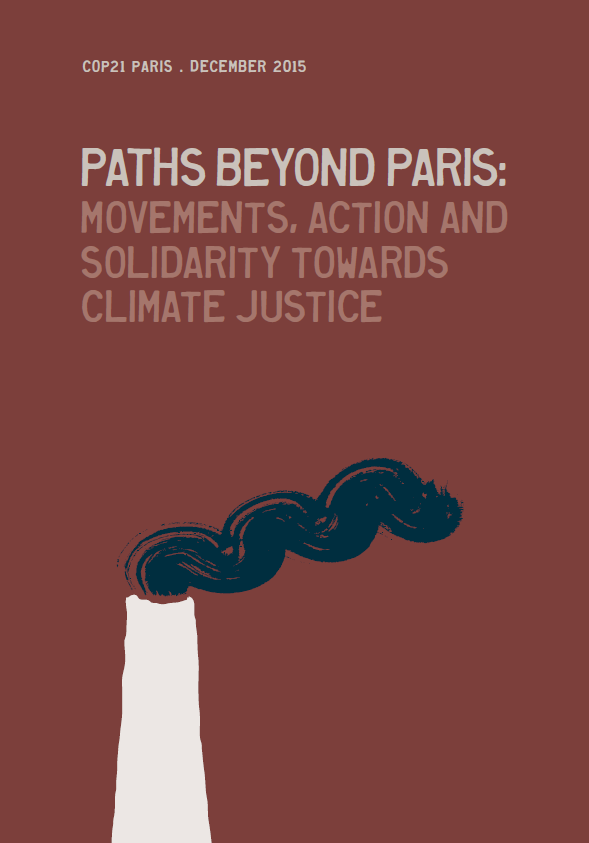
Paths Beyond Paris: Movements, Action and Solidarity Towards Climate Justice

By various - Carbon Trade Watch, December 2015

Over twenty years have passed since governments within the United Nations Framework Convention on Climate Change (UNFCCC) began to discuss the impending climate crisis. Year after year, we witness the talks moving further away from identifying the root causes of climate change while the increasing impacts affect even more peoples and regions. Every meeting has given more space for corporate involvement and less to the voices of those directly affected by these climate policies. Despite the promoters’ fancy “green” campaigns and videos, the main focus at the climate negotiations continues to be about saving the free-market economy for those who are holding the cards – the biggest transnational corporations and financial institutions. The same corporations that are largely behind the destruction of forests, rivers, diversity, territories – as well as the violation of human and collective rights and so on – are also the main polluters and plunderers of the Earth.

The climate crisis poses a real threat to the current economic model which is based on the continuous extraction and production of fossil fuels, hydrocarbons and “natural resources” such as land, minerals, wood and agriculture. If talks were to seriously address climate change, there would need to be a discussion on the many ways to support the hundreds of thousand of small-scale farmers, fishers, Indigenous Peoples, forest-dwelling communities and others whose territories and livelihoods are at risk from capital expansion, and how to transition to different economic systems where fossil fuels could be kept underground; where the consumption “mantra” would shift towards more local, diverse and collective discourses and practices. However, the hegemonic and colonial powers are once more violently closing doors, creating more “structural adjustments” and, ultimately, harming the people who are the least responsible for current and historical pollution levels suffering the most from the impacts.

The fallacy that we can continue with the same economic model is irremediably flawed, bankrolled by big polluters, and intrinsically linked to land and livelihoods grabbing, especially in the Global South. Nonetheless, mechanisms like carbon markets, which expand the extractivist and free-market logic, continue to be promoted as unilateral, program- matic “solutions” to mitigate climate change and address deforestation and biodiversity loss. From carbon trading to forests and biodiversity offsets, the climate crisis has been turned into a business opportunity, worsening the already felt impacts, especially for those who are the least responsible. Debates over molecules of carbon being accounted for and “moved” or “stored” from one location to the other detracts from the necessary debates on shifting away from extraction, unjust power structures and oppression. While being fully informed of the causes of climate change, international climate negotiations strive to ensure that the hegemonic economic model expands and rewards polluters.

The consequence is that “climate policies” (aka economic policies) finance the most destructive industries and polluters, often destroying genuinely effective actions that support community livelihoods and keep fossil fuels in the ground. Moreover, these policies further the “financialization of nature” process, which presupposes the separation and quantification of the Earth’s cycles and functions – such as carbon, water and biodiversity – in or-der to turn them into “units” or “titles” that can be sold in financial and speculative markets. With governments establishing legal frameworks to set these markets in place, they also have provided the financial “infrastructure” for negotiating financial “instruments”, by using derivatives, hedge funds and others. While financial markets have a growing influence over economic policies, the “financialization of nature” hands over the management to the financial markets, whose sole concern is to further accumulate capital.

Read the report (PDF).

Pages

The Fine Print I:

Disclaimer: The views expressed on this site are not the official position of the IWW (or even the IWW’s EUC) unless otherwise indicated and do not necessarily represent the views of anyone but the author’s, nor should it be assumed that any of these authors automatically support the IWW or endorse any of its positions.

Further: the inclusion of a link on our site (other than the link to the main IWW site) does not imply endorsement by or an alliance with the IWW. These sites have been chosen by our members due to their perceived relevance to the IWW EUC and are included here for informational purposes only. If you have any suggestions or comments on any of the links included (or not included) above, please contact us.

The Fine Print II:

Fair Use Notice: The material on this site is provided for educational and informational purposes. It may contain copyrighted material the use of which has not always been specifically authorized by the copyright owner. It is being made available in an effort to advance the understanding of scientific, environmental, economic, social justice and human rights issues etc.

It is believed that this constitutes a 'fair use' of any such copyrighted material as provided for in section 107 of the US Copyright Law. In accordance with Title 17 U.S.C. Section 107, the material on this site is distributed without profit to those who have an interest in using the included information for research and educational purposes. If you wish to use copyrighted material from this site for purposes of your own that go beyond 'fair use', you must obtain permission from the copyright owner. The information on this site does not constitute legal or technical advice.