You are here

extractivism

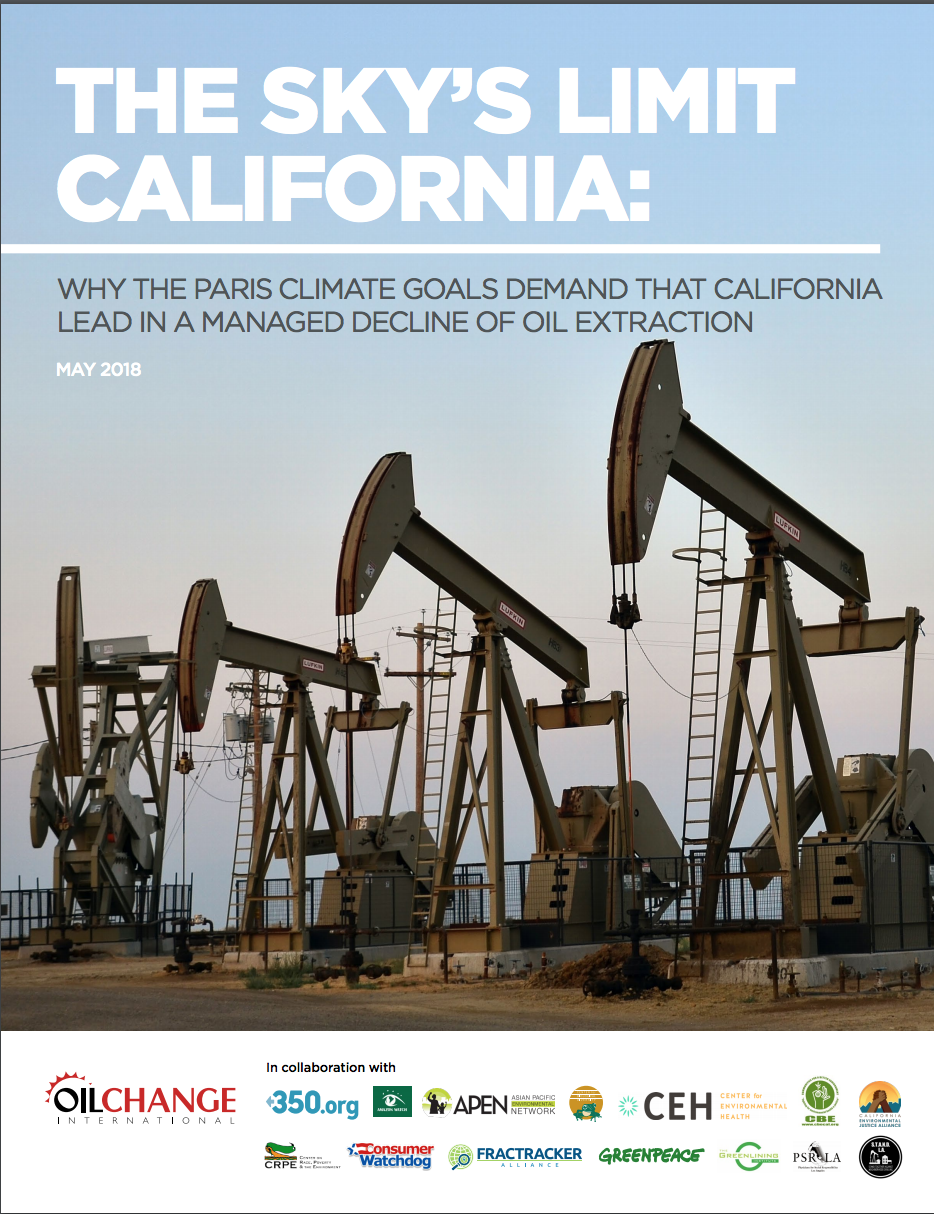
The Sky’s Limit California: why the Paris Climate Goals demand that California lead in a managed decline of oil extraction

By Kelly Trout, et. al. - Oil Change International, May 22, 2018

This study examines the implications of the Paris Agreement goals for oil production and climate leadership in California.

California’s leaders, including Governor Jerry Brown, have been vocal supporters of the Paris Agreement. Yet, California presently has no plan to phase out its oil and gas production in line with Paris-compliant carbon budgets. Under the Brown administration, the state has permitted the drilling of more than 20,000 new wells, including extraction and injection wells.

We provide new data findings related to:

  • The climate implications of ongoing permitting of new oil wells in California;
  • The ways that a managed decline of existing wells can prioritize health and equity; and
  • Elements of a just transition for affected workers and communities.

We recommend that the state take the following actions:

  • Cease issuing permits for new oil and gas extraction wells;
  • Implement a 2,500-foot health buffer zone around homes, schools, and hospitals where production must phase out;
  • Develop a plan for the managed decline of California’s entire fossil fuel sector to maximize the effectiveness of the state’s climate policies; and
  • Develop a transition plan that protects people whose livelihoods are affected by the economic shift, including raising dedicated funds via a Just Transition Fee on oil production.

As a wealthy oil producer, California is well positioned to take more ambitious action to proactively phase out its fossil fuel production and has a responsibility to do so in order to fulfill its commitment
to climate leadership. By taking these steps, California would become the first significant oil and gas producer globally to chart a path off fossil fuel production in line with climate limits.

Download (PDF).

Capitalism Is Killing the Earth: An Anarchist Guide to Ecology

By John Warwick, et. al. - Anarchist Federation, 2018

We are in a period of crisis that we in MEDCs cannot yet see. The signs are there if you look hard enough but at the moment the water is still flowing, the crops are still reliable the ski lifts are still running. The first wave of climate refugees are trying to make their way into Europe but they are being dismissed as "economic migrants" or those displaced by war. In all likelihood, MEDCs will not feel the effects of climate change for some time; our relative wealth will push the impacts onto those who haven't the means to adapt or whose local climates were less temperate to begin with. The longer we wait to act, however, the bigger the coming crunch will be.

Collectively, MEDCs are responsible for the overwhelming majority of cumulative carbon emissions and will have to radically change their energy and transport systems if an ecological disaster is to be avoided. Who will bear the brunt of the costs and who will get rich from this process is sadly predictable. The working class in MEDCs and most people in LEDCs will pay for the fossil fuel addiction and growth-at-all-costs model of the capitalist system. We have already begun to see this happen in the black, working-class communities devastated by natural disasters in the USA and flooding killing thousands in Bangladesh.

Capitalism relies on constantly increasing accumulation of profits. This has been achieved historically by appropriations (a polite term for thefts) both internal and external to the nation state. Internally, in Europe from the fifteenth century onwards, this has followed the model of stealing common land from the people to create a proletarian class dependent on wage labour to support itself. Externally, this expansion was tied to a move outside Europe's borders to exploit natural resources and labour in other locations. Thus colonialism and capitalism were, from the beginning, linked to processes of resource extraction and accumulation.

Capitalism is now in crisis; with so few areas beyond its reach, there are no easy sources of growth to appropriate, and the ability of the earth's ecosystems to accommodate further growth is being seriously questioned. How then to continue growth and profit? In MEDCs, we are seeing a fresh attack on workers? rights, with more precarious jobs, lower pay and poorer social care. In LEDCs, the neoliberal development model is pushed with privatisation and financial deregulation extracting the most profit for the capitalists.

We write this pamphlet to discuss the environmental problems that capitalism has created, with a focus on climate change and the false solutions offered up to us. There has been wider understanding of environmental issues since mainstream publications such as Silent Spring, Gaia and An Inconvenient Truth; however, an anti-capitalist critique has been lacking.

Read the report (PDF).

The Cost of Caring for the Land: Attacks on Communities in Resistance in Mexico

By Analy S. Nuño - It's Going Down, January 12, 2018

In the last decade, indigenous and mestizo communities in Michoacán, Jalisco, and Colima have confronted developers, mining and other extractive industries, governmental authorities, and criminal gangs to protect their territories from dispossession and destruction. Along the way, they have come up against threats, disappearances, criminalization, and death.

The body of the P’urhépecha indigenous woman Guadalupe Campanur Tapia was found on January 16th, around the 15th kilometer of the Carapan-Playa Azul highway, in a place known as Irapio. She had disappeared several days earlier.

Guadalupe, 32, was a woman who had broken the mold of her community by joining the group of forest defenders and participating actively in the search for security, justice, and territorial reclamation. The journalist Alejandra Guillén, author of the book Guardians of the Territory: Security and Community Justice in Cherán, Nurío, and Ostula, defined her as “one of the critical voices who pointed out internal contradictions — because she knew that the struggle is built day by day, starting with the small and the everyday things.”

Guadalupe was the founder of the Community Patrol, the movement against illegal logging, and a member of the “Cherán K’eri: Knowing and Recognizing our Territory” project.

On many occasions, she carried out searches for community members who had been reported as disappeared. Her murder is the latest in a series of killings of activists and land defenders in the region, including Jalisco, Colima, and Michoacán, whose natural resources are targeted by both capitalist interests and criminal groups.

“This can be interpreted as a message to intimidate and silence those who genuinely aim to re-value life through community actions that go beyond resistance. It is also a means of terrorizing women, and, on top of everything, it fits within a broader ethnocidal technique intended to diminish the struggle for life carried on by the P’urhépecha community of Cherán,” wrote her friend, Carolina Lunuen.

Still, the attacks occurring in this region are only a sampling of the systematic attacks that have been carried out against social leaders, activists, and land defenders nationwide in the last decade.

Focus on China: The East is green?

By Martin Empson - Socialist Review, February 2018

China’s rapid economic expansion is based on massive state investment, low pay and manufacturing for export to the Western economies at the same time as the promotion of domestic consumerism. Global competition for resources and markets means China must continue this economic model. But this brings with it the risk of war, economic crisis and the threat of workers fighting for an increased share of the enormous wealth being generated. But it is also driving environmental disaster on a local and international scale.

Last October Chinese President Xi Jinping outlined a five-year economic strategy. He focused on putting China at the centre of the world economy, offering “a new option for other countries and nations who want to speed up their development while preserving their independence”. But commentators noted how Xi also emphasised the environment, using the word 89 times in the 3-hour, 23-minute speech and pledging to lead globally on the environment.

In a dig at Donald Trump’s withdrawal of the United States from the Paris climate agreement, Xi argued that, “No country alone can address the many challenges facing mankind. No country can afford to retreat into self-isolation.” By contrast he claimed that China had “taken a driving seat in international cooperation to respond to climate change”, and echoing Friedrich Engels, concluded that, “Only by observing the laws of nature can mankind avoid costly blunders in its exploitation. Any harm we inflict on nature will eventually return to haunt us. This is a reality we have to face.”

China faces an unprecedented environmental crisis. Mao Zedong’s decision to make China’s economy match and then overtake the West triggered numerous environmental problems. But the sheer scale of today’s economic expansion means that China’s environmental crises today are colossal.

China is the world’s leading polluter in absolute terms. The country is responsible for around 30 percent of global carbon emissions, twice that of the next biggest polluter, the US. In per capita terms, China’s emissions (7.9 tons per person) fall below those of many other industrialised countries such as the US (16.4) or Germany (9.2). But this merely highlights the size of China’s population (1.4 billion). Meanwhile, current economic trends will only drive emissions upwards. In 2000 China’s per capita emissions were just 2.7 tons per person.

Africa: New evidence of ongoing corporate looting

By Patrick Bond - Climate and Capitalism, February 5, 2018

A brand new World Bank report, The Changing Wealth of Nations 2018offers evidence of how much poorer Africa is becoming thanks to rampant minerals, oil and gas extraction. Yet Bank policies and practices remain oriented to enforcing foreign loan repayments and transnational corporate (TNC) profit repatriation, thus maintaining the looting.

Central to its “natural capital accounting,” the Bank uses an “Adjusted Net Savings” (ANS) measure for changes in economic, ecological and educational wealth. This is surely preferable to “Gross National Income” (GNI, a minor variant of Gross Domestic Product), which fails to consider depletion of non-renewable natural resources and pollution (not to mention unpaid women’s and community work).

In its latest world survey (with 1990-2015 data), the Bank concludes that Sub-Saharan Africa loses roughly $100 billion of ANS annually because it is “the only region with periods of negative levels – averaging negative 3 percent of GNI over the past decade – suggesting that its development policies are not yet sufficiently promoting sustainable economic growth… Clearly, natural resource depletion is one of the key drivers of negative ANS in the region.”

The Bank asks, “How does Sub-Saharan Africa compare to other regions? Not favorably.” Contrary to pernicious “Africa Rising” mythology, the ANS decline for Sub-Saharan Africa was worst from 2001-09 and 2013-15.

Other regions of the world scored strongly positive ANS increases, in the 5-25 percent range. Richer, resource-intensive countries such as Australia, Canada and Norway have positive ANS resource outcomes partly because their TNCs return profits to home-based shareholders.

Africa’s smash-and-grab ‘development policies’ aiming to attract Foreign Direct Investment have, even the Bank suggests, now become counter-productive: “Especially for resource-rich countries, the depletion of natural resources is often not compensated for by other investments. The warnings provided by negative ANS in many countries and in the region as a whole should not be ignored.”

Such warnings – including the 2012 Gaborone Declaration by ten African governments – are indeed being mainly ignored, and for a simple reason, the Bank hints: “The [ANS] measure remains very important, especially in resource-rich countries. It helps in advocating for investments toward diversification to promote exports and sectoral growth outside the resource sector.”

Africa desperately needs diversification, but governments of resource-cursed countries are instead excessively influenced by TNCs intent on extraction. Even within the Bank such bias is evident, as the case of Zambia shows.

Chile: Lies, dam lies and a Mapuche activist murdered

By - Freedom, January 30, 2018

It has taken nearly a year-and-a-half of fighting the authorities, and a second autopsy, to confirm what the family of Macarena Valdés Muñoz already knew – she was hanged after her death. There was no suicide. 

On the afternoon of Monday August 22nd, 2016 Macarena, a Mapuche environmental activist fighting against the construction of a mini-hydroelectric dam near and over her property in Newen-Tranguil, near Liquine, Los Rios, was found hanged in her home aged 32. A noose was round her neck and for the coroner the situation was obvious: “Death by suffocation and hanging” – a suicide with a technical explanation that baffled her family.

What had actually happened however was murder. A doctor was first to explain to loved ones that key factors for a suicide had not happened. Her cervical vertebra hadn’t been broken, and it was clear, explained her father-in-law, Mapuche political leader Marcelino Collío, she had been killed. Most likely, it had happened in front of her one-year-old child who was with her at the time.

But it wouldn’t be until January 19th 2018, with the trail long cold, that they would have their suspicions confirmed by a government department in a statement that acknowledged Macarena could not have killed herself. She had instead been killed and then hanged to simulate suicide,

Last week, following the second report, the family and supporters from the Health For All Movement made a number of demands of the authorities, who they suspect of effective collusion in what amounts to a racist strong-arming of the Mapuche community in Tranguil to force them to accept damaging mini-hydroelectric dams across the regional river network. They called for:

  • A new statement of intent on the part of authorities and agencies involved in the investigation of Macarena’s death
  • The the results of both autopsies be clarified to show why the first was inaccurate
  • That resources be provided to investigate the murder fully and bring the killers to justice

They added:

We denounce the violence and permanent intimidation suffered by the community of Tranguil, exercised by the State and the hydroelectric companies interested in extracting the riches of the territory, at the expense of the destruction of the natural and cultural heritage of the town.

Through our history in Latin America we know that this crime corresponds to the way in which, both state policies and business groups, repress through terror and silencing the dissidence and diversity of peoples.

There were strong reasons for the suspicions of Macarena’s family and community, which have repeatedly clashed with both the government and hydroelectric companies over the future of development in and around Tranguil, in the mountains of Los Rios.

Vivir Bien: Old Cosmovisions and New Paradigms

By Pablo Solón - Great Transition Initiative, February 2018

The concept of Vivir Bien (or Buen Vivir) gained international attention in the late twentieth century as people searched for alternatives to the rampage of neoliberalism. Imperfect translations of the Andean concepts of suma qamaña and sumaq kawsay, Vivir Bien and Buen Vivir reflect an indigenous cosmovision that emphasizes living in harmony with nature and one another. As these ideas’ popularity has grown, however, their meaning has been compromised. Governments in Bolivia and Ecuador incorporated Vivir Bien and Buen Vivir, respectively, into their constitutions and governing agendas on paper, but not in spirit. Rather than radical alternatives to the dominant paradigm of development and progress, these concepts have become new branding for (un)sustainable development. The lessons are clear: to avoid state cooptation, truly revolutionary change must be based on emancipation and self-determination from below. And to succeed in our interdependent world, proponents of Vivir Bien must link up with advocates of complementary global movements on the path of a better future for all.

Leaked Trump Infrastructure Plan is a Blueprint for Corporate Subsidies

By  - CounterPunch, January 29, 2018

The Trump administration’s plans to rebuild infrastructure in the United States have been leaked, and it appears to be as bad as feared. At least three-quarters of intended funding will go toward corporate subsidies, not actual projects. It is possible that no funding will go directly toward projects.

There’s no real surprise here, given that President Donald Trump’s election promise to inject $1 trillion into infrastructure spending was a macabre joke. What is actually happening is that the Trump administration intends to push for more “public-private partnerships.” What these so-called partnerships actually are vehicles to shovel public money into private pockets. These have proven disastrous wherever they have been implemented, almost invariably making public services more expensive. Often, far more expensive. They are nothing more than a variation on straightforward schemes to sell off public assets below cost, with working people having to pay more for reduced quality of service.

That is no surprise, as corporations are only going to provide services or operate facilities if they can make a profit. And since public-private partnerships promise guaranteed big profits, at the expense of taxpayers, these are quite popular in corporate boardrooms. And when those promises don’t come true, it taxpayers who are on the hook for the failed privatization.

The collapse earlier this month of Carillion PLC in Britain put 50,000 jobs at risk, both those directly employed and others working for subcontractors. The holder of a vast array of government contracts for construction, services and managing the operations of railways, hospitals, schools and much else, Carillion received contracts worth £5.7 billion just since 2011. Overall, an astonishing £120 billion was spent on outsourcing in Britain in 2015.

What did British taxpayers get for this corporate largesse? It certainly not was the promised savings. Parliament’s spending watchdog agency, the National Audit Office, found that privately financing public projects costs as much as 40 percent more than projects relying solely on government money. The office estimates that existing outsourcing contracts will cost taxpayers almost £200 billion for the next 25 years. (This report was issued before Carillion’s collapse.) In response, Labour leader Jeremy Corbyn said, “These corporations need to be shown the door. We need our public services provided by public employees with a public service ethos and a strong public oversight,” The Guardian reported.

Naturally, there was one group that did quite well from this privatization: Carillion’s shareholders, who reaped £500 billion in dividends in the past seven years. But it is the government that will have to pick up the tab if the company’s employees are to continue to be paid. On top of that, the company’s pension shortfall reached £900 billion, according to Reuters.

By no means is Carillion’s collapse the only privatization disaster in Britain. A bailout of the corporate-run East Coast rail system is expected to cost hundreds of millions of pounds. There are numerous other examples that have proven windfalls for corporate executives but expensive mistakes for the public.

Human Rights in Wind Turbine Supply Chains

By staff - ActionAid, January 19, 2018

This briefing paper sheds light on the risks that are brought about by the projected increase in demand for minerals, such as iron ore and chromium, which are needed for the production of new wind turbines. An overview is provided of how the mining of these minerals affects people and the environment in international supply chains.

The paper also describes what is expected of companies supplying the Netherlands with wind turbines in terms of their supply chain responsibility and respecting human rights. The paper then reviews efforts by these companies to undertake due diligence to identify, prevent and mitigate risks of adverse impacts in their metals and minerals supply chain.

Commissioned by ActionAid Netherlands and written by SOMO, the paper is primarily intended to inform the Dutch government and companies in the wind energy sector about the social and environmental risks in renewable energy supply chains. It’s aim is to influence and improve Dutch policy to ensure fair and sustainable mineral supply chains globally and to broaden the scope of the energy transition agenda.

Read the report (PDF).


November 2019 Update

This report is a follow-up to the 2018 research ‘Human Rights in Wind Turbine Supply Chains‘. This report assess the extent to which the seven wind turbine manufacturers that were examined in the initial report have acted on previous recommendations and improved their policies related to risk-based due diligence in their wind turbine supply chains. The report takes the different steps of due diligence expected by the UNGPs and the OECD Guidelines as its starting point and normative benchmark.

The research analyses the companies’ general due diligence processes as well as at how the companies approach the specific risks associated with the extraction and processing of minerals that play an important role in the production of wind turbines, such as iron, aluminium and copper. The report also provides recommendations for governments and companies.

Read the report (PDF).

Declaration From The Regional Encounter For The Defense Of Our Territories: Oaxaca, Mexico

By Anonymous Contributor - It's Going Down, December 8, 2017

On the 6th of December, this year, we met in the community of Morro Mazatán, Municipality of Santo Domingo Tehuantepec, as the Agrarian Authorities and representatives of the communities of: San Miguel Chongos, Guadalupe Victoria, Santa María Zapotitlán, San José Chiltepec, Santa Lucía Mecaltepec, Santa María Candelaria, San Pedro Sosoltepec and San Pedro Tepalcatepec, all members of the Asamblea del Pueblo Chontal para la Defensa del Territorio [Chontal People’s Assembly for the Defense of the Territory]; as well as representatives of Morro Mazatán, Santa Gertrudis Miramar, Tilzapote, San Pablo Mitla, Tlacolula de Matamoros, Rincón Bamba, Asamblea de Comuneros de Unión Hidalgo [Comuneros’ Assembly of Unión Hidalgo], Colectivo Matzá [Matzá Collective] from the community of San Miguel Chimalapa, and Tequio Jurídico AC [Collective Legal Work Civil Association], to advance the “Regional Encounter for the Defense of Our Territories,” with the goal of informing each other and articulating ourselves for our own defense in the face of megaprojects that dispossess us and extractive projects, among them, mining and Special Economic Zones.

In our analysis, our territories find themselves at risk under a capitalist system which in our country began to deepen in the 90s with the reconfiguration of the state’s legal framework. This included reforms to constitutional article 27, the mining law, the foreign investment law, and the entry into the North American Free Trade Agreement, or NAFTA, generating legal conditions favoring national and international businesses that seek to impose neo-extractivist projects such as mining, wind energy projects, hydroelectric dams, high-tension towers, Special Economic Zones, tourist projects and as a consequence the militarization and paramilitarization of the territory.

In this encounter we listened to the experiences of regional organization processes from San Pablo Mitla and Tlacolula de Matamoros, who are defending their territory in the face of the installation/relocation of a military zone by the federal government through the Ministry of National Defense (SEDENA), the state government, the Ministry of the Interior, and the Municipal Presidents of San Pablo Mitla and Tlacolula de Matamoros.

Thanks to citizen organization, they have suspended this project; however, they remain attentive before new threats to reactivate the project utilizing a real estate company on land in Tlacolula. The residents also denounced the mining concessions in the district of Tlacolula de Matamoros.

Likewise, we listened to the experiences of the Chontal People’s Assembly for the Defense of the Territory, who have organized to defend themselves faced with the imposition of the mining concession Zapotitlán 1 granted to the companies Zalamera SA de CV and Minaurum Gold by the Ministry of the Economy. It would strip 5,413 hectares [13,375 acres] from six Chontal communities in the high region.

In this encounter, the representatives of the communities of Tilzapote and San Francisco Cozoaltepec, Municipality of Santa María Tonameca, denounced the supposed small proprietors Pedro Martínez Araiza and Domitila Guzmán Olivera. The community doesn’t know these people, who are trying to take away their territory under the argument that they are executing a resolution of the Unitary Agrarian Tribunal that recognizes them as the owners of 300 hectares [741 acres] where the village sits, in so doing, displacing them from their community. The Agrarian Ombudsman’s office, the Ministry of Agrarian, Territorial, and Urban Development, the National Agrarian Register, and the aforementioned Unitary Agrarian Tribunal Number 21 are among those responsible for this situation, putting the pueblo—composed of 70 families—at risk. These government institutions and small proprietors threaten the inhabitants with the loss of 300 hectares, which spans the entirety of their territory, and the neglect of their personal defense. [Translator’s note: read more about this situation here, and there is a video in Spanish here.]

Those representing the Matzá Collective from the community of San Miguel Chimalapa denounced the fact that their 134,000 hectare [331,000 acre] communal territory has been pierced by a series of landgrabs characterized by agrarian conflicts with the state of Chiapas and mining concessions, which span 7,200 hectares [18,000 acres] of communal lands. The companies involved are Zalamera, Minaurum Gold, and Gol Cooper, and their projects would put at risk the Espíritu Santo, Zacatepec, and Ostuta rivers, on which the lives of the Zoques, Binniza, and Ikoots peoples depend.

The representative of the Comuneros’ Assembly of Unión Hidalgo denounced the illegality of the contracts on common lands signed by wind energy companies like France Electric and EDEMEX with supposed small proprietors. The Unitary Agrarian Tribunal of Tuxtepec does not acknowledge the experts’ reports offered by the agrarian community, and validates these contracts.

Pages

The Fine Print I:

Disclaimer: The views expressed on this site are not the official position of the IWW (or even the IWW’s EUC) unless otherwise indicated and do not necessarily represent the views of anyone but the author’s, nor should it be assumed that any of these authors automatically support the IWW or endorse any of its positions.

Further: the inclusion of a link on our site (other than the link to the main IWW site) does not imply endorsement by or an alliance with the IWW. These sites have been chosen by our members due to their perceived relevance to the IWW EUC and are included here for informational purposes only. If you have any suggestions or comments on any of the links included (or not included) above, please contact us.

The Fine Print II:

Fair Use Notice: The material on this site is provided for educational and informational purposes. It may contain copyrighted material the use of which has not always been specifically authorized by the copyright owner. It is being made available in an effort to advance the understanding of scientific, environmental, economic, social justice and human rights issues etc.

It is believed that this constitutes a 'fair use' of any such copyrighted material as provided for in section 107 of the US Copyright Law. In accordance with Title 17 U.S.C. Section 107, the material on this site is distributed without profit to those who have an interest in using the included information for research and educational purposes. If you wish to use copyrighted material from this site for purposes of your own that go beyond 'fair use', you must obtain permission from the copyright owner. The information on this site does not constitute legal or technical advice.