You are here

extractivism

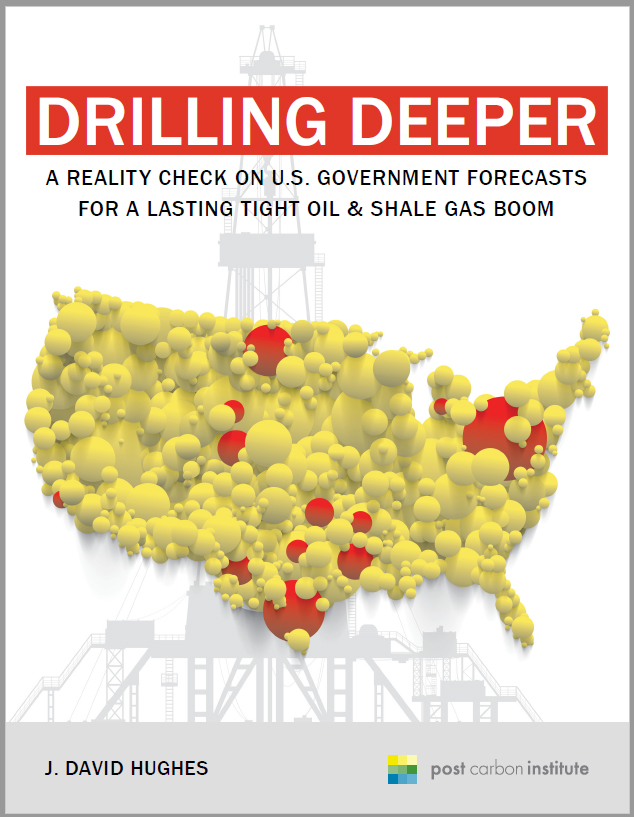
Drilling Deeper: a Reality Check on U.S. Government Forecasts for a Lasting Tight Oil & Shale Gas Boom

By J David Hughes - Post Carbon Institute, October 2014

In recent years Americans have been hearing that the United States is poised to regain its role as the world’s premier oil and natural gas producer, thanks to the widespread use of horizontal drilling and hydraulic fracturing (“fracking”). This “shale revolution,” we’re told, will fundamentally change the U.S. energy picture for decades to come—leading to energy independence, a rebirth of U.S. manufacturing, and a surplus supply of both oil and natural gas that can be exported to allies around the world. This promise of oil and natural gas abundance is influencing climate policy, foreign policy, and investments in alternative energy sources.

The primary source for these rosy expectations of future production is the U.S. Department of Energy (DOE). Each year the DOE’s Energy Information Administration (EIA) releases its Annual Energy Outlook (AEO), which provides a range of forecasts for energy production, consumption, and prices.

The 2014 AEO reference case projects U.S. crude oil production to rise to 9.6 million barrels of oil per day (MMbbl/d) in 2019 and slowly decline to 7.5 MMbbl/d by 2040, while natural gas production is projected to grow for at least the next 25 years and hit 37.5 trillion cubic feet per year in 2040. Tight oil (shale oil) and shale gas serve as the foundation for these optimistic forecasts.

This report provides an extensive analysis of actual production data from the top seven tight oil and seven shale gas plays in the U.S. (These plays account for 89% of current tight oil production and 88% of current shale gas production, and serve as the primary sources of future production in the EIA’s forecasts—82% of forecast tight oil and 88% of forecast shale gas production through 2040.) It concludes that the current boom in domestic oil and gas production is unsustainable at the rates projected by the EIA, and that the EIA’s tight oil and shale gas forecasts to 2040 are extremely optimistic. What this means is that the country's current energy policy—which is largely based on the expectation of domestic oil and natural gas abundance far into the future—is badly misguided and is setting the country up for a painful, costly, and unexpected shock when the boom ends.

Indigenous Anarchist Critique of Bolivia’s ‘Indigenous State': Interview with Silvia Rivera Cusicanqui

By Bill Weinberg - Upside Down World, September 7, 2014

Disclaimer: The views expressed here are not the official position of the IWW (or even the IWW’s EUC) and do not necessarily represent the views of anyone but the author’s.

Originally published on June 7, 2014 at World War 4 Report, with a shorter version on May 26, 2014 at Indian Country Today Media Network.

Bolivian historian and social theorist Silvia Rivera Cusicanqui is author of the classic work Oppressed But Not Defeated: Peasant Struggles Among the Aymara and Quechua in Bolivia, and has recently emerged as one of the country’s foremost critics of President Evo Morales from an indigenous perspective. Indian Country Today Media Network spoke with her in New York City, where she recently served as guest chair of Latin American studies at New York University’s King Juan Carlos Center. The complete text of the interview appears for the first time on World War 4 Report.

What are you doing here in New York City?

I have been invited as chair of Latin American studies by the King Juan Carlos Center, which is sort of funny, it sounds like a horrible place for me. But Spain should give us back a little bit of what they took! And my salary is like a millionth part of what they owe us.

And what are you doing now in Bolivia?

I used to teach at the Universidad Mayor de San Andrés, which is the biggest public university in Bolivia. And I was very much involved in university politics, because I was trying to fight corruption in the university. In 2005, I had a 15-day-long hunger strike, and we managed to kick the dean out. But he left a lot of corruptos were still there, and I was forced to retire.

Since then, I have been doing community things, trying to network and create micro-politics… Since I wrote my study on anarchism, I discovered the importance of community to politics, as opposed to the individualist liberal conception…

What was the title?

Los Artesanos Libertarios y la Ética de Trabajo (Libertarian Artisans and the Work Ethic), based on oral history.

What kind of artisans?

Shoe-makers, carpenters, masons. In La Paz. They founded the Local Workers Federation. The foundation date is uncertain. We more or less think it was 1926 or ’27. ..

An anarcho-syndicalist federation?

Yes. It actually started with discussion circles as early as 1908—purely workers, without any intellectuals. Only intellectuals that were workers at the same time. I discovered that my great-uncle, from an estranged part of the family—because he was a worker, a mechanic, so my mother wanted nothing to do with him—was an ideologue of this movement.

This federation still exists?

No, no, no. It was destroyed by the MNR [National Revolutionary Movement, which took power in 1952]. Because under the Marxist view of the labor movement at the time, the artisans are not workers, and therefore they deserve to be erased from history! Only “proletarians” count, only the slaves of the machine count.

The final blow was in 1964, with the dictatorship. Only one union remained from the Federation, it was all-female union of flower vendors, in the Mercado de Floristas. We managed to find them still alive and conduct these interviews in 1985, ’86. And that archive, which is 100 cassettes, I have been working full-time digitizing here in New York…

And this relates to your current community work?

Yes, I am still working with artisans, with urban self-reliance groups in La Paz, ecological and feminist groups, working in the qhatu, or traditional peasant fair or market. This is a very ancient tradition form colonial times, in which indigenous communities used the market to prevent being used by the market. There is always a barter section, negotiation of prices, at the local level. It is a market that is not depersonalized; it is a conscious market, where people are there, not just prices and commodities. It is against the supermarket, against the mall. It is against the corporations and brands and selling things that are pre-packaged. You harvest lentils from your own garden, and you never put it in a plastic package. So the qhatu is a form of resistance to the world market. It is resisting the market with market—it is almost like a vaccination!

I am part of a collective that produced hand-made books and hand-woven bags frmo recycled plastic, as well as lettuce and potatoes and fava beans and sweet peas and medicinal herbs. Grown in community gardens in La Paz. And we sell them at the traditional markets in La Paz.

And we have made campaigns—a campaign against plastic bags, a campaign to promote walking instead of taking trucks or buses or cars. Walking is very difficult in La Paz if it’s uphill, because of the altitude. So we have a slogan, Camina La Paz, aun que sea la bajada—Walk through La Paz, even if it’s only downhill! At least just get a bus ticket one way!

So we try to link every public issue where human rights, indigenous rights, and the rights of the Pachamama are involved. So we joined with TIPNIS, we joined CONAMAQ, we joined the support network for the human rights office that was almost taken over by the government. We are defending the CONAMAQ people who were kicked out of their office… We are just there for them, if they need shelter for the night or a good breakfast, we go and do that. We are not many, but we do whatever we can.

We call ourselves Colectivo Ch’ixi—from the Aymara word meaning “stain.” We are mestizos, but we have a strong Indian stain in our souls. We are “impure.” We are not “pure” people. And we have to recognize also that there is a European stain in our bodies and in our subjectivities. And the good part of that stain is the idea of freedom and individual rights. From the Indian part we get the idea of community and of cycle, intimacy with the cycles of nature. But we do recognize the value of individual freedoms and rights—sexual rights, the right to have a sexual identity that is different from the rest, or of abortion. All this comes from the best contributions of European civilization and the Enlightenment.

Mobilizing for Justice in the Anthropocene: Autogestion, Radical Politics, and the Owl of Minerva (2/2)

By Javier Sethness Castro and Alexander Reid Ross - Notes toward an International Libertarian Eco-Socialism, September 18, 2014

This is part II of an interview on Grabbing Back: Essays Against the Global Land Grab (AK Press, 2014). Read part I here.

In the interviews you hold with Chomsky and Hardt in Grabbing Back, both thinkers point out the irony whereby the so-called “socialist” governments that have been elected throughout much of Latin America in recent years—Venezuela, Bolivia, Ecuador, and Uruguay, for example—notoriously have in fact been engaged in a significant intensification of the extractivist trends which their neoliberal precedecessors oversaw. This developmentalism has inexorably brought these “Pink Tide” governments into conflict with indigenous peoples, and it certainly has not been auspicious for nature, however much posturing Rafael Correa and Evo Morales like to advance in terms of the “rights of nature.” The fate of Ecuador’s YasuníNational Park is emblematic in this sense. As editor of Upside-down World, Grabbing Back contributor Benjamin Dangl has written at length on these tensions. How do you see indigenous concepts like sumak kawsay (“living well”) as realistic alternatives to State-capitalist depredation?

I think the implications of Dangl’s analysis of extractivism is as important today as, say, Rosa Luxemburg’s work on the Accumulation of Capital in the 1910s or David Harvey’s work on the Limits to Capital in the 1980s, and it fits with some really important thinking going on by people like Silvia Rivera CusicanquiRaúl Zibechi, and Pablo Mamani Ramírez. The Pink Tide governments are interesting to me, because they show how rhetoric centered around land can lead to a kind of fixation on natural resources and infrastructure, which precludes the Prebisch-style development of the Third World. So I wonder, does the focus on “the land” come about through the export-based economies that were generated by the annihilation of industrial infrastructure vis-à-vis globalization, and does it also reflexively work to thrust into power a so-called populist leadership that makes gains in the social wage by simply speeding up the process?

Workers At Coal Waste Landfill Told That Coal Ash Is ‘Safe Enough To Eat,’ Lawsuit Says

By Emily Atkin - Think Progress, September 5, 2014

Disclaimer: The views expressed here are not the official position of the IWW (or even the IWW’s EUC) and do not necessarily represent the views of anyone but the author’s.

Employees of an Ohio landfill used primarily for disposing of toxic coal waste byproducts like coal ash were told that the waste was “safe enough to eat” and weren’t required to wear protective gear, resulting in numerous illnesses and some deaths, according to a lawsuit filed on behalf of 77 people last month.

Doug Workman, a supervisor at the General James M. Gavin Residual Waste Landfill landfill in North Cheshire, Ohio, allegedly responded to worker inquiries about whether working with the coal waste was safe “by sticking his finger into the coal waste and then placing his fly-ash covered finger into his own mouth,” thereby implying that “that coal waste was ‘safe enough to eat,’” according to a report in the West Virginia Record. Both Workman and American Electric Power — the power company that owns the landfill — are targets of the lawsuit, which claims that workers who handled the waste were not adequately protected from its toxic properties.

“Repeatedly, individuals were not provided with protective equipment, such as overalls, gloves or respirators when working in and around coal waste,” the lawsuit reads. “These working men and women, already exposed to the contaminants at the job site, then, in turn, carried the coal waste home to their families on their clothes and shoes, thus even exposing family members to the deadly toxins.”

The lawsuit was filed on behalf of 77 people, 39 of whom were direct employees of the landfill and others who claim they were harmed by contact with those employees. The West Virginia Record notes that most of the workers were actually employees of contractor companies that worked for AEP.

AEP owns the landfill because it is directly next to one of its coal-fired power plants, and is therefore used to dispose of the waste that comes from that plant. One of the biggest forms of waste from burning coal is called coal ash, which is usually stored with water in large ponds, or in landfills. The black sludgy substance is known to contain arsenic, lead, and mercury.

However, workers at the Gavin landfill were allegedly told that the coal ash was only a mixture of “water and lime,” and that it contained “such low levels of arsenic, it made no difference.” The workers were allegedly told that the “lime neutralizes the arsenic,” according the the Record’s report.

Integrated life-cycle assessment of electricity-supply scenarios confirms global environmental benefit of low-carbon technologies

By Edgar G. Hertwich, et. al. - National Academy of Sciences of the United States, September 3, 2014

Decarbonization of electricity generation can support climate-change mitigation and presents an opportunity to address pollution resulting from fossil-fuel combustion. Generally, renewable technologies require higher initial investments in infrastructure than fossil-based power systems. To assess the trade offs of increased up-front emissions and reduced operational emissions, we present, to our knowledge, the first global, integrated life-cycle assessment (LCA) of long-term, wide-scale implementation of electricity generation from renewable sources (i.e., photovoltaic and solar thermal, wind, and hydropower) and of carbon dioxide capture and storage for fossil power generation. We compare emissions causing particulate matter exposure, freshwater eco-toxicity, freshwater eutrophication, and climate change for the climate-change-mitigation (BLUE Map) and business-as-usual (Baseline) scenarios of the International Energy Agency up to 2050. We use a vintage stock model to conduct an LCA of newly installed capacity year-by-year for each region, thus accounting for changes in the energy mix used to manufacture future power plants. Under the Baseline scenario, emissions of air and water pollutants more than double whereas the low-carbon technologies introduced in the BLUE Map scenario allow a doubling of electricity supply while stabilizing or even reducing pollution. Material requirements per unit generation for low-carbon technologies can be higher than for conventional fossil generation: 11–40 times more copper for photovoltaic systems and 6–14 times more iron for wind power plants. However, only two years of current global copper and one year of iron production will suffice to build a low-carbon energy system capable of supplying the world’s electricity needs in 2050.

Read the report (PDF).

The Global Ocean Grab

By Carsten Pedersen, et. al. - World Fishers, September 2014

The term ‘ocean grabbing’ aims to cast new light on important processes and dynamics that are negatively affecting the people and communities whose way of life, cultural identity and livelihoods depend on their involvement in small-scale fishing and closely related activities. Small-scale fishers and fishing communities in both the Global South and the Global North are increasingly threatened and confronted by powerful forces that are dramatically reshaping existing access rights regimes and production models in fisheries. This process is leading not only to the dwindling of control by small-scale fishers over these resources, but also in many cases to their ecological destruction and very disappearance.

Today we are witnessing a major process of enclosure of the world’s oceans and fisheries resources, including marine, coastal and inland fisheries. Ocean grabbing is occurring mainly through policies, laws, and practices that are (re)defining and (re)allocating access, use and control of fisheries resources away from small-scale fishers and their communities, and often with little concern for the adverse environmental consequences. Existing customary and communal fisheries’ tenure rights systems and use and management practices are being ignored and ultimately lost in the process. Ocean grabbing thus means the capturing of control by powerful economic actors of crucial decision-making around fisheries, including the power to decide how and for what purposes marine resources are used, conserved and managed now and in the future. As a result, these powerful actors, whose main concern is making profit, are steadily gaining control of both the fisheries’ resources and the benefits of their use.

Read the report (English PDF).

Notes on Ferguson, Extractivism, and Global Revolt

By Alexander Reid Ross - Earth First! Newswire, August 26, 2014

Disclaimer: The views expressed here are not the official position of the IWW (or even the IWW’s EUC) and do not necessarily represent the views of anyone but the author’s.

Force of Gentrification

Unfortunately, when talking about Ferguson, few people are really talking about gentrification. And if we can’t say gentrification and Ferguson in the same breath, we can’t look at the bigger problems. The murder of an unarmed black teenager? How about the racialized murder of civil society by the police state and the ongoing destruction of the world that it is bringing about?

These things may seem fragmented, but they are all connected. It’s necessary to look at them separately before they start to make sense together. Through the tear gas, pepper spray, and smoke, the home invasions, church trespassing, and illegal arrests, the police state is creating a toxic breeding ground that could happen anywhere. It is becoming a model for domestic military response to fast-growing insurrection.

Ferguson was a small town on the outskirts of St. Louis until the 1950s. When the US industry boom occurred after World War II, rapid urbanization ensued. Towns like Ferguson would double in population size between 1950 and 1960, and then double again between 1960 and 1970. But then something happened. We call it neoliberalism, but might as well call it good old fashioned colonialism.

The industrial economy was kneecapped by the State, and nothing was put up in its place to break the fall, except the prison industry and “urban renewal.” Towns like Furgeson started declining in population, but another phenomenon emerged: the racial switch. As gentrification slammed communities of color in St. Louis during the 1990s and 2000s, Furgeson went from 73 percent white to 67 percent African American. One of the hardest hit areas in the whole country, the Washington Ave “Historic District” designation saw the white share of the population of Zip Code 63101 in St. Louis rocket from 28 percent to nearly 50 percent between 2000 and 2010.

Today, Ferguson is the 19th most rapidly gentrifying city in the US—after being the “shatter zone” for people of color being pushed out of other urban areas, the population of Ferguson is being pushed out again. Police practices of persecuting the poor—such as convicting people in closed-session court, giving them large fines, and then locking them up when they can’t pay—are plentiful in Ferguson, and the police openly discriminate on the basis of color.

The police force in Ferguson has become notorious for its outlandishly racist policies, such that some might say that the racism of the Ferguson police we have seen over the past two weeks is worthy of the Third Reich. But this is Missouri, the state that the St. Louis coordinator of the NAACP calls “the most racist state” in the US. We have our own history to contend with here in the US of Amerikkka.

First Nations protesters block workers’ access to another Imperial Metals mine

By Amy Judd - Global News, August 9, 2014

Disclaimer: The views expressed here are not the official position of the IWW (or even the IWW’s EUC) and do not necessarily represent the views of anyone but the author’s.

VANCOUVER – The disaster at the Mount Polley Mine will have long-term consequences for years to come across the whole of the mining industry but specifically for Imperial Metals – the owners of the Cariboo mine and a major resource company in B.C.

Earlier this week the company took a huge hit on its stock price and on Friday, near Dease Lake at the Red Chris Mine, First Nations members blocked access to employees.

Red Chris is a five-hundred million dollar gold operation that has been front and center in B.C.’s resource sector for a decade.

Indigenous Resistance Grows Strong in Keystone XL Battle

By Crysbel Tejada and Betsy Catlin - Waging Nonviolence, May 8, 2013

Disclaimer: The views expressed here are not the official position of the IWW (or even the IWW’s EUC) and do not necessarily represent the views of anyone but the author’s.

On cloudy days, heavy smoke fills the air of Ponca City, Okla., with grey smog that camouflages itself into the sky. The ConocoPhillips oil refinery that makes its home there uses overcast days as a disguise to release more toxins into the air. These toxins are brimming with benzene — a chemical that, according to the Centers for Disease Control, can cause leukemia, anemia and even decrease the size of women’s ovaries. According to the Environmental Protection Agency, in 2008 the ConocoPhillips refinery released over 2,000 pounds of this chemical into the air in Ponca City.
“Of the maybe 800 of us that live locally, we have averaged over the last five to seven years maybe one funeral a week,” explained Casey Camp-Horinek, a Ponca woman and longtime activist. “Where we used to have dances every week, now most people are in mourning.”

The refinery is located only 1,000 yards behind Standing Bear Park, which is named after the Ponca chief who, in 1877, led his people on their Trail of Tears, from the Ponca homelands in northern Nebraska to present day Oklahoma. But the park is more than a memorial to the distant past. In 1992, the oil giant’s tank farm spilled and contaminated ground water in a nearby predominantly Ponca neighborhood. As a result, ConocoPhillips agreed to purchase the contaminated land and tear down the 200 homes that were on it. In its place, the company built Standing Bear Park — a bitter testament to the Ponca people’s history of forced relocation and genocide.

“We live in a situation that could only be described as environmental genocide,” said Camp-Horinek. Beyond the refineries, she explained, “We also have had the misfortune of living on top of a spider web of pipelines as a result of ConocoPhillips being here.”

Some of these pipelines are transporting Canadian tar sands bitumen, which carries chemicals such as natural gas, hydrogen sulfide, benzene and toluene. This highly toxic diluted substance runs through large pipelines such as Enbridge’s Pegasus line, which recently burst in Mayflower, Ark., and would also flow through TransCanada’s contested Keystone XL pipeline if completed.

“It will not only come through the original territory of the Ponca people [but] it will follow the Trail of Tears of the Ponca people from the 1800s,” said Camp-Horinek. “As a Ponca woman these things are not far removed from us. My own grandfather, my mother’s father, was on this Trail of Tears of the Ponca.”

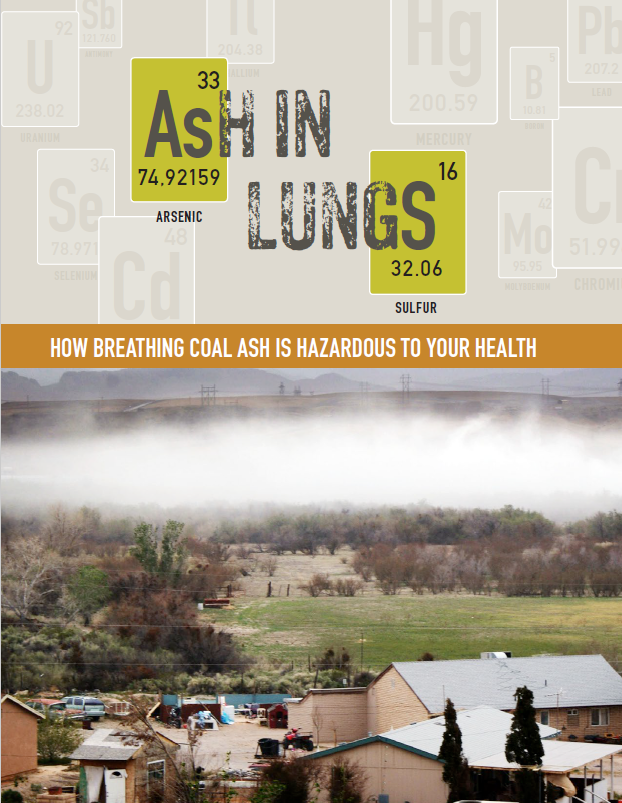
Ash in Lungs: How Breathing Coal Ash is Hazardous to Your Health

By Alan H Lockwood, Physicians for Social Responsibility and Lisa Evans, Earth Justice - Report, August 2014

Take a deep breath. But if you live near a coal-burning power plant that dumps coal ash into a nearby landfill or lagoon, don’t inhale too deeply because you’re probably breathing fugitive dust made up of airborne coal ash filled with dangerous and toxic pollutants. Whether blown from an uncovered dump site or from the back of an open truck, toxic dust contaminates hundreds of fence line communities across the country. Acrid dust stings residents’ eyes and throats, and asthmatics, young and old, are forced to reach for inhalers. Breathing this toxic dust can be deadly, and yet no federal standards exist to protect affected communities.

This report describes the health impacts of the pollution found in coal ash dust. It also points to the imminent need for federal controls to limit exposure and protect the health of millions of Americans who live near coal ash dumps. Coal combustion waste (or coal ash), particularly fly ash, a major component of coal ash waste, poses significant health threats because of the toxic metals present in the ash, such as arsenic, mercury, chromium (including the highly toxic and carcinogenic chromium VI), lead, uranium, selenium, molybdenum, antimony, nickel, boron, cadmium, thallium, cobalt, copper, manganese, strontium, thorium, vanadium and others. Ironically, as coal plant pollution controls like electrostatic precipitators and baghouse filters become more effective at trapping fly ash and decreasing coal plant air pollution, the waste being dumped into coal ash waste streams is becoming more toxic.

Read the report (PDF).

Pages

The Fine Print I:

Disclaimer: The views expressed on this site are not the official position of the IWW (or even the IWW’s EUC) unless otherwise indicated and do not necessarily represent the views of anyone but the author’s, nor should it be assumed that any of these authors automatically support the IWW or endorse any of its positions.

Further: the inclusion of a link on our site (other than the link to the main IWW site) does not imply endorsement by or an alliance with the IWW. These sites have been chosen by our members due to their perceived relevance to the IWW EUC and are included here for informational purposes only. If you have any suggestions or comments on any of the links included (or not included) above, please contact us.

The Fine Print II:

Fair Use Notice: The material on this site is provided for educational and informational purposes. It may contain copyrighted material the use of which has not always been specifically authorized by the copyright owner. It is being made available in an effort to advance the understanding of scientific, environmental, economic, social justice and human rights issues etc.

It is believed that this constitutes a 'fair use' of any such copyrighted material as provided for in section 107 of the US Copyright Law. In accordance with Title 17 U.S.C. Section 107, the material on this site is distributed without profit to those who have an interest in using the included information for research and educational purposes. If you wish to use copyrighted material from this site for purposes of your own that go beyond 'fair use', you must obtain permission from the copyright owner. The information on this site does not constitute legal or technical advice.